
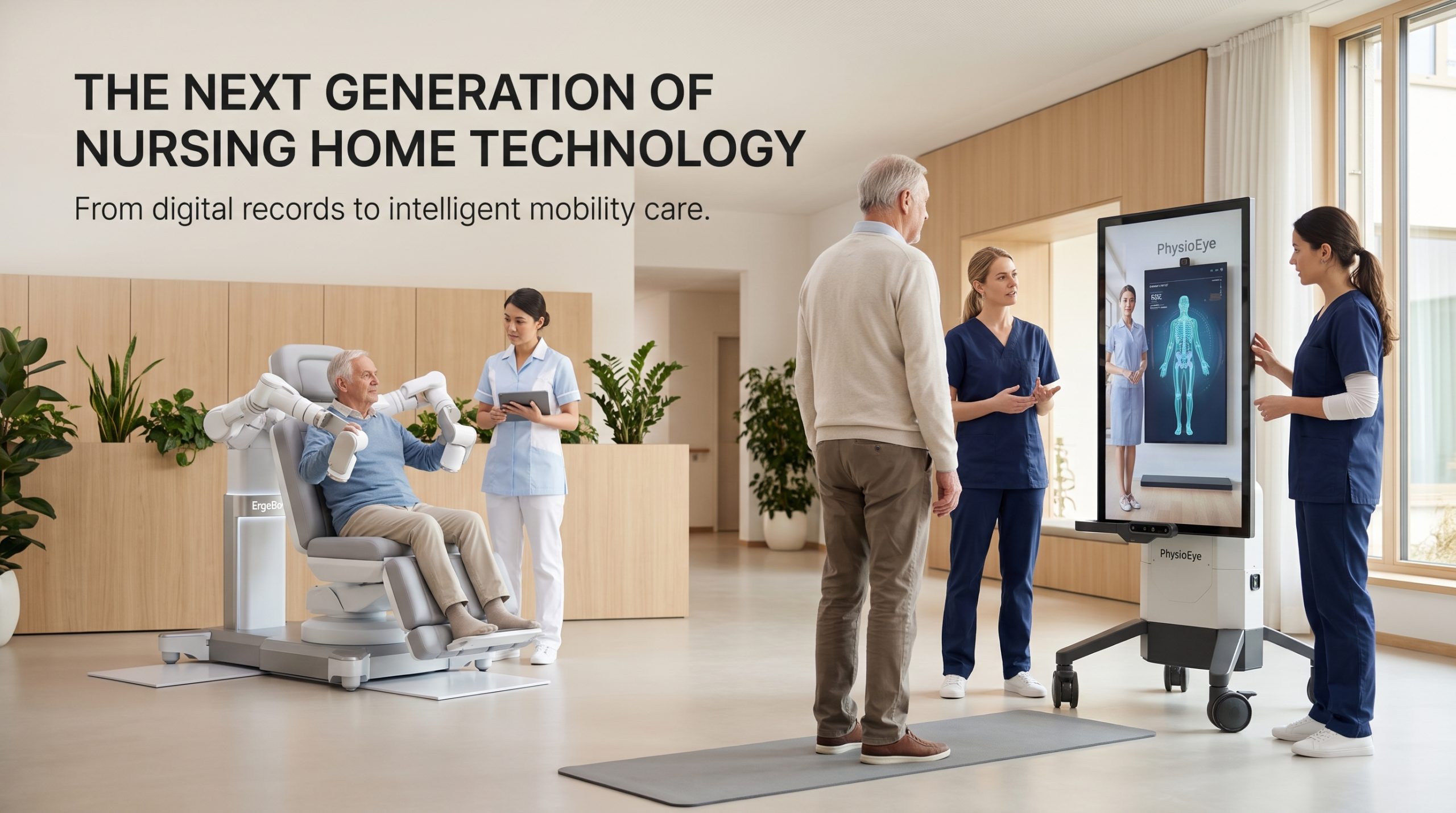
Nursing Home Technology: From Electronic Records to Intelligent Mobility Care
The long-term care sector is undergoing a profound paradigm shift. Facing an unprecedented Aging Population Crisis alongside a severe Occupational Therapist Shortage, traditional care facilities can no longer rely on manual workflows and reactive medical models. Historically, technology in senior care was largely administrative—focused primarily on digitizing patient files, scheduling shifts, and meeting billing compliance.
Today, modern nursing home technology has evolved into a connected ecosystem of ambient sensors, artificial intelligence, automated risk screening, and physical robotics. This transformation shifts facility operations from reactive documentation to proactive, intelligent mobility care—intercepting physical decline, preventing catastrophic falls, and protecting resident dignity while relieving immense physical strain on staff.
According to global public health data published by the World Health Organization (WHO), accidental falls remain the second leading cause of unintentional injury deaths worldwide. Furthermore, clinical evidence indexed by the National Institutes of Health (NIH) emphasizes that implementing advanced health information technologies and digital monitoring tools in nursing facilities directly improves quality-of-care metrics and resident safety outcomes.
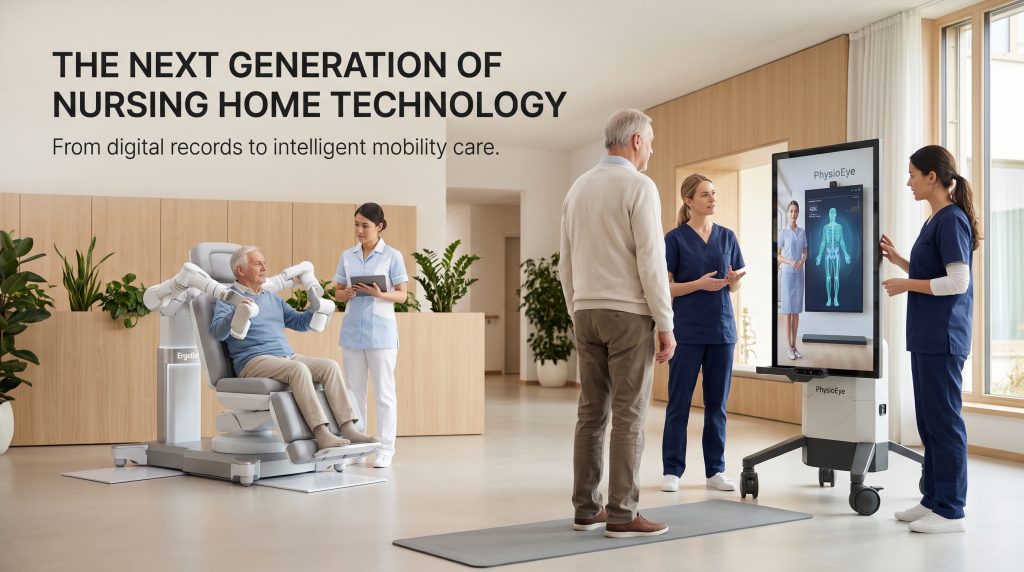
The Evolutionary Arc of Nursing Home Technology
To understand where senior care technology is headed, healthcare leaders must recognise how digital tools have matured across four distinct technological generations over the past two decades.
Generation 1: Administrative Digitization (EHRs & eMARs)
The initial digital transformation focused on replacing paper binders with Electronic Health Records (EHRs) and Electronic Medication Administration Records (eMARs). While essential for documentation and regulatory auditing, these first-generation platforms remained purely administrative. They recorded what had already occurred without actively assisting in physical resident care.
Generation 2: Reactive Safety & Alarm Systems
To address wander risk and accidental falls, facilities introduced wearable push-button call pendants, bed pressure pads, and door motion sensors. While a step forward in resident safety, these systems proved inherently reactive—sounding alarms after a resident had already fallen or vacated a safe zone. Moreover, frequent false alarms led to widespread alarm fatigue among nursing staff.
Generation 3: Ambient Monitoring & Predictive Analytics
Leveraging contact-free radar, infrared depth sensors, and ambient computer vision, third-generation systems monitor resident living spaces continuously without requiring wearables or invading privacy. By tracking subtle changes in nocturnal wander patterns, respiratory rates, and bed exit velocity, AI analytics flag early signs of urinary tract infections, delirium, or Osteoporosis Warning Signs before acute hospitalizations occur.
Generation 4: Intelligent Mobility Care & Physical Robotics
The current frontier combines digital intelligence with physical intervention. Recognizing that mobility is the single greatest predictor of quality of life and survival in senior care, fourth-generation technology integrates zero-touch kinetic assessment with physical rehabilitation devices. This connected approach actively restores movement function, preventing Hospital-Acquired Deconditioning and preserving Senior independence.
Core Technological Pillars of the Modern Smart Nursing Home
A comprehensive, state-of-the-art facility integrates multiple technology layers to streamline operations and elevate clinical care:
Transforming Assessment: Objective 3D Kinematics with PhysioEye
Traditional mobility assessments in nursing homes—such as the Berg Balance Test, Five Times Sit to Stand Test, or Short Physical Performance Battery (SPPB)—have long relied on manual stopwatches and subjective visual grading. This creates inconsistency across shifts and fails to catch micro-variations in motor control.
To modernize diagnostic screening, forward-thinking facilities deploy Robotic Assisted Nursing Home solutions like the PhysioEye platform. PhysioEye delivers Class Im CE-marked 3D Markerless Motion Capture without forcing frail residents to wear uncomfortable sensors or physical markers.
Driven by computer vision models, PhysioEye conducts an Automated Mobility Assessment during routine daily movements or standardized tests like the Functional Reach Test. The platform captures exact joint angles, stride symmetry, and Postural Sway Assessment metrics, culminating in an Automated Geriatric Fall Risk Assessment / Fall Prevention report where the Fall Risk Index serves as the final feature of the diagnostic dashboard. In regions like Germany, this objective documentation directly supports accurate classification under the Pflegegrad care dependency framework, ensuring facilities secure appropriate funding for required resident care levels.
Transforming Rehabilitation: Safe Ergotherapy with ErgoBot
When diagnostic tools identify mobility decline, Frailty Syndrome in Geriatrics, or severe Joint Stiffness Prevention needs, nursing homes require safe, repeatable physical intervention tools.
While some developers have experimented with wearable exoskeletons, wearable suits present major hurdles in long-term care: they require 15 to 20 minutes of complex donning, impose heavy joint alignment risks on frail bones, and carry over-ground fall hazards.
To overcome these barriers, Hash-Tech GmbH engineered the ErgoBot system. ErgoBot is designed specifically as a stationary upper- and lower-limb rehabilitation robot for all joints—it is definitively not a wearable exoskeleton, gait suit, or strength training machine.
Residents remain comfortably and safely seated in a standard chair or wheelchair while interfacing with ErgoBot using minimal, clinically accurate ring-shaped attachments connected to the limbs. These minimal ring interfaces replace outdated fork-type end-effectors, eliminating pressure spikes and accommodating hypertonic joint contractures.
ErgoBot provides high-dose Robotic Assisted Ergotherapy / Occupational Therapy, enabling motor-assisted Passive Range of Motion Therapy and active resistance training. This approach supports Joint Contracture Prevention, Post-Operative Hip Recovery, and Knee Replacement Rehabilitation without putting residents at risk of falls or subjecting staff to physical strain, addressing the root causes of Nurse Back Pain Prevention.
The Visionary Horizon: Unimplemented & Emerging Innovations
While platforms like PhysioEye and ErgoBot represent the current state-of-the-art in intelligent mobility, the next decade of nursing home technology will introduce even deeper levels of automation and ambient intelligence:
Smart Floor Pressure Mapping and Acoustic AI
Future care suites will integrate piezoelectric floor tiles capable of tracking indoor gait velocity, step pressure distribution, and foot drag in real time as residents move naturally about their rooms. Paired with acoustic AI micro-array sensors that listen for respiratory distress, sudden gasps, or calls for assistance, facilities will achieve complete safety coverage without invasive optical cameras in private bath and sleeping quarters.
Autonomous Patient Transfer Logistics
Manual lifting remains the leading cause of occupational injury among nursing staff. Emerging heavy-lift robotic transfer assistants—utilizing soft pneumatic grippers and automated weight-balancing—will manage bed-to-wheelchair and chair-to-bath transfers automatically, eliminating physical strain for human caregivers.
Predictive Health Data Fusion and Tele-Oversight
Future long-term care frameworks will merge kinetic data from PhysioEye, joint torque metrics from ErgoBot, ambient room vitals, and continuous EHR streams into a unified AI engine. Through Tele operational oversight, off-site geriatricians and rehabilitation physicians will monitor dozens of facilities simultaneously, adjusting care plans autonomously and shifting medicine from reactive treatment to true Predictive Healthcare.
Key Takeaways
-
Beyond Paperless Records: Modern nursing home technology moves past administrative EHRs to deliver active, automated physical care and predictive mobility management.
-
Zero-Touch Diagnostics: Optical platforms like PhysioEye conduct automated kinematic screening without wearable sensors, presenting a validated Fall Risk Index as the final feature of the evaluation dashboard.
-
Stationary Ergotherapy Safety: Devices like ErgoBot provide high-dose joint mobilization using minimal ring-shaped end-effectors, completely avoiding the fall risks, setup delays, and alignment issues of wearable suits.
-
Protecting Caregivers: Automating risk assessment and motor therapy drastically reduces physical lifting burdens on nursing staff, tackling staff turnover and occupational injury risks.
Frequently Asked Questions
How does intelligent mobility technology differ from standard Electronic Health Records (EHR)? Standard EHRs are passive documentation databases that log past medical events. Intelligent mobility technology actively monitors physical function, analyzes joint kinematics in 3D space, predicts fall risks, and directly guides physical robotic rehabilitation to preserve resident movement.
Why are stationary rehabilitation devices preferred over wearable exoskeletons in nursing homes? Wearable exoskeletons carry heavy setup times, complex harness adjustments, joint alignment hazards, and over-ground fall risks during resident training. Stationary devices like ErgoBot allow residents to remain safely seated, utilizing minimal ring-shaped end-effectors for targeted joint mobilization with zero risk of falling.
How does PhysioEye help nursing homes comply with regulatory funding frameworks like Pflegegrad? PhysioEye provides objective, sub-millimeter 3D kinematic documentation of a resident’s physical capabilities, range of motion, and fall risk. This verifiable data offers clear evidence of care dependency levels, supporting accurate classification and reimbursement under official care frameworks like Germany’s Pflegegrad system.
Can ambient room monitoring systems operate without compromising resident privacy? Yes. Modern ambient monitoring utilizes contact-free radar micro-doppler sensors and infrared depth mapping that process movement patterns locally without recording recognizable video or images. This ensures 24/7 fall detection and mobility tracking while fully respecting resident privacy.