
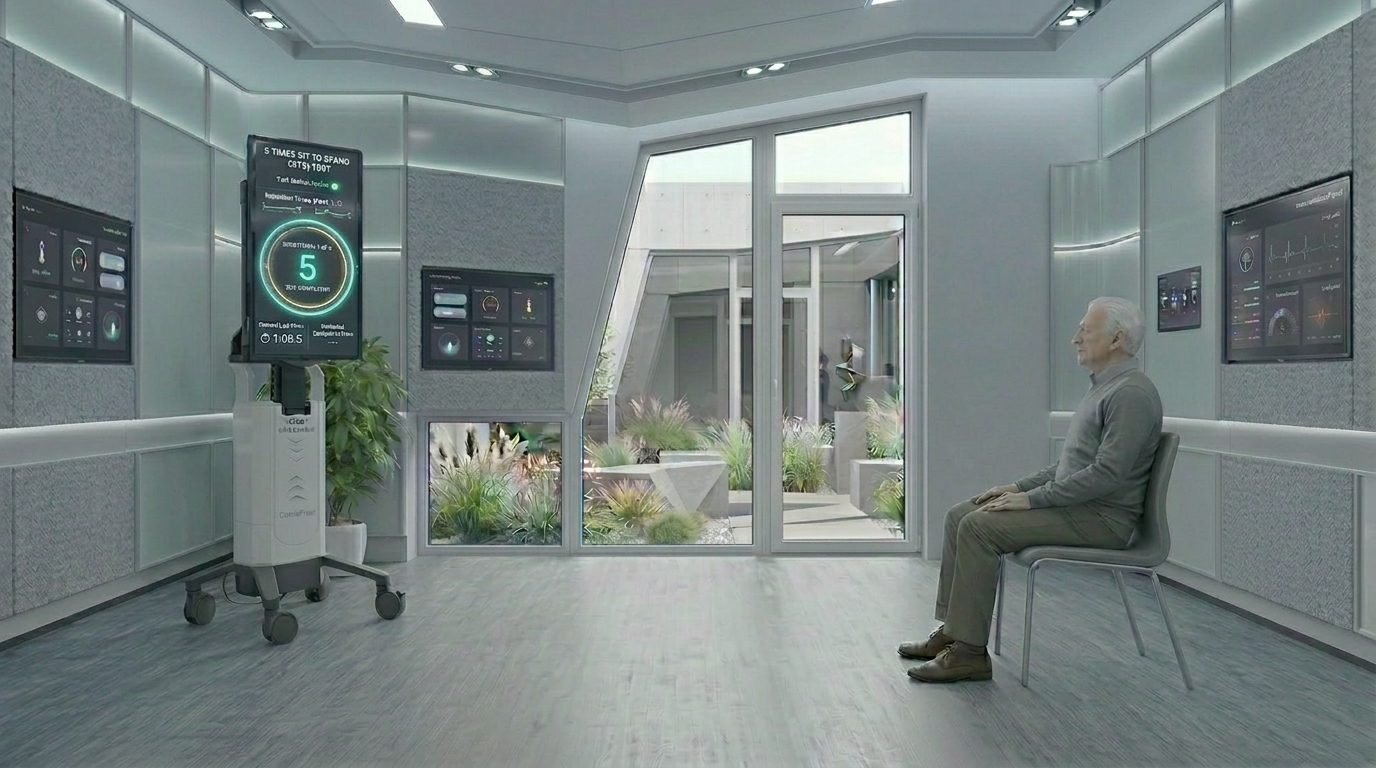
Five Times Sit to Stand Test: 6 Devastating Fall Risks PhysioEye Effortlessly Detects in Seniors
The Five Times Sit to Stand Test (5xSTS) is universally recognized as a critical clinical instrument in geriatric and neurological rehabilitation. The biomechanical act of rising from a chair against gravity demands a complex orchestration of lower limb muscle strength, precise postural control, and dynamic balance. However, the traditional execution of the Five Times Sit to Stand Test—relying entirely on a clinician manually clicking a stopwatch—suffers from severe diagnostic limitations that leave elderly patients vulnerable to devastating falls and undiagnosed muscular decline.
The financial imperative to modernize these diagnostics is immense. Fall Protection Market size was valued at USD 2.60 Billion in 2024 and is projected to reach USD 4.87 Billion by 2032, growing at a CAGR of 8.13% from 2026 to 2032. Facilities in Munich, Bavaria, and across the broader European MedTech landscape must adopt objective, AI-driven solutions to mitigate liability and optimize patient outcomes.
Clinical literature firmly establishes that while the total time taken to complete the 5xSTS is a valid predictor of gross fall risk, the specific kinematic sub-phases (flexion, extension, stabilization) contain vital biomarkers for sarcopenia, frailty, and early-stage neurological disorders. A manual stopwatch completely ignores these crucial sub-phases.
The PhysioEye by Hash Tech GmbH revolutionizes the Five Times Sit to Stand Test. By acting as a highly advanced Automated Mobility Assessment, the markerless 3D AI captures the entirety of the patient’s biomechanics. Here are 6 critical diagnostic insights PhysioEye effortlesly extracts during the test, far beyond basic fall risk prediction.
Pinpointing Asymmetrical Weight Bearing in the Five Times Sit to Stand Test
When a senior rises from a chair, they should theoretically distribute their body weight evenly across both legs. However, hidden orthopedic issues (like early hip osteoarthritis) or mild neurological deficits (such as a previous micro-stroke) often cause the patient to subconsciously favor one leg. A stopwatch cannot detect this invisible shift. PhysioEye captures the exact millimeter-level 3D spatial trajectory of the pelvis and trunk, instantly identifying unilateral weakness. This allows for highly targeted Predictive Care before a catastrophic fall occurs.
Quantifying Maximum Trunk Flexion Angle
To initiate the sit-to-stand motion, the patient must lean forward, shifting their center of mass over their base of support. Studies demonstrate that an exaggerated or excessively slow trunk flexion phase is highly correlated with a fear of falling and reduced proprioception in the elderly. By performing a flawless Senior joint mobility assessment, PhysioEye acts as a digital goniometer, objectively measuring the maximum flexion angle of the spine and hips, providing undeniable proof of postural instability.
Measuring the Rate of Force Development (Velocity)
The transition from sitting to standing requires not just absolute strength, but power—the ability to generate force quickly. A slow, grinding ascent is a primary biomarker for sarcopenia (age-related muscle loss). While traditional methods only yield a final time, the Five Times Sit to Stand Test via PhysioEye continuously tracks the angular velocity of the knee and hip extension. This allows clinicians to differentiate between a patient who lacks raw strength versus one who lacks motor unit recruitment speed.
Detecting Micro-Tremors and Postural Sway
The moment the patient reaches full extension (standing upright), they must stabilize their center of mass before initiating the descent back to the chair. Manual observation frequently misses subtle, high-frequency micro-tremors or excessive anterior-posterior sway during this critical stabilization phase. PhysioEye’s high-fidelity AI algorithms detect these microscopic deviations, which are often the earliest clinical indicators of Parkinsonian rigidity or cerebellar dysfunction.
Analyzing the Eccentric Control Phase (Descent)
The “sit” portion of the Five Times Sit to Stand Test is just as crucial as the “stand.” Lowering the body mass into the chair requires immense eccentric muscle control of the quadriceps. Patients with severe muscular atrophy will often exhibit a “controlled fall” into the chair rather than a smooth descent. PhysioEye measures the downward acceleration curve, instantly flagging a lack of eccentric control and highlighting a severe risk factor for vertebral compression fractures.
Seamless Integration for Robotic Prescription
The true power of upgrading the Five Times Sit to Stand Test with PhysioEye is what happens to the data afterward. The specific kinematic weaknesses identified—whether it is asymmetrical leg strength or poor trunk control—are instantly synced into the Hash Tech ecosystem. This data directly informs downstream treatments, allowing stationary hubs like the ErgoBot to deliver highly customized, mathematically precise Robotic Assisted Occupational Therapy to rebuild the exact deficits observed.
Redefining Geriatric Diagnostics
Relying on a stopwatch to evaluate the complex biomechanics of the human body is no longer a viable clinical standard. By deploying PhysioEye, facilities are aggressively advancing Nursing Home Automation, ensuring that objective, high-definition data dictates every aspect of a patient’s Pflegegrad evaluation and therapeutic journey.