
AI & Robotics in Nursing Care
Workforce Readiness & Practical Adoption Program
Position the offer as a structured organizational-readiness and professional development program rather than a conventional training course. It includes a baseline staff assessment, role-specific learning, a knowledge check, supporting materials, and a management report.
Successful technology adoption starts with people. Hash-Tech's AI & Robotics in Nursing Care program combines a pre-training readiness assessment, role-specific sessions, practical examples, and structured learning materials to help care organizations build the knowledge and confidence needed for technology-enabled care.
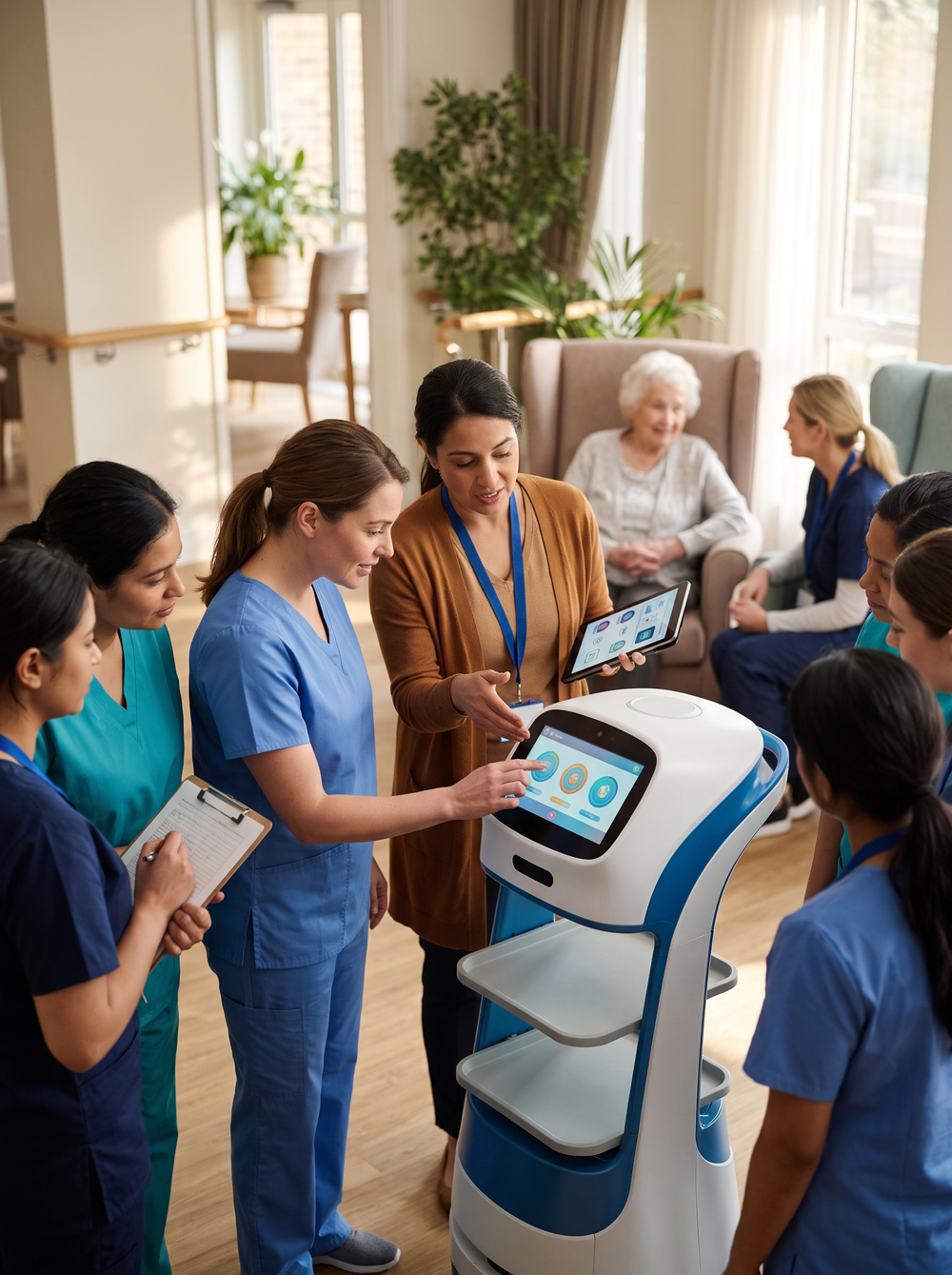
Overview
Technology Adoption Begins With Workforce Readiness.
AI and robotics are creating new opportunities in resident monitoring, rehabilitation, documentation, logistics, and care coordination. However, introducing new technologies without preparing the people who use them can create uncertainty, resistance, and unrealistic expectations.
Hash-Tech's program begins by evaluating the existing awareness and understanding of AI and robotics across the workforce. The results help management understand knowledge gaps, staff concerns, and training priorities.
Role-specific sessions then introduce practical applications, limitations, responsible use, and the implications for everyday work in nursing care.
The program concludes with a knowledge check and a learning package that staff can use after the sessions.
Perfect For

Nursing Home Managers

Nursing and Care Teams

Medical and Clinical Directors
What Makes the Program Different?
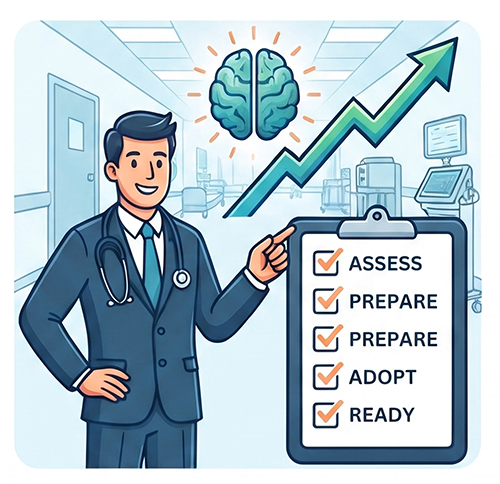
Readiness Before Training
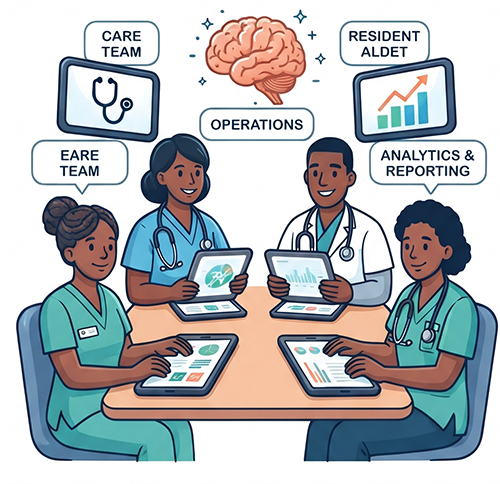
Role-Specific Learning
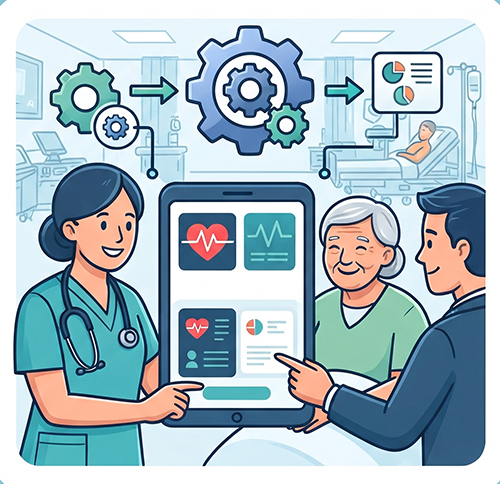
Practical Application

Management Insights and Learning Materials
Pre-Program Workforce Readiness Assessment
Understand Your Starting Point Before Training Begins.
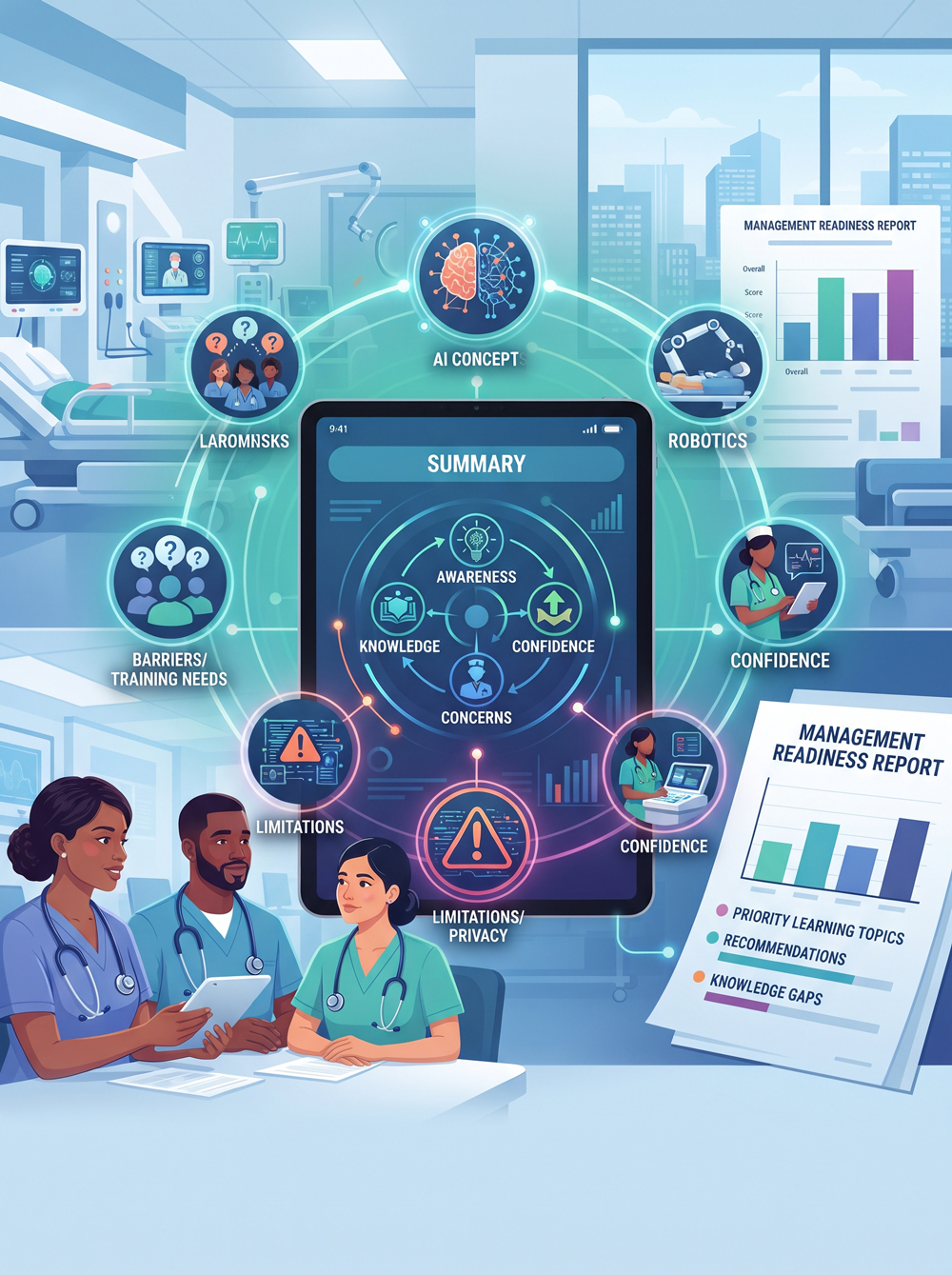
Before the first session, Hash-Tech evaluates staff awareness, knowledge, confidence, and concerns regarding AI and robotics in nursing care.
The baseline assessment is designed to help management understand the workforce's starting point and tailor the program to the organization's needs.
Assessment Areas
Familiarity with basic AI concepts.
Understanding of robotics and automated systems in care environments.
Awareness of possible applications in nursing care.
Confidence in working with technology-enabled systems.
Understanding of limitations, errors, and appropriate human oversight.
Awareness of privacy, safety, and responsible use.
Staff expectations, concerns, and perceived barriers to adoption.
Areas where additional explanation or practical training may be needed.
Management Readiness Report
The results are summarized in a report for management that can include:
Overall baseline awareness and knowledge.
Results by staff group, where appropriate and supported by the assessment.
Main knowledge gaps.
Common concerns and barriers.
Priority learning topics.
Recommendations for supporting responsible adoption.
Suggested areas for further staff development.
The report should be described as a baseline readiness assessment, not as a formal certification or an externally benchmarked organizational audit.
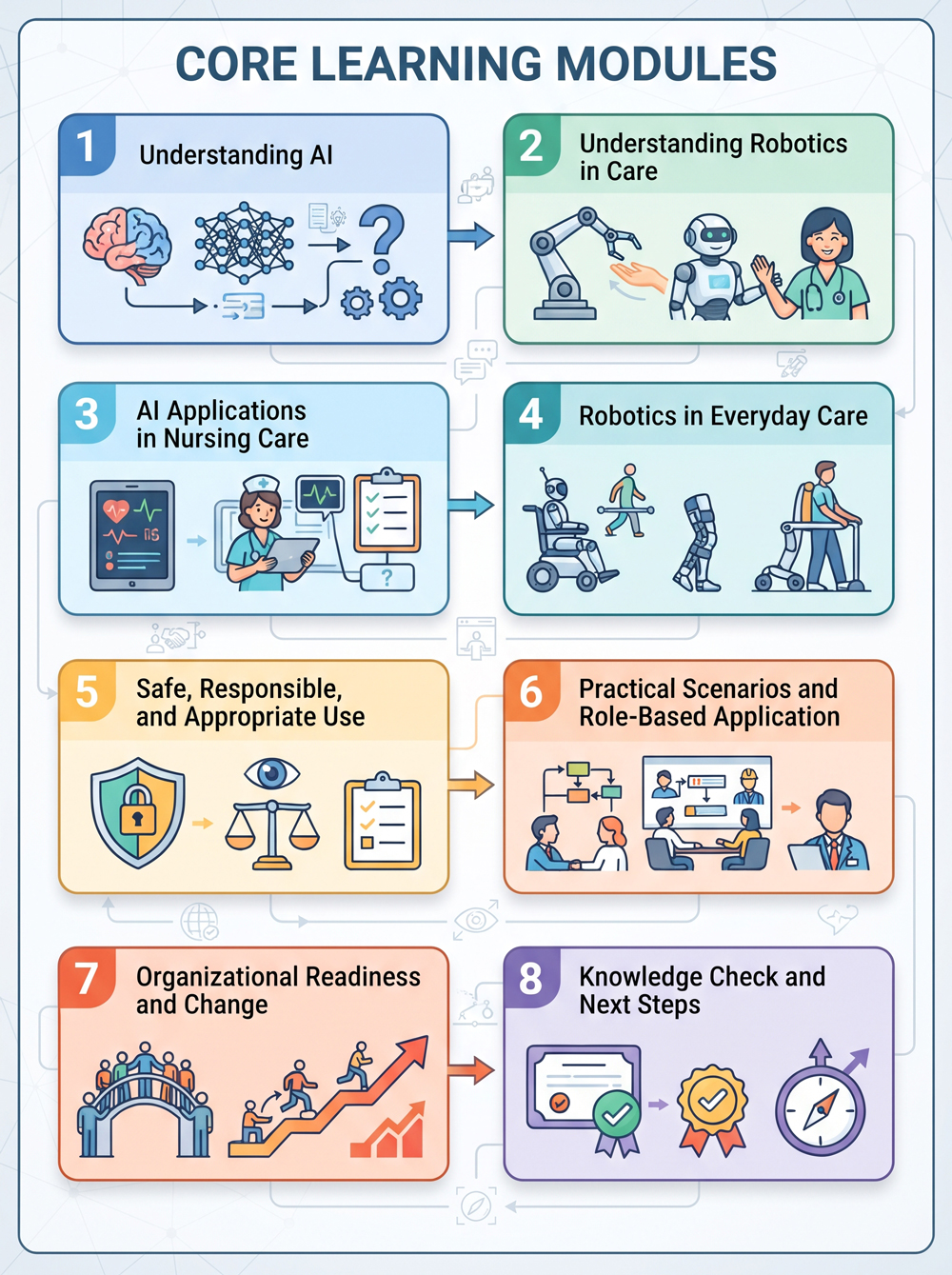
Core Learning Modules
Module 1 — Understanding Artificial Intelligence
Introduce core AI concepts, common terminology, practical capabilities, limitations, and examples relevant to healthcare.
Module 2 — Understanding Robotics in Care
Explain what care and rehabilitation robots can do, how staff interact with them, and where human supervision remains essential.
Module 3 — AI Applications in Nursing Care
Explore practical examples involving documentation support, information summaries, resident monitoring, workflow assistance, and other relevant applications.
Module 4 — Robotics in Everyday Care and Rehabilitation
Introduce relevant robotic applications in rehabilitation, physical assistance, and operational support, with attention to realistic use cases and limitations.
Module 5 — Safe, Responsible, and Appropriate Use
Address data privacy, confidentiality, reliability, human oversight, safety, accountability, and the importance of following organizational procedures.
Module 6 — Practical Scenarios and Role-Based Application
Use relevant scenarios to help staff recognize suitable applications, understand the limits of automation, and identify when human review is required.
Module 7 — Organizational Readiness and Change
Help staff and managers understand adoption challenges, communication needs, staff involvement, and the practical steps required to introduce technology responsibly.
Module 8 — Knowledge Check and Next Steps
Review key concepts, assess learning, clarify remaining questions, and identify opportunities for further development.
The exact depth and balance of the modules should be adapted to the audience and the technologies being considered by the care organization.
Program Structure
|
Item |
Des |
|---|---|
|
Program duration |
One month |
|
Number of classes |
8 |
|
Duration per class |
3 hours |
|
Total instructor-led delivery |
24 hours |
|
Readiness assessment |
Before training begins |
|
Knowledge check |
Included |
|
Learning materials |
Included |
|
Management report |
Included |

Frequently Asked Question
Integrates seamlessly with ErgoBot
Use assessment data from PhysioEye to automatically configure therapeutic interventions in ErgoBot.