Joint Stiffness Prevention: 6 Hidden Risks ErgoBot Helps Avoid After Long-Term Immobilization
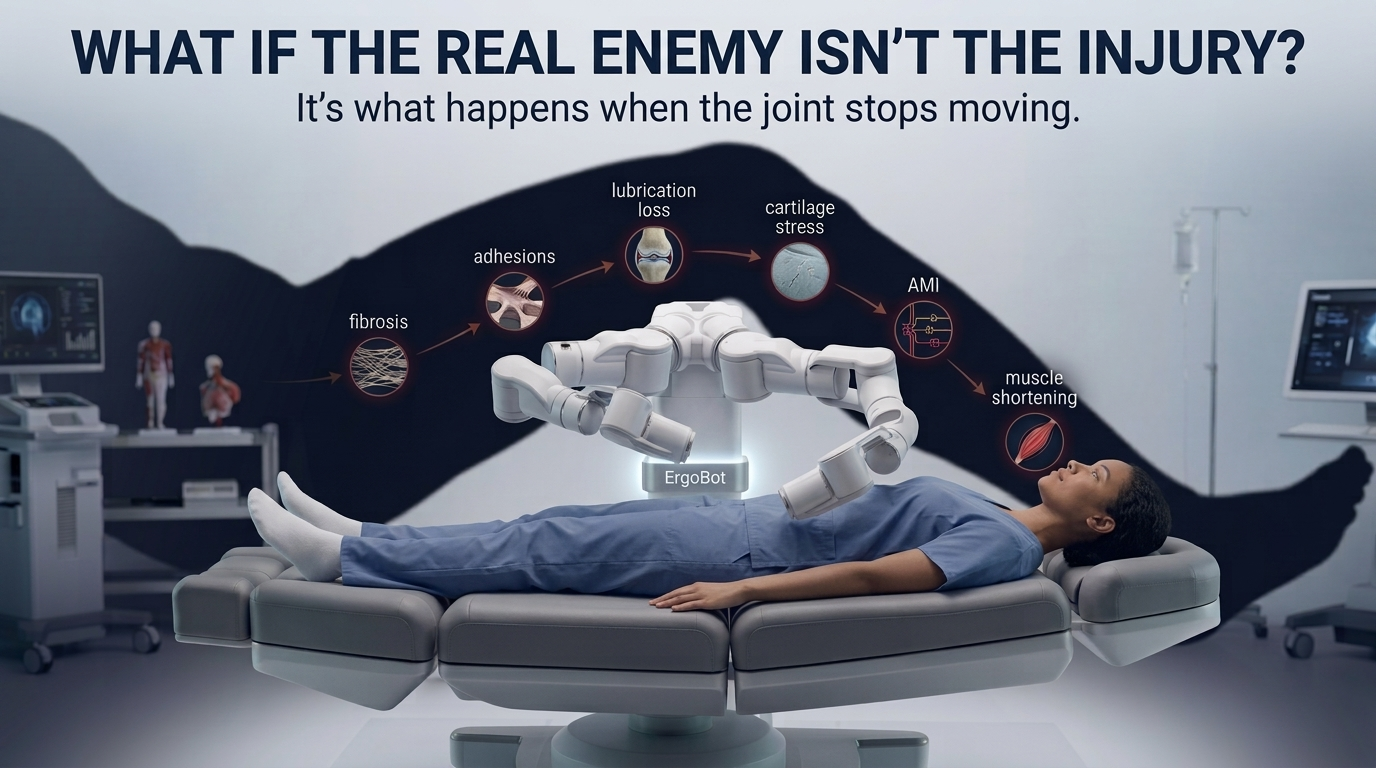
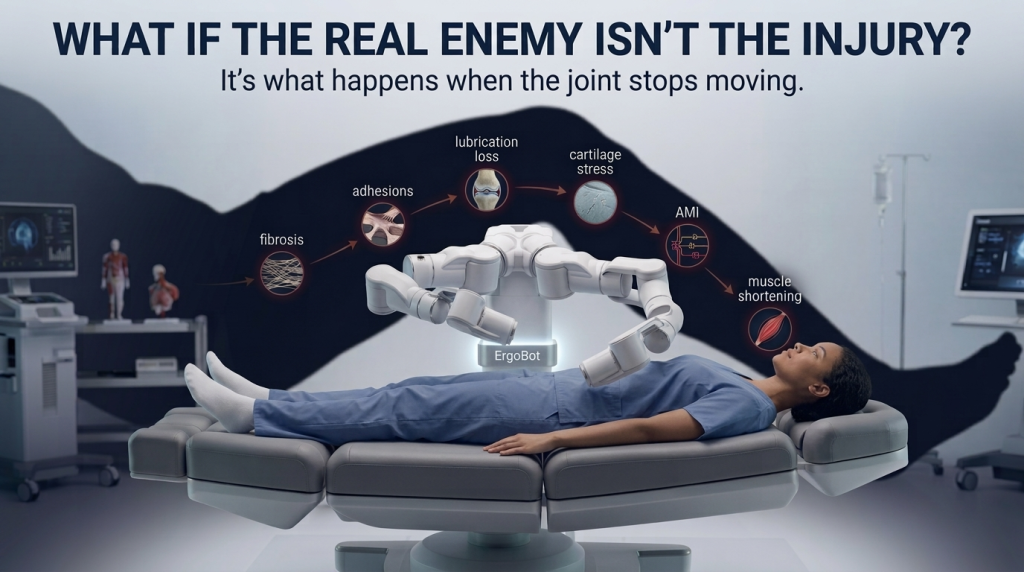
In acute orthopedic trauma, post-surgical recovery, and long-term care rehabilitation, joint immobilization is often treated as a necessary trade-off to protect healing bone and tissue. However, extended joint fixation triggers rapid, destructive changes within periarticular structures. Effective joint stiffness prevention requires addressing the subsurface biological cascades that transform temporary joint tightness into permanent, refractory contracture.
At Hash-Tech GmbH in Buchbach, Germany, our clinical engineering focuses on targeted, early-phase joint mobilization. Every hidden risk associated with long-term immobilization must be matched with a direct biomechanical solution. This article examines 6 clinically validated hidden risks of immobilization and demonstrates how our stationary joint rehabilitation platform, ErgoBot, directly solves each mechanism to prevent permanent motion loss.
The Biological Paradigm: Immobilization vs. Early Mobilization
Non-vascularized joint structures—such as articular cartilage and inner synovial membranes—depend entirely on cyclical movement and mechanical stress for nutrient transport, fluid lubrication, and extracellular matrix integrity.
| Pathological Mechanism | Prolonged Joint Immobilization | Direct ErgoBot Rehabilitation Solution |
| Capsular Matrix | Random Type I collagen cross-linking; severe fibrotic shortening. | Continuous motion arcs align collagen fibers along natural stress lines. |
| Synovial Hyaluronan | Dropping UDPGD enzyme activity; loss of HA boundary lubrication. | Cyclic movement stimulates UDPGD activity and restores HA concentration. |
| Synovial Recesses | Static contact causes membrane adhesion and recess obliteration. | Smooth displacement keeps synovial folds gliding freely without adhesion. |
| Articular Cartilage | Halts fluid imbibition; proteoglycan loss and chondrocyte starvation. | Rhythmic compression/decompression drives fluid uptake into cartilage. |
| Spinal Motor Pools | Arthrogenic Muscle Inhibition (AMI) shuts down muscle activation. | Biofeedback active-assisted motion restores mechanoreceptor afferent drive. |
| Muscle Architecture | Rapid longitudinal sarcomere loss and fixed myogenic tightness. | Controlled lengthening arcs maintain longitudinal muscle belly extensibility. |
6 Hidden Risks of Immobilization Solved Directly by ErgoBot
Every risk listed below represents a specific biological failure caused by joint unloading that can be mitigated through targeted, controlled mobilization.
Capsular Fibrosis and Collagen Cross-Linking
Within 7 to 14 days of joint fixation, fibroblasts proliferate within periarticular connective tissue, depositing disorganized Type I collagen. This creates dense cross-links across capsular folds, converting soft tissue into rigid fibrotic scar tissue. To combat this, the ErgoBot platform provides smooth, continuous passive motion (CPM) within prescribed elastic boundaries. This continuous mechanical stretching prevents random collagen cross-linking and forces newly synthesized collagen fibers to align parallel to functional movement vectors, thereby maintaining capsular compliance. Research on remobilization-induced fibrosis archived on PMC confirms that early, continuous passive motion successfully interrupts this fibrotic cascade.
Synovial Hyaluronan Depletion and Lubrication Failure
Static immobilization decreases uridine diphosphoglucose dehydrogenase (UDPGD) enzyme activity in synovial intima cells. This halts the synthesis of high-molecular-weight hyaluronan (HA), drastically reducing synovial fluid viscosity and destroying boundary lubrication. By delivering cyclic, low-friction motion, ErgoBot stimulates mechanosensitive synovial cells to reactivate UDPGD expression. This restores normal HA production and re-establishes smooth joint lubrication. A clinical study on synovial fluid hyaluronan reduction published in PubMed demonstrates that mechanical joint displacement is strictly required to maintain synovial fluid HA concentration and prevent joint degradation.
Synovial Recess Adhesions and Space Obliteration
When a joint remains motionless, opposing synovial folds press continuously against one another and against adjacent articular cartilage. Lacking fluid movement, fibrous adhesions form between these static surfaces, permanently obliterating the joint recess space. ErgoBot’s precise displacement drivers solve this by moving the joint through its full available range of motion, keeping opposing synovial membranes sliding past each other. This continuous displacement eliminates static surface contact and prevents fibrous adhesions from forming. Pathological analyses of joint contractures on PubMed confirm that continuous gliding prevents intra-articular adhesion formation.
Articular Cartilage Malnutrition and Chondrocyte Starvation
Articular cartilage lacks blood vessels and relies entirely on fluid exchange driven by cyclic mechanical loading. Immobilization stops this squeeze-and-release fluid movement, starving chondrocytes of nutrients, depleting proteoglycans, and causing cartilage thinning and surface fibrillation. During therapy, ErgoBot provides rhythmic, controlled joint compression and decompression. This artificial pump mechanism restores fluid imbibition, transporting essential nutrients directly into the avascular cartilage matrix to keep chondrocytes healthy. Investigations into joint unloading pathology emphasize that cyclical mechanical loading is necessary to protect articular cartilage integrity during post-injury recovery.
Arthrogenic Muscle Inhibition (AMI)
Pain, joint effusion, and altered capsular mechanoreceptor feedback trigger presynaptic spinal reflex inhibition. This phenomenon—Arthrogenic Muscle Inhibition (AMI)—shuts down neural drive to surrounding stabilizing muscles, rendering the patient unable to voluntarily initiate movement. To override this, ErgoBot incorporates biofeedback-guided active-assisted motion modes. By passively guiding the joint while providing real-time visual feedback, the system stimulates joint mechanoreceptors, restoring normal sensory input to the spinal cord and overriding presynaptic inhibition to reactivate dormant motor pools. Clinical data on AMI management on PMC demonstrates that early active-assisted motion with biofeedback effectively reduces reflex motor inhibition.
Adaptive Sarcomere Shortening and Myogenic Contracture
When a muscle is immobilized in a shortened position, the central nervous system and muscle fibers adapt by rapidly shedding sarcomeres in series. This longitudinal muscle shortening results in fixed myogenic tightness that severely restricts joint extension. ErgoBot addresses this by gently elongating periarticular muscle-tendon units using continuous, controlled lengthening arcs. By maintaining muscle length during early rehabilitation, the platform prevents sarcomere loss and maintains functional muscle belly extensibility. Research on muscle architecture adaptations on PubMed highlights that controlled mechanical elongation during recovery prevents fixed structural sarcomere loss.
The Hash-Tech Rehabilitation Ecosystem
Achieving successful joint stiffness prevention requires combining precision kinematic diagnostics with adaptive movement therapy.
1. Objective Kinematic Tracking with PhysioEye
PhysioEye is a contactless 3D motion analysis platform utilizing advanced Markerless Motion Capture. It allows clinical teams to track joint displacement arcs, angular velocity, and motor variability without physical markers. By establishing objective baseline kinematics, PhysioEye detects early range-of-motion restrictions before macro-level joint contractures form.
Within our CareWell corporate wellness program at facilities like Pflegeheim Damenstift am Luitpoldpark, PhysioEye provides automated mobility screening for residents and staff, enabling early detection of musculoskeletal tightness and timely physical therapy referrals.
2. Targeted Joint Rehabilitation with ErgoBot
When motion restrictions are identified, the ErgoBot platform delivers precise mobilization tailored to patient needs.
-
Safety and Stability: Wearable exoskeletons present balance and fall hazards for frail post-surgical patients. ErgoBot’s stationary design ensures absolute patient stability while delivering targeted joint therapy.
-
Targeted Motion Modes: Featuring continuous passive motion (CPM), active-assisted mobilization, and biofeedback-driven motor training, the platform is designed to maintain capsular compliance, restore synovial lubrication, and override motor inhibition seamlessly.
Key Takeaways
-
Joint stiffness prevention relies on early mobilization to stop capsular fibrosis, hyaluronan loss, and synovial adhesions before permanent contractures set in.
-
ErgoBot directly solves capsular fibrosis by aligning collagen fibers along functional stress vectors through continuous motion.
-
Synovial lubrication is restored as cyclic displacement stimulates UDPGD enzyme activity.
-
Synovial recess obliteration is prevented as the device keeps opposing membrane folds gliding freely.
-
Rhythmic joint compression via ErgoBot restores fluid imbibition into avascular articular cartilage, preventing chondrocyte starvation.
-
Biofeedback-guided active-assisted motion helps override Arthrogenic Muscle Inhibition (AMI) to reactivate spinal motor pools.
-
PhysioEye delivers Class Im CE-marked 3D markerless motion capture to identify early range-of-motion losses.
Frequently Asked Questions
Why does ErgoBot solve joint stiffness better than manual stretching alone?
Aggressive manual stretching of a stiff joint can induce micro-trauma in fibrotic capsular tissue, triggering secondary inflammation that accelerates scarring. ErgoBot delivers continuous, smooth passive motion within safe elastic limits, promoting collagen alignment without inciting an inflammatory response.
How soon after joint surgery can ErgoBot mobilization begin?
ErgoBot is engineered for early post-operative rehabilitation. Its stationary architecture allows clinicians to precisely set motion boundaries, delivering passive-assisted movement within surgeon-prescribed limits to protect surgical repairs while preventing joint stiffness.
How does ErgoBot help overcome Arthrogenic Muscle Inhibition (AMI)?
ErgoBot uses biofeedback-guided active-assisted motion modes. By providing real-time visual feedback while assisting joint displacement, it stimulates joint mechanoreceptors, restoring normal sensory input to the spinal cord and overriding presynaptic inhibition to help reactivate dormant muscle groups.
How does PhysioEye support the joint stiffness prevention workflow?
PhysioEye uses 3D markerless motion capture to track joint displacement, angular velocity, and movement symmetry during functional activities. It detects subtle range-of-motion losses early, allowing clinicians to initiate ErgoBot therapy before contractures become clinically severe.
Why is ErgoBot designed as a stationary device rather than a wearable exoskeleton?
Post-surgical, frail, or elderly patients facing long-term immobility often suffer from impaired balance and reduced muscle strength. Wearable exoskeletons introduce fall risks. ErgoBot’s stationary platform provides absolute stability while delivering high-precision joint mobilization for both upper and lower limbs.