
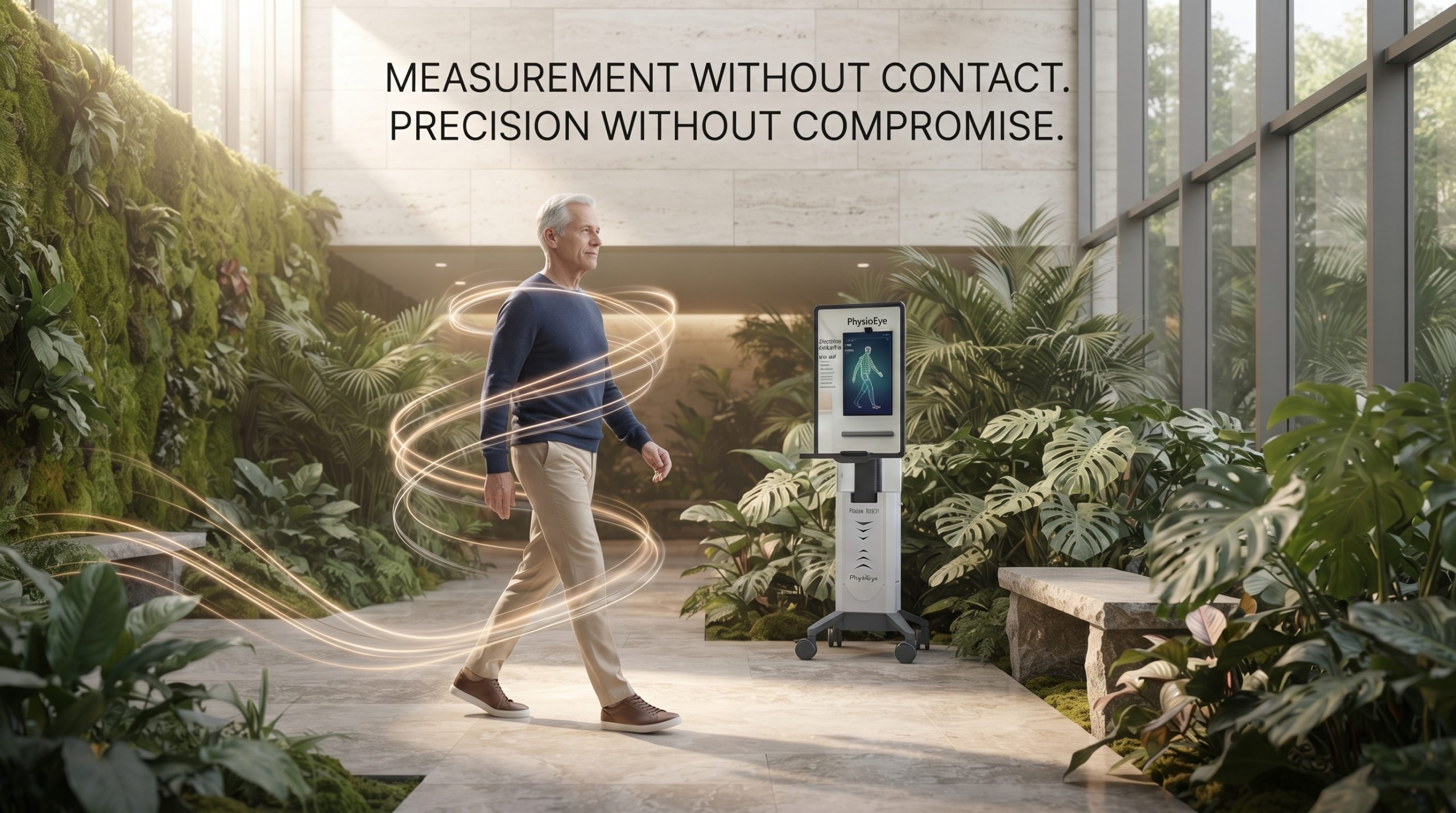
Markerless Motion Capture: 5 Revolutionary Ways PhysioEye Replaces Wearable Sensors in Clinical Assessment
Markerless motion capture is fundamentally redefining the baseline of clinical biomechanical analysis by stripping away the physical friction of traditional diagnostic hardware. For decades, obtaining objective kinematic data required strapping cumbersome wearable sensors, wires, and inertial measurement units (IMUs) onto frail or injured patients. This process consumes critical clinical time, alters the patient’s natural movement patterns, and limits high-fidelity assessments strictly to specialized biomechanics laboratories. This article breaks down the technological evolution of spatial tracking, exposes the inherent biomechanical flaws of skin-mounted sensors, and explores how advanced artificial intelligence algorithms transition highly accurate mobility assessments directly into standard patient care environments.
What Is Markerless Motion Capture?
Markerless motion capture is an advanced computer vision technology that quantifies human kinematics without requiring physical sensors attached to the patient. By utilizing artificial intelligence and deep learning algorithms, it extracts precise, three-dimensional joint center coordinates directly from standard video feeds to evaluate biomechanical performance and functional mobility.
Historically, capturing movement required the patient to wear retroreflective tape or electronic IMU straps.
What is it exactly? It is the algorithmic detection of the human skeletal pose. The software mathematically identifies anatomical landmarks—such as the lateral malleolus, greater trochanter, and acromion process—and tracks their spatial-temporal relationships frame by frame.
Why is it important? It democratizes clinical biomechanics, bringing laboratory-grade accuracy into everyday clinical settings without the prohibitive setup time of traditional hardware.
Who needs it? Any clinician responsible for evaluating human movement, particularly those managing older adults, post-operative orthopedic patients, and individuals recovering from neurological trauma.
When should it be used? It should be deployed universally during initial clinical evaluations, daily functional screening, and routine outcome monitoring to capture continuous, objective data.
How is it measured? Through single or multi-camera arrays that feed visual data into proprietary neural networks, outputting exact joint angles, gait velocities, and postural sway metrics in real-time.
The Current Challenges in Clinical Assessment
Relying on traditional wearable sensors in busy healthcare environments creates severe operational bottlenecks. The exhaustive setup time limits the frequency of objective testing, forcing clinicians to fall back on subjective visual observation, which fails to capture the micro-compensations that precede catastrophic injuries.
The global healthcare infrastructure cannot sustain inefficient diagnostic protocols. According to the World Health Organization (WHO), the proportion of the world’s population over 60 years will nearly double from 12% to 22% by 2050. This demographic explosion is accompanied by a dramatic rise in mobility-impairing conditions, requiring an unprecedented volume of clinical assessments. In the United States, the Centers for Disease Control and Prevention (CDC) estimates that 1 in 4 older adults fall each year, costing the healthcare system billions in acute trauma care.
In regions like Bavaria and the greater Munich area, severe shortages in specialized nursing and physical therapy staff compound this crisis. When a clinical team is understaffed, time-intensive protocols are the first to be abandoned.
-
Setup Burden: Applying a standard 15-sensor IMU suit or attaching 39 retroreflective markers takes a trained technician between 15 to 30 minutes per patient.
-
Reduced Testing Frequency: Because of the setup time, objective biomechanical analysis is often reserved only for complex research cases, leaving the vast majority of patients with unquantified, subjective evaluations.
-
Diagnostic Delay: Without high-frequency objective data, subtle declines in Functional Mobility—such as a 3-degree loss in knee extension—go completely unnoticed until the patient suffers a clinical event.
Traditional Wearable Sensors vs. Modern AI Solutions
Traditional wearable sensors introduce mechanical artifacts and require significant physical manipulation of the patient. Modern markerless AI solutions utilize deep learning to identify internal joint centers instantly, bypassing skin movement errors and allowing for entirely frictionless, non-invasive biomechanical assessments in any clinical environment.
The gold standard for decades has been optical marker-based systems or wearable IMUs. However, both suffer from a critical biomechanical flaw known as “soft tissue artifact.” When a sensor is strapped to a patient’s thigh, it rests on top of skin, adipose tissue, and muscle bellies. As the patient moves, the skin shifts over the underlying bone. Studies demonstrate that soft tissue artifact can introduce errors of up to 30 millimeters or 10 degrees in joint angle calculations, rendering the data potentially misleading, particularly in patients with higher body mass indices. Furthermore, IMUs are highly susceptible to magnetic drift—where the sensor loses its orientation relative to true gravity in environments with significant electronic interference (like a modern hospital).
Markerless computer vision fundamentally circumvents these physical limitations. Systems like PhysioEye do not track the surface of the skin. Instead, the AI has been trained on millions of anatomical images to mathematically estimate the center of rotation for the underlying joints. It bypasses the soft tissue artifact entirely, delivering highly reliable kinematic data through a completely frictionless patient experience.
5 Revolutionary Ways PhysioEye Replaces Wearable Sensors
Transitioning to markerless motion capture eliminates exhaustive donning and doffing, prevents the Hawthorne effect during walking, guarantees superior infection control, removes the physical discomfort of restrictive straps, and ensures assessment data instantly informs targeted robotic rehabilitation.
The integration of advanced computer vision is not merely an upgrade in convenience; it is a fundamental evolution in how we measure and interpret human movement.
Zero Setup Time: Eliminating Donning and Doffing
The most immediate operational advantage is the eradication of preparation time. Traditional gait analysis requires the therapist to physically locate bony landmarks, apply adhesive tape, and calibrate sensors. With PhysioEye, the patient simply walks into the camera’s field of view. The neural network detects the skeletal structure in milliseconds. A comprehensive Senior joint mobility assessment that previously took 45 minutes of laboratory time can now be completed accurately in under 3 minutes, allowing clinics to exponentially increase their daily patient throughput.
Unaltered Kinematics: Eradicating the Hawthorne Effect
Human beings alter their behavior when they know they are being measured. In biomechanics, strapping bulky electronics to an elderly patient’s ankles and waist fundamentally changes how they walk—a phenomenon known as the Hawthorne effect. They walk stiffer, slower, and more cautiously. Wearable sensors measure how a patient moves while encumbered by sensors, not how they move naturally. Markerless tracking captures authentic Gait Analysis by observing the patient as they move freely in their everyday clothing, yielding data that is far more representative of their true functional capacity.
Superior Infection Control Protocols
In post-pandemic healthcare environments and vulnerable nursing home settings, infection control is paramount. The CDC states that on any given day, about 1 in 31 hospital patients has at least one healthcare-associated infection. Sharing wearable straps and adhesive markers across multiple immune-compromised patients introduces a severe cross-contamination vector. Markerless technology is entirely contactless. The patient never touches the diagnostic equipment, making it the safest possible modality for acute care wards and geriatric facilities.
Overcoming Hardware Discomfort and Skin Integrity Issues
For populations recovering from severe trauma, such as Post-Operative Hip Recovery, the surgical site is highly sensitive. For geriatric patients, skin becomes paper-thin and easily bruised. Applying tight elastic IMU straps or adhesive tape to these areas causes pain, skin tearing, and psychological distress. Markerless assessment requires zero physical contact, completely eliminating the risk of iatrogenic skin injury during routine mobility testing.
Seamless Transition to Objective Care Pathways
Data captured by a wearable IMU often requires manual exportation, filtering, and interpretation before it becomes useful. PhysioEye is deeply integrated into the digital clinical ecosystem. The moment the computer vision algorithm detects a kinematic deficit, it instantly structures that data to inform therapeutic intervention, bridging the crucial gap between diagnosis and treatment.
The Complete Clinical Care Pathway: From Computer Vision to Robotic Therapy
An accurate markerless assessment is only the first step in a complete evidence-based workflow. The clinical value lies in seamlessly transferring this objective kinematic data directly into clinical decision support systems, which instantly program stationary robotic hardware for highly customized patient rehabilitation.
Hash-Tech GmbH views the elimination of wearable sensors not as the end goal, but as the catalyst for a much larger, closed-loop clinical pathway designed to maximize neuroplasticity and joint recovery.
-
Frictionless Screening: The patient performs functional movements (like squats, reaches, or walking) in front of the PhysioEye camera. No sensors are attached.
-
Instant Diagnosis: The AI quantifies the exact joint angles, instantly diagnosing mechanical deficits such as a 15-degree limitation in shoulder abduction.
-
Objective Assessment: The clinical team reviews the digitized kinematics. In Germany, this immutable digital evidence provides exact documentation required for accurate Pflegegrad (care grade) classification, ensuring the patient receives appropriate insurance support.
-
Automated Treatment Planning: Clinical decision support software utilizes the markerless data to generate an exact therapeutic exercise protocol designed specifically to overcome the identified 15-degree deficit.
-
Targeted Rehabilitation: The patient transitions to ErgoBot. ErgoBot is a stationary upper and lower limb rehabilitation device for all joints. Because it integrates with the assessment data, ErgoBot automatically sets its resistance and range-of-motion limits to perfectly match the patient’s exact biomechanical needs.
-
Continuous Outcome Monitoring: After a series of robotic sessions, the patient simply walks in front of the PhysioEye camera again. The system calculates the exact millimeter and degree improvements, validating the efficacy of the therapy.
-
Remote Preventive Care: By deploying markerless cameras in long-term care environments, clinical managers can achieve unprecedented Tele operational oversight, allowing specialists to review automated movement analytics remotely and intervene before a patient deteriorates.
Assessment Technology Comparison Summary
To understand the paradigm shift, clinicians must evaluate the operational realities of both modalities:
-
Wearable IMUs: 15–30 min setup, requires skin contact, alters natural gait, susceptible to magnetic drift, high cross-contamination risk.
-
Retroreflective Markers: 30+ min setup, requires a dedicated lab with specialized lighting, extensive post-processing data cleaning, completely unscalable for daily use.
-
Markerless Computer Vision: Zero setup time, zero skin contact, captures natural unencumbered movement, instantaneous data processing, highly scalable for any clinical room.
Original Hash-Tech Clinical Insight
The most significant barrier to Geriatric Tech Adoption has historically been the “sensor burden.” Clinicians often assume that older adults reject technology because it is digital. In reality, they reject technology because it is physically uncomfortable and intrusive.
When we force an 85-year-old frail patient to undress, apply cold adhesives to their joints, and strap heavy battery packs to their waist just to measure how they walk, we strip them of their dignity and alter the very mechanics we are attempting to measure. Markerless motion capture is the ultimate exercise in empathetic engineering. By removing the hardware from the patient’s body and placing the intelligence into the camera lens, we respect the patient’s physical boundaries while simultaneously providing the clinician with exponentially superior diagnostic data.
Key Takeaways
-
-
Predictive healthcare utilizes AI and longitudinal data to forecast and prevent adverse medical events, shifting the focus from trauma management to health optimization.
-
Reactive medicine is financially unsustainable, costing healthcare systems trillions annually to treat chronic conditions and catastrophic injuries like hip fractures that could be prevented.
-
Traditional subjective assessments fail to capture the subtle, subclinical biomechanical changes that precede major functional decline.
-
Implementing mandatory monthly objective evaluations creates a high-fidelity data trend that allows AI to accurately predict falls, joint contractures, and neuromuscular degradation.
-
Predictive screening must be directly linked to therapeutic action, seamlessly transitioning identified risks into personalized, stationary robotic therapy to close the clinical loop.
-
Future Outlook
As artificial intelligence models become increasingly sophisticated, markerless motion capture will transition from a dedicated clinical assessment tool into continuous ambient intelligence. Future iterations will seamlessly integrate into the architecture of nursing homes and assisted living facilities. Cameras embedded in hallways will perform continuous, background Elder Mobility Assessment / Predictive Care as residents go about their daily routines. When the AI detects a microscopic deterioration in a resident’s stride length over a two-week period, it will autonomously alert the physiotherapy department to intervene, effectively eliminating undetected functional decline.
Clinical Implications
For rehabilitation clinic owners and hospital administrators, clinging to manual assessments or outdated wearable sensor technology is no longer clinically defensible. The time wasted on donning and doffing equipment represents a massive drain on staffing resources and billable clinical hours. By adopting markerless motion capture, facilities can screen 100% of their patient population objectively, rapidly identify hidden musculoskeletal deficits, and establish an indisputable, data-driven foundation for advanced robotic therapy, ultimately driving superior clinical outcomes and operational efficiency.
Frequently Asked Questions
How accurate is markerless motion capture compared to wearable sensors? Modern markerless systems powered by deep learning are highly accurate, frequently validating within 2 to 5 degrees of joint angle measurement when compared to gold-standard retroreflective laboratory systems. More importantly, they eliminate the “soft tissue artifact” errors caused by sensors shifting on the skin.
Does PhysioEye require the patient to wear specific clothing? No. One of the primary advantages of advanced computer vision is its ability to identify anatomical joint centers through standard everyday clothing, eliminating the need for patients to change into specialized clinical garments or expose their skin.
Can markerless technology be used for patients with walkers or canes? Yes. High-quality AI algorithms are trained to differentiate between the human skeletal structure and assistive devices. The system can accurately track the patient’s kinematics even when their view is partially occluded by a rolling walker or cane.
Why is eliminating setup time so important in clinical practice? Physical therapists frequently face severe time constraints, often only having 30 to 45 minutes per patient session. If 15 minutes is spent setting up wearable sensors, half the therapeutic window is lost. Markerless technology allows the entire session to be dedicated to active treatment and rehabilitation.
How does ErgoBot use the data generated by the markerless assessment? ErgoBot is a stationary upper and lower limb rehabilitation device for all joints. When PhysioEye captures a specific limitation—such as a lack of shoulder extension—that precise mathematical data is fed into ErgoBot’s software. The device then calibrates its resistance and range-of-motion limits to specifically target and improve that exact deficit.
Is markerless tracking safe for nursing home residents? It is the safest possible objective assessment method. Because it is 100% contactless, it eliminates the risk of skin tears from adhesive tape, completely removes the physical burden of wearing heavy sensors, and prevents cross-contamination of equipment between vulnerable residents.