
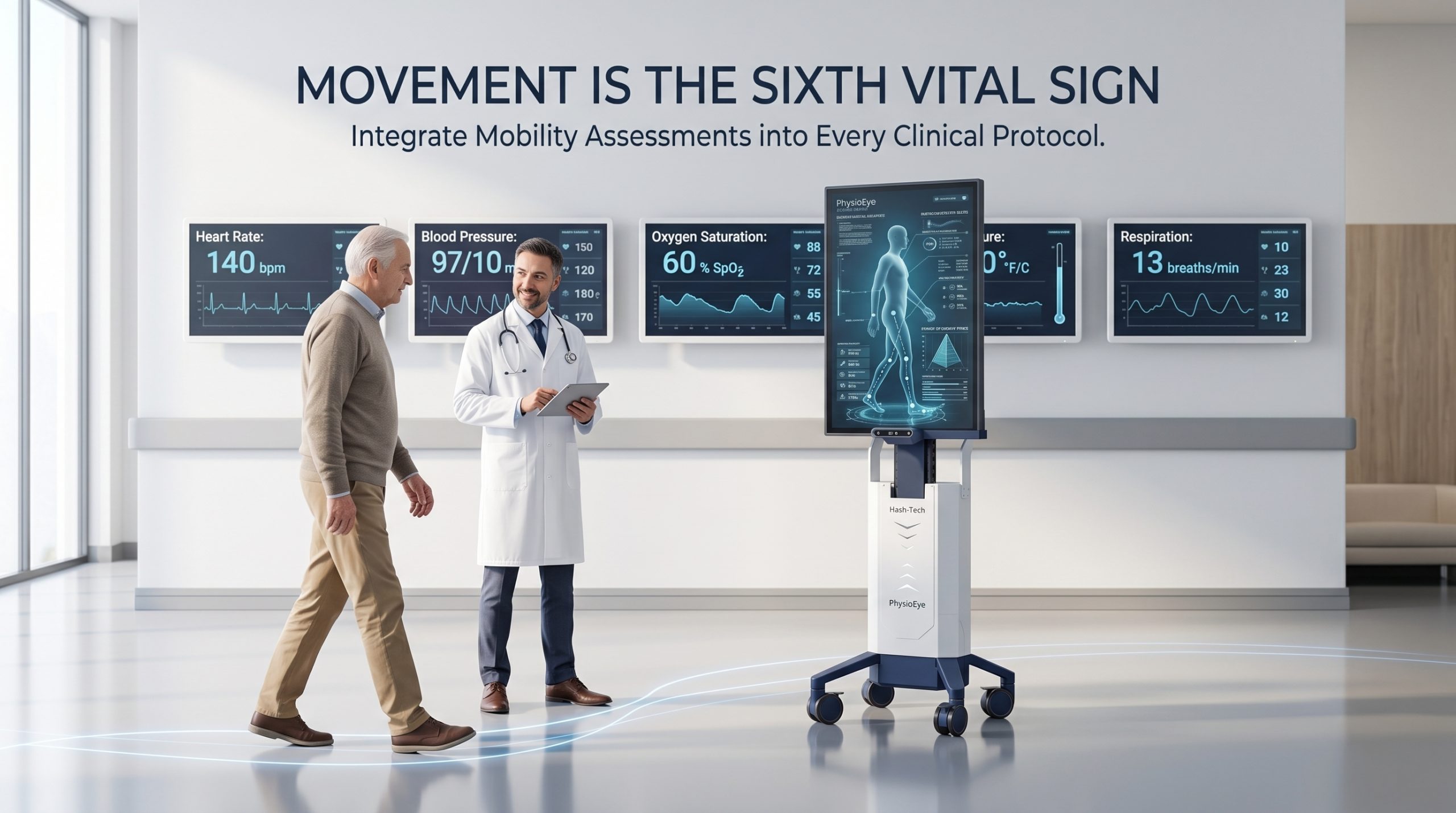
Functional Mobility: 7 Proven Reasons It Should Be Monitored Like Blood Pressure
More than 28% of adults aged 65 and older report falling each year, according to the Centers for Disease Control and Prevention (CDC), resulting in over 3 million emergency department visits for acute injuries. Yet, in most clinical settings, walking biomechanics and balance are only assessed after a catastrophic fracture occurs. If a patient’s blood pressure spikes, clinical alarms sound immediately; if their gait speed drops by 0.1 meters per second, the decline usually goes entirely unnoticed.
This article explains why tracking Functional Mobility is the missing vital sign in predictive geriatric care. You will learn the underlying physiology of human locomotion, why traditional observational tools completely fall short in modern clinical workflows, and how modern optical artificial intelligence is transforming early diagnosis for aging populations. Ultimately, prioritizing
What is Functional Mobility?
Functional mobility is the physiological ability of an individual to safely and independently move through their environment to accomplish daily tasks. It encompasses walking velocity, standing up from a chair, postural control, and the complex neuromuscular coordination required to navigate physical obstacles.
To truly understand this concept, clinicians must view human movement not as a simple mechanical output, but as a comprehensive neurological report card. Taking a single step requires an intricate symphony between the central nervous system, sensory inputs, and the musculoskeletal system. The brain must process visual acuity, align it with vestibular orientation in the inner ear, and send precise electrical signals down the spinal cord to fire the correct muscles at the exact right millisecond.
When any part of this network degrades—whether from microvascular brain ischemia, deteriorating cartilage, or diabetic neuropathy—the body instinctively alters its movement patterns to compensate. Physical therapists and neurologists evaluate these shifts by analyzing spatiotemporal parameters. These specific data points include stride length, cadence, double-support time (the fraction of a second when both feet touch the floor simultaneously), and step-width variability.
When an older adult begins to lose executive function or muscle mass, their double-support time increases as they subconsciously seek more stability. Tracking these microscopic biomechanical shifts through precise Functional Mobility assessments allows healthcare providers to see internal physiological deterioration long before the patient visibly stumbles in the hallway.
Why is Functional Mobility Important? 7 Proven Reasons
It is a Direct Predictor of Mortality
Gait speed is recognized by global health authorities as a powerful predictor of survival in older adults. Clinical evidence indicates that a decrease of 0.1 meters per second in walking speed is associated with a 12% higher risk of mortality.
The aging population experiences a natural, predictable decline in physiological reserves. However, a rapid drop in walking velocity indicates that the body’s cardiovascular and pulmonary systems can no longer supply adequate oxygen to the skeletal muscles. When a geriatric patient begins to walk slower than 0.8 meters per second, it signals severe systemic distress. Monitoring Functional Mobility speed gives medical teams a non-invasive, objective warning sign that the patient requires immediate systemic evaluation. By intervening early, clinical teams can potentially prevent fatal medical events before they escalate into emergency room visits.
It Unmasks Cognitive Decline
Walking requires significant executive function. When seniors perform a secondary task while walking, cognitive overload occurs. MCI-related gait changes were most pronounced when subjects are challenged cognitively (i.e., dual-task), suggesting that gait assessment with an additional cognitive tasks is useful for diagnosis.
The real world is never a sterile, single-task environment. Patients must talk to friends, process visual stimuli like traffic, and plan their physical path simultaneously. If the brain is suffering from early Alzheimer’s disease or Mild Cognitive Impairment, it simply cannot handle this divided attention. The patient will instinctively slow down or stop walking entirely just to process a spoken question. Implementing an objective Dual-Task Gait Assessment allows memory clinics to quantify this “dual-task cost.” This delivers a definitive biomarker for dementia progression long before memory loss becomes severe enough to diagnose through traditional cognitive exams.
It is the Earliest Indicator of Frailty
A decline in movement efficiency usually precedes severe muscle loss, known as sarcopenia. Identifying subtle kinetic weakness allows clinicians to intervene aggressively before the permanent onset of frailty syndrome.
Frailty is not a sudden, overnight event; it is a creeping biological cascade characterized by unintended weight loss, chronic exhaustion, and profound physical weakness. By utilizing continuous Functional Mobility monitoring, nursing homes can detect the earliest micro-hesitations in a resident’s step. Recognizing these early, microscopic deficits empowers physical therapists to prescribe high-protein nutritional interventions and targeted resistance training. This proactive approach effectively reverses the biological clock and staves off the catastrophic physical decline associated with Frailty Syndrome in Geriatrics.
It Quantifies Surgical Recovery
Following joint replacement, visual observation cannot detect micro-asymmetries. A precise, AI-driven locomotion assessment mathematically guarantees that a surgical joint bears weight symmetrically before a patient is cleared for hospital discharge.
Orthopedic surgeons rely heavily on post-operative data to determine clinical success. If a patient is discharged with a 5-degree compensatory trunk lean, they are virtually guaranteed to suffer a secondary fall at home within weeks. The human eye simply cannot see these slight deviations. By measuring exact joint kinematics through a digital Functional Mobility evaluation, facilities ensure a mathematically verified, secure Post-Operative Hip Recovery. This standard of care drastically reduces costly hospital readmission rates and protects the patient from enduring a second agonizing surgery.
It Exposes Hidden Musculoskeletal Vulnerabilities
Changes in walking biomechanics, such as a widened base of support or an increased double-support phase, often serve as subconscious compensations for underlying skeletal pain or degrading bone density.
Patients with degrading bone mass rarely feel any physical pain until a bone actually snaps. However, their nervous system detects micro-instabilities deep within the joints and forces the body to alter its walking rhythm to protect the skeleton. A sudden shortening of step length or a visible reluctance to place full force on one limb often serves as one of the few physical Osteoporosis Warning Signs. Identifying this asymmetry during a routine evaluation prompts physicians to order DEXA scans and initiate bone-density treatments proactively.
It Drives Neurological Rehabilitation
In stroke and spinal trauma recovery, establishing a baseline movement profile is strictly required. This exact data guides therapists in applying the precise therapeutic dosage needed for effective neural repair.
You cannot manage what you do not measure. For survivors of severe neurological trauma, restoring movement requires thousands of precise, errorless repetitions. Objective tracking provides the absolute road map for intense Neuromuscular Re-education. For paralyzed or severely impaired patients, understanding their residual Functional Mobility capabilities determines the strategic trajectory of their Spinal Cord Injury Therapy. This guarantees that every single clinical hour yields maximum neuroplastic benefit, rewiring the brain through exact, measured movement.
It Shapes Proactive Safety Protocols
Falls represent a massive financial and physical burden on the healthcare system. Clinical evidence indicates that objective tracking forms the ultimate foundation for intelligent, predictive safety protocols.
According to the World Health Organization, Falls are the second leading cause of unintentional injury deaths worldwide. Reactive care models simply wait for the ambulance to arrive. By treating Functional Mobility as a vital sign, clinical directors can accurately stratify patients by their mathematical risk level. This strategy allows facilities to allocate nursing resources efficiently and implement highly targeted Fall Prevention Strategies that keep community-dwelling adults out of expensive long-term institutional care.
Who Needs It and When Should It Be Used?
Older adults over 65, patients recovering from orthopedic surgery, and individuals with neurological conditions require routine movement monitoring. Clinical guidelines recommend assessing these metrics annually for community-dwelling seniors and continuously during post-acute inpatient rehabilitation.
Any patient experiencing a transition of medical care should undergo an immediate walking analysis. When a senior transfers from a critical care hospital back to an assisted living facility, their physical capacity has almost always diminished due to extended bed rest. Failing to establish a new, accurate baseline puts them at extreme risk for a readmission event. Therapists must integrate these assessments upon admission, at strict 30-day intervals during active physical therapy, and immediately prior to any final discharge decision.
How is Functional Mobility Measured?
Traditional Methods and Current Challenges
Historically, clinicians evaluated movement using manual tools like stopwatches and visual observation. Tests like the Timed Up and Go (TUG) or the Berg Balance Scale are common but suffer from extreme subjectivity and clinical ceiling effects.
For decades, physical therapists have relied on a clipboard and a simple stopwatch to evaluate complex human mechanics. During a standard manual Berg Balance Test, the clinician must ask the patient to perform specific physical tasks and then subjectively grade them on a scale of 0 to 4. This manual grading introduces massive inter-rater reliability issues; one therapist might score a patient a 3 on Monday, while a different therapist scores them a 2 on Tuesday for the exact same performance.
Visual observation is inherently flawed because the human eye processes visual information at roughly 10 to 12 frames per second. It is biologically impossible for a nurse to accurately quantify a visual Postural Sway Assessment down to the millimeter. Adding complex wearable sensors to patients to gather better data has largely failed. Wearables irritate fragile skin, require constant Bluetooth pairing, and exhaust nursing staff, leading directly to the current industry-wide crisis in Geriatric Tech Adoption.
Modern AI Solutions
Modern healthcare utilizes 3D markerless motion capture and artificial intelligence to measure kinematics instantly. These contact-free systems automate clinical evaluations, extracting exact spatiotemporal data like stride length and joint angles without requiring wearable sensors.
Clinical workflows are changing rapidly. Automated optical systems significantly reduce the time required to administer standardized physical performance tests in clinical settings compared to manual evaluation. One prime example of this evolution is PhysioEye, an optical AI platform engineered by Hash-Tech GmbH in Buchbach, Germany. PhysioEye uses standard camera feeds to extract 3D skeletal data instantly as a patient moves naturally. It requires absolutely no physical setup, completely eliminating administrative friction for overworked nurses while delivering flawlessly accurate Functional Mobility data.
Once this objective diagnostic data is captured, it guides the entire clinical response. If the data shows a patient is entirely bedridden and losing flexibility, this tracking dictates exactly when to initiate Joint Contracture Prevention. Facilities then utilize advanced robotic tools to deliver the necessary therapy safely. Systems such as ErgoBot—a highly advanced, entirely stationary rehabilitation system designed to treat all human joints—provide the exact AI-calibrated haptic feedback needed. ErgoBot is not an exoskeleton and is not a gait-assisted walking robot. By keeping the patient in a 100% secure, seated or in-bed environment, ErgoBot delivers massive doses of Cognitive-Motor Therapy and precise Bilateral Arm Therapy without exposing vulnerable seniors to the severe fall risks associated with upright robotic walking devices.
Future Outlook
The future of clinical care relies entirely on predictive automation. As artificial intelligence integrates deeper into long-term care, movement tracking will shift from a reactive post-fall diagnostic to a continuous, ambient vital sign.
We are rapidly approaching an era where intelligent cameras in hospital hallways will passively monitor walking speed, stride symmetry, and joint angles without ever interrupting the patient’s daily routine. When the AI detects a 5% drop in walking efficiency, the system will automatically alert the central nursing station and schedule a physical therapy intervention before the patient ever loses their balance. This closed-loop ecosystem—where frictionless diagnostics automatically inform precise, stationary robotic therapy—represents the definitive standard of predictive care.
Summary & Practical Takeaways
For Clinicians & Physicians:
-
Treat Functional Mobility as the critical sixth vital sign. A drop below 0.8 meters per second requires immediate medical investigation for systemic decline.
-
Stop relying exclusively on single-task walking tests. Implement dual-task cognitive assessments to unmask hidden executive dysfunction before falls occur.
For Nursing Homes & Hospital Directors:
-
Subjective evaluations are a massive operational liability. Invest in markerless optical AI to generate undeniable, objective proof of patient stability for safe discharges and insurance funding.
-
Prioritize frictionless technology to guarantee staff adoption. Systems that require wearable sensors increase staff burnout and suffer from consistently low clinical adherence.
For Physical & Occupational Therapists:
-
Use precise diagnostic data to customize your therapeutic dosage. You cannot optimize post-operative recovery or neurological repair based on visual guesswork.
-
Pair objective assessments with safe, stationary robotic rehabilitation systems to deliver thousands of pain-free repetitions in a secure environment.
Frequently Asked Questions (FAQs)
What is the best tool to evaluate Functional Mobility? The most accurate tools today utilize 3D markerless artificial intelligence, completely replacing subjective stopwatches and cumbersome wearable sensors to deliver exact kinematic data.
Who needs a walking biomechanics evaluation? Any adult over the age of 65, patients discharging from complex orthopedic surgery, and individuals suffering from neurological conditions like stroke, Parkinson’s, or Alzheimer’s disease.
How accurate is markerless motion capture for Functional Mobility? Clinical evidence indicates that modern markerless optical AI tracks human joint kinematics and spatiotemporal metrics with accuracy rates that closely rival gold-standard, expensive laboratory biomechanics setups.
How long does an automated assessment take? Unlike manual evaluations that drain 15 to 20 minutes of valuable nursing time, AI-driven optical systems capture, analyze, and generate comprehensive medical reports in less than 60 seconds.
Why is dual-tasking important in mobility analysis? The brain must process cognitive information and coordinate physical balance simultaneously in the real world. Dual-tasking exposes the specific cognitive-motor deficits that cause falls in early dementia patients.
What is the cost of ignoring Functional Mobility? Failing to measure movement objectively leads directly to premature hospital discharges, catastrophic secondary falls, rapid institutionalization, and severe financial penalties for healthcare facilities.