Cognitive-Motor Therapy: 4 Mind-Blowing Dual-Task Upgrades ErgoBot Brings to Dementia Care
Cognitive-Motor Therapy is rapidly becoming the definitive standard for dementia and Alzheimer’s rehabilitation, replacing the flawed traditional approach that treats the brain and the body as isolated systems. Across Germany—from major hospitals in Munich to specialized care facilities headquartered near Buchbach—nursing staff are overwhelmed by the rising tide of cognitive decline. Historically, patients in these facilities receive memory games in one room and basic physical exercises in another, doubling the clinical hours required for a single patient.
However, the human nervous system does not function in isolation. Navigating the real world requires simultaneous physical and cognitive exertion. When a patient walks while holding a conversation, avoiding an obstacle, or thinking about a destination, they are engaging in a “dual-task.”
In patients with early-stage dementia or mild cognitive impairment (MCI), this dual-tasking ability collapses. Older adults with mild cognitive impairment who exhibit a high dual-task gait cost are up to 3.8 times more likely to progress to dementia. Furthermore, high dual-task motor costs and increased steps during dual-tasking are direct predictors of future falls in patients with cognitive impairment.
To genuinely prevent falls, restore independence, and optimize limited staffing resources, clinics must bridge this gap. Modernizing dementia units requires the implementation of Robotic Assisted Elderly Care to deliver simultaneous physical and cognitive loading in a single, highly efficient session.
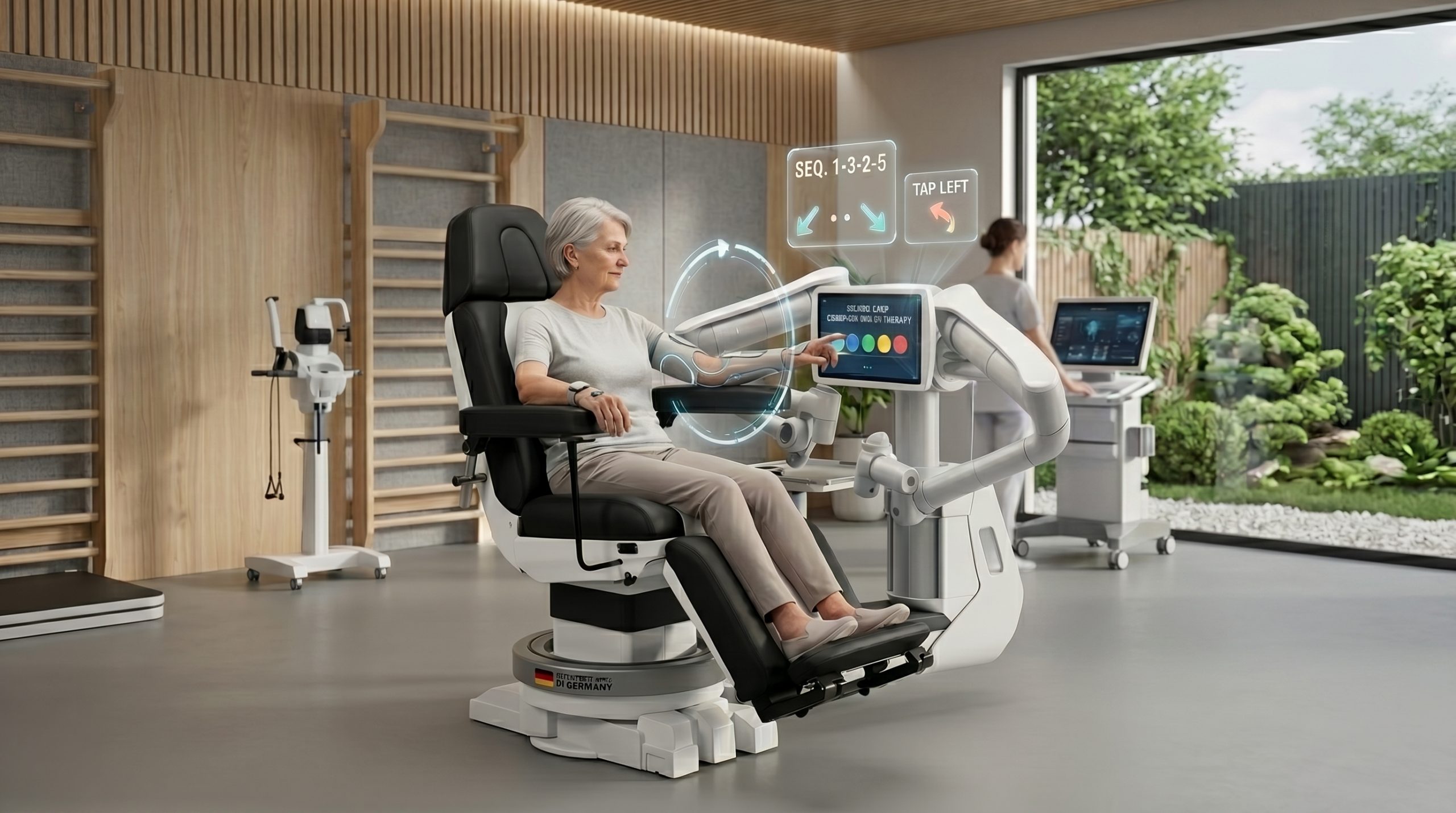
This is the exact science of Cognitive-Motor Therapy. By integrating the intelligent ErgoBot by Hash-Tech GmbH, facilities are entirely transforming dementia rehabilitation. Here are 4 mind-blowing dual-task upgrades the ErgoBot brings to the clinical floor.
Gamified Executive Function Loading in Cognitive-Motor Therapy
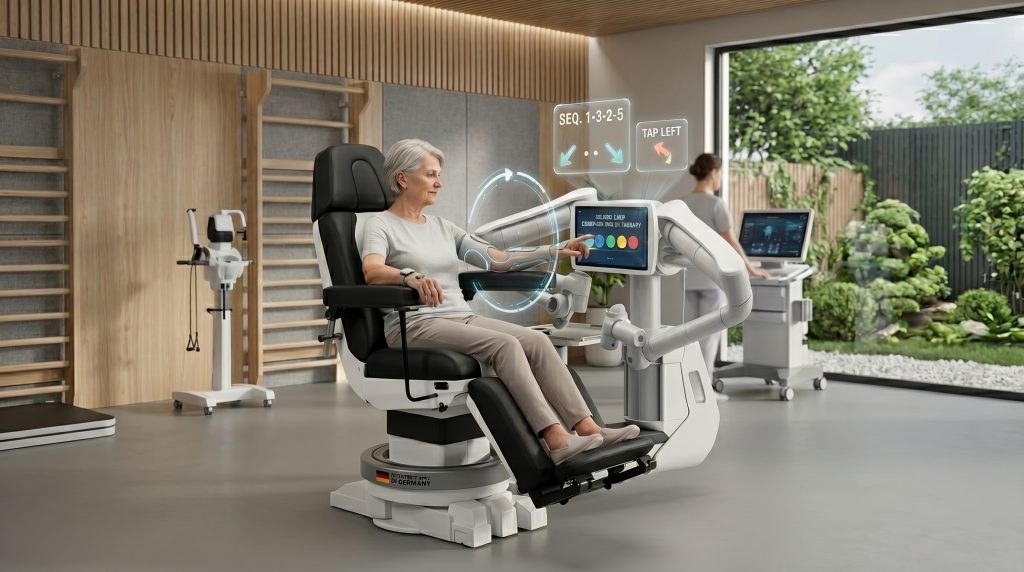
Asking a dementia patient to perform basic physical repetitions often leads to rapid disengagement and behavioral frustration. ErgoBot solves this by transforming Neuroplasticity Training into interactive, gamified cognitive tasks. While the patient physically pushes against the robot’s AI-calibrated resistance, they must simultaneously solve visual puzzles or respond to on-screen prompts.
AI-Assisted Errorless Learning During Cognitive-Motor Therapy
Patients with moderate to severe dementia struggle with “trial and error” learning; mistakes cause severe anxiety. ErgoBot elevates Cognitive-Motor Therapy by employing “errorless learning” through intelligent haptic guidance. If a patient becomes cognitively confused during a movement targeting essential Activities of Daily Living, the robot’s advanced torque sensors instantly recognize the hesitation. Similar to how it safely manages Spasticity Treatment, the robot securely guides the patient’s limbs through the correct trajectory, ensuring successful completion and reinforcing positive neural pathways without frustration.
Fear-Free Kinematic Exertion in Robotic Assisted Elderly Care
Cardiovascular and muscular exertion increases blood flow to the brain, which is neuroprotective against dementia progression. However, therapists hesitate to push cognitively impaired patients physically due to extreme fall risks. As one of the most advanced Robotic Rehabilitation Systems, ErgoBot allows patients to exert maximum physical effort in a completely secure, fall-free environment. They can safely rebuild strength, making it ideal for everything from generalized weakness to targeted Robotic Hip Fracture Rehabilitation.
Closed-Loop Tracking for Cognitive-Motor Therapy
A standard clipboard cannot measure the micro-second delays in a patient’s cognitive-motor reaction time. The Hash-Tech ecosystem seamlessly bridges diagnostics and Cognitive-Motor Therapy. Facilities can utilize the PhysioEye platform to conduct a baseline Automated Mobility Assessment, capturing objective data like early postural sway via Predictive Gait Analysis.
This kinematic data feeds directly into the ErgoBot, which tracks the patient’s dual-task reaction times during therapy. This creates a flawless, objective Longitudinal Mobility Assessment that proves both cognitive and physical progress to insurance boards and family members alike.
The Future of Dementia Rehabilitation
Relying on fragmented, manual therapy to treat neurodegenerative diseases leaves critical clinical potential untapped and drains facility budgets. By utilizing ErgoBot to deliver high-dosage Cognitive-Motor Therapy, facilities across Germany, Munich, and Buchbach are setting a revolutionary standard in Predictive Care.