Neuroplasticity Training: 6 Incredible Ways ErgoBot Rewires the Brain Faster After Severe Trauma
Neuroplasticity Training is the absolute foundation of recovery following a severe neurological event, such as a stroke, traumatic brain injury (TBI), or spinal cord injury. The human brain possesses a miraculous ability to reorganize its neural pathways and adapt to damage. However, this physiological rewiring does not happen passively. It requires highly specific, high-dosage, and mathematically precise functional repetition.
For clinics operating across Munich, Bavaria, and the global healthcare sector, relying on manual therapy to drive this process is a devastating operational flaw. A human therapist simply cannot physically endure the thousands of repetitions required to spark optimal neuroplasticity without risking severe musculoskeletal injury and burnout.
The shift toward intelligent, high-volume therapy is an economic inevitability. The Global Neurorehabilitation Robotics Market, valued at $1.20 billion in 2026, is surging toward a projected $4.95 billion by 2034, growing at a robust CAGR of 19.3%. To remain competitive, facilities must adopt intelligent automation.
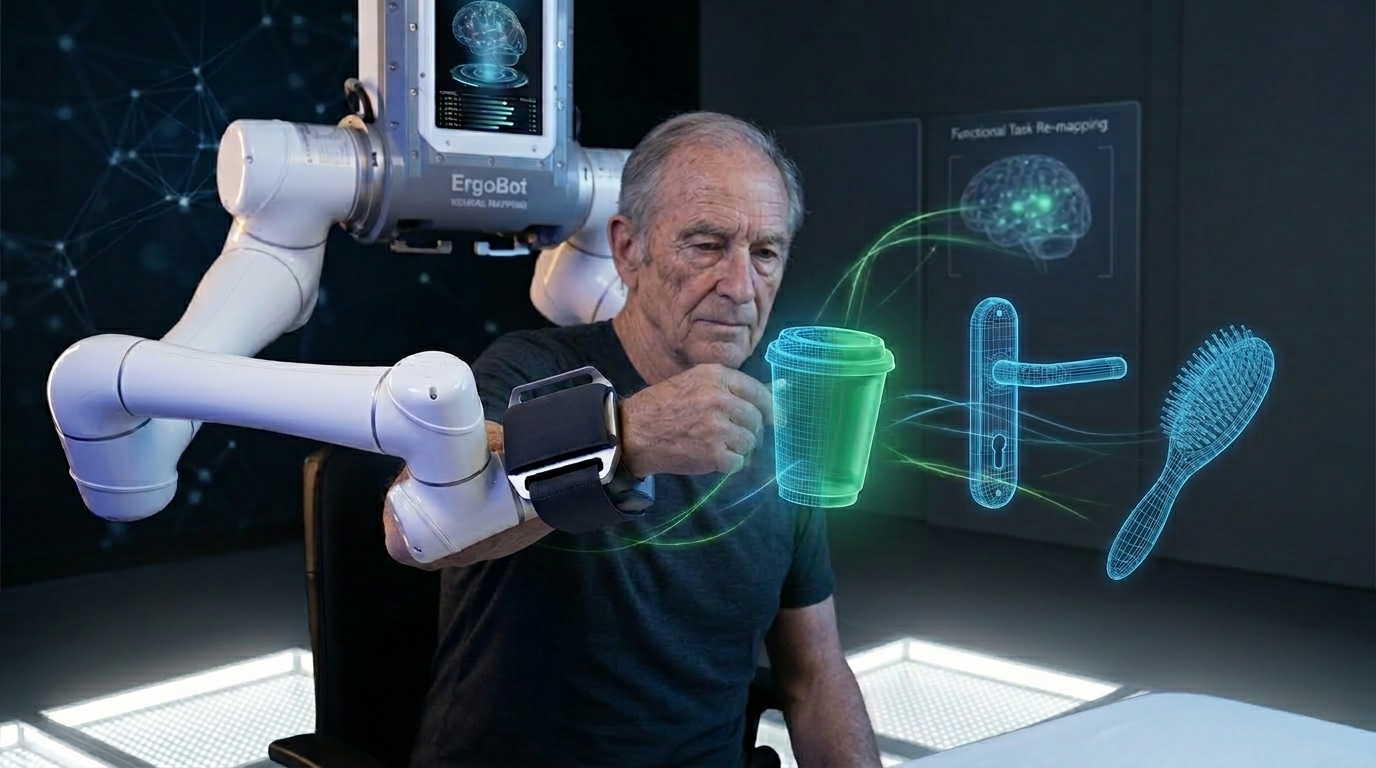
The ErgoBot by Hash Tech GmbH is explicitly designed to maximize this neural recovery. Working in flawless synchronization with the markerless PhysioEye diagnostic platform, the ErgoBot delivers the ultimate ecosystem for Robotic Assisted Occupational Therapy.
Here are 6 incredible ways ErgoBot accelerates Neuroplasticity Training.
The High-Dosage Repetition Threshold
To create a new neural pathway, the brain requires thousands of identical repetitions. Manual therapy often caps out at a few dozen movements before the patient or the therapist fatigues. ErgoBot shatters this barrier. By actively supporting the weight of the paretic limb, the system allows the patient to perform hundreds of precise, task-specific repetitions in a single session, pushing the brain past the threshold required to trigger true Neuroplasticity Training.
Symmetrical Bimanual Mirroring
One of the most potent triggers for neuroplasticity is bilateral symmetrical training. If a patient’s right arm is paralyzed, ErgoBot’s dual-arm modularity allows the healthy left arm to drive the movement. The robot forces the paralyzed right arm to perfectly mirror the left arm’s trajectory. This powerful, synchronized feedback loop forces the undamaged hemisphere of the brain to help rewire the damaged hemisphere, drastically accelerating the recovery of complex Elderly Care Solutions like grooming and dressing.
Precision Active-Assistive Sensing
If a robot does all the work, the brain disengages, and neuroplasticity stops. Conversely, if a patient cannot initiate the movement, frustration halts progress. ErgoBot utilizes highly advanced AI torque sensors. The robot senses the exact micro-voltage of effort the patient is applying. It provides only the minimum assistance required to complete the movement. This “assist-as-needed” paradigm ensures the brain remains highly engaged, actively firing motor neurons throughout the entire range of motion.
Overcoming Spasticity to Unblock Neural Pathways
Following a severe stroke, spasticity (rigid, involuntary muscle contraction) physically blocks the limb from moving, preventing functional Neuroplasticity Training. Manual stretching is painful, dangerous, and often exacerbates the spastic reflex. ErgoBot’s intelligent resistance algorithms detect the onset of a spastic catch instantly. The robot smoothly absorbs the resistance, safely easing the joint capsule open without triggering the stretch reflex. Once the limb is free, neural rewiring can resume.
Multi-Joint Functional Kinematics
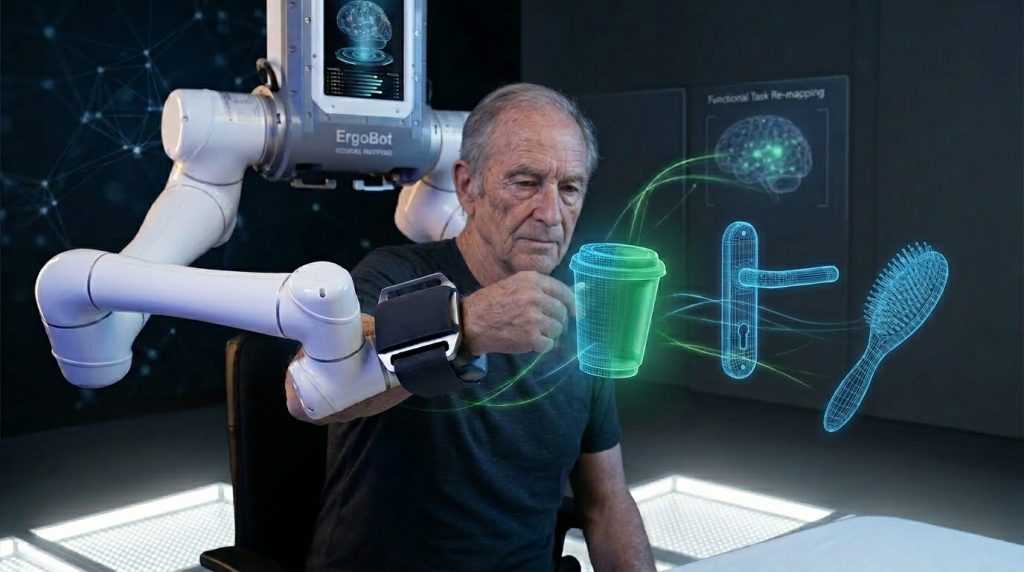
Traditional robots often focus on isolating a single joint (e.g., only the elbow). But the brain does not think in isolated muscles; it thinks in complex, functional tasks. ErgoBot is engineered to replicate multi-joint, real-world kinematics. By guiding the patient through complex, 3D spatial trajectories (like reaching for a cup), the robot ensures the brain is mapping highly functional pathways, rather than useless, isolated twitches.
Closed-Loop Objective Biofeedback
Neuroplasticity thrives on immediate feedback. When integrated with an initial Automated Mobility Assessment from the PhysioEye, ErgoBot continuously tracks the patient’s precise kinematic output. The patient receives instant visual and mechanical feedback on their performance. This closed-loop system reinforces successful motor planning, allowing the brain to rapidly correct errors and solidify new pathways.
The Standard of Nursing Home Automation
Facilities across Munich and the broader MedTech landscape must recognize that sheer human endurance cannot rebuild a damaged brain. True Neuroplasticity Training requires the mathematical precision and relentless volume that only intelligent robotics can provide.
By deploying the Hash Tech ecosystem, clinics ensure flawless data collection for accurate Pflegegrad grading, while simultaneously upgrading their operations to proactive Predictive Care. Integrating ErgoBot is the definitive move toward total Nursing Home Automation, securing the fastest possible recovery for your patients.