Activities of Daily Living (ADL): 6 Flawless Robotic Motions That Restore Patient Independence
Activities of Daily Living (ADLs) are the ultimate benchmark of clinical success in neurorehabilitation. For a stroke survivor, regaining the ability to independently eat, dress, and transfer safely is not just a medical goal; it is the restoration of human dignity. For decades, clinics across Munich, Bayern, and the broader global healthcare network have relied exclusively on manual therapy to guide patients back to independence. However, the physical limitations of manual therapy have created a devastating bottleneck in patient recovery.
The urgency to solve this bottleneck is reflected in the massive financial trajectory of the MedTech sector. The Global Neurorehabilitation Robotics Market is accounted for $1.20 billion in 2026 and is expected to surge to $4.95 billion by 2034, growing at a robust CAGR of 19.3%. Clinics that fail to adopt these intelligent systems risk falling behind clinically and economically.
To truly recover Activities of Daily Living, a patient’s brain requires neuroplasticity, which is triggered exclusively through high-volume, task-specific repetition. Clinical trials confirm that robot-assisted therapy combined with functional training is significantly more effective than conventional manual therapy in improving motor function and the quality of life in subacute stroke patients.
This is where the ErgoBot by Hash Tech GmbH completely changes the paradigm of Robotic Assisted Occupational Therapy. Traditional robots often focus on rigid, single-joint isolation. The ErgoBot, engineered right here in Bavaria, is designed to replicate complex human biomechanics. By seamlessly integrating with the PhysioEye to perform a baseline Automated Mobility Assessment, the system identifies exact kinematic deficits and deploys precise robotic motions.
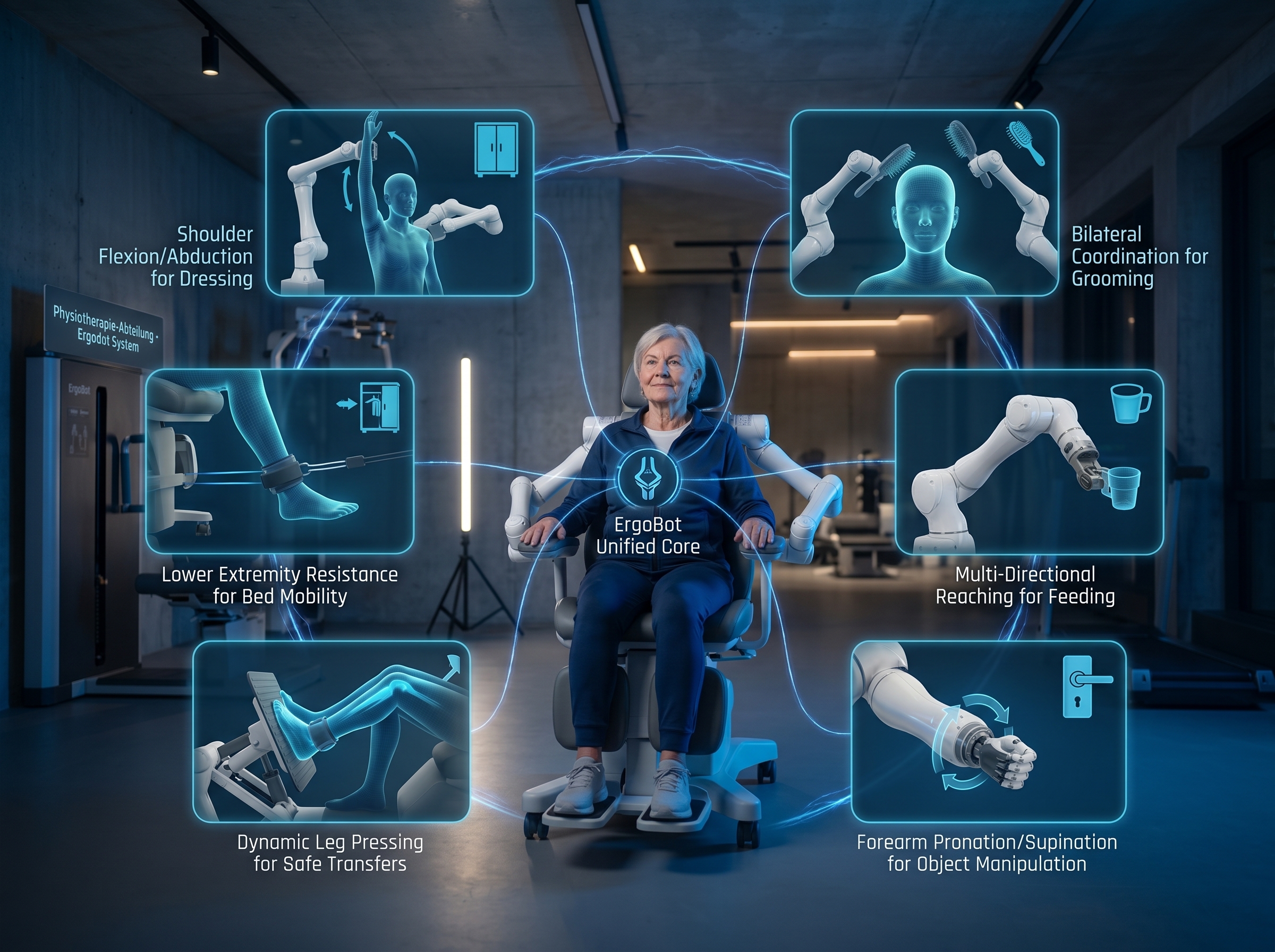
Here are 6 flawless robotic motions the ErgoBot utilizes to systematically restore a patient’s Activities of Daily Living.
Multi-Directional Reaching for Feeding and Drinking
One of the most critical Activities of Daily Living is the ability to feed oneself. This requires complex coordination of the shoulder, elbow, and wrist to bring an object to the mouth against gravity. Manual therapy struggles to provide the thousands of assisted repetitions needed to re-map this neural pathway. The ErgoBot provides active-assistive, 3D spatial guidance, allowing the paretic arm to practice the precise trajectory of bringing a cup to the mouth while dynamically supporting the weight of the limb.
Forearm Pronation and Supination for Object Manipulation
Unlocking a door, turning a stove knob, or pouring water all require fine rotational control of the forearm. Scientific reviews demonstrate that targeting multiple degrees of freedom, including forearm pronation and supination, via robotic assistance yields significantly larger improvements in upper limb capacity. The ErgoBot’s end-effector safely drives these rotational movements, pushing through spasticity with AI-monitored resistance to rebuild functional hand use for complex Activities of Daily Living.
Symmetrical Bilateral Coordination for Grooming
Many basic Activities of Daily Living, such as washing one’s face or buttoning a shirt, require the brain to coordinate both arms simultaneously. ErgoBot’s advanced dual-arm capability facilitates mirrored bilateral training. If a stroke patient moves their healthy arm, the robot forces the paretic arm to perfectly mirror the trajectory. This symmetrical feedback loop powerfully stimulates the damaged motor cortex, accelerating recovery far beyond unilateral manual stretching.
Dynamic Leg Pressing for Safe Transfers
Moving from a bed to a wheelchair requires massive lower-body strength and symmetrical weight-bearing. It is vital to note that ErgoBot is a stationary clinical hub—it is not an exoskeleton and cannot be used for gait rehabilitation. However, its lower-extremity module excels at training the isolated, symmetrical leg pressing needed to safely push up from a seated position. By securing a targeted Senior joint mobility assessment, the robot prevents the severe falls that frequently occur during these high-risk Activities of Daily Living.
Shoulder Flexion and Abduction for Dressing
Putting on a coat or reaching into a high cabinet requires massive shoulder mobility. Without high-dosage therapy, the paretic shoulder rapidly freezes. The ErgoBot acts as an absolute necessity for Elderly Care Solutions, delivering perfectly smooth, AI-guided shoulder flexion and abduction. It provides continuous tension that adapts in real-time, safely stretching the joint capsule and ensuring the patient regains the range of motion required for these essential Activities of Daily Living.
Lower Extremity Resistance for Bed Mobility
Before a patient can attempt a physical transfer, they must be able to roll over and bridge their hips in bed. Though ErgoBot does not perform locomotion or walking therapy, it provides the focused, multi-joint resistance required to rebuild foundational leg and core strength. This enables patients to reposition themselves safely, conquering the most basic Activities of Daily Living necessary for ward independence.
Automating the Path to Independence
We can no longer rely on human endurance to rebuild broken neurological pathways. To restore Activities of Daily Living efficiently, facilities throughout Munich and the global market must embrace intelligent technology.
By implementing the Hash Tech ecosystem, clinics capture perfect kinematic data for accurate Pflegegrad classifications while simultaneously offering world-class Predictive Care. Integrating ErgoBot is the ultimate step toward complete Nursing Home Automation, ensuring that every patient receives the exact mathematical dosage of therapy required to reclaim their independence.