Neuromuscular Re-education: 4 Astonishing Ways ErgoBot’s Intelligent Resistance Accelerates Healing
Neuromuscular Re-education is the ultimate clinical objective when treating severe neurological trauma. Whether a patient has suffered a stroke or requires intensive Spinal Cord Injury Therapy, the goal is not merely to build raw muscle. The goal is to teach the damaged brain how to communicate with the body again.
Historically, therapists in Germany and across the globe have relied on manual resistance, rubber bands, or static weights to achieve this. But the central nervous system does not rewire itself efficiently against “dumb” resistance. A static weight cannot adapt if a patient suddenly experiences a spastic spasm, nor can a rubber band assist a patient through a complex, bimanual trajectory.
To achieve genuine Predictive Care, the resistance must be as intelligent as the therapy itself. By integrating the highly advanced ErgoBot by Hash-Tech GmbH, clinics are replacing static weights with dynamic, AI-calibrated haptic feedback.
Here are 4 astonishing ways ErgoBot utilizes intelligent resistance to redefine Neuromuscular Re-education in modern healthcare.
Fostering Neuroplasticity in Neuromuscular Re-education
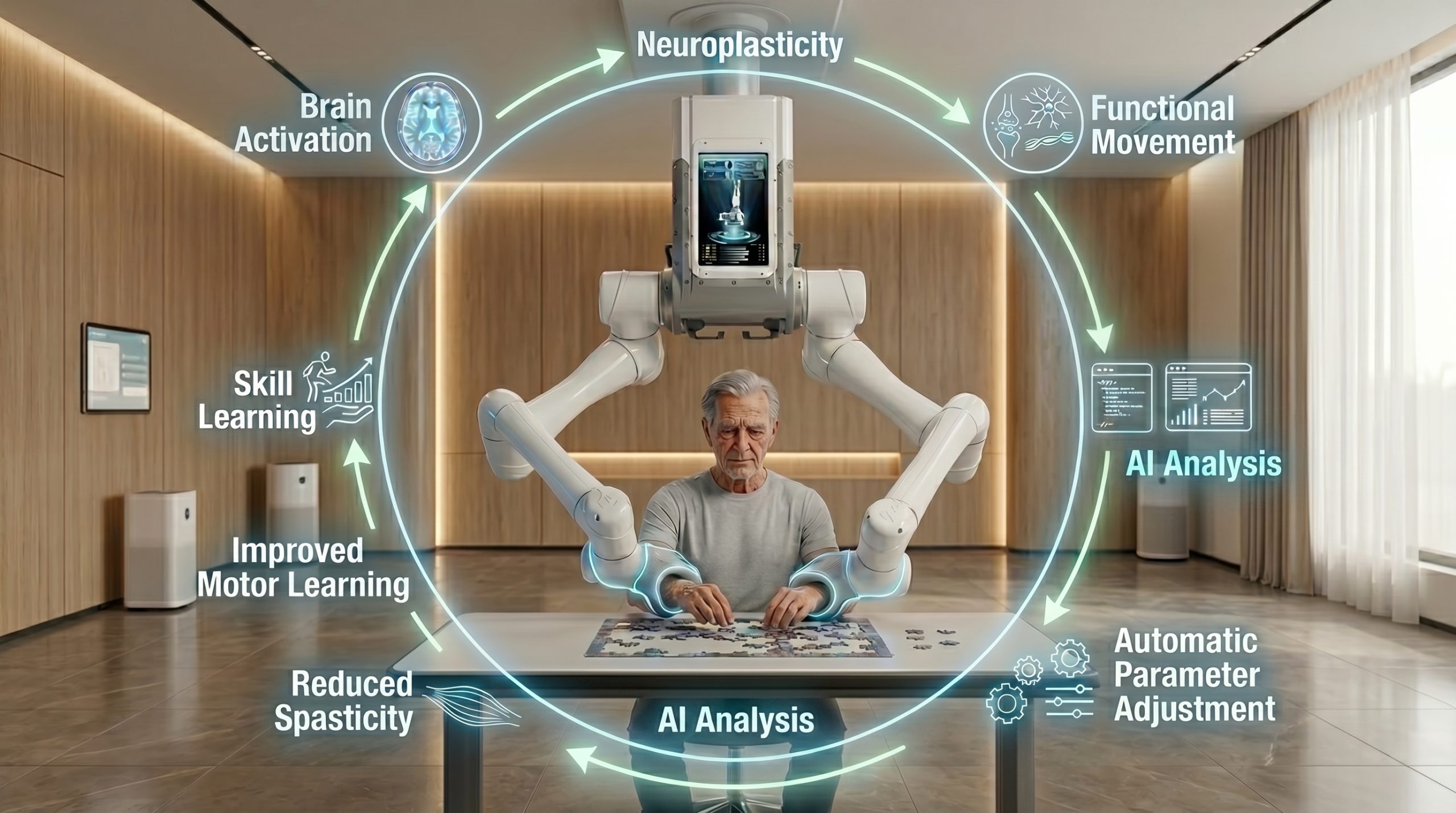
The fundamental flaw of traditional physical therapy is that a human therapist cannot provide mathematically perfectly consistent resistance over hundreds of repetitions. ErgoBot’s advanced torque sensors act as a flawless extension of the clinical team, providing exactly the right amount of assistance or resistance needed to challenge the motor cortex without overwhelming the patient. Robotic-exoskeleton training showed improvement in motor outcomes and cortical-excitability in patients with stroke.
By applying intelligent, robotic resistance, ErgoBot forces the brain to actively re-engage with the paralyzed limb. This is especially vital during Bilateral Arm Therapy, where ErgoBot uses the momentum of the healthy arm to guide the damaged arm, forcing interhemispheric crosstalk and accelerating the healing process.
Task-Specific Motor Learning over Brute Strength
A major misconception in neuro-rehabilitation is that recovery is purely about regaining strength. If a patient regains muscle mass but cannot coordinate those muscles to feed themselves, the therapy has failed. Our findings suggest that, as motor recovery progresses, an internal representation of the task is rebuilt by the brain in a process that better resembles motor learning than motor adaptation.
ErgoBot elevates Neuromuscular Re-education by focusing entirely on functional movement. Through intelligent resistance, the robot guides patients through the complex, multi-joint trajectories required for the Activities of Daily Living (ADL). This ensures that the patient isn’t just pushing against a weight, but is actively relearning the precise motor controls needed for independence.
Automated Parameter Tuning for Neuromuscular Re-education
Every patient’s nervous system reacts differently to fatigue. In manual therapy, a therapist must guess when a patient is tiring and manually adjust the resistance. ErgoBot eliminates this guesswork entirely.
As the patient progresses through a session of Neuromuscular Re-education, ErgoBot’s AI continuously analyzes their force output in real-time. If the system detects sudden weakness or early signs of Frailty Syndrome in Geriatrics, it instantly lowers the resistance and increases haptic assistance. This prevents frustrating muscular failure and safely bridges the gap toward advanced Cognitive-Motor Therapy.
Eradicating Spasticity Through Adaptive Support
When dealing with severe neuro-trauma, patients often develop intense spasticity. Attempting to force a spastic limb against a static weight triggers pain and further tightens the pathological synergy. The demonstrated improvement in motor function and in muscular activation pattern suggests how a short robotic training could be effective in chronic post-stroke spasticity of upper limb.
ErgoBot executes this through “errorless learning.” If a patient with severe spasticity or hidden skeletal issues—like early Osteoporosis Warning Signs—hesitates or locks up during a movement, the intelligent resistance immediately shifts into a supportive mode. This allows for safe, pain-free Spasticity Treatment, gently guiding the arm through the correct path.
The Objective Ecosystem of Predictive Care
To maximize the effectiveness of ErgoBot’s robotic therapy, facilities must baseline their patients accurately. By combining the therapeutic power of ErgoBot with the diagnostic precision of our PhysioEye platform—whether utilizing it to conduct an automated Berg Balance Test or a microscopic Postural Sway Assessment—Hash-Tech GmbH is building an undeniable, closed-loop ecosystem. This is the definitive future of Robotic Assisted Elderly Care in Germany and beyond.