Spinal Cord Injury Therapy: 4 Spectacular Milestones ErgoBot Unlocks for Paralyzed Patients
Spinal Cord Injury Therapy is one of the most physically and neurologically demanding challenges in modern rehabilitation. Following trauma to the cervical spine, patients are often left with severe tetraplegia, stripped of their independence, and trapped in bodies that can no longer execute basic commands. In specialized neurological units across Germany—from critical care hospitals in Munich to our advanced engineering headquarters in Buchbach—traditional, manual rehabilitation is hitting a rigid clinical ceiling.
Historically, manual Spinal Cord Injury Therapy has been constrained by human limitations. A therapist can only guide a paralyzed arm through so many repetitions before physical exhaustion sets in. However, reversing neurological damage requires massive, high-dosage movement that a human simply cannot provide alone.
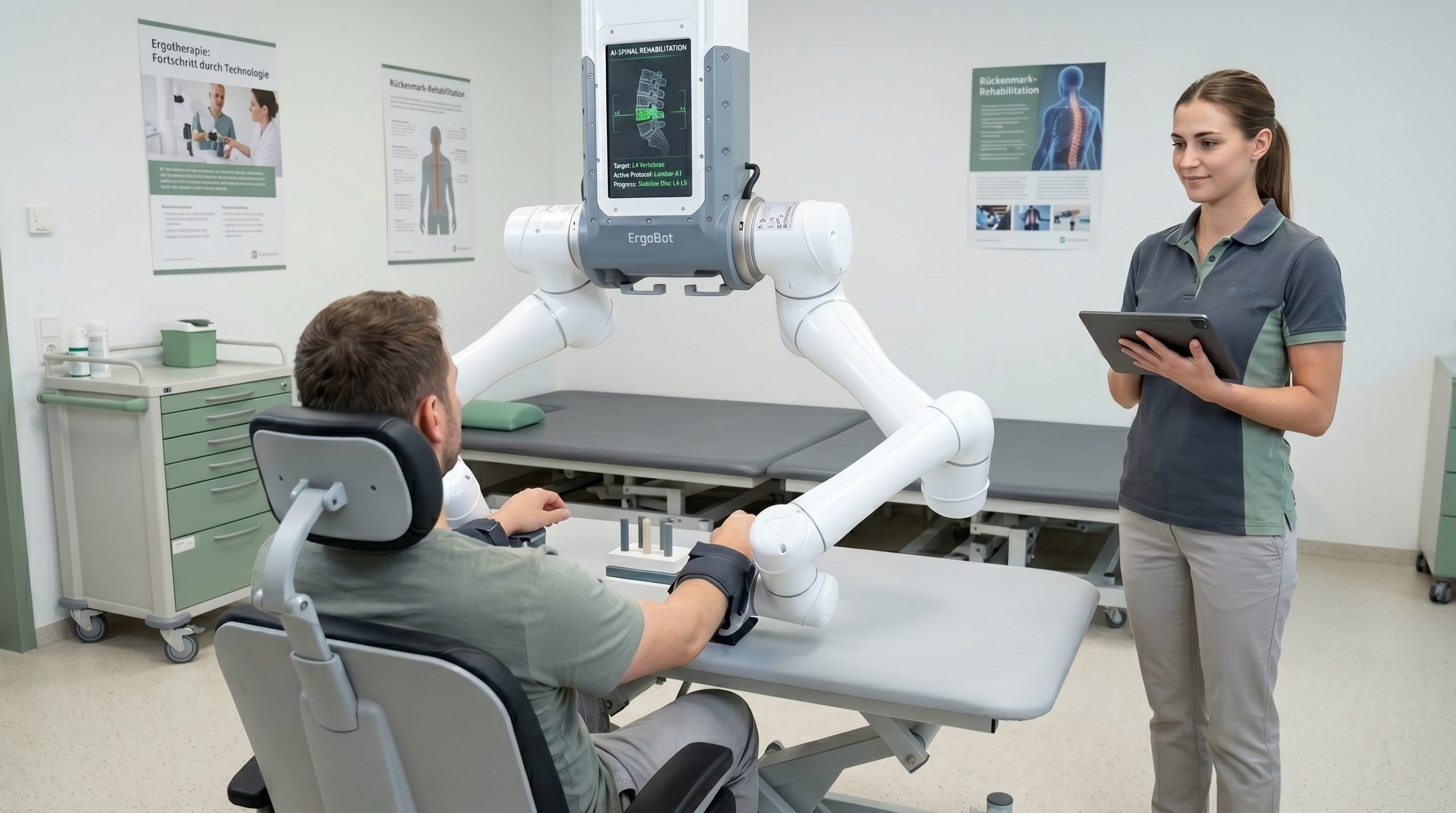
To overcome this, forward-thinking facilities are pivoting toward Nursing Home Automation and advanced robotics. By integrating the intelligent ErgoBot by Hash-Tech GmbH, clinics are redefining what is possible in neuro-recovery.
Here are 4 spectacular milestones that ErgoBot achieves in modern Spinal Cord Injury Therapy, backed by exact clinical literature.
Eradicating Labor-Intensive Bottlenecks in Spinal Cord Injury Therapy
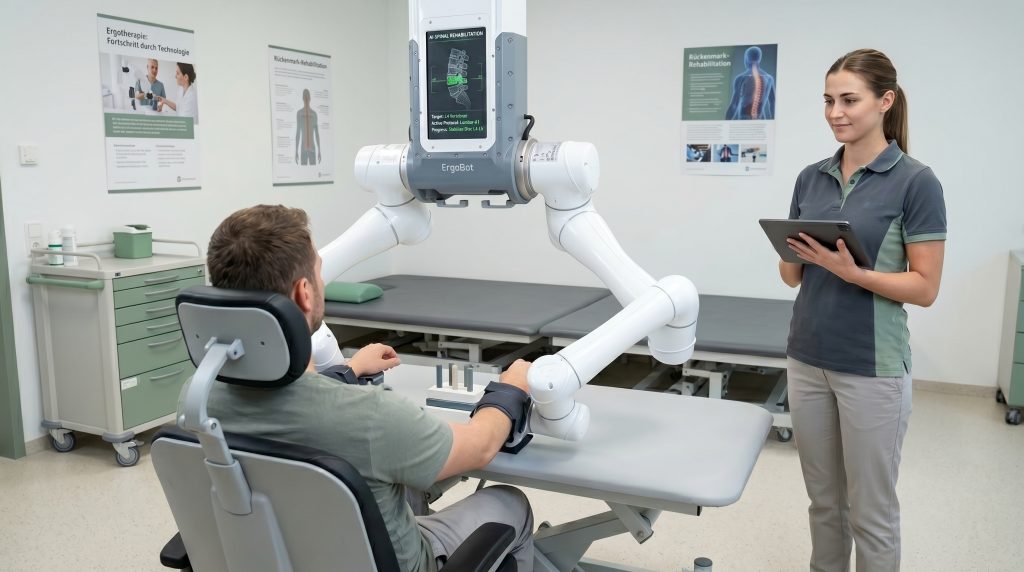
The fundamental flaw of manual rehabilitation is that it is exhausting for the clinical staff. German nurses and therapists suffer from severe ergonomic injuries trying to support the dead weight of paralyzed limbs. ErgoBot fundamentally changes this dynamic, acting as a tireless extension of the clinical team.
By bearing the physical load, ErgoBot allows therapists to focus on the cognitive and strategic elements of Spinal Cord Injury Therapy, making it the ultimate tool for scalable Robotic Assisted Elderly Care.
Overcoming the Motor Repetition Barrier
Healing a damaged spinal pathway is a numbers game. The central nervous system needs thousands of precise, uninterrupted movement cycles to begin rewiring itself. In a standard hour of manual therapy, a patient might achieve 40 to 50 repetitions.
ErgoBot shatters this ceiling. upper limb robotic devices increase the number of motor repetitions to aid patient recovery and provide consistent training to measure performances outcomes.
By utilizing these highly advanced Robotic Rehabilitation Systems, a patient undergoing Spinal Cord Injury Therapy can safely execute hundreds of perfect, symmetrical repetitions in a single session, achieving a dosage volume that was previously impossible to secure.
Triggering Adaptive Neuroplasticity
When the spinal cord is damaged, the brain must find new pathways to communicate with the muscles. This rewiring process is heavily dependent on specific, task-oriented movement. ErgoBot does not just move the arm randomly; it uses AI-calibrated resistance and interactive environments to force the brain to engage with the movement actively.
This creates a flawless environment for profound Neuroplasticity Training. Furthermore, by using intelligent haptic feedback, ErgoBot gently guides the patient through movements without triggering painful tonal resistance, providing a safe avenue for simultaneous Spasticity Treatment with ErgoBot.
Restoring Crucial Independence and ADLs
The ultimate goal of any clinical intervention is getting the patient their life back. For a tetraplegic patient, regaining the ability to feed themselves or brush their own hair is a monumental victory.
ErgoBot bridges the gap between raw muscle strengthening and the real world. By focusing Spinal Cord Injury Therapy directly on bimanual coordination and functional trajectories, ErgoBot ensures that strength gains translate immediately into mastering the Activities of Daily Living (ADL).
The Standard of Predictive Care in Germany
By combining ErgoBot’s therapeutic power with the diagnostic precision of Automated Mobility Assessment by PhysioEye, clinics can track recovery with absolute mathematical certainty. This closed-loop ecosystem is the definitive future of Predictive Care, proving that with the right technology, paralysis is a challenge we can actively fight.