
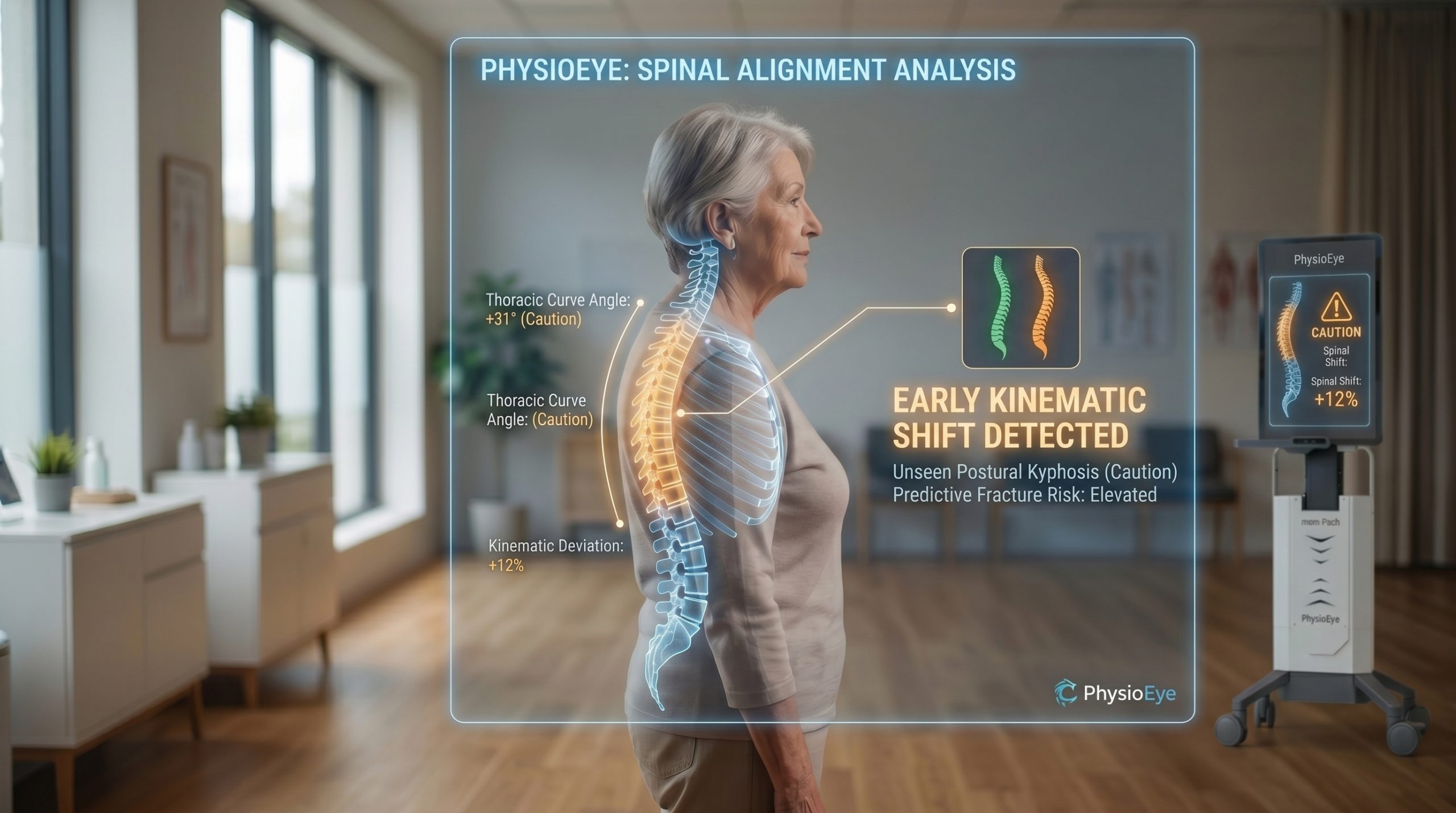
Osteoporosis Warning Signs: 5 Subtle Kinematic Shifts PhysioEye Captures That Manual Tests Miss
Osteoporosis Warning Signs are notoriously difficult to detect in traditional geriatric care, leaving the disease largely hidden until a catastrophic hip or vertebral fracture occurs. Clinical statistics from the International Osteoporosis Foundation reveal that up to 80% of patients who have already suffered a fragility fracture are neither identified nor treated for osteoporosis. By the time a patient is sent for a DEXA scan post-fall, the most crucial window for preventative intervention has already closed.
While a diagnostic camera cannot measure bone mineral density, the human body does not hide the disease. Long before a severe fracture happens, micro-fractures and skeletal weakening force the body to alter its biomechanics to protect the spine and maintain balance.
Relying on a manual stopwatch and clipboard to evaluate seniors misses these micro-compensations completely. To achieve true Predictive Care, facilities must track the biomechanical fallout of bone deterioration.
Here are the 5 critical Osteoporosis Warning Signs—backed by clinical biomechanics—that the PhysioEye platform captures effortlessly.
Anterior Displacement of the Center of Mass (Hyperkyphosis)
As osteoporosis silently causes wedge micro-fractures in the thoracic vertebrae, the spine begins to curve forward, creating hyperkyphosis. This postural shift forces the patient’s center of mass dangerously forward. Research published in the Journal of Bone and Mineral Research indicates that older adults with hyperkyphosis have a 1.38 to 2.0 times greater risk of suffering a future fall.
Manual observation often dismisses this as “normal aging.” Using 3D markerless AI, PhysioEye acts as an advanced Spinal Curvature Deformity tracker, calculating the exact degree of thoracic curvature in seconds, alerting clinicians to structural osteoporotic changes before the patient loses their balance.
Eccentric Descent Failure During Sit-to-Stand
When a senior with weakened vertebrae sits down, the spine is highly vulnerable to compression forces. To avoid pain or structural failure, osteoporotic patients unconsciously alter their sit-to-stand mechanics. Clinical biomechanics studies demonstrate that frail older adults exhibit significantly higher downward vertical velocity and less eccentric muscular control during the descent phase of standing to sitting, literally “dropping” into the chair.
A stopwatch cannot measure this descent velocity. By conducting an Automated Mobility Assessment, PhysioEye tracks the exact descent kinematics during the Five Times Sit to Stand Test, flagging this protective compensation immediately.
Increased Double Support Time in Gait
Fear of falling and the subconscious need to protect fragile bones fundamentally alters how a patient walks. One of the earliest Osteoporosis Warning Signs is a widening of the base of support and a prolonged “double support time”—the fraction of a second where both feet remain on the ground simultaneously. Literature in Gait & Posture confirms that increased double support time is a primary, independent predictor of future falls in the elderly, highly correlated with balance deficits.
While traditional Gait Speed Measurement only tracks total time, PhysioEye conducts high-definition Predictive Gait Analysis, isolating these exact stride compensations to predict an impending fall.
Rigid, Segmented Turning Mechanics
Turning requires complex spinal rotation and a temporary narrowing of the base of support. For a senior with osteoporotic spinal rigidity, a fluid turn is dangerous. They will compensate by utilizing a rigid, block-like turning strategy. Failing to recognize this rigidity is missing one of the most critical Osteoporosis Warning Signs. Studies indicate that older adults who require more than three steps to complete a 180-degree turn face a significantly elevated risk of falling, particularly hip-impact falls.
When executing a Timed Up and Go Fall Risk assessment or a targeted 360° Turn Test, PhysioEye’s AI captures the exact rotational kinematics and step count during the pivot, exposing hidden skeletal rigidity.
Progressive Loss of Spinal Range of Motion over Time
The most devastating error in manual clinical testing is the lack of objective, historical data. Osteoporotic decline happens gradually. A nurse estimating a patient’s posture on a clipboard cannot accurately detect a subtle 3-degree loss in spinal mobility over six months.
PhysioEye eliminates this blind spot. By providing seamless Longitudinal Mobility Assessment, the system creates an undeniable, digitized historical record, automatically tracking these Osteoporosis Warning Signs and flagging progressive kinematic deterioration before it results in a clinical emergency.
The Standard of Nursing Home Automation
Facilities can no longer afford to wait for a fracture to diagnose fragility. By utilizing the markerless AI of PhysioEye, clinics can detect the earliest biomechanical Osteoporosis Warning Signs, seamlessly integrating this objective data to justify proactive therapies. This is not just an upgrade to physical therapy; it is the definitive infrastructure for modern predictive care.