Timed Up and Go Fall Risk: 7 Proven AI Upgrades to Prevent Catastrophic Nursing Home Injuries
Timed Up and Go Fall Risk assessments are the cornerstone of elderly mobility screening across Germany and the globe. For decades, the manual TUG test has been simple: a clinician tells the patient to stand from a chair, walk three meters, turn around, walk back, and sit down, all while clicking a manual stopwatch.
However, evaluating Timed Up and Go Fall Risk using only a stopwatch is a catastrophic clinical blind spot. Time alone tells you how long a patient took, but it completely ignores how the patient moved. Did they stagger on the turn? Was their step length asymmetric? Did they struggle to generate momentum out of the chair?
Today, facilities across Frankfurt am Main, Hessen, and the broader German healthcare system are recognizing that manual testing leaves them exposed to immense liability. A systematic review published in the National Institutes of Health confirms that instrumented, technologically enhanced TUG tests offer vastly superior predictive value for identifying fallers compared to traditional stopwatch methods.
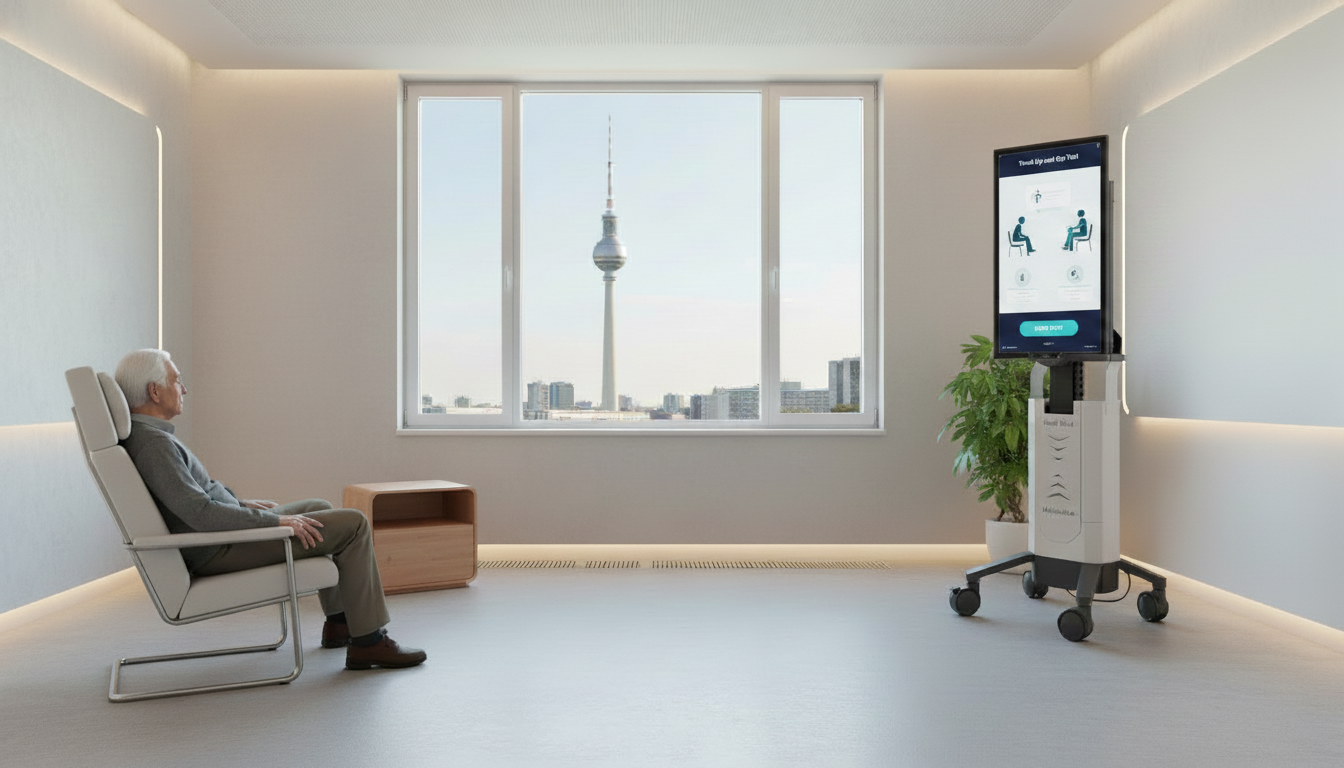
By upgrading to the PhysioEye platform, clinics can capture 3D biomechanical intelligence during the test. Here are 7 proven AI upgrades that eliminate the fatal flaws of the manual stopwatch, transforming Timed Up and Go Fall Risk screening into absolute precision.
Moving Beyond the “Time-Only” Fallacy in Timed Up and Go Fall Risk
The most dangerous flaw in a manual TUG test is reducing a complex neurological and musculoskeletal process to a single number. A patient might finish the test in 12 seconds but exhibit severe postural sway—a major red flag for falls. PhysioEye evaluates every single gait parameter simultaneously. Clinical evidence demonstrates that capturing spatial parameters alongside temporal data significantly increases the discriminatory power to detect high-risk fallers.
Deconstructing the Sit-to-Stand (STS) Sub-Phase
The simple act of rising from a chair requires massive lower-body strength and trunk control. A stopwatch cannot measure if a patient hesitated or required asymmetric momentum. PhysioEye acts as an objective Automated Mobility Assessment, instantly calculating the maximum angular velocity and trunk acceleration of the sit-to-stand phase, capturing weakness long before it results in a hip fracture.
Quantifying the 180-Degree Turning Velocity
Turning requires extreme dynamic balance. If a patient pivots rigidly or takes too many micro-steps, they are highly vulnerable to a catastrophic fall. Scientific research has established that fear of falling and actual fall risk are most strongly correlated to turning velocity during the TUG test, rather than overall walking speed. PhysioEye captures the exact degree and speed of rotation, securing a perfect Senior joint mobility assessment.
Eliminating Subjective Stopwatch Errors
Human reaction time is inherently flawed. Different nurses will start and stop a timer at different moments, destroying inter-rater reliability. This inconsistency is dangerous when determining an accurate Pflegegrad classification. PhysioEye provides highly standardized, automated start-to-finish precision, completely removing human error from the equation.
Exposing Cognitive-Motor Interference
In advanced geriatrics, clinicians use the “Dual-Task TUG” (asking the patient to count backward while walking). If the brain struggles to manage both tasks, the gait physically deteriorates. Recent clinical studies prove that splitting the TUG into detailed kinematic sub-tasks yields a predictive accuracy of 74% with an incredible 95.9% specificity. PhysioEye effortlessly measures the exact deviation in gait speed when cognitive load is introduced.
Capturing Invisible Step Asymmetry
A manual stopwatch cannot tell if a patient’s left stride is 10% shorter than their right stride. Asymmetry is a critical early biomarker for neurological decline (such as stroke or Parkinson’s disease). PhysioEye’s markerless AI detects these millimeter-level deviations in real-time, elevating standard Elderly Care Solutions into the realm of true Predictive Care.
Seamless Data Flow to Robotic Rehabilitation
When you measure Timed Up and Go Fall Risk with a stopwatch, the data dies on a clipboard. When you measure it with PhysioEye, the data lives within an ecosystem. The specific kinematic weaknesses identified during the AI test are instantly synced to our robotic systems, like the ErgoBot. This closed-loop data pipeline automatically dictates highly targeted Robotic Assisted Occupational Therapy, ensuring every minute of rehab is backed by hard math.
Protecting Facilities with Objective Data
Managing Timed Up and Go Fall Risk is not just about clinical excellence; it is about defending your facility from liability. Replacing manual tools with objective AI is the foundation of modern Nursing Home Automation.
By evaluating all gait parameters simultaneously, PhysioEye ensures that no subtle sign of decline ever goes unnoticed. Stop timing your patients, and start analyzing them.