
Gait Speed Measurement: Why Geriatricians Consider It the “Sixth Vital Sign” for Seniors 60+
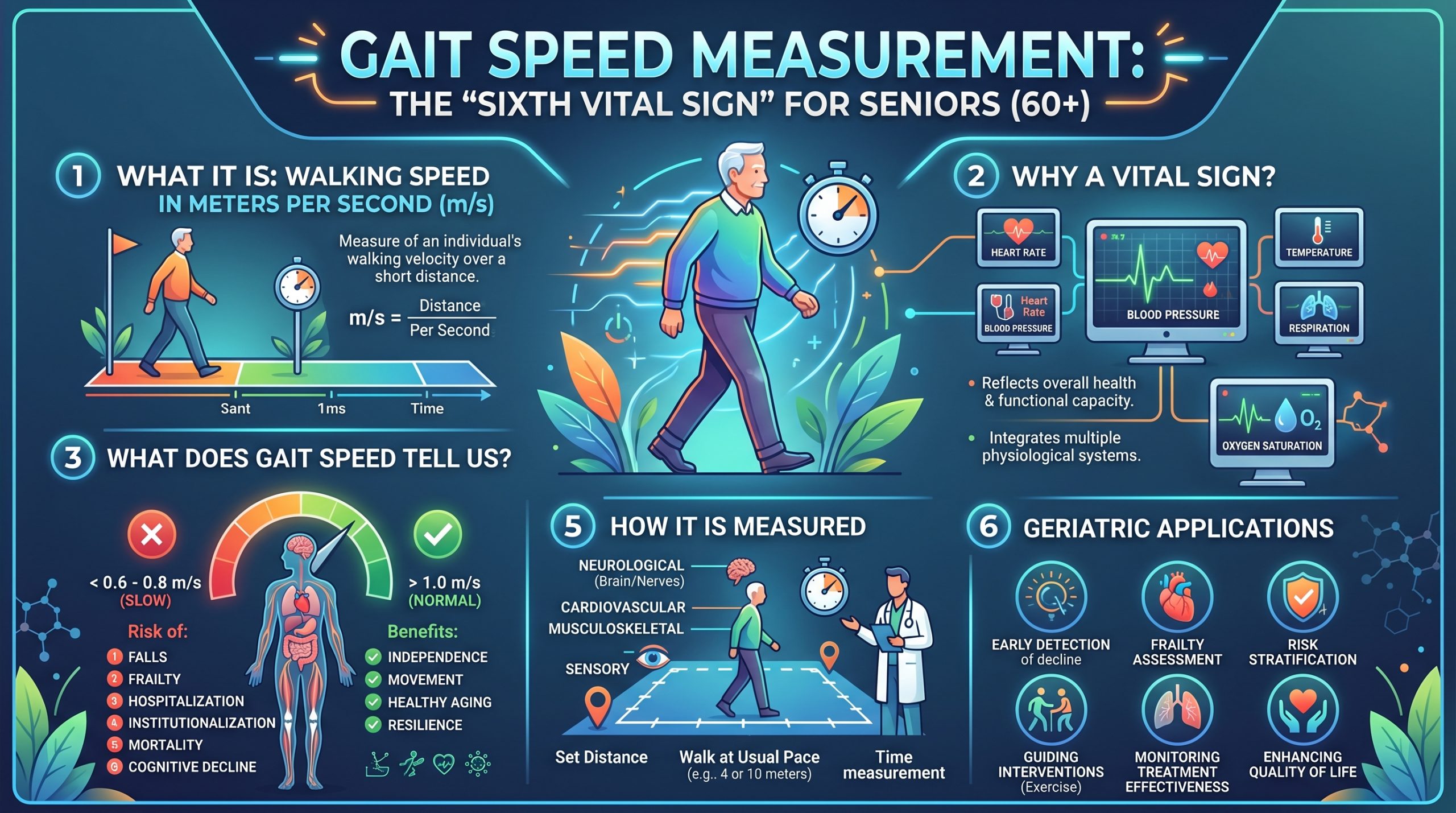
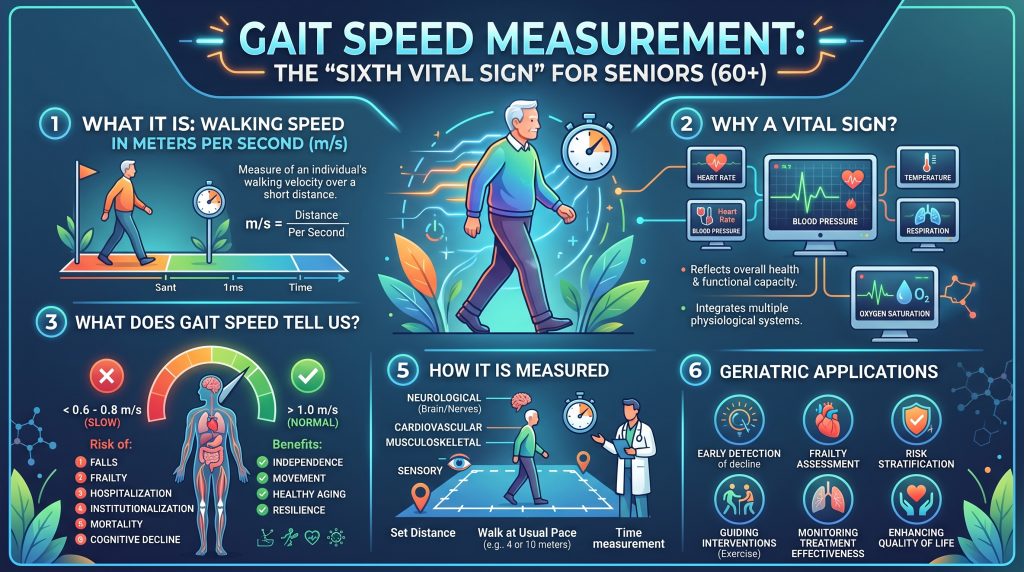
Gait Speed Measurement is no longer just a physical therapy exercise; it is universally recognized by geriatricians as the “sixth vital sign” [1]. Much like blood pressure or heart rate, walking speed provides an immediate, high-fidelity snapshot of an older adult’s systemic health, encompassing cardiovascular, neurological, and musculoskeletal function [2].
With annual fall-related healthcare expenditures in the United States exceeding $80 billion [3], relying on subjective observation is an operational liability. Facilities must transition toward automated predictive gait analysis to proactively intercept mobility decline.
The Physiology Behind the “Sixth Vital Sign”
Why is Gait Speed Measurement so remarkably predictive of overall decline? Walking is not an isolated mechanical action; it is an incredibly complex physiological symphony. To take a single step at a normal pace, the human body must seamlessly integrate cardiovascular endurance to oxygenate tissues, central and peripheral nervous system coordination to execute motor planning, and profound musculoskeletal strength to propel the body forward against gravity.
When any one of these interconnected systems begins to fail—whether due to microscopic vascular brain lesions, early-stage osteoarthritis, or cardiopulmonary decline—the body’s subconscious, protective response is to instantly reduce velocity. Therefore, Gait Speed Measurement acts as an early warning radar, detecting internal systemic deterioration long before isolated symptoms become clinically obvious.
The Scientific Thresholds of Gait Speed Measurement
Scientific literature has established strict, objective numbers to interpret a patient’s functional status based on their walking pace.
-
1.26 m/s: This is the mean maximum gait speed observed in highly functional, ambulatory elderly patients [4].
-
0.8 m/s Threshold: Walking at approximately 0.8 m/s represents the median life expectancy for older adults [5]. It is also the widely accepted cutoff value for detecting clinical sarcopenia [6].
-
0.6 m/s Cutoff: A gait speed dropping below 0.6 m/s is considered abnormally slow and is heavily associated with severe declines in functional independence and a heightened risk for early mortality [5].
The Deep Financial and Systemic Impact
The financial and survival impacts of these precise metrics are staggering:
-
10% Mortality Increase: Studies demonstrate a 10% increased risk in 5-year mortality for every 0.1 m/s decrease in walking speed among older populations [7].
-
90% Greater Mortality Risk: Seniors experiencing a “fast decline” in their gait speed (defined as a drop of 0.030 m/s per year or 2.4% annually) face a 90% greater risk of mortality than those whose speed declines slowly [8].
-
$1,188 in Annual Savings: Improving walking speed has direct economic benefits. Research shows that each 0.10 m/s per year increase in walking speed yields cost reductions of $1,188 per patient annually, alongside a reduction in hospital stay lengths [9].
The Clinical Workflow Crisis
Furthermore, the clinical workflow surrounding traditional Gait Speed Measurement is fundamentally broken. In a bustling care facility in Munich or anywhere in Bavaria, nurses are already overburdened. Forcing them to manually measure out a 4-meter course in a crowded hallway, instruct the patient, click a stopwatch, and manually calculate the meters-per-second ratio on a clipboard invites massive human error. This friction means the test is performed infrequently—usually only after a resident has already suffered a mobility-related incident. This is reactive care, which costs the healthcare system billions and compromises patient safety. True predictive medicine requires continuous, frictionless data collection.
Interpretations Beyond Speed: What the Data Reveals
A stopwatch only captures total time. In predicting adverse outcomes over time, assessing gait speed at a usual pace over a short distance is a highly sensible, primary diagnostic tool recognized by international task forces [10]. But measuring the intricate biomechanics of the walk reveals much more:
-
Neurological Decline: Subtle changes in postural sway and stride length can often serve as Parkinson’s early signs long before severe tremors manifest.
-
Fall Risk: Assessments like the Timed Up and Go (TUG) Test rely heavily on the sit-to-stand transition and walking velocity. Poor kinematic performance here is a primary indicator of catastrophic fall risk.
What PhysioEye Can Do
While stopwatches capture exactly one data point (time), the PhysioEye platform captures thousands. Using markerless 3D computer vision, PhysioEye conducts completely automated evaluations. It replaces subjective clipboard analysis with objective digital biomarkers, tracking everything from gait asymmetry to exact limb velocity. By capturing the complete biomechanical picture, PhysioEye empowers facilities in Munich and beyond to turn Gait Speed Measurement from a simple test into a powerful, predictive clinical science.