
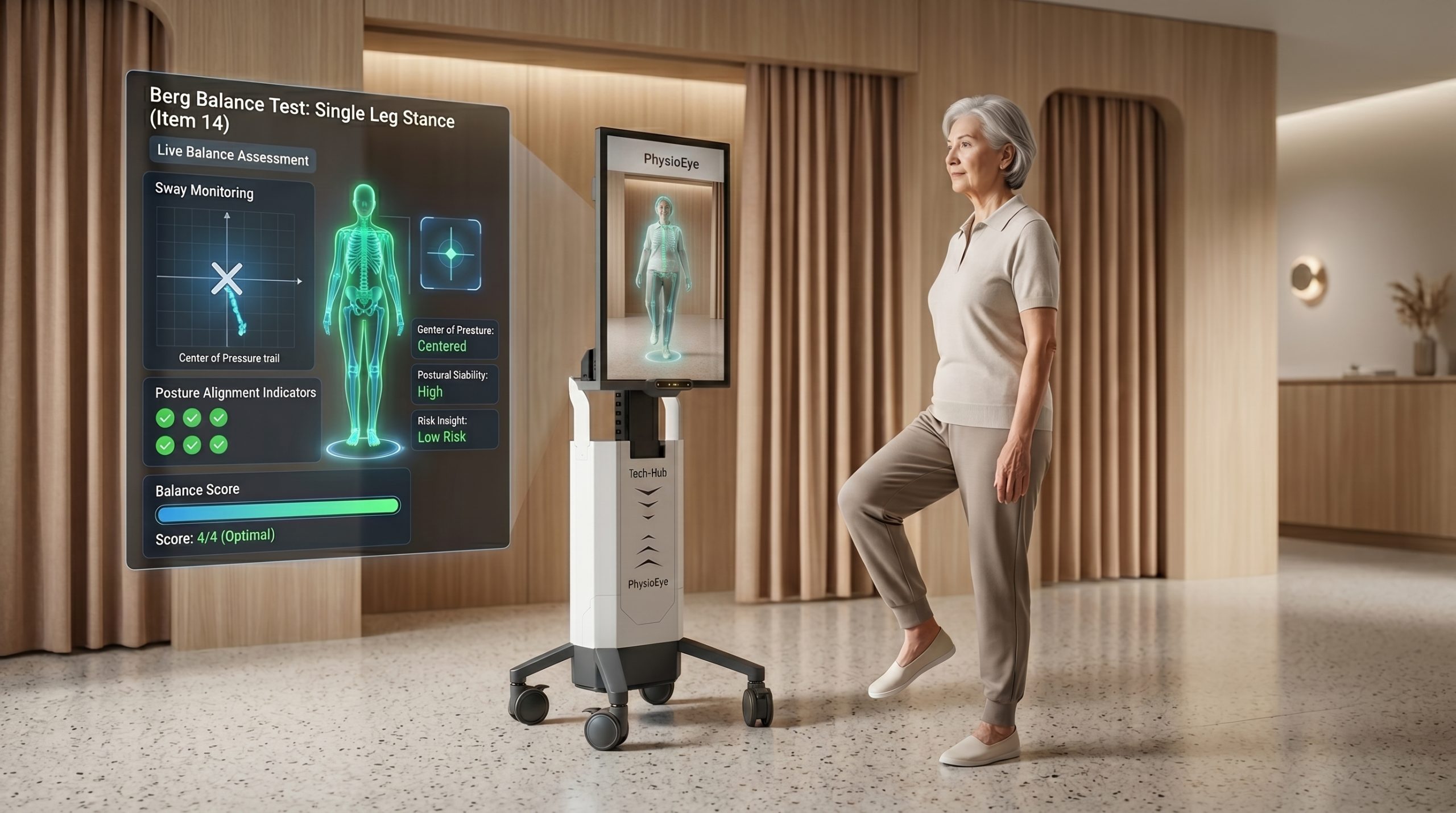
Berg Balance Test: 4 Spectacular AI Upgrades PhysioEye Uses to Eradicate the Clinical Clipboard
The Berg Balance Test has long been considered the standard clinical measure for static and dynamic balance in elderly care. In nursing homes across Germany—from specialized neurology clinics in Munich to our corporate testing facilities in Buchbach—physical therapists rely heavily on this 14-item assessment. However, relying on a subjective clipboard and human observation to score a Berg Balance Test is rapidly becoming a massive clinical and operational liability.
While the manual Berg Balance Test can identify seniors who are already severely impaired, it consistently fails to detect the subtle, micro-kinematic instabilities that precede a catastrophic fall in highly functioning adults.
To achieve genuine Predictive Care, facilities must digitize their clinical evaluations. Utilizing the optical AI of the PhysioEye platform by Hash-Tech GmbH, clinics can perform a completely contact-free Automated Mobility Assessment by PhysioEye, fundamentally modernizing how the Berg Balance Test is executed and analyzed.
Here are 4 spectacular ways PhysioEye upgrades the traditional Berg Balance Test, eradicating the flaws of manual observation.
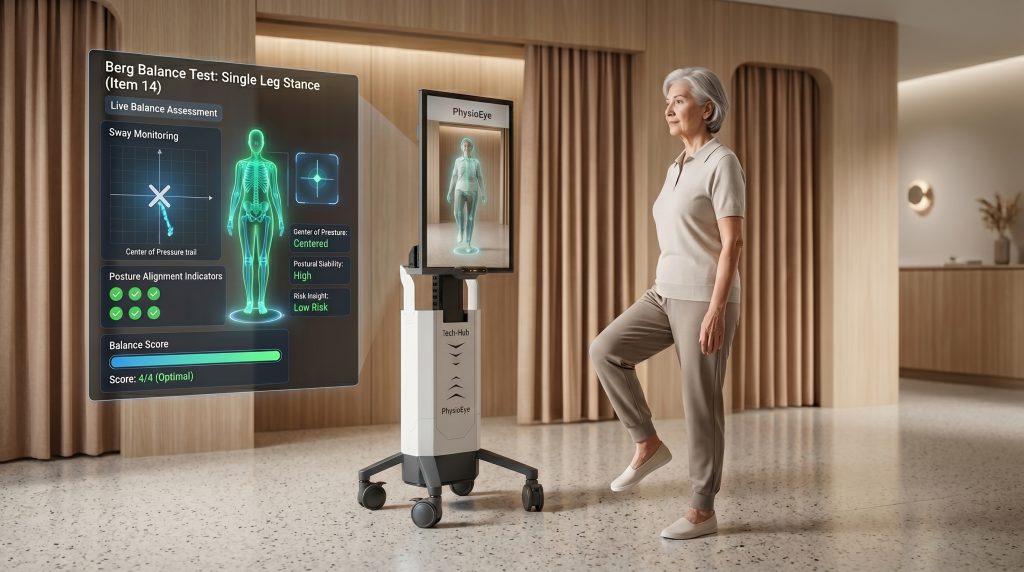
Eliminating the Ceiling Effect of the Berg Balance Test
The most significant clinical flaw of a manual Berg Balance Test is its inability to accurately grade individuals who are pre-frail but still highly active. A senior might score a perfect 56/56 because they can physically complete the final task (standing on one leg), but the test ignores the dangerous, erratic kinematic swaying they use to stay upright.
By tracking exact anatomical nodes without wearable sensors, PhysioEye eliminates this ceiling effect. Even if a patient completes the physical task of the Berg Balance Test, our AI acts as a digital Postural Sway Assessment, capturing the microscopic instability that proves they are actually suffering from early Frailty Syndrome in Geriatrics.
Solving the Uncertain Predictability of Falls
Relying solely on the total score of a manual Berg Balance Test creates a false sense of security for nursing home directors. Recent clinical literature proves that the test’s ordinal scoring system is not sensitive enough to be the sole predictor of a future fracture.
PhysioEye solves this by adding a layer of deep biomechanical analysis to every movement within the Berg Balance Test. Instead of just checking a box, PhysioEye synergizes the balance data with insights from our Predictive Gait Analysis and Gait Speed Measurement, exposing hidden compensations like prolonged double support time.
Exposing Low Responsiveness in the Berg Balance Test
In populations suffering from neurological decline, the manual Berg Balance Test struggles to measure small improvements or deteriorations over time. The human eye cannot accurately detect a 2-degree loss in spinal range of motion or a fraction-of-a-second delay in transition speed.
PhysioEye turns the Berg Balance Test into a highly responsive, high-definition scanning event. Whether the patient is executing a 360 Degree Turn Test or demonstrating early Osteoporosis Warning Signs through hyperkyphosis tracking via our Spinal Curvature Deformity module, the AI captures the exact rotational kinematics and rigidity that manual testing misses. This level of precise tracking is also crucial for validating recovery during intensive Spinal Cord Injury Therapy or Bilateral Arm Therapy with the ErgoBot.
Flawless Data for the Pflegeversicherung
Relying on handwritten notes from a Berg Balance Test to justify care funding is an operational nightmare. Care facilities need undeniable, objective data to prove that a resident requires advanced intervention, such as Robotic Assisted Elderly Care or dedicated Cognitive-Motor Therapy.
By establishing a digital baseline through an AI-enhanced Berg Balance Test, facilities generate a perfect Longitudinal Mobility Assessment. This automated, indisputable data is the ultimate asset for securing exact Pflegegrad Assessment funding across the German healthcare system, actively saving the facility from costly liabilities.
The Objective Standard for Nursing Home Automation
Subjective observation is an operational risk. The Berg Balance Test must be measured mathematically. By deploying PhysioEye, care facilities transform elderly care from reactive guesswork into proactive, AI-driven science.