
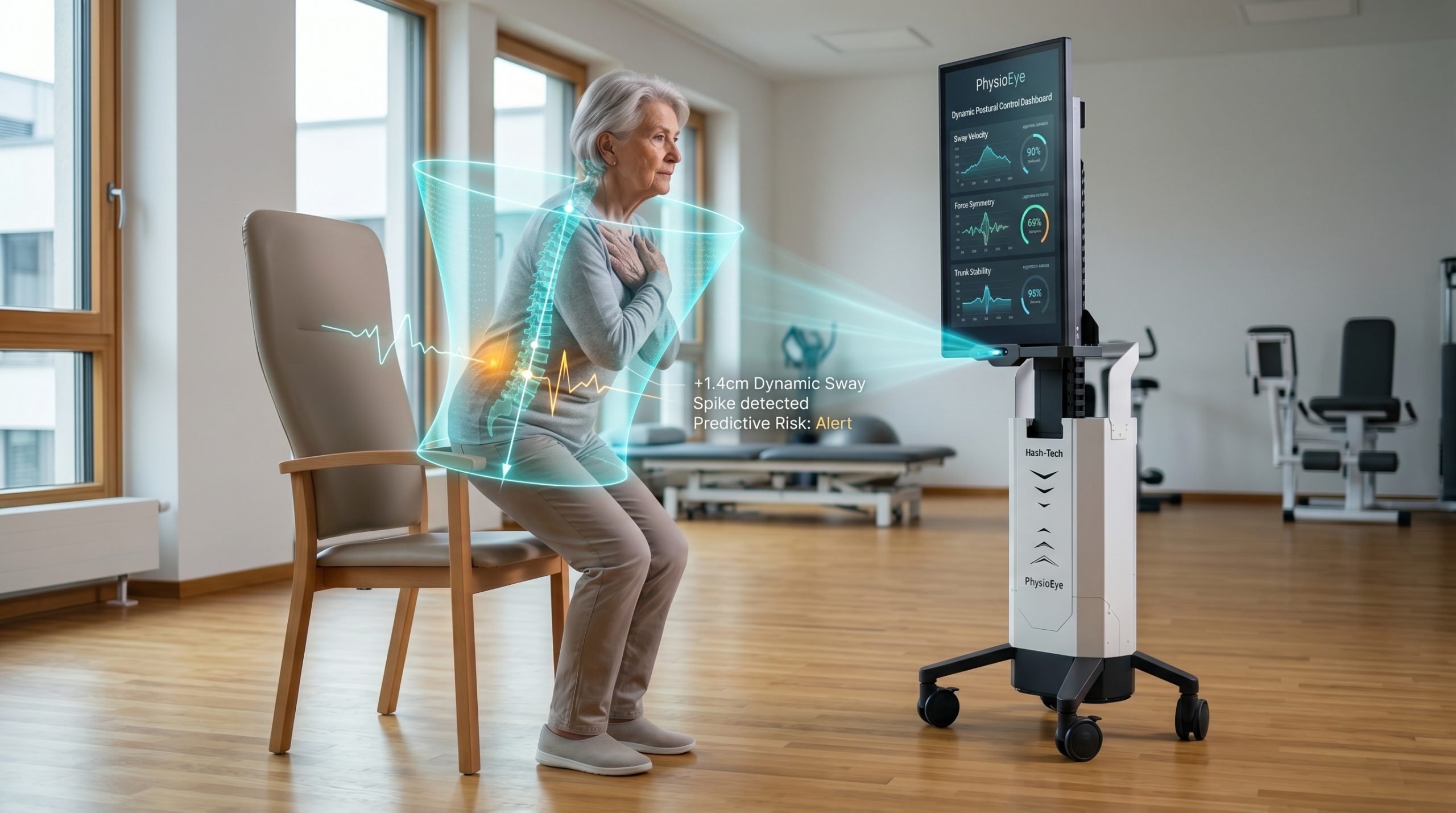
Postural Sway Assessment: 5 Invisible Kinematic Instabilities PhysioEye Detects to Prevent Falls
Postural Sway Assessment is the absolute frontier of true preventative geriatrics. In care facilities across Germany—from specialized dementia units in Munich to our corporate headquarters in Buchbach—the traditional approach to fall prevention is fundamentally reactive. Clinics wait until a senior resident visibly stumbles or suffers a catastrophic hip fracture before initiating a comprehensive diagnostic workup.
However, the human body signals an impending fall long before the first stumble occurs. When the complex interaction of visual, vestibular, and proprioceptive systems begins to deteriorate, a patient’s skeletal alignment becomes highly unstable during quiet standing.
Measuring this microscopic instability requires a highly precise Postural Sway Assessment. Traditional clipboards and stopwatches are entirely useless for this evaluation because the human eye cannot accurately measure millimeter-level kinematic deviations. Furthermore, legacy biomechanics labs rely on expensive, cumbersome pressure plates to measure center of mass—a totally impractical solution for a busy nursing home.
To achieve genuine Predictive Care, facilities must digitize this clinical process using optical AI. Utilizing the PhysioEye platform by Hash-Tech GmbH, clinicians can instantly execute a contact-free, markerless Postural Sway Assessment, tracking exact body points and joint nodes to turn invisible micro-instabilities into actionable data without ever touching the patient.
Here are 5 devastating biomechanical deficits that a modern, markerless Postural Sway Assessment captures effortlessly to keep seniors safe.
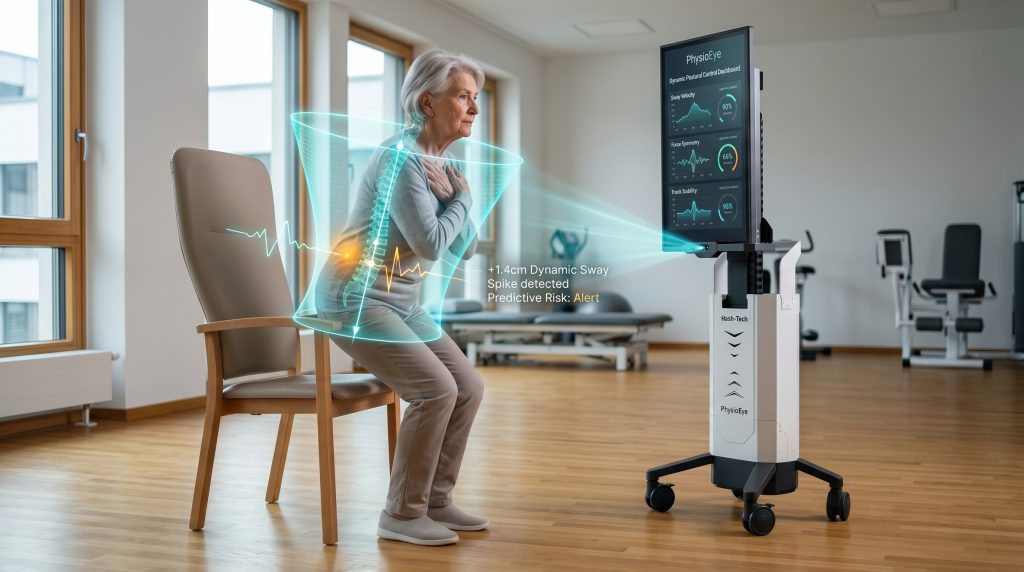
High-Velocity Kinematic Node Deviation in Postural Sway Assessment
Because PhysioEye is a purely optical, markerless system, it does not rely on pressure sensors or center of mass calculations. Instead, it acts as an advanced skeletal tracker. The simplest indicator of failing postural control is how far key anatomical landmarks—such as the C7 vertebra, shoulders, and head—deviate from their neutral vertical axis.
When seniors lose lower limb strength, their upper body kinematic sway area expands dramatically to compensate. Clinical studies tracking head and trunk sway via optical sensors demonstrate that increased kinematic sway velocity is a highly significant, independent predictor of future falls in elderly populations.
PhysioEye instantly conducts an Automated Mobility Assessment by PhysioEye, tracking the exact millimeter-level spatial deviation of a patient’s posture. This removes the guesswork, allowing facilities to identify high-risk individuals instantly before a fracture occurs.
Dangerous Mediolateral Shifts During a Postural Sway Assessment
Not all sway is created equal. While slight anterior-posterior (front-to-back) swaying is a natural mechanism for maintaining balance, mediolateral (side-to-side) swaying of the trunk and hips is a massive clinical red flag. Increased mediolateral postural sway of the trunk is one of the strongest independent risk factors for severe, lateral hip-impact falls among older adults.
During a digital Postural Sway Assessment, PhysioEye isolates and measures the exact directional vectors of these anatomical points. This vital data seamlessly complements our Predictive Gait Analysis, catching the dangerous lateral instability that precedes a catastrophic pelvic fracture.
Cognitive Destabilization and Dual-Task Postural Sway Assessment
Balance is a highly cognitive function. When a senior with early-stage dementia is asked to stand still while answering a question, their muscular coordination often collapses. Optical postural sway variability measured under dual-task cognitive conditions is extraordinarily sensitive to early neurological decline and mild cognitive impairment (MCI).
By combining a Postural Sway Assessment with cognitive loading, PhysioEye exposes the exact moment the brain fails to regulate the body’s posture. This is a critical screening tool for capturing Parkinson’s Early Signs and bridging the gap toward advanced, integrated Robotic Assisted Elderly Care.
Hidden Neuromuscular Frailty Revealed by Postural Sway Assessment
In frail populations, subtle shifts in joint alignment reveal severe unilateral weakness. A nurse observing a standing patient cannot accurately calculate if the patient’s hip joints are chronically shifting to compensate for unilateral knee degeneration. In frail nursing home residents, purely kinematic biomechanical measures like trunk sway length are highly correlated with rapidly deteriorating musculoskeletal function and imminent immobility.
By establishing a baseline through a precise, markerless Postural Sway Assessment, facilities can generate a perfect PhysioEye Breakthrough: 4 Ways to End the Blind Spot of Longitudinal Mobility Assessment in Nursing Homes. This automated, indisputable data is the ultimate asset for proving physical decline and securing exact Pflegegrad Assessment by PhysioEye funding across the German healthcare system.
Replacing the Clipboard: The Ultimate Postural Sway Assessment
The human eye is an incredible tool, but it is not a calibrated medical instrument. Attempting to conduct a highly sensitive Postural Sway Assessment via visual observation is a massive operational flaw. Facilities often rely on the Five Times Sit to Stand Test or the Timed Up and Go Fall Risk test, but without AI tracking, they miss the micro-instabilities that occur between the macro-movements.
Normative data from thousands of older adults proves that precise, digitally measured kinematic sway abnormalities are definitive, age-related risk factors for accidental falls. Whether tracking rotational balance during a The 360° Turn Test: How PhysioEye Detects Fall Risk That Manual Exams Miss or evaluating the postural shifts caused by Spinal Curvature Deformity, PhysioEye upgrades diagnostics from subjective guesses to mathematical certainty without a single wearable sensor.
The Standard of Nursing Home Automation in Germany
It is time to end reactive diagnostics. By deploying PhysioEye for a daily or weekly Postural Sway Assessment, clinics across Germany, Munich, and Buchbach are shifting the paradigm. Objective, markerless anatomical tracking is the only way to protect residents, relieve overburdened nursing staff, and build the infrastructure of modern geriatric care.