
Post-Operative Hip Recovery: 4 Critical Kinematic Milestones PhysioEye Tracks for Safe Discharge
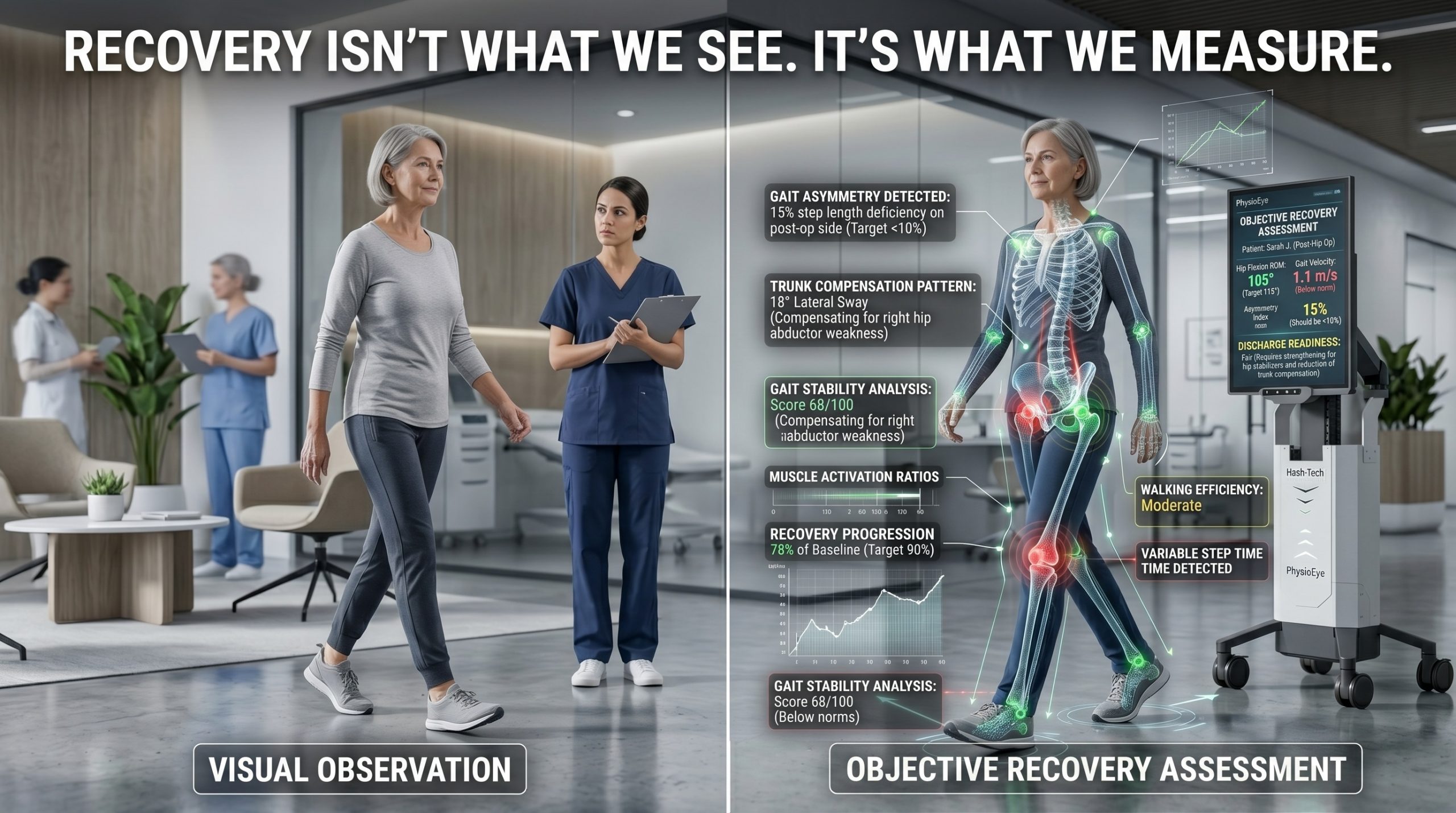
Post-Operative Hip Recovery is one of the most critical transitional phases in modern orthopedics. Following a Total Hip Arthroplasty (THA), deciding exactly when a patient is biomechanically stable enough to be discharged from a clinical facility is an immense responsibility. In hospitals and care centers across Germany, this decision is too often based on subjective observation or how confidently a patient “looks” while walking down a hallway.
However, visual observation cannot measure microscopic gait deviations. Discharging a patient prematurely based on a flawed, manual assessment leads directly to devastating secondary falls, readmissions, and severe operational liabilities for the clinic.
To guarantee a safe discharge during Post-Operative Hip Recovery, facilities must transition from visual guesswork to mathematically precise, digital biomarkers. By utilizing the markerless AI of the PhysioEye platform by Hash-Tech GmbH, clinics can track undeniable kinematic milestones before authorizing a patient to go home.
Here are 4 spectacular milestones PhysioEye evaluates during Post-Operative Hip Recovery, backed by exact scientific literature.
Validating Spatiotemporal Stability in Post-Operative Hip Recovery
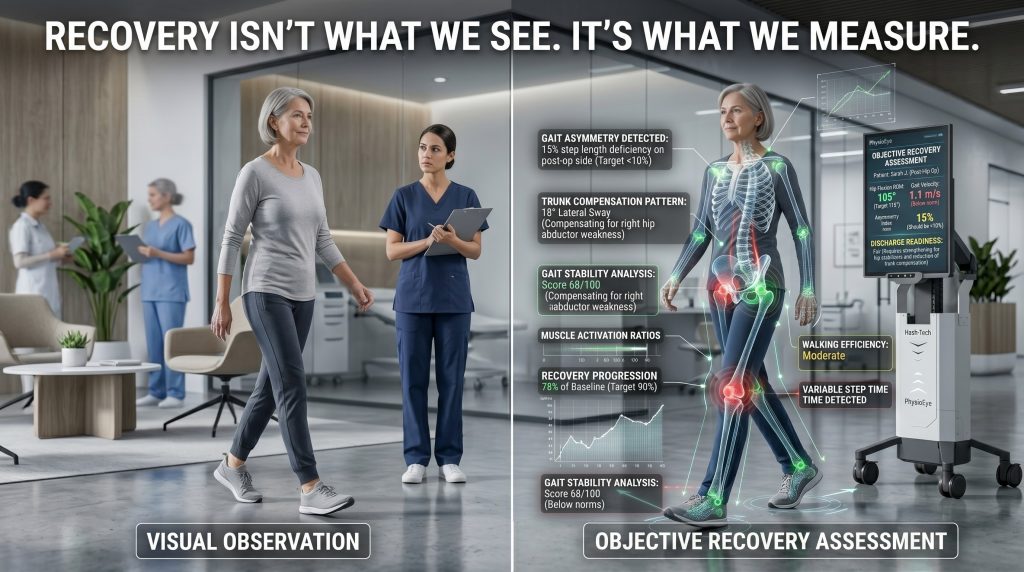
The foundation of a safe discharge is ensuring the patient has regained a stable baseline of walking speed and step symmetry. Traditional methods require a stopwatch and measuring tape, which are highly prone to human error. PhysioEye uses advanced optical AI to capture these metrics flawlessly without ever touching the patient.
By capturing this precise spatiotemporal data, PhysioEye provides undeniable mathematical proof of a patient’s readiness to navigate their home environment, far surpassing the subjective limitations of a standard Berg Balance Test.
Identifying High-Risk Gait Domains
Immediately following hip surgery, the body adopts protective mechanisms that alter the entire walking cycle. If a patient is rushing their steps or spending too little time on the operated leg, they are actively hiding severe instability.
PhysioEye instantly exposes these specific gait domains. By digitally tracking the exact milliseconds of stance time and the precise width of the base of support, the AI highlights the microscopic vulnerabilities that foreshadow an imminent fall, effectively diagnosing early indicators of Frailty Syndrome in Geriatrics.
Unmasking Compensatory Trunk Lean
One of the most dangerous, yet easily overlooked, signs of a failed Post-Operative Hip Recovery is compensatory biomechanics. When the hip abductors are too weak to stabilize the pelvis, patients will often unconsciously tilt their upper body to maintain balance.
Because the human eye struggles to accurately measure small degrees of spinal tilt in real-time, manual observation frequently misses this compensation. PhysioEye’s 3D spatial mapping functions as an automated Postural Sway Assessment, detecting exact degrees of trunk lean and instantly alerting clinicians to hidden muscular deficits or underlying Osteoporosis Warning Signs.
Restoring Sagittal Range of Motion
A patient cannot be safely discharged if their operated joint lacks the mechanical freedom to clear standard obstacles, like stairs or door thresholds. A restricted range of motion is a direct catalyst for tripping.
Reductions in walking velocity, stride length and sagittal hip range of motion were observed.
PhysioEye maps the exact sagittal kinematics of the hip joint during natural movement. If the AI detects that the leg is not achieving adequate extension or flexion, the system flags the patient for continued rehabilitation, preventing a premature discharge and protecting the clinic from readmission penalties.
The Objective Future of Full-Body Rehabilitation
A safe discharge is not an opinion; it is a mathematical certainty. By integrating PhysioEye’s diagnostic power, Hash-Tech GmbH is setting the definitive standard for predictive care. From analyzing walking patterns in orthopedics to utilizing the ErgoBot for complex Spinal Cord Injury Therapy, synchronized Bilateral Arm Therapy, and advanced Cognitive-Motor Therapy, we are building a closed-loop ecosystem where every phase of recovery is driven by undeniable digital truth.