
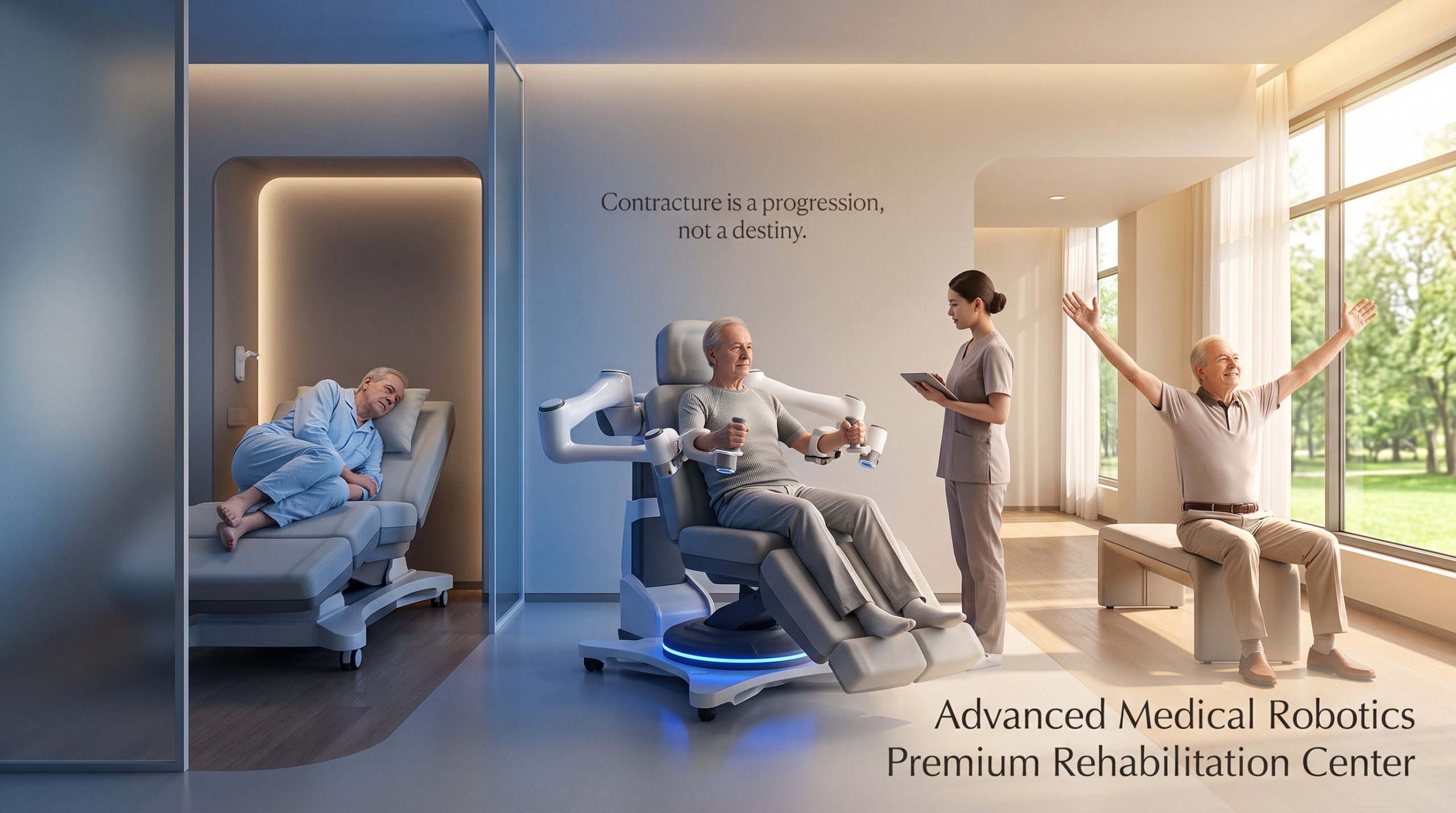
Joint Contracture Prevention: 4 Ways ErgoBot Stops the “Fetal Position” in Bedridden Seniors
Joint Contracture Prevention is an urgent race against time. When an elderly patient or stroke survivor becomes severely immobilized, the human body instinctively begins to fold inward. Muscles, tendons, and ligaments physically shorten, drawing the limbs toward the chest in a rigid, painful “fetal position.”
Once a joint permanently locks, the damage is catastrophic. The patient loses all remaining independence, daily hygiene becomes agonizingly painful, and the facility faces severe clinical liabilities. Relying solely on exhausted clinical staff to manually stretch heavy, spastic limbs multiple times a day is a mathematical impossibility. A nurse cannot physically deliver the thousands of therapeutic repetitions a damaged limb requires.
To guarantee true Joint Contracture Prevention, we must remove the physical burden from our nurses and apply mathematically precise, high-dosage robotic mobilization. By utilizing the ErgoBot by Hash-Tech GmbH—a highly advanced, rehabilitation system designed for all human joints—facilities can stop this devastating physical decline.
Here are 4 spectacular ways ErgoBot actively drives Joint Contracture Prevention in a safe, seated environment, backed by scientific literature.
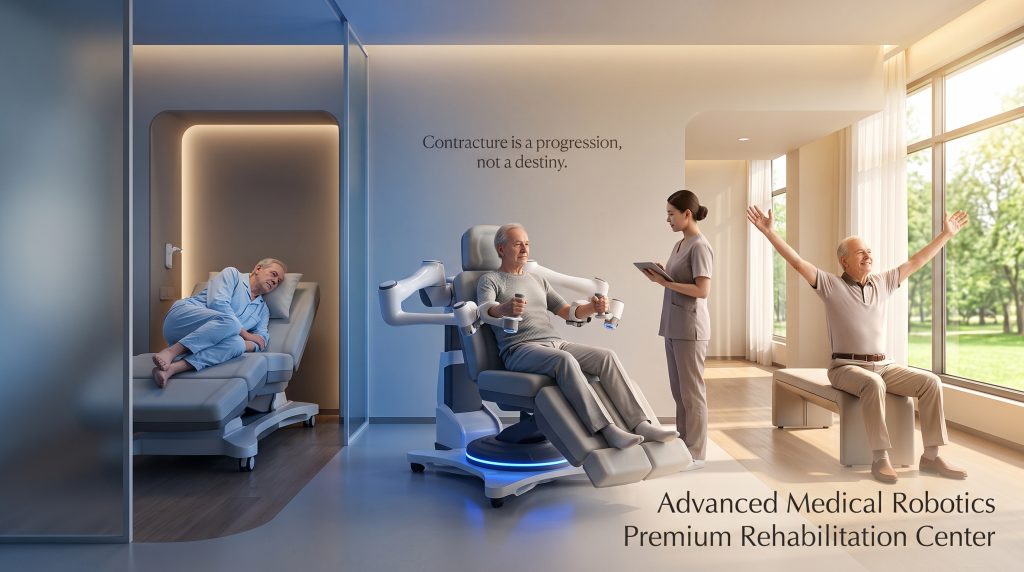
High-Dosage PROM for Joint Contracture Prevention
The most critical factor in stopping muscle shortening is sheer volume. Manual therapy is limited by human endurance, but a stationary robotic system never fatigues.
ErgoBot seamlessly delivers thousands of cycles of Continuous Passive Motion (CPM) to both the upper and lower extremities. This flawless repetition provides the exact mechanical dosage required for Joint Contracture Prevention, vastly outperforming manual stretching techniques.
Defeating Spasticity in Joint Contracture Prevention
Neurological trauma, such as a severe stroke, often triggers violent muscular spasticity. When human therapists try to pull against a spastic arm, it can tear the tissue or worsen the contraction.
ErgoBot’s intelligent haptic sensors instantly detect spastic resistance. Instead of forcing the joint, the AI gently adapts its resistance, safely melting away pathological flexor synergies. This errorless guidance is identical to the technology we use to secure a flawless Post-Operative Hip Recovery and rebuild neural pathways in Spinal Cord Injury Therapy.
Full-Body Mobilization in Joint Contracture Prevention
Unlike an exoskeleton or a risky walking robot, ErgoBot is a stationary hub that can safely rehabilitate every single joint in the human body.
From stretching the ankles to prevent foot-drop, to executing complex Bilateral Arm Therapy for the shoulders, ErgoBot ensures no joint is left to freeze. This full-body, stationary approach mitigates the rapid onset of Frailty Syndrome in Geriatrics without exposing patients to the risks normally associated with Fall Prevention Strategies.
Painless Tissue Elasticity for Joint Contracture Prevention
A patient locked in a fetal position is in immense pain. Fear of this pain causes them to resist therapy, creating a vicious cycle of stiffness.
ErgoBot provides a 100% secure, seated environment. By moving the limbs within pain-free thresholds, it reduces the fear of therapy, paving the way for advanced Neuromuscular Re-education and active Cognitive-Motor Therapy once the patient regains flexibility.
The Objective Ecosystem of Predictive Care
Effective Joint Contracture Prevention requires exact data and tireless robotics. Outdated manual evaluations like the Berg Balance Test or a visual Postural Sway Assessment fail to identify tissue shortening in bedridden patients. Similarly, a Dual-Task Gait Assessment is useless if a patient cannot even unbend their knees.
By utilizing ErgoBot’s full-body stationary rehabilitation alongside PhysioEye’s ability to detect hidden Osteoporosis Warning Signs, Hash-Tech GmbH is ending the fetal position forever.