
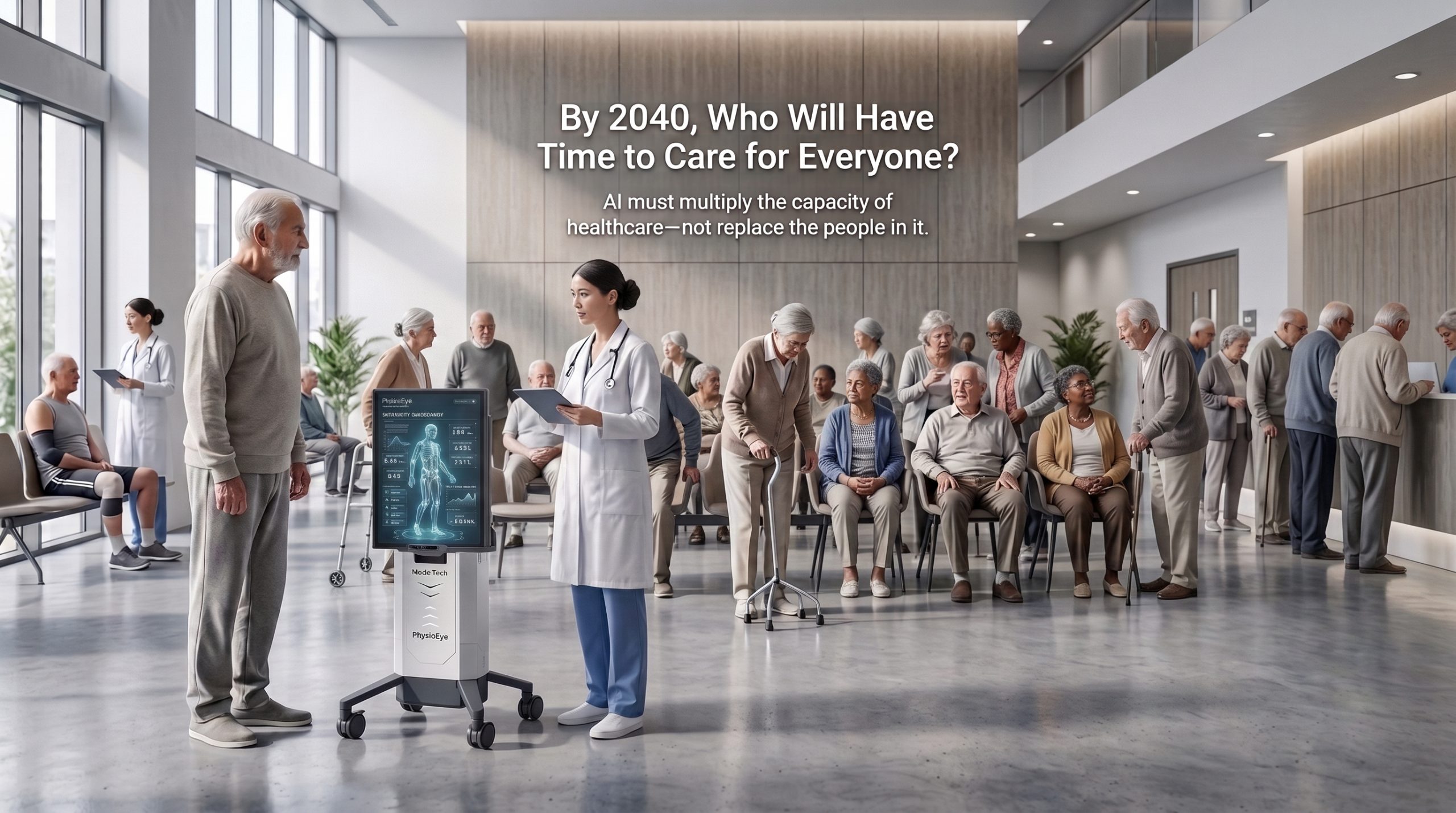
Aging Population Crisis: 5 Healthcare Challenges Artificial Intelligence Must Solve Before 2040
The global healthcare ecosystem is rapidly approaching an unprecedented tipping point. By 2040, the demographic realities of the Aging Population Crisis will fundamentally reshape social infrastructure, clinical workflows, and economic stability worldwide. According to official forecasts from the World Health Organization (WHO), the global population of adults aged 60 and older will double to 2.1 billion by 2050, with the segment of individuals aged 80 and older tripling to 426 million. Concurrently, data compiled by the National Institutes of Health (NIH) reveals that over 80% of seniors suffer from at least one chronic age-related disease, with more than 50% managing two or more complex conditions simultaneously.
The sheer volume of age-related physical and cognitive decline—ranging from stroke and sarcopenia to Alzheimer’s disease—is rapidly outstripping the capacity of traditional, human-dependent care frameworks. Without rapid technological intervention, long-term care institutions face catastrophic operational collapse. This article explores the root causes of this demographic shift, the structural limitations of current care models, and how artificial intelligence and advanced clinical robotics from Hash-Tech GmbH are rising to solve five critical healthcare challenges before 2040.
What Is the Aging Population Crisis and Why Is It Accelerating?
The Aging Population Crisis refers to the profound structural strain placed on society and healthcare networks due to a rapidly expanding elderly demographic paired with declining birth rates and an unprecedented shortage of clinical caregivers.
The Mathematical Reality of the “Silver Tsunami”
For the first time in human history, adults over the age of 65 outnumber children under five years old globally. Advances in medical science have successfully extended lifespan, but healthspan—the period of life spent free from severe chronic disability—has failed to keep pace.
As individuals live longer, the incidence of progressive musculoskeletal and neurological conditions escalates exponentially. According to the Centers for Disease Control and Prevention (CDC), millions of seniors suffer from severe mobility loss that threatens their basic Activities of Daily Living (ADL). This prolonged morbidity creates a massive, continuous demand for physical mobilization, monitoring, and nursing care that modern healthcare budgets cannot sustain through human labor alone.
The Compounding Burden of Co-Morbidities
Aging is rarely characterized by a single isolated deficit. An older adult admitted to a care facility frequently presents with a complex web of physical and cognitive impairments:
-
Musculoskeletal Atrophy: Progressive muscle degradation (Sarcopenia Screening) that destroys balance and power.
-
Cognitive Decline: Neurodegenerative diseases like dementia that impair sensory processing, spatial orientation, and instruction comprehension.
-
Joint Immobility: Irreversible capsule tightening (Joint Contracture Prevention) caused by prolonged bed rest during acute hospitalizations.
Managing these intersecting pathologies through traditional manual care methods requires immense, continuous labor—a luxury that modern healthcare infrastructures no longer possess.
The Structural Collapse of Traditional Geriatric Care Models
The conventional paradigm of elderly care relies heavily on 1-to-1 human interaction: a nurse physically lifting a patient, an occupational therapist manually exercising a limb, or a clinician visually observing a patient’s walk with a clipboard. This manual dependency is encountering an insurmountable labor deficit.
The Widening Healthcare Labor Deficit
The healthcare sector is experiencing an unprecedented workforce contraction. The U.S. Bureau of Labor Statistics (BLS) projects a severe Occupational Therapist Shortage, while the WHO forecasts a global deficit of 10 million health workers by 2030.
Physical and occupational therapists suffer from extremely high rates of work-related musculoskeletal disorders—exceeding 40% across clinical settings, according to studies archived by the NIH—due to the intense physical demand of manually lifting, supporting, and mobilizing heavy or spastic limbs. As experienced clinicians burn out and exit the workforce, care facilities are left severely understaffed, forcing them to reduce patient therapy hours.
The Pitfalls of Subjective, Reactive Healthcare
Traditional geriatric care is fundamentally reactive rather than predictive. Healthcare providers typically intervene after a catastrophic event has already occurred—such as a hip fracture resulting from a fall, or irreversible joint stiffness following weeks of bedbound immobility.
Furthermore, routine clinical assessments rely on subjective visual estimations or manual stopwatches (e.g., timing how fast a patient stands from a chair). These manual tests fail to capture subtle, sub-clinical micro-changes in movement dynamics, allowing functional decline to progress unnoticed until it leads to hospitalization.
| Operational Dimension | Traditional Manual Care Model | AI & Robotic Care Ecosystem |
| Care Delivery Ratio | Strictly 1-to-1 (One clinician per patient). | 1-to-Many (One clinician supervising multiple stations). |
| Diagnostic Precision | Subjective visual observation and manual stopwatches. | Objective 3D computer vision and millimeter-level kinematics. |
| Physical Staff Strain | High risk of physical injury and burnout from lifting/ranging. | Zero physical lifting strain on human staff. |
| Care Model | Reactive (Intervening after falls or contractures occur). | Predictive (Detecting micro-declines to prevent disability). |
Aging Population Crisis: 5 Healthcare Challenges AI Must Solve Before 2040
To prevent the catastrophic collapse of elderly care services over the next decade and a half, artificial intelligence and clinical robotics must be deployed to automate, scale, and refine healthcare delivery.
Here are the five critical healthcare challenges that AI-driven clinical technology must solve before 2040:
The Crippling Rehabilitation Labor Deficit
As the clinician-to-patient ratio deteriorates, relying solely on human hands to perform repetitive physical therapy is mathematically impossible. AI must step in to assume the heavy physical burden of high-repetition mobilization.
By automating high-dose motor therapy, intelligent clinical platforms can shift the clinician’s role from a manual laborer to a strategic care supervisor. Systems powered by smart algorithms allow a single occupational therapist to safely oversee multiple automated rehabilitation sessions simultaneously, multiplying facility care output without increasing staff fatigue or injury rates.
Early Detection of Invisible Neuromuscular and Cognitive Decline
Subtle physical changes—such as micro-decelerations in walking speed, minor loss of standing power, or increased postural sway—are early warning signs of severe conditions like sarcopenia, stroke, or dementia. Human eyes cannot reliably detect these minute biomechanical shifts during a brief, occasional checkup.
AI-driven computer vision must continuously screen patient movement in real time. By converting ambient visual data into precise mathematical metrics, AI systems can flag early functional degradation months before it manifests as a visible, debilitating disability, enabling timely preventive care.
Non-Invasive Assessment for Patients with Dementia
Evaluating physical health in seniors suffering from cognitive impairment presents a major clinical challenge. The WHO reports that over 55 million people live with dementia globally. Patients with advanced cognitive decline often experience anxiety, confusion, or agitation when subjected to formal physical examinations or when required to wear intrusive body sensors.
AI systems must solve this challenge through completely non-invasive, markerless assessment. Using computer vision, AI can passively observe natural movement patterns—such as spatial hesitation, wandering, or pacing—extracting vital biomechanical data without requiring complex instructions, verbal compliance, or physical contact.
Eradicating Hospital-Acquired Deconditioning & Contractures
When elderly patients are hospitalized or confined to bed in nursing facilities, prolonged immobility leads to rapid structural degradation. According to the Journal of the American Medical Association (JAMA), up to 65% of older adults experience Hospital-Acquired Deconditioning, losing their functional independence during acute hospital stays.
AI-driven mobilization systems must be deployed to provide perfectly calibrated, scheduled passive joint movement. By ensuring continuous joint lubrication and maintaining soft tissue elasticity automatically, AI can prevent joint contractures from forming in bedbound seniors, preserving their baseline mobility.
Transitioning from Reactive Trauma to Scalable, Predictive Care
Modern healthcare systems spend billions of dollars reacting to preventable trauma, such as emergency surgeries and long-term hospitalizations following severe falls. According to the CDC, fall-related medical expenses exceed $50 billion annually.
AI algorithms must analyze vast amounts of objective biomechanical data to transform geriatric medicine into a truly predictive discipline. By establishing continuous, objective baselines for individual patients, AI can calculate precise fall risk scores and recommend tailored preventive interventions before a fall takes place.
The Integrated Clinical Pathway: From Markerless Screening to Stationary Robotic Rehabilitation
Step 1: Objective Markerless Diagnostic Screening with PhysioEye
The clinical journey begins with PhysioEye, a Class Im CE-marked 3D AI and computer vision motion assessment system. PhysioEye uses Markerless Motion Capture technology to passively track a patient’s spatial kinematics in real time.
Because PhysioEye requires no body sensors, wires, or complicated verbal instructions, it is exceptionally well-suited for patients with dementia who might become distressed by invasive hardware. It automatically calculates critical biomechanical metrics—such as Gait Speed Measurement, postural sway, sit-to-stand velocity, and Minimum Toe Clearance—detecting early signs of decline with complete objectivity.
Step 2: Safe, High-Dose Automated Rehabilitation with ErgoBot
Once PhysioEye identifies specific movement deficits, the care team initiates targeted rehabilitation using ErgoBot.
It is critical to note that ErgoBot is a stationary rehabilitation system for upper and lower limbs across all joints—it is strictly NOT an exoskeleton.
For frail, sarcopenic, or cognitively impaired seniors, wearable exoskeletons introduce significant balance instability and unacceptable fall hazards. ErgoBot’s stationary architecture eliminates fall risk entirely during therapy, as the patient remains safely seated or supported throughout the session. ErgoBot delivers perfectly calibrated, high-dose Passive Range of Motion Therapy and progressive resistance training, rebuilding muscle strength and preserving joint flexibility without placing any physical strain on the therapist’s body.
By establishing this integrated ecosystem, Hash-Tech GmbH is paving the way for scalable, predictive care. With strategic expansion plans targeting 2,000 active facility users for the PhysioEye application by year five, this closed-loop platform provides a proven blueprint for managing elderly health effectively.
Original Hash-Tech Insight
The current discourse surrounding the aging population crisis often focuses solely on increasing healthcare budgets or recruiting more staff. However, throwing money at an unsustainable, labor-intensive model cannot overcome the underlying demographic realities. At Hash-Tech GmbH, we believe the solution requires a fundamental shift in how human clinicians are utilized. The physical therapy profession must stop treating the clinician’s body as an engine for lifting and stretching heavy limbs. By assigning repetitive, heavy physical labor to precision stationary platforms like ErgoBot, and delegating continuous monitoring to AI systems like PhysioEye, we liberate human clinicians to focus on complex decision-making, emotional support, and personalized care planning—the irreplaceable human elements of healing.
Key Takeaways
-
The global Aging Population Crisis is creating an unprecedented mismatch between the demand for geriatric care and the availability of clinical staff.
-
Traditional manual therapy is limited by human clinician fatigue, high injury rates, and subjective, unstandardized record-keeping.
-
AI must solve 5 major challenges before 2040: labor deficits, early decline detection, non-invasive dementia screening, contracture prevention, and predictive fall management.
-
PhysioEye provides ambient, markerless 3D computer vision screening, eliminating the need for invasive sensors and reducing anxiety for patients with dementia.
-
ErgoBot is a stationary upper and lower limb rehabilitation device—not an exoskeleton—ensuring therapy is delivered with zero risk of patient falls.
-
Combining objective AI diagnostics with automated robotic therapy establishes a scalable, predictive care pathway that preserves senior independence.
Frequently Asked Questions
How does artificial intelligence help address the occupational therapist shortage? AI does not replace occupational therapists; it enhances their clinical reach. By taking over repetitive physical tasks—such as guiding joints through repetitive motions or manually timing walking tests—tools like ErgoBot and PhysioEye allow a single therapist to oversee multiple patients simultaneously, multiplying care capacity without increasing staff fatigue.
Why is markerless computer vision preferred over wearable sensors for elderly screening? Wearable sensors require physical attachment, battery management, and calibration, which can cause discomfort or anxiety. Many older adults, especially those with dementia, actively resist wearing hardware. Markerless 3D computer vision operates passively from a distance, gathering accurate biomechanical data without touching the patient or requiring complex setup.
Is ErgoBot safe for elderly patients with severe muscle weakness? Yes. ErgoBot is a stationary rehabilitation platform designed to support upper and lower limb movements safely while the patient is comfortably seated or positioned. Because it is a stationary device and not a wearable exoskeleton, there is zero risk of the patient losing their balance or falling during therapy.
How does AI assist in detecting dementia-related movement changes? Dementia frequently manifests as subtle motor alterations long before severe cognitive symptoms appear. AI algorithms analyze continuous spatial movement data to identify patterns such as increased hesitation, loss of gait rhythmicity, or unprovoked pacing, providing clinicians with valuable diagnostic indicators of cognitive-motor decline.
Can automated rehabilitation prevent joint contractures in bedbound patients? Yes. Joint contractures develop when an immobile joint is not regularly stretched through its full spatial range. Automated systems like ErgoBot provide perfectly calibrated, scheduled passive range of motion therapy that maintains connective tissue flexibility and stimulates synovial fluid circulation without requiring continuous physical labor from nursing staff.