
Sarcopenia Screening: 5 Critical AI Biomarkers PhysioEye Detects Before Muscle Loss Causes Disability
Sarcopenia Screening is the clinical frontline against one of the most debilitating conditions in geriatric care: the progressive, pathological loss of skeletal muscle mass and strength. According to the Centers for Disease Control and Prevention (CDC), severe mobility impairments currently affect more than 40% of adults over the age of 65, frequently cascading into irreversible disability. Without early intervention, clinical studies published by the National Institutes of Health (NIH) demonstrate that severe muscle degradation directly triples a patient’s risk of all-cause mortality within a ten-year period. Furthermore, global care guidelines from the World Health Organization (WHO) highlight that untreated musculoskeletal decline drastically accelerates the loss of functional independence, forcing millions of seniors into long-term institutional care prematurely.
This article explores the physiological realities of age-related muscle loss, the dangerous inadequacies of traditional physical performance tests, and how modern AI-driven markerless 3D computer vision from Hash-Tech GmbH is shifting geriatric medicine from reactive trauma treatment to objective, proactive prevention.
What Is Sarcopenia Screening and Why Is It Important?
Sarcopenia Screening is the systematic clinical evaluation of skeletal muscle strength, mass, and physical performance in older adults. It is essential for identifying early biomechanical decline, allowing clinicians to intervene with targeted rehabilitation before muscle loss results in severe frailty, unrecoverable falls, or institutionalization.
The Hidden Pathology of Skeletal Muscle Loss
Sarcopenia is not simply the natural weakening that accompanies old age; it is a recognized muscular disease with profound systemic implications. The condition is characterized by a decrease in the size of muscle fibers (atrophy) and a reduction in muscle quality, often due to fat infiltration. Research published in the journal Age and Ageing indicates that the prevalence of sarcopenia ranges from 10% to 27% among adults over the age of 60.
Because human muscle mass peaks in the early 30s, individuals can lose up to 30% of their total muscle mass by age 80, according to NIH databases. This severe degradation acts as the primary catalyst for Frailty Syndrome in Geriatrics. Sarcopenia Screening is the only way to intercept this decline before the patient loses the mechanical strength required to independently stand, walk, or perform basic daily functions.
The Financial and Human Cost of Missed Diagnoses
When sarcopenia goes undetected, the result is inevitably a catastrophic fall. The financial burden of these reactive interventions is staggering, with hospital costs for fall-related injuries exceeding $50 billion annually in the United States alone. However, the human cost is far worse. Older adults who experience a severe fall due to underlying muscle weakness often develop a severe fear of falling, leading to self-imposed immobility that rapidly accelerates their muscular atrophy.
The Dangerous Limitations of Traditional Clinical Assessment
Traditional muscle loss evaluations rely heavily on subjective clinician observation and manual stopwatches, which fundamentally fail to detect sub-clinical micro-variations in movement. These outdated methods are labor-intensive, prone to extreme human error, and struggle to accurately assess patients with concurrent cognitive decline.
The Flaws of the Manual Stopwatch
Historically, diagnosing functional decline has relied on manual tests such as the Short Physical Performance Battery (SPPB). A clinician asks the patient to walk a short distance or stand from a chair while recording the time with a handheld stopwatch.
This methodology is fundamentally flawed. A stopwatch only records duration; it cannot measure the compensatory biomechanics the patient used to achieve the movement. Did the patient utilize extreme trunk flexion to gain momentum? Did they favor their right leg due to left-sided quadriceps atrophy? A stopwatch is blind to these critical, early warning signs of physical breakdown.
Dementia and the “White Coat” Movement Effect
Evaluating muscle loss is exceptionally difficult when a patient suffers from cognitive impairment. The WHO reports that 55 million people worldwide live with dementia. Dementia directly alters movement patterns, manifesting specific indicators such as spatial hesitation, pacing, and multi-directional wandering.
When a clinician instructs a dementia patient to perform a specific physical test, the patient often exhibits anxiety or confusion, altering their natural gait. Furthermore, attaching wearable sensors to a patient with dementia often causes severe distress and combative behavior. Therefore, traditional assessments often record the patient’s cognitive confusion rather than their true baseline physical strength.
| Assessment Feature | Traditional Manual Testing | AI-Driven Markerless Screening |
| Measurement Tool | Stopwatch and subjective visual estimation. | 3D depth sensors and AI kinematics. |
| Data Captured | Total time taken (duration only). | Exact joint angles, velocity, and sway. |
| Patient Burden | High (requires following strict commands). | Zero (passive, ambient observation). |
| Dementia Suitability | Poor (instructions cause anxiety). | Excellent (no wearables or instructions needed). |
Sarcopenia Screening: 5 Critical AI Biomarkers Detected by PhysioEye
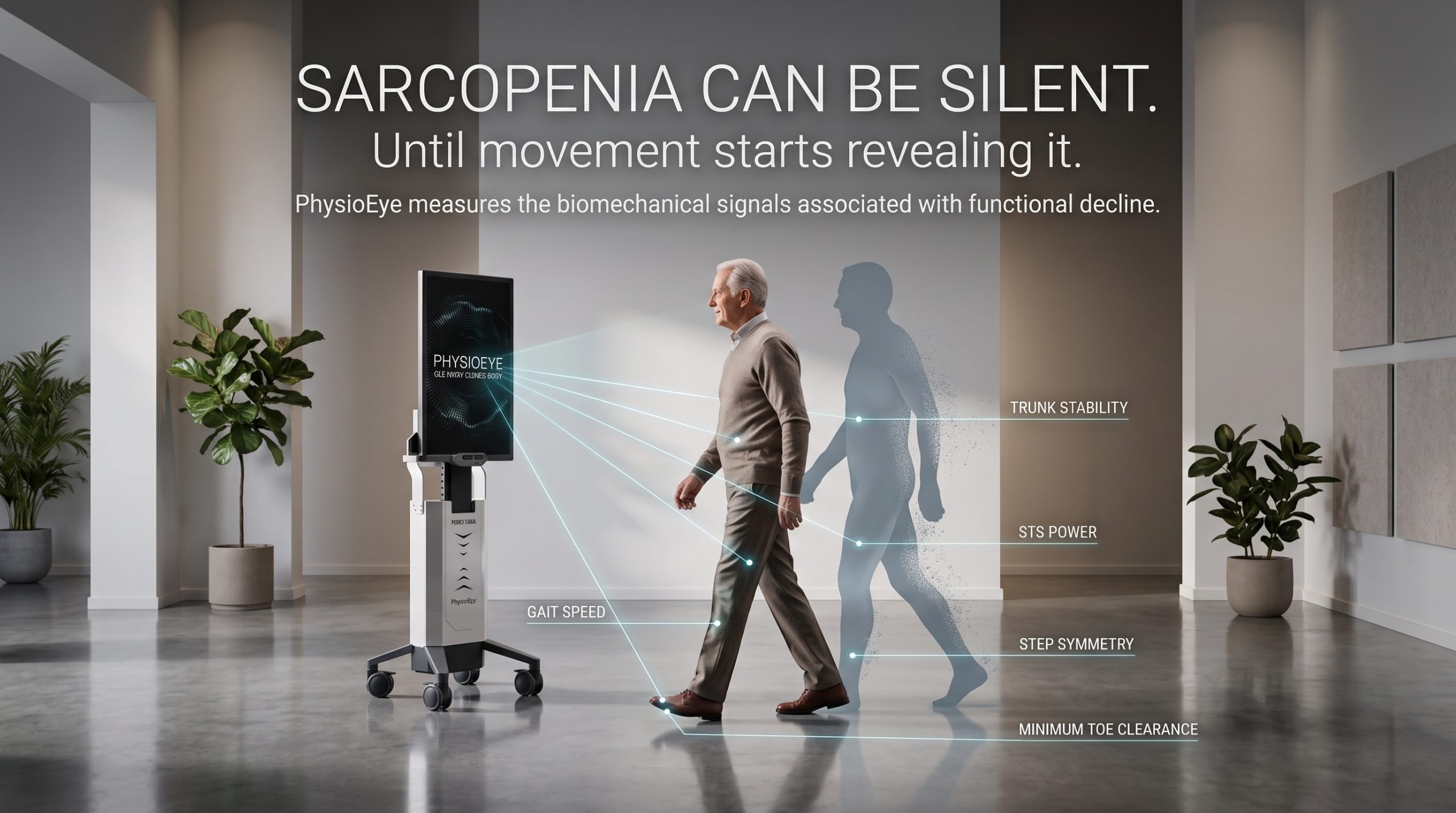
PhysioEye is a markerless 3D AI and computer vision clinical assessment tool that continuously monitors sub-clinical movement deviations. By analyzing exact kinematic data, it identifies five crucial biomechanical biomarkers of sarcopenia long before a catastrophic fall occurs.
Through its advanced Markerless Motion Capture technology, PhysioEye extracts millions of data points from a patient’s natural movement without requiring them to wear cumbersome suits or follow complex instructions. This Class Im CE-marked software analyzes the following five predictive biomarkers:
Micro-Declines in Baseline Gait Speed
Gait Speed Measurement is widely considered the “sixth vital sign” in geriatrics. According to data from the JAMA Network, a gait speed falling below 0.8 meters per second is a highly accurate predictor of impending disability and sarcopenia. However, human eyes cannot reliably detect a drop from 1.0 m/s to 0.9 m/s. PhysioEye performs continuous Predictive Gait Analysis, automatically flagging microscopic decelerations over weeks and months, alerting clinicians to the earliest stages of lower limb muscle wasting.
Sit-to-Stand Power Generation Loss
The ability to rise from a chair requires massive concentric force from the quadriceps and gluteal muscles. During a Five Times Sit to Stand Test, PhysioEye tracks the exact angular velocity of the hips and knees. Before a patient completely loses the ability to stand, they will begin to exhibit a slower velocity in the upward phase or rely heavily on forward momentum. PhysioEye isolates this loss of mechanical power generation, providing a definitive early biomarker of proximal sarcopenia.
Trunk Instability and Postural Sway
Core sarcopenia—the loss of muscle mass in the abdominal and paraspinal muscles—is incredibly dangerous but notoriously difficult to measure manually. PhysioEye excels at Trunk Stability Assessment. By tracking the patient’s center of mass during quiet standing or walking, the AI calculates objective postural sway metrics. Excessive lateral or anterior-posterior sway is a direct biomarker of core muscle degradation and a primary indicator of high fall risk.
Step Length Asymmetry and Unilateral Weakness
Muscle loss rarely occurs perfectly symmetrically. A patient may develop weakness in one limb faster than the other due to arthritis, past injuries, or minor neurological events. PhysioEye measures the exact spatial distance of every single step. If a patient’s left stride becomes consistently shorter than their right stride, it indicates that they are spending less time bearing weight on a weakened limb. This asymmetry is an immediate red flag for unilateral sarcopenia.
Diminished Minimum Toe Clearance
The muscles responsible for dorsiflexion (lifting the foot) are often the first to weaken in older adults. Minimum Toe Clearance refers to the exact distance between the toe and the floor during the swing phase of walking. Human eyes cannot measure a clearance of 1.5 centimeters versus 0.5 centimeters. PhysioEye calculates this clearance with millimeter precision. A diminishing toe clearance is a critical AI biomarker that a patient is beginning to shuffle—a movement indicator heavily associated with both distal sarcopenia and advanced dementia—which drastically increases the risk of tripping over carpets or thresholds.
The Complete Care Pathway: From Diagnostics to Robotic Rehabilitation
Effective geriatric care requires a closed-loop system connecting diagnostic data directly to physical therapy. Hash-Tech GmbH facilitates this evidence-based workflow: objective markerless assessment with PhysioEye provides exact clinical coordinates, which then inform high-dose, personalized robotic rehabilitation to reverse muscle loss safely.
Closing the Loop with ErgoBot
Once PhysioEye identifies the specific biomechanical deficits caused by sarcopenia, the clinical team can implement immediate, targeted intervention. This is where ErgoBot becomes indispensable. ErgoBot is a stationary upper and lower limb rehabilitation device for all joints. It is absolutely not an exoskeleton.
For frail seniors suffering from severe muscle loss, wearable exoskeletons introduce a massive and unacceptable fall hazard. ErgoBot’s stationary architecture removes balance anxiety entirely. Patients can undergo rigorous Personalized Rehabilitation while safely seated, receiving precise, high-repetition resistance therapy that triggers muscle hypertrophy without the risk of falling.
Scaling Predictive Care
By combining PhysioEye’s objective diagnostics with ErgoBot’s safe execution, Hash-Tech GmbH is pioneering true Predictive Healthcare. Instead of waiting for a patient to break their hip, clinicians can rebuild the specific muscle groups that prevent the fall in the first place. As Hash-Tech’s strategic models project the PhysioEye application reaching a baseline of 2,000 active facility users by year five, this closed-loop ecosystem will systematically elevate the global standard for geriatric musculoskeletal management.
Original Hash-Tech Insight
The medical community frequently makes the error of treating sarcopenia solely as a muscular disease, entirely overlooking its deep neurological roots. At Hash-Tech GmbH, we recognize that severe muscle loss fundamentally disrupts the patient’s internal sensory feedback loop (proprioception). By combining markerless visual diagnostics (PhysioEye) with stationary robotic proprioceptive resistance (ErgoBot), we do not just rebuild atrophied muscle fibers; we actively rewire the central nervous system’s spatial awareness. Treating the brain and the muscle simultaneously is the only proven methodology to restore true functional independence in geriatric populations.
Key Takeaways
-
Sarcopenia Screening is biologically essential; without it, natural age-related muscle loss inevitably cascades into Frailty Syndrome and severe disability.
-
Traditional manual tests using stopwatches only capture time, completely failing to measure the dangerous compensatory movements that precede a fall.
-
PhysioEye provides markerless 3D AI diagnostics, eliminating the “white coat” anxiety and sensory distress commonly seen in dementia patients during physical assessments.
-
Critical AI biomarkers for muscle loss include micro-declines in gait speed, loss of sit-to-stand power, pathological trunk sway, step asymmetry, and diminishing toe clearance.
-
ErgoBot is a strictly stationary rehabilitation system (not an exoskeleton), completely eliminating the fall risks associated with wearable robotics during strength training.
-
Effective geriatric care requires a closed-loop pathway: objective AI assessment drives precise, safe robotic rehabilitation.
Frequently Asked Questions
Why is an AI camera better than a stopwatch for Sarcopenia Screening? A stopwatch can only tell a clinician how long a task took. It cannot explain how the patient achieved the movement. AI cameras like PhysioEye capture exact joint angles, sway, and velocity, revealing the dangerous compensatory strategies a patient is using to hide their underlying muscle weakness.
At what age should routine Sarcopenia Screening begin? Because humans begin to lose muscle mass naturally in their 30s, and because clinical sarcopenia prevalence spikes after age 60, routine baseline screening should become a standard part of geriatric assessments for all adults aged 65 and older, regardless of their apparent health.
Can Sarcopenia Screening accurately track patients with severe dementia? Yes, but only if the technology is markerless. Patients with dementia often cannot follow instructions for manual tests and become combative if forced to wear sensors. PhysioEye acts passively, analyzing the patient’s natural, unprompted movements (like pacing) to gather objective muscle data without causing cognitive distress.
Why is ErgoBot designated as a stationary device rather than an exoskeleton? Safety is the ultimate priority in geriatric rehabilitation. Wearable exoskeletons force frail, sarcopenic patients to actively manage complex balance dynamics, creating a high risk of catastrophic falls. ErgoBot is a stationary platform that fully supports the patient’s weight, allowing them to rebuild muscle safely without any risk of falling.
Can lost muscle mass be regained in older adults? Absolutely. Sarcopenia is highly reversible with the correct interventions. High-dose, progressive resistance therapy—guided by objective AI diagnostics and delivered safely through stationary robotics—can trigger muscle hypertrophy and restore functional independence even in patients in their 80s and 90s.