
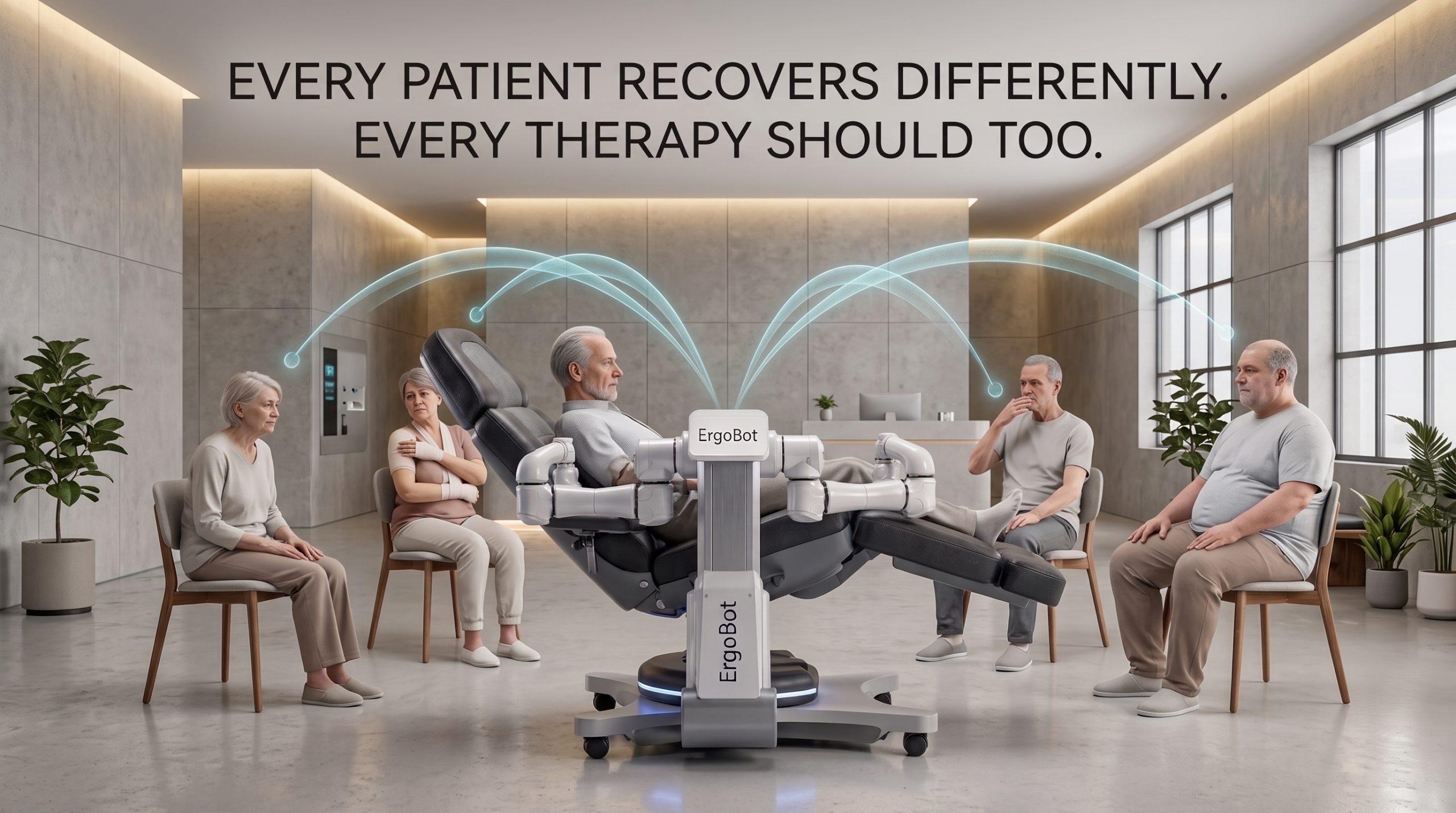
Personalized Rehabilitation: 5 Proven Ways ErgoBot Adapts Therapy to Every Patient’s Recovery Journey
Personalized rehabilitation transforms standard physical therapy from a generalized protocol into a highly targeted, biomechanically precise medical intervention. When a patient suffers a neurological injury or undergoes joint arthroplasty, applying generic exercise templates frequently leads to suboptimal recovery, hidden compensations, and plateaued clinical progress. Every neuromuscular system responds differently to tissue loading, pain, and fatigue. This article explores the physiological necessity of individualized therapy, examines the inherent flaws in standardized treatment models, and details how modern intelligent robotic systems adapt to real-time clinical data. Readers will learn the exact mechanisms driving adaptive therapies, the evidence-based workflow for maximizing functional independence, and how integrating objective biomechanical data redefines modern geriatric and neurological care.
What Is Personalized Rehabilitation?
Personalized rehabilitation is a customized therapeutic approach that continuously adapts to a patient’s specific biomechanical, neurological, and physiological capabilities. By utilizing objective data to prescribe precise movement parameters, it ensures interventions target the exact functional deficits of each individual for maximum clinical recovery.
At its core, customized therapy rejects the concept of a one-size-fits-all medical protocol.
Why is it important? Because prescribing excessive load to a recovering joint causes inflammation and tissue damage, while under-loading fails to stimulate cellular repair or Neuroplasticity Training. Who needs it? Any individual undergoing recovery, specifically geriatric populations managing frailty, post-surgical orthopedic patients, and individuals surviving complex neurological events like stroke. When should it be used? It must be deployed immediately during Early Mobilization phases and continuously adapted throughout the entire outpatient recovery process.
The Current Challenges in Standardized Physical Therapy
Standardized physical therapy protocols frequently fail to account for daily fluctuations in patient fatigue, spasticity, and pain. This generic approach risks under-stimulating high-functioning patients while overwhelming fragile individuals, leading to prolonged recovery times and reduced overall clinical efficacy.
The global demand for high-quality restorative care is fundamentally outpacing the capacity of traditional healthcare models. According to the World Health Organization (WHO), approximately 1.71 billion people globally have musculoskeletal conditions, which severely limit mobility and dexterity. Concurrently, neurological incidents impose a massive burden; the WHO estimates that 15 million people suffer a stroke worldwide each year, resulting in 5 million individuals left permanently disabled.
In the United States alone, the Centers for Disease Control and Prevention (CDC) reports that osteoarthritis—a primary driver of joint replacements—affects over 32.5 million adults. Within regions like Bavaria and the greater Munich area, severe staffing shortages in rehabilitation clinics collide directly with this aging demographic, exposing the critical flaws of standardized, manual therapy:
-
Subjective Loading: Therapists rely on elastic bands or manual resistance, making it impossible to apply the exact same biomechanical load from session to session.
-
Invisible Compensations: Patients often “cheat” movements. For example, a patient might use trunk momentum to complete a shoulder flexion exercise, masking a severe rotator cuff deficit.
-
Static Protocols: Paper-based exercise sheets cannot adapt. If a patient experiences a sudden spike in neuromuscular fatigue mid-session, a static printed program cannot reduce the resistance dynamically.
-
High Attrition: Patients who do not receive individualized challenges frequently become frustrated by a lack of measurable progress and abandon their treatment plans.
Traditional Methods vs. Modern Adaptive Solutions
Traditional therapy relies heavily on subjective visual estimation and manual resistance, which lacks precise quantification and consistency. Modern adaptive solutions utilize intelligent robotics and continuous data feedback to dynamically adjust therapeutic loads, ensuring perfectly optimized exercise parameters for every session.
The traditional clinical environment operates in data silos. A clinician manually measures a joint with a plastic goniometer, records the degree on a chart, and then subjectively estimates the appropriate weight for an exercise. This methodology introduces significant inter-rater reliability issues. If a patient sees three different therapists in a week, they receive three slightly different interpretations of their capability.
Conversely, AI-assisted modalities operate on continuous, objective data streams. Modern physical therapy utilizes advanced sensor technology and sophisticated computer algorithms to map a patient’s movement profile precisely. By capturing objective data on movement quality, velocity, and force, systems can construct a digital twin of the patient’s musculoskeletal performance. This allows therapeutic interventions to be precisely tailored, delivering Robotic Assisted Rehabilitation that reacts instantly to the patient’s nervous system.
5 Proven Ways ErgoBot Adapts to Every Patient’s Recovery Journey
ErgoBot utilizes intelligent algorithms to customize treatment by dynamically adjusting resistance, targeting isolated joint contractures, integrating objective assessment data, accommodating neurological asymmetries, and guiding patients safely through their progressive clinical recovery pathway.
Understanding how advanced medical devices deliver highly individualized therapy requires examining the exact mechanisms of human-machine interaction. Systems such as ErgoBot represent the pinnacle of this integration. Always positioning clinical clarity first, it is critical to note that ErgoBot is a stationary upper and lower limb rehabilitation device for all joints. It is not an exoskeleton, strength training machine, or gait-assisted robot. It is a precise medical instrument designed for comprehensive joint recovery.
Here are the specific ways this technology delivers individualized rehabilitation:
Dynamic Resistance Adjustment Based on Real-Time Fatigue
Muscular strength is not static; it depletes during a therapy session. If a patient is prescribed 3 sets of 15 repetitions, their force output on repetition 40 will be significantly lower than on repetition 1. Standard weights cannot change mid-set, forcing the patient into dangerous compensatory patterns to move the iron. ErgoBot’s intelligent actuators sense the patient’s specific force output millisecond by millisecond. If the system detects a 15% drop in torque output due to neuromuscular fatigue, it instantly scales back the resistance. This ensures the targeted muscle remains engaged without overloading the tendon or causing a dangerous loss of form.
Targeting Specific Joint Contractures with Millimeter Precision
A generic exercise machine forces a patient into a predetermined, rigid path of motion. This is disastrous for individuals recovering from severe osteoarthritis or post-surgical stiffness. Because ErgoBot is designed as a highly adaptable stationary device for all joints, it can be mathematically constrained to match the patient’s exact active range of motion. If a patient undergoing Knee Replacement Rehabilitation can only achieve 85 degrees of safe knee flexion, the robotic system creates a physical software boundary (“virtual wall”) at exactly 85 degrees, preventing accidental over-extension and protecting the surgical site while maximizing allowable movement.
Seamless Integration of Objective Assessment Data
A therapeutic intervention is only as effective as the diagnostic data that drives it. ErgoBot does not operate in a vacuum. It ingests objective data points gathered from prior diagnostic screenings. For example, if an initial assessment indicates a 22% strength deficit in the left shoulder external rotators compared to the right, ErgoBot automatically structures the resistance protocol to address this specific asymmetry, transforming raw assessment data into actionable physical medicine.
Accommodating Neurological Deficits and Asymmetries
Patients surviving neurological trauma present with highly complex motor control issues. Research published in the National Library of Medicine indicates that up to 80% of patients experience acute upper limb paresis following a stroke. In Robotic Stroke Rehabilitation, a patient may exhibit profound spasticity (involuntary muscle contraction) during certain movement phases. ErgoBot’s sensors detect the sudden spike in muscle tone associated with a spastic catch. Instead of forcing through the resistance—which exacerbates spasticity—the system yields, pausing the movement to allow the nervous system to reset, ensuring safe, individualized Parkinson’s rehabilitation and stroke recovery.
Safe Progression Through the Clinical Workflow
Recovery is non-linear. A patient might have a high-energy, pain-free day followed by a day of severe joint stiffness. ErgoBot tracks historical performance data, allowing therapists to analyze longitudinal trends. If the data shows a patient consistently plateauing at a specific force output over three sessions, the software prompts the clinician to alter the therapeutic strategy—perhaps shifting from isotonic (constant tension) to isokinetic (constant speed) training to break the plateau safely.
The Complete Clinical Care Pathway: From Screening to Preventive Follow-up
A successful personalized rehabilitation program demands a continuous, closed-loop workflow. Integrating objective diagnostic screening with targeted robotic therapy creates an evidence-based care pathway that continuously monitors outcomes and adjusts treatment parameters to prevent future functional decline.
To fully realize the benefits of individualized care, healthcare facilities must implement a rigid, data-driven methodology that connects every phase of the patient’s journey. Hash-Tech GmbH advocates for this complete clinical care pathway:
-
Screening: The patient undergoes an initial, objective movement evaluation using markerless motion capture. One example is PhysioEye, which quantifies baseline mobility without manual measurement tools.
-
Diagnosis: Clinicians review the precise kinematic data to diagnose the underlying biomechanical fault, such as restricted hip extension or asymmetrical weight bearing.
-
Assessment: The clinical team evaluates the severity of the deficit against age-matched normative data and the patient’s personal functional goals.
-
Treatment Planning: Clinical decision support software helps translate the exact range of motion and strength deficits into a highly specific exercise prescription.
-
Rehabilitation: The patient engages with ErgoBot. The device automatically loads the individualized parameters, providing safe, stationary therapy across the affected joints with real-time adaptive resistance.
-
Outcome Monitoring: Following the prescribed sessions, a follow-up objective assessment is performed. The exact mathematical improvements in joint angle and force output are compared against the baseline.
-
Preventive Follow-up: Long-term Predictive Care protocols are established. The longitudinal data alerts clinicians if the patient’s functional metrics begin to slowly decline months later, allowing for proactive, preventative interventions before a major medical event occurs.
Original Hash-Tech Clinical Insight
The traditional physical therapy model treats the diagnosis rather than the patient. Clinicians frequently apply a standard “post-op hip protocol” to a 65-year-old active runner and an 85-year-old frail individual identically.
The true breakthrough in modern rehabilitation is recognizing that range of motion and strength are inseparable from the patient’s immediate neurological state. By utilizing continuous force-feedback loops, robotic devices bridge the gap between static biomechanical targets and the patient’s dynamic, day-to-day central nervous system fatigue. ErgoBot does not merely execute a program; it negotiates with the patient’s nervous system in real-time, yielding when spasticity spikes and challenging when motor control stabilizes. This creates an environment where neuroplasticity is maximized because the patient is constantly kept precisely at the threshold of their physiological capability—never below it, and never dangerously above it.
Key Takeaways
-
Personalized rehabilitation discards generic treatment protocols in favor of highly individualized, data-driven interventions tailored to the patient’s exact biomechanical and neurological needs.
-
Traditional therapy suffers from subjective measurement, poor inter-rater reliability, and static resistance tools that cannot adapt to real-time patient fatigue or spasticity.
-
Over 1.71 billion people globally suffer from musculoskeletal conditions, and an aging demographic demands more efficient, adaptive therapeutic technologies to combat clinician burnout.
-
Intelligent robotics dynamically adjust resistance, perfectly target isolated joint contractures, and safely accommodate profound neurological deficits during complex recoveries.
-
Effective therapy requires a continuous, closed-loop clinical pathway: transitioning seamlessly from objective diagnostic screening directly into targeted robotic intervention, and concluding with longitudinal outcome monitoring.
Clinical Implications
For rehabilitation physicians, physical therapists, and hospital administrators, the era of subjective, unquantified therapy is rapidly closing. Relying on manual resistance and visual estimation results in inconsistent care, prolonged recovery timelines, and poor clinical documentation. Integrating adaptive robotic systems directly addresses these clinical liabilities. By ensuring every repetition of every session is perfectly calibrated to the patient’s exact physiological capability, facilities will dramatically accelerate functional recovery, reduce the incidence of secondary injuries, and provide irrefutable, data-backed evidence of therapeutic efficacy to healthcare payers and patients alike.
Frequently Asked Questions
What makes personalized rehabilitation different from regular physical therapy? Regular physical therapy often relies on standardized exercise templates and manual resistance, which remain static regardless of daily changes in the patient’s body. Personalized rehabilitation uses continuous objective data to instantly adjust the type, speed, and resistance of therapy to precisely match the patient’s current capability.
How does ErgoBot adapt if I feel sudden pain or fatigue during an exercise? ErgoBot is equipped with advanced force sensors that monitor your exact output in milliseconds. If it detects a sudden drop in force (indicating fatigue) or an irregular movement pattern (often caused by pain), it automatically and instantly reduces the resistance to keep you safe.
Is personalized robotic therapy suitable for older adults with severe arthritis? Yes. In fact, it is highly recommended. ErgoBot is a stationary rehabilitation device for all joints that can be programmed to respect strict range-of-motion limits. It allows older adults to safely build strength without risking the over-extension or joint stress common with traditional free weights.
Can robotic rehabilitation help stroke survivors who have spasticity? Absolutely. Traditional weights can trigger or worsen spasticity. ErgoBot features advanced control algorithms designed to detect the sudden muscle contractions associated with spasticity and yield to them, providing a safe environment for neuromuscular re-education.
How do clinicians measure progress in a personalized rehabilitation program? Progress is measured through exact, objective data rather than subjective guesswork. The robotic system and integrated motion capture technology record millimeter improvements in joint angles and exact mathematical increases in force output, providing a clear, undeniable digital record of recovery.
Why is the “Complete Clinical Care Pathway” important? Rehabilitation fails when steps are disconnected. The complete pathway ensures that the exact deficits identified during an objective screening directly program the robotic therapy machine, and that subsequent assessments continually monitor the exact outcomes to prevent future injuries.