The Future of Trunk Stability Assessment: Markerless 3D Motion Capture with PhysioEye for Senior Rehabilitation
In the landscape of geriatric rehabilitation, core strength and spinal alignment are the structural foundations of safe mobility. As demonstrated by clinical research on trunk muscle mechanics, the ability of an older adult to remain upright during seated transitions or while recovering from a mild trip depends entirely on their central postural control. Because compromised core stability is a leading precursor to severe balance loss—a critical risk emphasized by clinical resources from the National Institute on Aging (NIA)—implementing a precise trunk stability assessment has become an absolute mandate within modern global clinical guidelines for fall prevention.
Despite its critical importance, clinical trunk stability assessment has historically relied on subjective observation. Therapists routinely utilize tools like the Berg Balance Scale or the Sitting Balance Scale, which require a clinician to visually estimate sway and assign a generalized numerical score. While these tools are foundational, they lack the kinematic precision required to detect the micro-level postural drift and subtle asymmetries that precede clinical falls.
The future of geriatric care demands objective, frictionless quantification. Enter markerless 3D motion capture. By utilizing advanced AI and computer vision platforms like PhysioEye, healthcare providers can now conduct a millimeter-accurate trunk stability assessment in under two minutes—without attaching a single wearable sensor to the patient.
The Clinical Blind Spot in Traditional Trunk Assessment
When evaluating trunk stability in older adults, visual observation often misses early-stage neuromuscular degradation. A patient may appear to sit unsupported quite well for 30 seconds, but visual observation cannot capture the underlying hyperactivity of the trunk musculature compensating for a weakened core.
| Assessment Method | Methodology | Clinical Blind Spot | Clinical Outcome |
| Observational Scales (e.g., Sitting Balance Scale) | Visual grading (0-4) based on ability to sit, reach, or nudge. | Cannot measure exact degrees of sway, angular velocity, or spinal curvature indexes. | Reactive; changes in status are only noted after significant physical decline. |
| Wearable IMU Sensors | Sensors strapped to the sternum and lumbar spine. | Time-consuming setup, patient discomfort, and potential sensor slip altering data. | Accurate but impractical for high-volume daily clinical workflows in nursing homes. |
| Markerless 3D AI (PhysioEye) | Deep learning computer vision analyzes full-body kinematics via a standard optical lens. | Requires a clear line of sight to the patient. | Proactive and frictionless; captures sub-millimeter postural data instantly during routine check-ups. |
To bridge this diagnostic gap, Hash-Tech GmbH developed PhysioEye, a Class Im CE marked device under EU MDR, designed to bring laboratory-grade kinematic analysis directly to the clinic or nursing home floor.
How PhysioEye Quantifies Trunk Stability in Older Adults
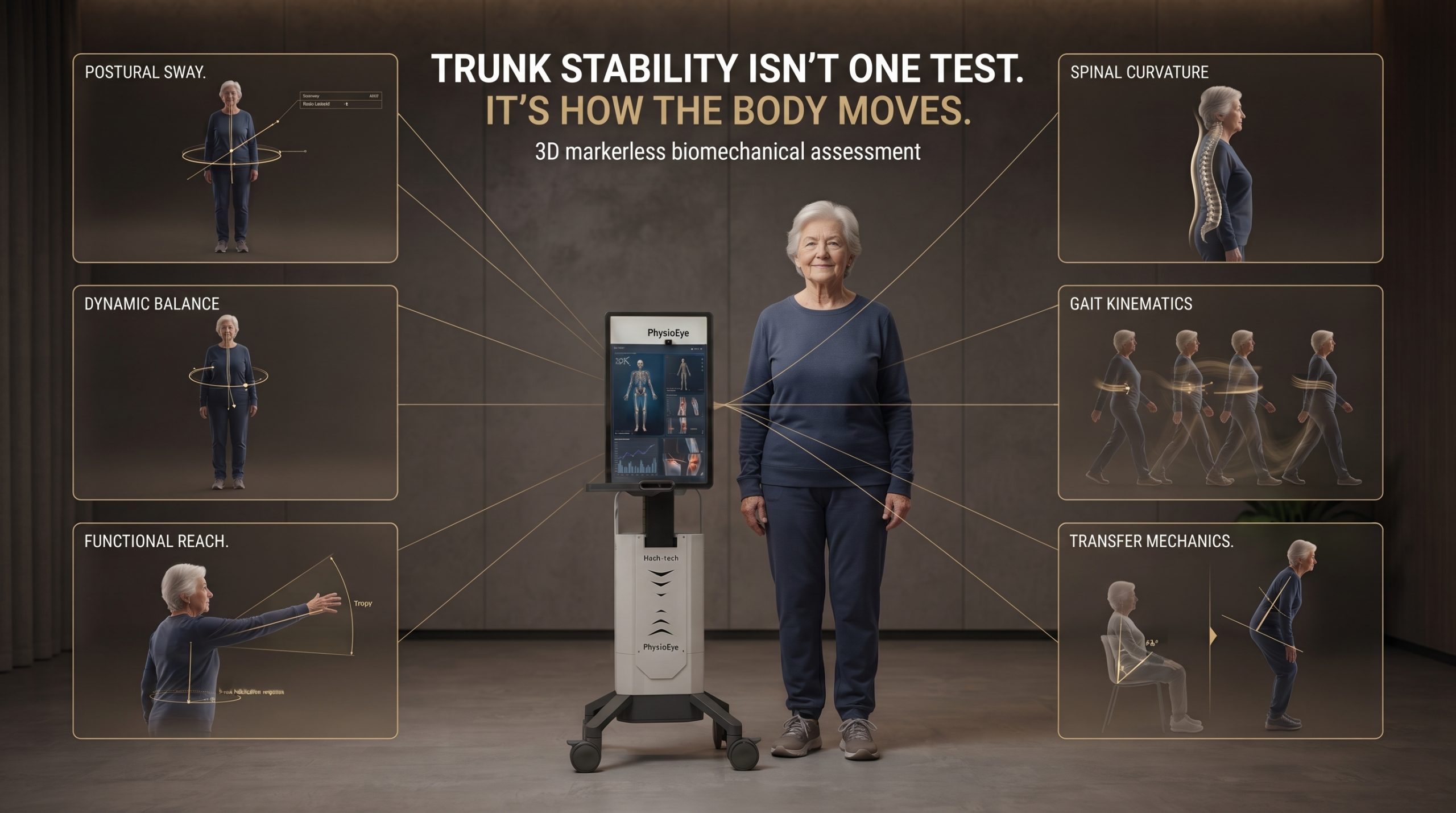
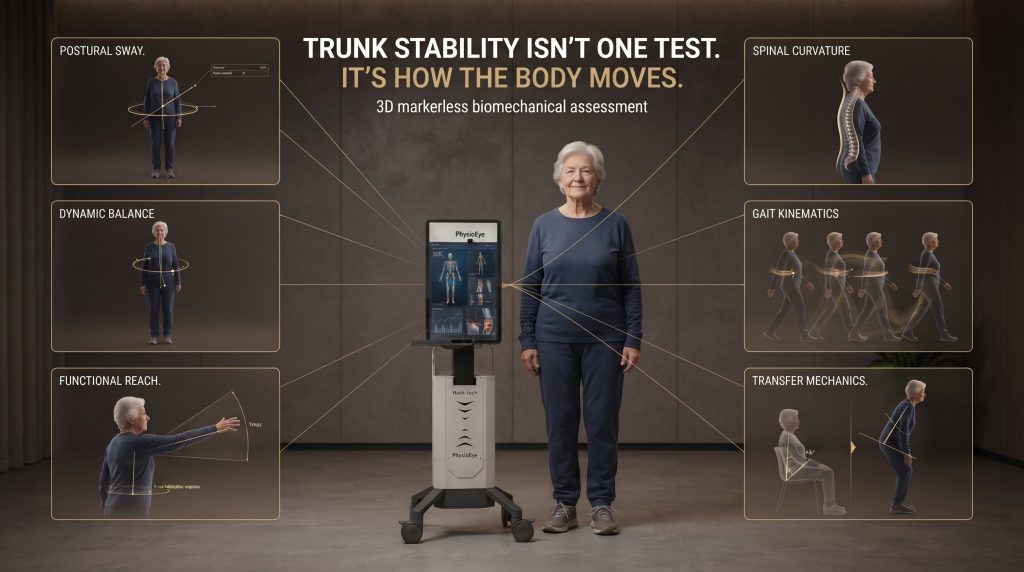
During a trunk stability assessment, PhysioEye captures and processes thousands of data points per second to construct a highly precise, real-time 3D skeletal model of the patient. This allows clinicians to isolate and measure specific biomechanical parameters that dictate core control:
Multi-Directional Postural Sway and Drift
Instead of simply noting whether a patient “leans,” PhysioEye quantifies the exact anterior-posterior (front-to-back) and medio-lateral (side-to-side) sway trajectory of the trunk in seated and standing positions. Identifying elevated sway velocity alerts clinicians to sensory integration deficits and impending fall risks long before a loss of balance occurs.
Thoracic and Lumbar Curvature Analysis
Age-related hyperkyphosis drastically shifts a patient’s center of gravity forward, severely compromising trunk stability. PhysioEye calculates the precise Thoracic Kyphosis Index and Lumbar Lordosis Index during static resting postures and dynamic movements. Tracking these metrics over time provides objective data on spinal loading and structural degradation.
Kinematic Reaching and Functional Limits of Stability
A key component of a comprehensive trunk stability assessment involves dynamic reaching tasks, such as the Functional Reach Test. PhysioEye evaluates how effectively the core stabilizes the spine while the upper limbs are in motion. It measures the maximum excursion distance while simultaneously tracking whether the pelvis remains anchored or inappropriately compensates.
Sit-to-Stand Transfer Mechanics
The 5 Times Sit to Stand Test is a gold standard for evaluating lower limb power, but it is equally reliant on trunk momentum. PhysioEye analyzes the forward trunk inclination angle and angular velocity during the exact moment of lift-off, identifying if a patient is using excessive spinal flexion to compensate for weak leg musculature.
For a deeper dive into how this data influences total body movement, explore our guide on Automated Mobility Assessment by PhysioEye.
Closing the Loop: From Assessment to Multi-Joint Rehabilitation
Gathering precise data during a trunk stability assessment is only the first step. To effectively reduce fall risk and improve Activities of Daily Living (ADL), this kinematic data must inform targeted therapeutic interventions.
When PhysioEye identifies specific core deficits—such as poor rotational symmetry or excessive lateral sway—clinicians can seamlessly transition the patient to ErgoBot.
ErgoBot is a highly advanced, stationary rehabilitation system for upper and lower limbs (addressing all joints). Because it is a stationary multi-joint system—and not an exoskeleton—it provides an incredibly stable, safe environment for elderly patients to perform active-resistive and active-assistive exercises. By utilizing ErgoBot, therapists can isolate the core and limbs, progressively loading the neuromuscular system to rebuild the strength and proprioception required to maintain an upright, stable posture in the real world.
Original Hash-Tech Clinical Insight
The reliance on subjective scoring in geriatric physical therapy is rapidly becoming obsolete. Asking a clinician to visually estimate a 5-degree shift in a patient’s thoracic kyphosis or calculate the angular velocity of their seated sway is physically impossible.
By integrating 3D markerless motion capture into routine care, we are redefining the standard of precision in geriatrics. PhysioEye democratizes biomechanical laboratory technology, making it accessible at the patient’s bedside. When paired with the restorative mechanical power of ErgoBot, clinics can offer a complete, closed-loop Predictive Care pathway that turns hidden fall risks into actionable, measurable rehabilitation goals.
Key Takeaways
-
Traditional trunk stability assessment relies heavily on subjective visual observation, missing subclinical core degradation.
-
Markerless 3D computer vision provides objective, millimeter-accurate measurements of spinal sway, postural drift, and curvature indexes without patient sensors.
-
PhysioEye automates clinical tests like the Functional Reach and Sit-to-Stand, isolating precise trunk kinematics.
-
Targeted rehabilitation using a stationary system like ErgoBot effectively addresses the core and multi-joint deficits identified during the assessment.
-
Automating these assessments creates a proactive, data-driven approach to senior care and fall prevention.
Frequently Asked Questions
Why is trunk stability considered a primary predictor of fall risk? The trunk contains the body’s center of mass. Research consistently demonstrates that impaired postural control of the trunk limits a patient’s ability to recover from unexpected balance perturbations, making core stability as critical as lower limb strength in preventing falls.
How does PhysioEye perform a trunk stability assessment without markers? PhysioEye utilizes advanced AI and computer vision trained on massive biomechanical datasets. Through a standard 2D or 3D camera lens, the software identifies anatomical landmarks (like the shoulders, spine, and pelvis) in real-time, calculating spatial coordinates and kinematic angles without requiring physical IMUs or reflective markers.
Can patients with cognitive impairments (like dementia) undergo this assessment? Yes. One of the greatest advantages of markerless systems is their frictionless nature. Patients do not need to be strapped into unfamiliar equipment, which can cause distress. They simply perform basic movements (like sitting or standing) while the camera passively records the kinematic data.
How does ErgoBot support trunk stability rehabilitation? As a stationary rehabilitation system for all joints, ErgoBot provides a secure, controlled environment for patients to engage in guided, repetitive movement therapy. By safely restricting or assisting specific ranges of motion, it helps patients rebuild the muscular coordination needed for robust trunk control.