
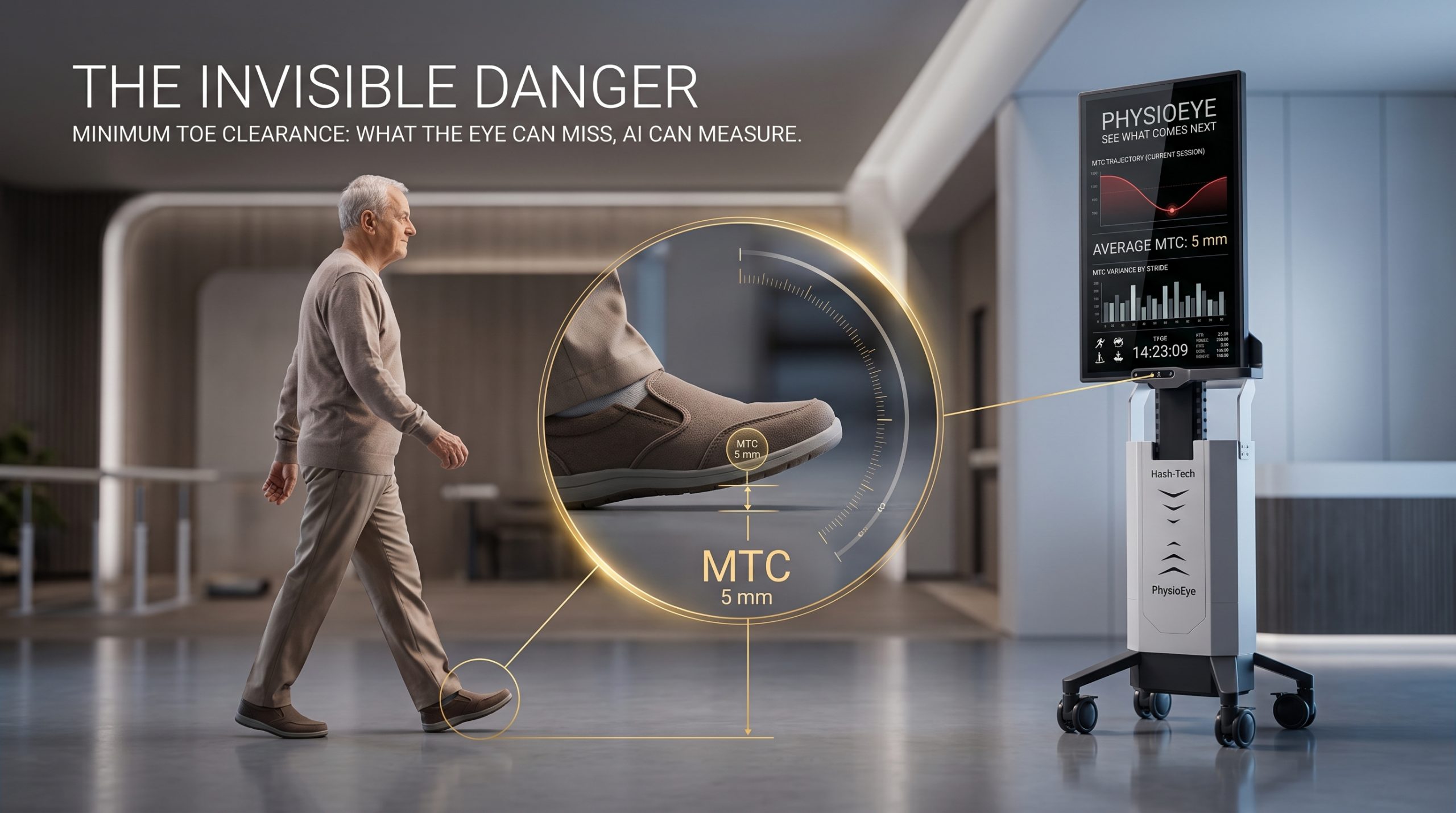
Minimum Toe Clearance: 5 Invisible Risks PhysioEye Identifies Before Serious Falls Happen
Minimum Toe Clearance (MTC) is widely recognized in clinical biomechanics as the single most critical—and most volatile—metric during the swing phase of human locomotion. While macro-level parameters like overall gait speed or stride length receive the majority of clinical attention, they completely fail to capture the millimeter-level micro-dynamics that dictate whether a swing foot safely clears an obstacle or impacts the ground, triggering an unrecoverable forward fall.
During mid-swing, the vertical space between the toe of the shoe and the walking surface narrows to a microscopic margin—often between just 10 to 20 millimeters—while the foot reaches its maximum forward velocity. This article isolates the specific biomechanical mechanics of Minimum Toe Clearance, exposes why human visual observation and standard mobility tests cannot detect MTC failure, and details how advanced markerless computer vision identifies subclinical MTC degradation before catastrophic trips occur.
What Is Minimum Toe Clearance?
Minimum Toe Clearance is the precise minimum vertical distance between the lowest point of the swing foot’s shoe/toe and the walking surface during the mid-swing phase of the gait cycle, occurring precisely when the swing foot passes the stance foot at peak forward velocity.
Unlike stance-phase parameters that evaluate weight-bearing stability, MTC is strictly a swing-phase kinematic event requiring precise neuromuscular coordination between the ankle dorsiflexors, knee flexors, and hip flexors.
Why is it important? Because mid-swing is when the swing foot reaches its maximum forward speed; catching a toe on even a 5-millimeter carpet edge or floor threshold at this moment transfers immense kinetic energy forward, making a fall almost physically impossible to prevent.
Who needs it evaluated? Older adults, post-stroke survivors, patients managing neurological disorders (e.g., Parkinson’s disease or peripheral neuropathy), and individuals recovering from lower-limb orthopedic surgeries.
When should it be measured? Consistently during routine monthly evaluations, as well as under fatigued or dual-task conditions, because MTC degrades rapidly when neurological or muscular fatigue sets in.
How is it measured? Through high-speed 3D markerless computer vision that continuously tracks the spatial trajectory of the anterior foot boundary relative to the floor plane throughout the swing phase.
The Current Challenges of Assessing Minimum Toe Clearance
Assessing Minimum Toe Clearance in standard clinical practice is notoriously difficult because MTC failure is entirely invisible to the naked eye. Clinicians relying on gross observation or timed mobility tests routinely miss millimeter-level trajectory drops until the patient actually trips.
Standard clinical fall-risk screens—such as the Timed Up and Go (TUG) test or 10-Meter Walk Test—measure total duration and gross velocity. However, biomechanical studies demonstrate that a patient can maintain a “normal” walking speed while their Minimum Toe Clearance collapses to dangerous near-zero thresholds.
-
The Velocity/Margin Paradox: At standard walking speeds (1.0 to 1.4 meters per second), the foot passes through mid-swing in a fraction of a second. The human eye cannot process whether a shoe cleared the ground by 15 millimeters or 3 millimeters.
-
Instrumented Lab Friction: Historically, accurately measuring MTC required placing retroreflective markers directly on the anterior tip of the patient’s shoe inside a multi-camera biomechanics laboratory. Setting up these physical markers takes 20 to 30 minutes, and marker placement errors on varying shoe geometries can introduce errors larger than the MTC margin itself.
-
The Cumulative Trip Danger: According to data from the Centers for Disease Control and Prevention (CDC), falls remain the leading cause of injury-related hospitalizations among older adults. Because MTC is an event that occurs hundreds of times during a brief walk, a single stride with an MTC drop of just 5 millimeters can result in a catastrophic trip, even if the patient’s average gait appears stable.
Traditional Visual Observation vs. Markerless AI MTC Tracking
Traditional visual observation cannot resolve millimeter-level vertical toe margins during high-velocity swing phases. Modern markerless AI solutions utilize high-frame-rate computer vision to map full foot geometry frame-by-frame, continuously outputting exact MTC values, trajectory curves, and standard deviations without touching the patient.
When clinicians attempt to visually estimate toe height, they are visually occluded by the patient’s stance leg and clothing. Furthermore, visual observation only captures a single snapshot in time, failing to record how toe height fluctuates over 50 consecutive strides.
Platforms like PhysioEye resolve this diagnostic blind spot through deep learning pose estimation. By identifying the exact spatial boundary of the toe and tracking its trajectory against true vertical gravity at 60+ frames per second, PhysioEye extracts sub-millimeter MTC data instantly. It isolates the exact moment of mid-swing, calculating both the absolute Minimum Toe Clearance height and the stride-to-stride variance, giving clinicians an objective window into swing-phase trip risk during every Automated Mobility Assessment.
5 Invisible MTC Risks PhysioEye Identifies Before Serious Falls Happen
By focusing strictly on the vertical trajectory of the toe during mid-swing, PhysioEye identifies subtle biomechanical failures that precede trip-related falls. Here are the five specific MTC risks captured by markerless analysis:
Subclinical Ankle Dorsiflexor Fatigue
The tibialis anterior muscle is responsible for lifting the foot during early swing to establish necessary toe height. Under mild fatigue, the muscle’s force production drops subtly, causing ankle dorsiflexion to decrease by just 2 or 3 degrees during mid-swing. While the patient continues walking at their normal pace, their Minimum Toe Clearance drops from a safe 14 mm down to a critical 4 mm. PhysioEye tracks this trajectory decay in real-time, alerting clinicians to dorsiflexor fatigue long before the patient displays overt “foot drop.”
Elevated MTC Variability (High Standard Deviation Across Strides)
When assessing trip risk, mean MTC height is only half the story. A patient may average an apparently safe 12 mm of toe clearance, but if their stride-to-stride standard deviation is high (e.g., fluctuating between 22 mm and 2 mm), they are at extreme risk of tripping. This high MTC variability indicates impaired central nervous system control over the swing leg. PhysioEye automatically calculates the standard deviation of MTC across all recorded strides, flagging unpredictable swing trajectories during routine Predictive Gait Analysis.
Cognitive Load-Induced MTC Collapse (Dual-Task MTC Degradation)
Managing toe clearance during mid-swing requires active neurological oversight. When older adults walk while simultaneously engaging in a cognitive task (such as answering a question or navigating a busy hallway), attentional resources are diverted away from motor control. PhysioEye detects the immediate, selective collapse of Minimum Toe Clearance under dual-task conditions—even when the patient’s overall gait speed remains entirely unchanged.
Late Swing Trajectory Flattening Driven by Plantarflexor Rigidity
Hypertonia or rigidity in the gastrocnemius/soleus complex (the calf muscles) creates mechanical resistance against ankle dorsiflexion during swing initiation. Instead of rising smoothly into an inverted arc, the toe’s trajectory flattens prematurely, forcing the foot to travel dangerously parallel to the ground throughout mid-swing. PhysioEye maps the complete parabolic curve of the swing phase, identifying this dangerous “flattened trajectory” profile immediately during a comprehensive Senior joint mobility assessment.
Compensatory Circumduction Masking True MTC Deficits
When a patient experiences weakness in toe elevation, they often instinctively compensate by swinging their leg outward in a semi-circle (circumduction) or hiking their hip to clear the floor. While these compensations may temporarily prevent the toe from dragging during basic Activities of Daily Living (ADL), they create severe mechanical instability and decrease MTC margin during unexpected obstacles. PhysioEye analyzes 3D spatial kinematics, revealing whether toe clearance is being achieved through proper ankle dorsiflexion or through hazardous compensatory mechanics.
The Complete Clinical Care Pathway for MTC Correction
Identifying a Minimum Toe Clearance deficit is the catalyst for targeted, evidence-based intervention. To effectively restore swing-phase clearance, clinical networks must implement an integrated diagnostic and therapeutic workflow.
Hash-Tech GmbH advocates for this continuous MTC care pathway:
-
Frictionless MTC Screening: The patient walks naturally in front of the PhysioEye camera. The computer vision system isolates the swing phase, measuring MTC height, trajectory arc, and stride-to-stride variability without applying physical sensors or shoe markers.
-
Trajectory Analysis: The system flags specific MTC risks, such as a drop in toe height during mid-swing or elevated MTC variance driven by tibialis anterior fatigue.
-
Automated Care Plan Generation: Clinical decision support software utilizes the MTC data to structure a targeted therapeutic protocol specifically designed to strengthen ankle dorsiflexors and restore swing-phase motor control.
-
Targeted Neuromuscular Rehabilitation: The patient engages in focused rehabilitation using ErgoBot. ErgoBot is a stationary upper and lower limb rehabilitation device for all joints. It provides precise, data-driven resistance and active assistance to the ankle joint and lower limb kinetic chain, targeting the exact dorsiflexion and knee flexor deficits identified by PhysioEye.
-
Mandatory Monthly Evaluation Cycle: Because MTC recovery requires consistent monitoring, facilities enforce a mandatory monthly evaluation cycle. Screening the patient’s MTC every 30 days provides an indisputable trend line within their Predictive Care plan, ensuring that improvements in toe clearance height are maintained over time.
Original Hash-Tech Clinical Insight
The medical community’s overwhelming reliance on macro-gait parameters like walking speed is one of the most dangerous oversights in fall prevention. Gait speed is a gross measure of displacement; Minimum Toe Clearance is a micro-measure of spatial survival.
A senior can walk at an impressively fast pace while hovering a mere 3 millimeters above the floor during mid-swing. In a sterile clinic hallway with smooth linoleum, that senior appears perfectly functional. However, the moment they encounter a rug, an uneven sidewalk, or a low door threshold, that 3-millimeter margin guarantees a trip. Because the foot is moving at peak velocity during mid-swing, the resulting fall is violent and unpreventable. Clinicians must stop assuming that a fast walker is a safe walker. Isolate Minimum Toe Clearance as a distinct, mandatory clinical metric, and treat millimeter drops in toe height with the same urgent intervention reserved for acute balance loss.
Key Takeaways
-
-
-
-
-
Minimum Toe Clearance (MTC) occurs during mid-swing at peak forward foot velocity, with normal spatial margins narrowing to just 10 to 20 millimeters.
-
MTC failure is the primary biomechanical cause of tripping falls, yet it is completely invisible to human visual observation.
-
Macro-gait metrics like gait speed fail to detect MTC drops; a patient can walk quickly while maintaining a dangerously low toe clearance trajectory.
-
PhysioEye utilizes 3D markerless computer vision to quantify sub-millimeter MTC height, stride-to-stride MTC variability, and trajectory flattening without physical shoe markers.
-
ErgoBot provides stationary multi-joint rehabilitation to directly address the ankle dorsiflexion and lower-limb deficits responsible for low MTC, supported by a mandatory monthly evaluation cycle.
-
-
-
-
Future Outlook
The future of MTC risk management lies in integrating real-time ambient computer vision directly into long-term care infrastructure. Hallway-mounted cameras running PhysioEye algorithms will continuously monitor residents’ swing-phase kinematics as they walk to meals or activities. If a resident’s Minimum Toe Clearance drops by more than 3 millimeters over a 48-hour period—signaling acute fatigue, medication side effects, or neurological decline—the system will automatically alert the nursing staff to intervene before a trip occurs.
Clinical Implications
For physical therapists, geriatricians, and healthcare facility managers, continuing to ignore Minimum Toe Clearance in routine fall-risk screenings creates massive clinical liability. Tripping falls in elder care settings lead to severe trauma, costly hospitalizations, and permanent functional decline. By adopting markerless MTC screening with PhysioEye and delivering targeted joint rehabilitation with ErgoBot, clinical teams can detect invisible trip risks at the millimeter level, implement precise preventive protocols, and dramatically lower fall incidence rates across their facilities.
Frequently Asked Questions
Why is Minimum Toe Clearance different from general gait analysis? General gait analysis looks at macro-level parameters like stride length, cadence, and overall walking speed. Minimum Toe Clearance isolates a specific micro-metric: the exact vertical distance (in millimeters) between the toe and the floor during mid-swing. A patient can have normal stride length and speed while having a dangerously low MTC.
Can a person with a fast walking speed still be at high risk for tripping? Yes. In fact, a fast walking speed combined with low Minimum Toe Clearance is particularly dangerous. High forward foot velocity during mid-swing means that if the toe impacts an obstacle, the forward kinetic energy is significantly higher, resulting in a severe, unrecoverable trip.
How does PhysioEye measure Minimum Toe Clearance without sensors on the shoes? PhysioEye uses high-frame-rate cameras and deep learning algorithms trained on anatomical and footwear geometry. It maps the spatial boundary of the toe and calculates its exact distance from the ground plane frame-by-frame throughout the swing phase.
How does ErgoBot help increase Minimum Toe Clearance? ErgoBot is a stationary upper and lower limb rehabilitation device for all joints. When PhysioEye detects a low MTC caused by weak ankle dorsiflexors or stiff calf muscles, ErgoBot is programmed to deliver precise active assistance and targeted resistance to the ankle joint, retraining the muscles required to elevate the toe during swing.
What is MTC variability, and why is it dangerous? MTC variability measures how much toe clearance height changes from one stride to the next. High variability means the patient’s swing leg control is inconsistent; even if their average clearance is 12 mm, occasional strides may dip down to 2 mm, drastically increasing the statistical probability of a trip.