
Occupational Therapist Shortage: Hash-Tech Solutions That Could Transform Elderly Care by 2035
The Occupational Therapist Shortage is rapidly becoming one of the most critical bottlenecks in global healthcare, directly threatening the quality of elderly care across acute, post-acute, and residential facilities. The statistical reality is stark: the U.S. Bureau of Labor Statistics projects that occupational therapy employment will need to grow 14% to 17% between 2024 and 2034, creating over 10,000 openings annually just to keep pace with demand. Furthermore, European demographic models forecast a staggering deficit of nearly 1 million healthcare workers across the EU by 2070, with some regional analyses already reporting localized OT personnel shortages exceeding 70%.
This workforce crisis extends far beyond a single pathology. While the rapid rise in dementia demands intensive functional training, the shortage equally jeopardizes care for stroke survivors, orthopedic post-op patients, and generally frail seniors who require daily rehabilitative support to maintain their Activities of Daily Living (ADL). Without immediate technological intervention, millions of seniors will be left without the functional independence they deserve.
To prevent a total collapse in the quality of long-term care by 2035, the industry must augment human expertise with intelligent, scalable technology. This article explores how Hash-Tech GmbH is addressing the workforce gap across multiple rehabilitative disciplines through advanced markerless computer vision and automated, multi-joint stationary rehabilitation.
The Multi-Faceted Impact of the OT Workforce Crisis
An occupational therapist’s scope of practice is vast. When a facility is short-staffed, the consequences ripple across every patient demographic, delaying recovery and accelerating functional decline.
| Patient Demographic | Standard OT Intervention | Consequence of the OT Shortage |
| Stroke Survivors | Neuromuscular re-education, upper limb functional recovery, hemiparesis management. | Missed critical neuroplasticity windows; permanent loss of unilateral motor function. |
| Orthopedic (e.g., Hip/Knee Replacement) | Joint mobility restoration, weight-bearing training, safe transfer mechanics. | Prolonged bed rest leading to muscle atrophy, deep vein thrombosis, and chronic stiffness. |
| Dementia & Cognitive Decline | Dual-task training, spatial orientation, repetitive ADL muscle-memory preservation. | Rapid loss of functional independence; increased AI-Assisted Fall Prevention incidents due to unmonitored wandering. |
| General Senior Frailty | Sarcopenia management, endurance building, Senior Joint Mobility Assessment. | Premature transition from assisted living to high-dependency skilled nursing care. |
Transforming Care: 3 Hash-Tech Solutions to Bridge the Gap
By 2035, relying solely on manual observation and 1-on-1 physical therapy will be mathematically impossible for most nursing homes. Hash-Tech GmbH has developed a technology ecosystem designed to automate time-consuming diagnostics and safely multiply therapeutic output.
Automating Diagnostics with PhysioEye
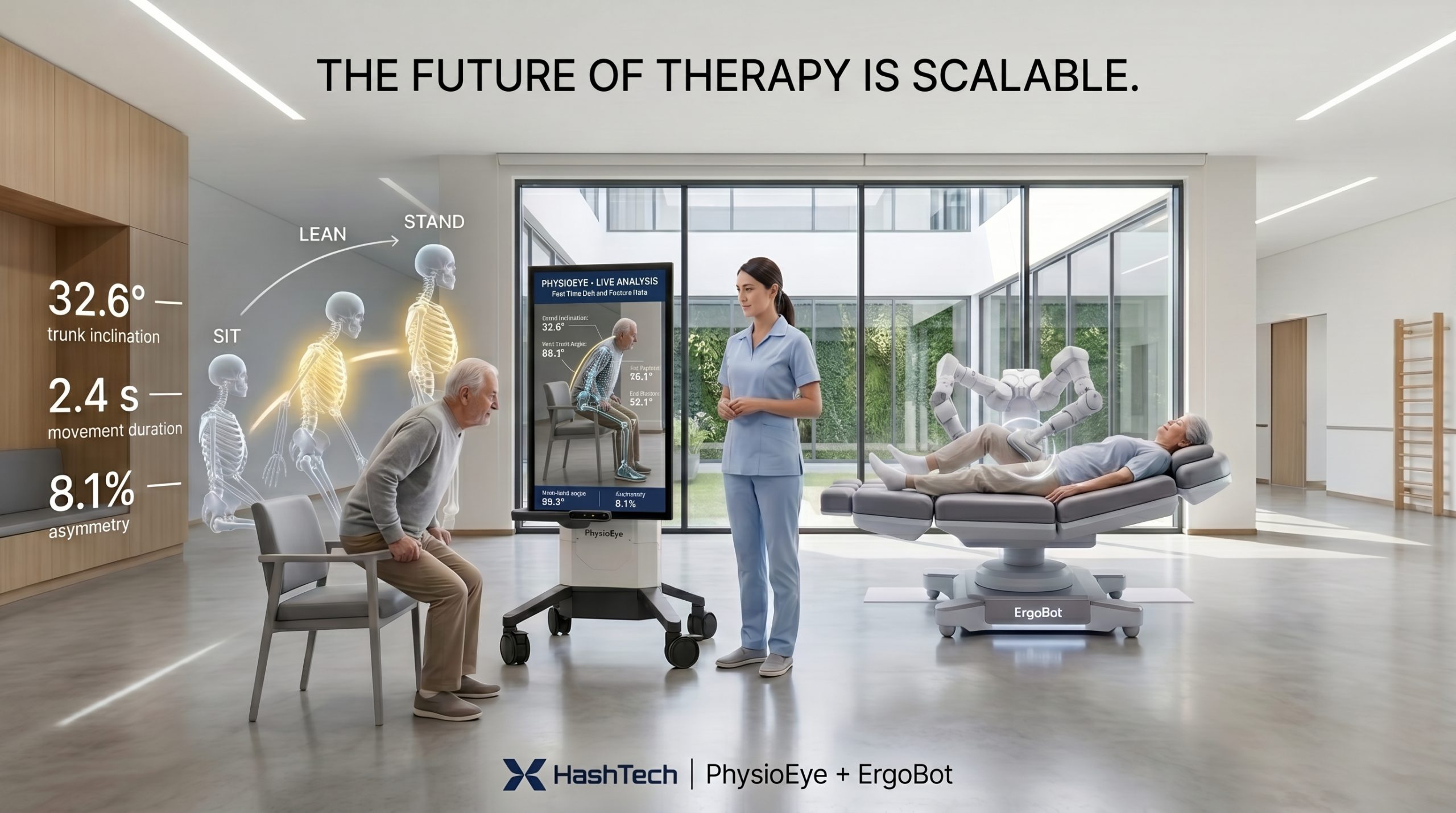
The most time-consuming aspect of an OT’s day is administering, scoring, and charting manual mobility assessments. PhysioEye is a markerless 3D AI motion assessment device that completely automates this process.
Instead of spending 20 minutes setting up a standard Timed Up and Go (TUG) test—and watching closely to ensure the patient rises from the chair without using the armrests for support—an OT can rely on PhysioEye to capture the entire movement instantly. The system maps the patient’s kinematics at 60+ frames per second, calculating sit-to-stand velocity, trunk stability, and stride variability automatically. This allows a single therapist to conduct a Senior joint mobility assessment in a fraction of the time, freeing them to focus on complex, high-value clinical interventions rather than routine data collection.
Scaling Therapy with ErgoBot (Stationary Rehabilitation)
When addressing physical decline, particularly in dementia patients, consistency and safety are paramount. Wearable exoskeletons often require extensive fitting times and close supervision, which is impractical during an Occupational Therapist Shortage.
ErgoBot solves this bottleneck. ErgoBot is a stationary rehabilitation system for upper and lower limbs that addresses all human joints. Because it is a stationary device and not an exoskeleton, it provides a highly secure, controlled environment for older adults. Patients can safely engage in repetitive, active-assistive, or resistive exercises to maintain their ADL capacity. Its stationary nature means a single supervising therapist or trained wellness coordinator can oversee multiple patients simultaneously, effectively tripling therapeutic throughput without sacrificing safety.
Predictive Scaling and Global Reach by 2035
Technology is only effective if it reaches the facilities that need it most. As Hash-Tech GmbH pursues stringent EU MDR compliance and Class Im CE marking for PhysioEye, the strategic goal is widespread, accessible deployment across European nursing homes and beyond.
By strategically targeting a manageable, high-quality scale of 2,000 active facility users on the PhysioEye App within our primary 5-year growth phase, we are establishing a robust, data-dense network. This structured growth ensures that the AI models continuously learn from diverse dementia-related movement profiles, culminating in a highly predictive, automated care ecosystem by 2035 that empowers even the most short-staffed facilities to deliver world-class proactive care.
Original Hash-Tech Clinical Insight
The Occupational Therapist Shortage is not a problem that can be solved simply by aggressive recruiting; the demographic math of an aging population vastly outpaces our ability to train new clinicians.
We must fundamentally change how occupational therapy is delivered. By removing the friction of manual data collection with markerless AI like PhysioEye, and providing safe, multi-joint therapy through stationary systems like ErgoBot, we elevate the OT from a “data gatherer” to a true clinical architect. Technology will never replace the empathy and clinical judgment of a therapist, but these solutions will be the essential tools that allow them to extend their reach and preserve the dignity of the aging population.
Key Takeaways
-
The Occupational Therapist Shortage is a verified global crisis, with the U.S. projecting a 14% to 17% growth in demand over the next decade.
-
The shortage severely impacts all areas of geriatric care, including stroke recovery, orthopedic rehabilitation, and dementia management.
-
PhysioEye automates complex kinematic evaluations (like the TUG test) using markerless 3D computer vision, saving thousands of clinical hours.
-
ErgoBot is a stationary rehabilitation system for upper and lower limbs (not an exoskeleton), enabling safe, scalable, multi-joint therapy for elderly patients.
-
Transitioning to a proactive Predictive Care model is the only mathematically viable way to overcome the workforce gap by 2035.
Frequently Asked Questions
How does the occupational therapist shortage affect orthopedic recovery in seniors? Following a hip or knee replacement, seniors require immediate, daily occupational and physical therapy to restore joint mobility and safe transfer mechanics. A shortage of therapists leads to delayed sessions, which increases the risk of chronic stiffness, muscle atrophy, and prolonged loss of independence.
How does PhysioEye make an OT’s job more efficient? PhysioEye removes the need for stopwatches, physical measuring tapes, and subjective scoring. An OT can have a patient perform a movement, and the markerless AI instantly provides clinical-grade data on joint angles, velocity, and sway, allowing the therapist to spend their time treating the patient rather than measuring them.
Why is ErgoBot designed as a stationary system rather than an exoskeleton? Safety and scalability. ErgoBot is a stationary rehabilitation system for upper and lower limbs that addresses all joints securely. Exoskeletons require lengthy setup times and carry higher fall risks for frail patients. A stationary system allows patients to safely engage in therapy while enabling a single staff member to safely monitor multiple users at once.
What is the projected demand for Occupational Therapists? According to the U.S. Bureau of Labor Statistics, employment of occupational therapists is projected to grow much faster than the average for all occupations, with approximately 10,200 openings projected each year through 2034.