Nurse Back Pain Prevention: 7 Powerful Ways AI Posture Assessment Reveals Hidden Musculoskeletal Risks in Nursing Homes
Occupational back pain among nursing staff is one of the most persistent, costly challenges facing long-term care facilities worldwide. Nurse Back Pain Prevention is no longer just a workplace health topic—it is a core requirement for staff retention, operational safety, and care quality. According to occupational health literature archived by the National Institutes of Health (NIH), over 70% of nursing personnel experience work-related musculoskeletal disorders (WMSDs) during their careers, with low back strain listed as the leading cause of lost workdays and physical burnout.
Historically, ergonomic evaluations relied either on subjective visual observations or theoretical mathematical models estimating internal spinal forces (such as L5/S1 compressive loads). In real-world clinical environments, claiming that ambient optical sensors can measure internal joint kinetics through clothing is scientifically unfeasible. True, clinically validated ergonomic progress requires focus on observable kinematic data: quantifying exact body segment angles, movement frequencies, postural asymmetries, reach boundaries, and long-term movement shifts using markerless 3D computer vision.
This article explores the 7 scientifically grounded ways AI posture assessment reveals hidden musculoskeletal risks in nursing homes, moving from surface-level inspection to objective decision support.
Optimal posture category sizes
The Shift from Theoretical Force Estimates to Feasible Kinematic Assessment
To build a reliable occupational safety framework, healthcare organizations must distinguish between theoretical kinetic estimates and feasible, observable kinematic measurements.
Why Internal Force Estimates Fail in Real-World Settings
In biomechanical research laboratories, calculating exact spinal compressive or shearing forces requires invasive pressure sensors, skin-attached electromyography (EMG) electrodes, or detailed individual MRI scans paired with force plates. Attempting to estimate internal disc pressure through standard clothing using external cameras introduces substantial measurement error. Hair, loose scrubs, variable lighting, and unpredictable patient interactions make direct force estimation impractical for daily operational auditing.
The Power of 3D Kinematic Surface Tracking
Computer vision excels at measuring observable geometry in 3D space: body segment orientations, joint angles, movement velocities, and repetition counts. Rather than speculating on internal tissue loads, AI systems quantify the external postural inputs—such as sustained trunk flexion or severe asymmetric twisting—that are clinically proven to increase musculoskeletal risk.
| Ergonomic Parameter | Unfeasible / Theoretical Approach | Scientifically Validated Kinematic AI Approach |
| Lumbar Stress | Claiming direct measurement of internal L5/S1 pressure through clothing. | Quantifying trunk flexion angle (°), duration (seconds), and velocity. |
| Torsional Strain | Speculating on internal annulus fibrosus shear stress. | Measuring external trunk axial rotation & lateral inclination asymmetry. |
| Workload Volume | Subjective shift-long recall or manual clipboards. | Tracking repetition counts & movement durations within standardized observation windows. |
| Movement Strategy | Binary grading (“Good posture” vs. “Bad posture”). | Analyzing coordination efficiency, compensatory motions, and postural stability. |
Nurse Back Pain Prevention: 7 Powerful Ways AI Posture Assessment Reveals Hidden Musculoskeletal Risks
By focusing on real-world 3D kinematics, artificial intelligence transforms ergonomic risk detection into a precise, repeatable science. Here are the 7 ways AI posture assessment identifies hidden physical risks before they result in injury:
Detect Excessive Trunk Flexion
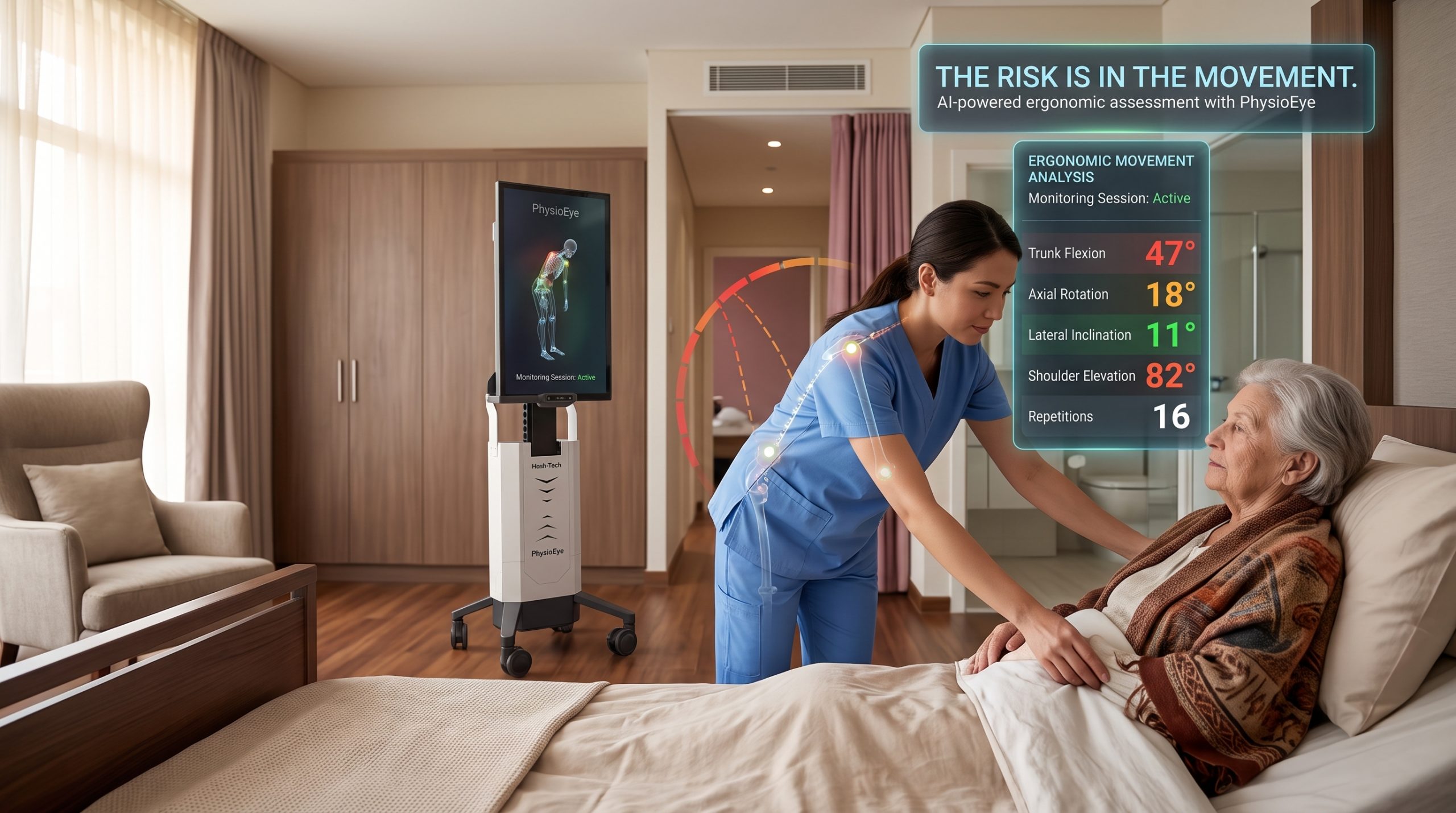
Forward trunk bending is one of the most frequent biomechanical strains in nursing care. Staff constantly flex forward to adjust bed heights, assist residents with footwear, change wound dressings, or operate low-level equipment.
AI computer vision quantifies how far and how long the trunk moves into forward flexion during a specific task.
-
Kinematic Metrics: Absolute trunk flexion angle (in degrees), total time spent beyond defined risk thresholds (e.g., >30° or >60° flexion), and flexion frequency per session.
-
Clinical Value: Instead of guessing if a nurse is “bending too much,” the system provides objective duration and angle data, pinpointing specific care routines that force employees into non-neutral postures.
Identify Repeated Asymmetric Postures
A nurse may not bend straight forward; frequently, care tasks require working with the trunk rotated or with body weight shifted unevenly to one side—such as reaching across a bed while assisting a resident. While an isolated asymmetrical movement may seem harmless, high repetition of asymmetrical movement strategies creates severe localized muscular fatigue and mechanical strain.
AI computer vision detects subtle left-right postural imbalances rather than relying on qualitative impressions.
-
Kinematic Metrics: Trunk axial rotation angle, lateral trunk inclination (side bending), pelvic orientation tilt, and left vs. right movement asymmetry during repeated tasks.
-
Clinical Value: Uncovering systemic lateral bias allows facilities to correct equipment placement and bedside positioning before chronic muscle imbalances develop.
Quantify Awkward Reaching and Working Positions
Nursing duties involve continuous upper limb reach—stretching across wide hospital beds, accessing medication carts, retrieving supplies from high shelves, or supporting resident limbs during hygiene care.
3D computer vision maps the spatial relationship between the nurse’s upper limbs, trunk, and immediate working environment.
-
Kinematic Metrics: Shoulder flexion angle, shoulder elevation/abduction, elbow joint extension, trunk inclination during reach, and frequency of extreme end-range joint positions.
-
Clinical Value: Connects physical reach demands directly to shoulder and upper-back fatigue without asserting unverified medical diagnoses, helping managers optimize cart and bed placement.
Measure Movement Repetition and Workload Patterns
Ergonomic risk is a function of both posture severity and exposure frequency. Traditional audits capture single snapshot photos; they fail to record the cumulative volume of physical transitions across a care routine.
AI analyzes movement patterns over standardized observation windows (e.g., a 10-minute standardized resident transfer or bed-making task).
-
Kinematic Metrics: Cumulative count of postural transitions, frequency of combined flexion-rotation cycles, and movement tempo.
-
System Scope Note: Responsible platforms like PhysioEye evaluate standardized, task-specific observation periods rather than claiming unvalidated, shift-long continuous optical tracking.
-
Clinical Value: Converts video data into clear, quantitative exposure profiles that highlight high-repetition bottlenecks in care routines.
Detect Inefficient Movement Strategies
Two nurses of similar height and strength can perform the exact same resident care task using radically different movement mechanics. One may use a clean hip-hinge strategy with stable foot placement, while another relies entirely on excessive lumbar bending and unstable momentum shifts.
AI-based biomechanical analysis evaluates movement quality and coordination strategies.
-
Kinematic Metrics: Ratio of lumbar flexion to hip flexion, presence of unnecessary compensatory jerks, jerky velocity spikes, and postural instability during weight shifts.
-
Clinical Value: Focuses ergonomic assessment beyond task completion (“Did the job get done?”) to movement execution (“How efficiently did the body move?”), forming a foundation for targeted staff re-education.
Track Changes in Musculoskeletal Movement Over Time
A single posture assessment represents a brief snapshot. The true value of AI posture assessment lies in longitudinal movement monitoring—tracking an individual worker’s movement patterns across weeks and months (e.g., Baseline → 3 Months → 6 Months → 12 Months).
By comparing standardized kinetic profiles over time, AI identifies progressive, sub-clinical movement changes.
-
Longitudinal Indicators: Gradual increase in baseline trunk flexion, declining movement symmetry, reduced joint range of motion during routine tasks, or emerging compensatory movement patterns.
-
Clinical Value: Transforms ergonomic safety from reactive accident reporting into a proactive, predictive monitoring framework, catching early physical fatigue long before it escalates into an acute disability claim.
Create an Objective Movement Profile for Decision Support
The final goal of AI posture assessment is not to generate raw data charts, but to deliver actionable decision support for facility managers, occupational health specialists, and physical therapists.
AI aggregates complex spatial coordinate streams into standardized, readable movement risk profiles.
-
Decision Support Outputs: Objective risk scores per care task, identified ergonomic red flags, targeted movement retraining recommendations, and facility-level equipment placement adjustments.
-
Clinical Value: Empowers leadership to make evidence-based decisions regarding equipment purchasing, bed height standardization, and tailored physical therapy support.
The Hash-Tech Ecosystem: Combining Markerless Assessment with Automated Rehabilitation
At Hash-Tech GmbH, based in Buchbach, Germany, actionable ergonomics requires connecting diagnostic evaluation to practical workflow solutions.
1. Feasible 3D Kinematic Tracking via PhysioEye
PhysioEye is a Class Im CE-marked 3D AI motion assessment system utilizing Markerless Motion Capture. Operating passively without body sensors or wires, PhysioEye captures 3D spatial coordinate data during standardized physical movement tasks.
While widely used for resident Automated Mobility Assessment, PhysioEye delivers exceptional value in staff occupational health. It measures observable kinematic parameters—such as trunk flexion angle, lateral asymmetry, and reach boundaries—providing reliable baseline data for longitudinal tracking without making unverified claims about internal tissue kinetics.
2. Offloading Physical Handling Loads with ErgoBot
Identifying ergonomic risks is only half the solution; facilities must actively reduce physical handling demands. This is where ErgoBot transforms nursing home operations.
It is critical to note that ErgoBot is a stationary rehabilitation platform for upper and lower limbs across all joints—it is strictly NOT an exoskeleton.
In conventional long-term care settings, nursing staff spend hours manually lifting, holding, and ranging heavy resident limbs to prevent Hospital-Acquired Deconditioning and joint stiffness. ErgoBot takes over this high-dose, repetitive mobilization entirely while the resident remains safely seated. By offloading manual limb support tasks to a stationary robotic system, facilities protect staff from extended bending and static lifting strain, addressing the Occupational Therapist Shortage while ensuring consistent therapy for residents.
Key Takeaways
-
Nurse Back Pain Prevention relies on scientifically grounded, real-world kinematic assessment rather than unfeasible internal force claims.
-
3D computer vision quantifies observable movement geometry: trunk flexion angle, lateral asymmetry, reach boundaries, and repetition frequency.
-
Evaluating movement strategies helps distinguish efficient hip-hinge mechanics from risky, compensate-heavy trunk loading.
-
Longitudinal tracking across 3, 6, and 12 months reveals early movement changes before acute injury occurs.
-
PhysioEye provides passive, markerless 3D kinematic assessment during standardized observation windows without requiring body sensors.
-
ErgoBot is a stationary rehabilitation system (strictly NOT an exoskeleton) that offloads heavy, repetitive joint mobilization tasks from nursing staff.
Frequently Asked Questions
Can AI computer vision measure internal L5/S1 spinal compression forces through clothing? No. Claiming to measure exact internal joint pressure or spinal compression forces through clothing using standard optical cameras is scientifically unfeasible. AI computer vision evaluates observable 3D kinematics—such as trunk flexion angle, lateral inclination, rotational velocity, and reach distance—which serve as validated indicators of ergonomic risk.
How does tracking trunk flexion angle help prevent nurse back injuries? Forward trunk flexion increases the lever arm acting on the lumbar spine. By quantifying the exact angle, duration, and repetition frequency of trunk flexion during care tasks, AI posture assessment identifies specific routines that force workers into extreme non-neutral postures, allowing managers to adjust bed heights and work surfaces.
What is the difference between kinetic and kinematic ergonomic assessment? Kinematics focuses on observable movement geometry—angles, positions, velocities, and acceleration—without attempting to measure internal forces directly. Kinetics attempts to measure internal forces, torques, and muscular tension. AI posture assessment utilizes feasible 3D kinematics to evaluate real-world workplace risks accurately.
Why is ErgoBot classified as a stationary system rather than an exoskeleton? ErgoBot is a stationary rehabilitation system designed to support upper and lower limb joint mobilization while the resident is safely seated or positioned. It is strictly not an exoskeleton. Exoskeletons are wearable devices that carry fall risks for frail patients, whereas stationary systems ensure patient stability while offloading repetitive physical limb-holding labor from human therapists.
How does longitudinal movement tracking support occupational health? Single ergonomic audits provide only a snapshot in time. Longitudinal tracking compares standardized movement profiles across 3, 6, or 12 months, highlighting subtle trends such as increasing trunk flexion, declining movement symmetry, or emerging compensatory mechanics before an acute injury occurs.