
Functional Reach Test: 6 Powerful Reasons PhysioEye Predicts Fall Risk Before Balance Decline Becomes Dangerous
Functional Reach Test screenings serve as the critical first line of defense against catastrophic balance loss in aging populations. Unrecognized biomechanical deterioration creates a silent clinical emergency, often remaining entirely invisible until an older adult suffers a severe injury. Subtle shifts in postural control and proprioceptive feedback mechanisms degenerate over time, masking themselves behind compensatory movement strategies. Readers will learn the underlying physiology of this standardized assessment, how manual testing methods fall short in modern clinical environments, and how objective artificial intelligence fundamentally restructures geriatric care pathways.
What Is the Functional Reach Test?
The Functional Reach Test is a standardized clinical assessment that measures the maximum distance an individual can reach forward while standing without stepping, losing balance, or requiring external support. It is widely used to evaluate postural stability, functional balance, and fall risk in older adults and neurological populations.
Developed in the early 1990s, the Functional Reach Test remains one of the most practical balance assessments because it requires minimal equipment, takes less than one minute to perform, and can be administered in almost any clinical environment.
During the assessment, the individual stands beside a measuring device with one arm raised to approximately shoulder height. Without moving the feet, the person leans forward as far as safely possible before returning to the starting position. The horizontal distance traveled by the fingertips represents the functional reach distance.
Although the procedure appears straightforward, it evaluates a complex interaction of physiological systems, including:
- Static and dynamic balance
- Trunk stability
- Lower-limb strength
- Joint mobility
- Motor planning
- Neuromuscular coordination
- Vestibular function
- Visual feedback
- Proprioception
Because these systems naturally decline with aging and many neurological or musculoskeletal disorders, the Functional Reach Test has become an important screening tool in geriatric rehabilitation, physiotherapy, occupational therapy, and fall prevention programs.
It is also frequently performed alongside other validated assessments such as the Five Times Sit to Stand Test, the Berg Balance Test, Gait Speed Measurement, the Short Physical Performance Battery (SPPB), and Dual-Task Gait Assessment, providing clinicians with a broader understanding of an individual’s functional mobility.
Why Is the Functional Reach Test Important?
This assessment is crucial because it translates invisible stability deficits into measurable clinical data. Identifying restricted anterior reach allows healthcare professionals to intervene before a catastrophic fall occurs, significantly reducing morbidity, mortality, and the immense financial burden on healthcare infrastructure.
The clinical reality surrounding balance decline is severe. Data published by the Centers for Disease Control and Prevention (CDC) reveals that more than one in four older adults report falling each year. The consequences of these events are devastating. In 2023, hospitals treated over 3 million older adults in emergency departments specifically for fall-related trauma.
Furthermore, falls represent the leading cause of fatal and nonfatal injuries among older Americans, with over 800,000 hospitalizations annually, most often due to head injuries or hip fractures. The Functional Reach Test acts as a highly validated prognostic tool to interrupt this trajectory. Integrating this data into broader Fall Prevention Strategies allows clinical teams to deploy preventative measures rather than purely reactive medical treatments.
Who Should Receive a Functional Reach Test?
The test is vital for any patient at risk of neuromuscular decline or compromised stability. This includes geriatric patients, individuals recovering from orthopedic surgery, and those managing neurodegenerative conditions, ensuring that subtle shifts in balance are documented and addressed immediately.
Older adults
Routine screening is mandatory for the aging demographic. As individuals age, muscle mass decreases, and sensory feedback loops slow down. Incorporating this assessment into annual physicals or general wellness checks establishes a longitudinal baseline, highlighting subtle deviations in core stability before they manifest as clinical emergencies.
Individuals living in nursing homes
Long-term care facilities face disproportionate risks regarding patient mobility. Research indicates that between 50% and 75% of nursing home residents experience a fall annually. In regions like Bavaria and the greater Munich area, where demographic shifts are accelerating the demand for eldercare, implementing systemic screening protocols is essential. Integrating these measurements into broader Nursing Home Automation / Elderly Care Solutions provides administrators with the objective data required to allocate staffing resources effectively and protect high-risk residents.
Neurological rehabilitation
Patients recovering from strokes or managing Parkinson’s disease exhibit profound deficits in motor planning and execution. The test helps neurologists and therapists quantify the extent of proprioceptive loss and monitor the efficacy of dopaminergic medications or neuroplasticity interventions.
Orthopedic rehabilitation
Following lower extremity joint arthroplasty, patients often develop compensatory weight-bearing strategies to avoid pain. Assessing their anterior reach provides critical insights into their willingness to load the surgical limb and their overall recovery trajectory during postoperative care.
Community fall prevention programs
Public health initiatives rely on rapid, scalable screening tools. Because the traditional test requires minimal equipment, it serves as an excellent triage mechanism in community centers, identifying high-risk individuals who require immediate referral to specialized physical therapy or occupational therapy clinics.
How Is the Functional Reach Test Performed?
The Functional Reach Test is performed by measuring the maximum forward reaching distance while an individual maintains a stable standing position without moving the feet. Standardized testing procedures are essential to ensure reliable and reproducible results across repeated assessments.
Although the Functional Reach Test requires only a measuring device and less than one minute to complete, its clinical value depends heavily on standardized execution. Small variations in patient positioning, arm height, foot placement, or measurement technique can significantly influence the recorded reach distance, making consistency critical for longitudinal monitoring.
A typical assessment follows these steps:
1. Prepare the Patient
The patient stands upright beside a measuring scale or wall-mounted ruler with feet comfortably shoulder-width apart. Shoes are generally kept consistent across follow-up assessments to reduce variability.
Healthcare professionals should ensure the patient is medically stable and can stand safely without immediate assistance before beginning the assessment.
2. Establish the Starting Position
One arm is elevated to approximately 90 degrees of shoulder flexion with the elbow extended and the hand closed into a fist. The examiner records the initial position of the third metacarpal head as the starting reference point.
Maintaining a consistent starting posture is essential because differences in shoulder position or trunk alignment can artificially increase or decrease the measured reach distance.
3. Perform the Reach
Without lifting the heels, stepping forward, or losing balance, the patient slowly reaches forward as far as possible while maintaining control.
Rather than moving quickly, patients are encouraged to perform the movement in a smooth and controlled manner to reflect functional postural stability rather than momentum.
4. Record the Maximum Reach Distance
The final position of the third metacarpal head is measured, and the difference between the starting and ending positions represents the Functional Reach distance.
Many clinicians repeat the test two or three times and record either the best performance or the average value depending on the clinical protocol being followed.
5. Interpret Within the Clinical Context
The Functional Reach Test should never be interpreted in isolation.
Healthcare professionals typically combine the results with additional assessments such as Gait Speed Measurement, the Five Times Sit to Stand Test, the Berg Balance Test, the Short Physical Performance Battery (SPPB), and Dual-Task Gait Assessment to build a more comprehensive understanding of functional mobility and fall risk.
What Does the Functional Reach Test Actually Measure?
Fundamentally, it measures the limits of stability and anterior-posterior postural control. It captures the patient’s physiological ability to coordinate complex neuromuscular responses, specifically the ankle and hip strategies, necessary to manage shifts in the center of mass.
While the output is a simple distance measurement in inches or centimeters, the underlying biomechanics are highly complex. A successful reach requires adequate ankle dorsiflexion, hamstring flexibility, core strength, and precise proprioceptive feedback. When a patient reaches forward, they intentionally induce a state of disequilibrium. By analyzing this movement, clinicians evaluate the integrity of the patient’s sensory and motor systems. Integrating this test with Postural Sway Assessment provides a comprehensive picture of both dynamic excursion and static stability, revealing hidden deficits in balance maintenance.
How Are Functional Reach Test Results Interpreted?
Results are interpreted by comparing the maximum reach distance against age-matched normative data. Distances below specific clinical thresholds strongly correlate with heightened fall risk, prompting targeted investigations into the patient’s underlying musculoskeletal and neurological health.
Landmark peer-reviewed research provides rigid stratification guidelines. Studies demonstrate that if an older adult’s reach is less than or equal to 6 inches, they exhibit a significantly increased risk for recurrent falls. An inability to reach at all indicates profound impairment. Clinicians must interpret these distances through several physiological lenses:
Age
Normative values decline naturally across the lifespan. For adults aged 20 to 40, a normal reach spans approximately 14 to 17 inches. For those aged 70 to 87, the normative range drops to 10.5 to 13.2 inches. Clinicians must benchmark the patient’s performance against their specific age cohort rather than an absolute universal standard.
Musculoskeletal Health
A restricted reach frequently points to physical limitations rather than pure neurological decline. Severe osteoarthritis in the hips or knees can restrict the mechanical range of motion necessary for forward excursion. Similarly, Frailty Syndrome in Geriatrics often manifests as insufficient core and lower extremity strength, preventing the patient from controlling their body weight during the reach.
Neurological Function
If musculoskeletal limitations are ruled out, a poor score suggests a breakdown in motor planning or sensory integration. Patients may lack the proprioceptive awareness required to know where their center of mass is located relative to their base of support, leading to premature termination of the movement to avoid falling.
Fear of Falling
Psychological factors heavily influence the results. Patients who have previously experienced a severe fall often develop kinesiophobia (fear of movement). Even if their physical capacity allows for a 10-inch reach, acute anxiety may cause them to stop at 5 inches. Differentiating between a physical limitation and psychological hesitation is critical for proper treatment planning.
The Hidden Limitation of Traditional Functional Reach Testing
Traditional Functional Reach Test measurements quantify how far a person reaches but provide limited information about how the movement was performed. Modern clinical assessment increasingly values movement quality in addition to movement quantity.
For decades, clinicians have relied on the final reach distance as the primary outcome of the Functional Reach Test.
While this measurement remains clinically useful, it represents only the endpoint of a much more complex movement.
Important questions often remain unanswered:
- Was the movement smooth or unstable?
- Did trunk compensation occur?
- Was the weight shift symmetrical?
- Did the patient rely primarily on hip strategy or ankle strategy?
- Was postural sway excessive?
- Were subtle protective movements present?
- Did the patient hesitate during the reach?
- Was movement velocity reduced?
- Were there early signs of fatigue?
These biomechanical characteristics may provide valuable insight into declining mobility long before a noticeable reduction in reach distance occurs.
Consequently, rehabilitation professionals are increasingly complementing traditional observational assessment with objective movement analysis technologies capable of capturing the entire reaching movement rather than only its final outcome.
Why Objective Movement Analysis Is Changing Functional Reach Testing
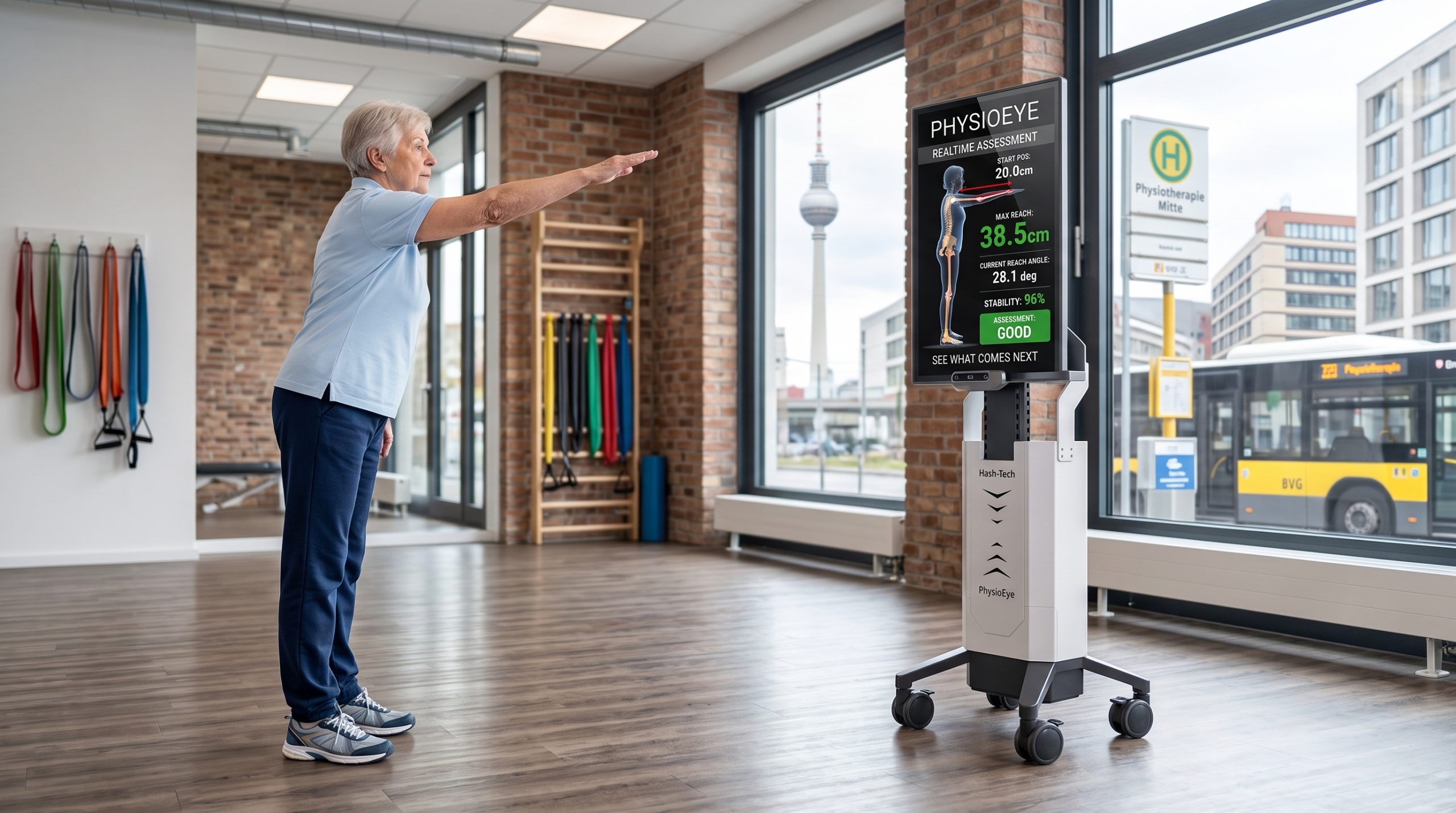
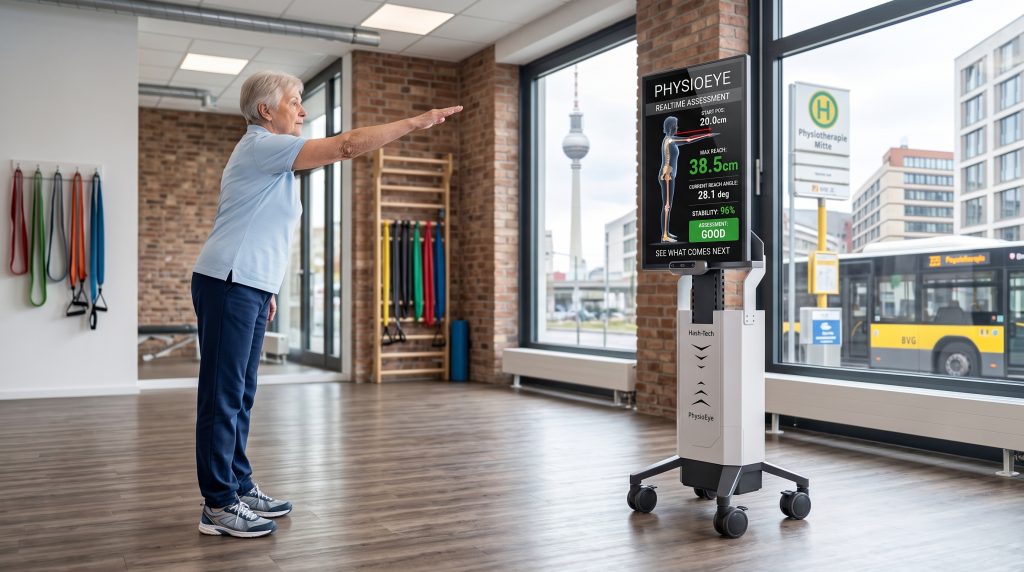
Objective movement analysis replaces subjective human observation with highly precise computer vision. Systems like PhysioEye capture full-body kinematics in real-time, instantly quantifying joint angles and movement quality alongside the exact reach distance.
The transition to artificial intelligence eliminates parallax error and the data silos associated with paper charting. By deploying markerless motion capture via systems such as PhysioEye, clinical facilities transition from basic distance measurement to comprehensive biomechanical mapping. The camera objectively tracks the exact coordinates of the acromion, the spine, the greater trochanter, the knee, and the lateral malleolus simultaneously at 60 frames per second. This depth of data transforms a simple screening tool into a robust diagnostic instrument, instantly identifying exactly why a patient cannot reach the normative threshold.
6 Powerful Reasons AI-Enhanced Functional Reach Testing Predicts Fall Risk Earlier
Artificial intelligence does not replace the Functional Reach Test. Instead, it transforms a simple distance measurement into a comprehensive biomechanical assessment that helps clinicians identify subtle movement impairments before they become clinically obvious.
Objective Measurement Eliminates Subjective Observation
The reliance on human eyesight to mark a moving target introduces massive inter-rater variability. AI eliminates this by calculating spatial coordinates algorithmically. A reach measured at 8.4 inches by the system will always be 8.4 inches, regardless of which staff member initiates the software, ensuring absolute data integrity.
Movement Quality Matters More Than Reach Distance Alone
Computer vision detects compensation. If an older adult achieves a far reach by lifting their heels off the floor—a protocol violation that masks dangerous instability—the software instantly flags the error. Capturing Automated Geriatric Fall Risk Assessment / Fall Prevention metrics ensures clinicians understand the biomechanical strategy, not just the final output.
Longitudinal Monitoring Reveals Progressive Decline
Paper records make tracking subtle deterioration nearly impossible. AI systems automatically aggregate data over time. If a patient’s reach decreases by half an inch every month for three months, the software generates a predictive alert. This Predictive Care model ensures interventions occur before the decline crosses the threshold of high clinical risk.
Earlier Identification Supports More Personalized Rehabilitation
Precise kinematic data dictates precise therapy. If the AI identifies that restricted hip flexion is the limiting factor during the reach test, the subsequent therapy protocol can focus exclusively on hip mobilization rather than generic balance exercises, accelerating recovery timelines.
Consistent Measurements Improve Team Communication
In large hospital networks or regional healthcare systems like those operating throughout Bavaria, patients frequently transition between acute care, inpatient rehab, and outpatient clinics. Standardized, digitized AI metrics provide a universal language. The receiving physical therapist immediately understands the patient’s baseline without needing to repeat the initial assessments.
AI Supports Clinical Decisions Without Replacing Clinical Expertise
Artificial intelligence does not diagnose; it quantifies. By automating the arduous process of data collection and calculation, the software frees the clinician to perform high-level pattern recognition and human-centric care planning. It acts as clinical decision support, augmenting the therapist’s expertise with mathematically perfect data.
Clinical Applications of the Functional Reach Test
This assessment integrates seamlessly across the entire healthcare continuum. From acute orthopedic wards to community wellness centers, objective stability data drives clinical decision-making, informs discharge planning, and dictates the precise parameters for subsequent robotic rehabilitation.
Geriatric Assessment
During comprehensive geriatric evaluations, the reach test serves as a primary indicator of functional independence. Correlating this data with assessments like the Timed Up and Go (TUG) allows geriatricians to construct a highly accurate risk profile regarding the patient’s ability to safely navigate their home environment independently.
Nursing Homes
In long-term care, staffing ratios demand high-efficiency protocols. Automated screening allows care aides to conduct reliable tests, flagging at-risk residents for the physical therapy department. This systematic approach drastically reduces the incidence of preventable falls within the facility.
Orthopedic Rehabilitation
Post-surgical joint replacement patients require careful loading of the affected limb. Monitoring the anterior reach helps therapists gauge the patient’s neuromuscular confidence and mechanical stability as they progress toward full weight-bearing activities.
Neurological Rehabilitation
For stroke survivors dealing with hemiparesis, the reach test highlights dangerous asymmetries in weight shifting. Understanding these deficits is critical before transferring the patient to advanced therapeutic modalities, such as Robotic Assisted Rehabilitation, to restore bilateral coordination.
Community Health Programs
Preventative community health heavily relies on identifying at-risk individuals before they enter the hospital system. Deploying automated reach assessments in senior centers provides immediate, actionable data that connects aging individuals with appropriate local outpatient therapy resources.
Original Hash-Tech Clinical Insight
One of the most significant developments in musculoskeletal rehabilitation is the transition from isolated clinical assessments toward continuous, data-driven rehabilitation pathways.
Rather than viewing the Functional Reach Test as a single measurement, it can become part of a complete clinical workflow:
Objective movement assessment → Clinical decision support → Individualized rehabilitation planning → Robotic-assisted rehabilitation when clinically appropriate → Longitudinal outcome monitoring.
Within this workflow, technologies such as PhysioEye provide objective biomechanical assessment, while rehabilitation systems such as ErgoBot may support the delivery of consistent upper- and lower-limb rehabilitation exercises under professional supervision. Together, assessment and rehabilitation remain connected through objective movement data while clinical decisions continue to be made by qualified healthcare professionals.
This integrated approach illustrates how modern rehabilitation is evolving from isolated examinations toward continuous, evidence-informed patient management.
Key Takeaways
- The Functional Reach Test is a validated assessment of functional balance and postural stability.
- Reach distance alone provides only part of the clinical picture.
- Objective biomechanical analysis captures movement quality in addition to movement quantity.
- AI-assisted assessment supports more consistent longitudinal monitoring.
- Functional Reach Testing is valuable across geriatric, neurological, orthopedic, and community healthcare settings.
- Modern rehabilitation increasingly integrates objective assessment with personalized intervention while maintaining clinician oversight.
Clinical Implications
Healthcare providers are moving toward standardized, objective movement assessment because reproducible measurements improve communication, longitudinal monitoring, and clinical decision-making.
The Functional Reach Test remains one of the simplest balance assessments available, yet combining it with markerless biomechanical analysis has the potential to provide clinicians with substantially richer information than distance measurement alone.
Frequently Asked Questions
What is considered a good Functional Reach Test result?
The interpretation depends on age, health status, and the clinical context. Rather than relying on a single cut-off value, clinicians evaluate Functional Reach Test performance alongside other functional assessments and patient-specific factors.
Can the Functional Reach Test predict falls?
The Functional Reach Test is associated with balance performance and fall risk, but it should be considered one component of a comprehensive fall-risk assessment rather than a standalone predictor.
How long does the Functional Reach Test take?
Most assessments require less than one minute to perform, although preparation, explanation, and repeated trials may extend the overall evaluation time slightly.
Is the Functional Reach Test appropriate after orthopedic surgery?
Yes. It is frequently incorporated into rehabilitation following procedures such as hip fracture repair and joint replacement when clinically appropriate and medically safe.
Why is objective movement analysis useful?
Objective measurements improve reproducibility, reduce observer variability, and enable clinicians to monitor mobility changes consistently over time.
Can AI replace therapists during Functional Reach Testing?
No. Artificial intelligence provides objective measurements and decision-support information, while healthcare professionals remain responsible for clinical assessment, diagnosis, and treatment decisions.