
Passive Range of Motion Therapy: 7 Proven Advantages of ErgoBot Over Manual Clinical Mobilization
Passive Range of Motion Therapy is the clinical foundation of joint preservation for patients who cannot voluntarily execute muscle contractions due to neurological or severe orthopedic deficits. According to clinical guidelines published by the National Institutes of Health (NIH), failing to systematically maintain joint mobility during acute hospitalization leads to severe, irreversible structural degradation within the joint capsule. Because more than 50% of stroke survivors develop disabling spasticity and joint contractures without consistent intervention, prioritizing early and continuous mobilization is a critical medical mandate. Furthermore, the World Health Organization (WHO) protocols on rehabilitative care heavily emphasize that ensuring consistent synovial fluid circulation and soft tissue elasticity is paramount for preserving long-term independence.
What Is Passive Range of Motion Therapy?
Passive Range of Motion Therapy is a specific rehabilitation technique where a patient’s joint is moved through its available spatial arc entirely by an external force, without any voluntary muscle contraction from the patient. This maintains tissue flexibility, prevents cartilage starvation, and manages severe neuromuscular tone abnormalities.
The Biomechanical Necessity of Continuous Joint Movement
The human joint is a living ecosystem that relies entirely on mechanical movement to survive. Unlike most tissues in the human body, articular cartilage does not have a direct blood supply. It receives its oxygen and nutrients entirely through the “sponge-like” compression and release of synovial fluid during movement. When a patient is rendered immobile due to a stroke, spinal cord injury, or advanced dementia, this fluid stagnates.
Without Passive Range of Motion Therapy, the joint capsule begins to shrink. Connective tissues, including ligaments and tendons, lose their viscoelasticity. Sarcomeres—the fundamental units of muscle contraction—begin to adapt to the shortened position. According to studies archived by the NIH, pathological joint contractures can begin forming in as little as three to seven days of total immobility. Once a severe contracture sets in, surgical intervention is often the only remedy. Therefore, Joint Contracture Prevention is not an optional adjunct therapy; it is a vital, time-sensitive medical intervention.
The High Cost of Hospital-Acquired Deconditioning
Immobility creates a compounding cascade of physical decline. The Journal of the American Medical Association (JAMA) reports that up to 65% of older adults lose their ability to walk independently following a prolonged hospital stay, a phenomenon known as Hospital-Acquired Deconditioning. When patients lose the baseline range of motion required to stand up or reach for a glass of water, they inherently lose their Activities of Daily Living (ADL) capacity, leading to immediate institutionalization.
Why Traditional Manual Mobilization Is Failing Modern Clinics
Traditional manual joint mobilization relies entirely on the physical labor of a clinician supporting the weight of a patient’s limb and moving it through a repetitive arc. While historically effective, this manual paradigm is rapidly collapsing under the mathematical weight of modern demographic shifts.
The Global Occupational Therapist Shortage
The primary barrier to delivering adequate Passive Range of Motion Therapy is a severe lack of human capital. The healthcare system is currently experiencing a crippling Occupational Therapist Shortage. The U.S. Bureau of Labor Statistics (BLS) projects a massive 14% growth in demand for occupational therapists by 2034, creating tens of thousands of unfilled vacancies. Globally, the WHO forecasts a deficit of 10 million health workers by 2030.
In a short-staffed nursing home, a therapist simply does not have the 45 uninterrupted minutes required to manually range the shoulders, elbows, hips, and knees of a single bedbound patient. Consequently, therapy is either rushed, abbreviated, or skipped entirely.
Subjective Measurement and Therapist Fatigue
The human body is an imperfect clinical instrument. When an occupational therapist manually ranges a heavy, spastic limb, they experience rapid physical fatigue. Clinical literature indicates that physical therapists suffer work-related musculoskeletal injuries at rates exceeding 40%, largely due to repetitive heavy lifting during patient mobilization.
Furthermore, manual therapy is highly subjective. A therapist must “feel” for tissue resistance. This means the actual force, velocity, and angle applied to the joint vary wildly from day to day and from therapist to therapist. This lack of objective standardization makes longitudinal outcome tracking nearly impossible.
| Clinical Factor | Manual Mobilization | Stationary Robotic Mobilization |
| Consistency of Movement | High variability due to human fatigue. | 100% mathematical precision. |
| Data Tracking | Subjective clinical notes and visual estimates. | Continuous, objective sensor data. |
| Staffing Requirement | 1-to-1 continuous manual labor. | 1-to-many tele-operational oversight. |
| Spasticity Detection | Dependent on slow human reflex times. | Millisecond, high-frequency sensor response. |
7 Proven Advantages of ErgoBot Over Manual PROM Therapy
Clinical robotics represent the necessary evolution of joint care. By transitioning the repetitive, heavy labor of joint mobilization from a human’s hands to a precisely calibrated clinical system, facilities can deliver perfect kinematics.
Here are seven specific ways ErgoBot outperforms traditional manual Passive Range of Motion Therapy:
Absolute Kinematic Precision vs. Human Variability
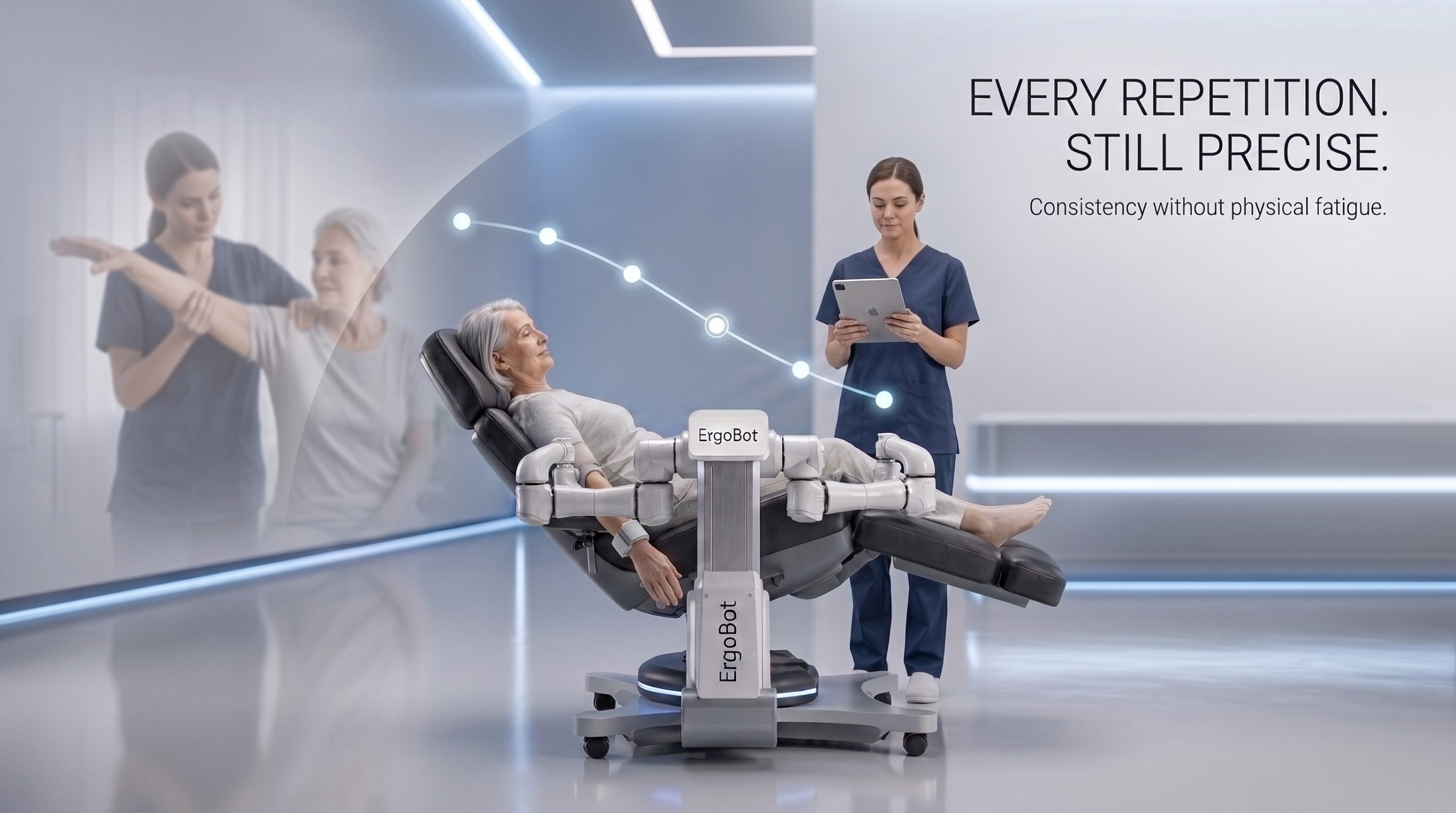
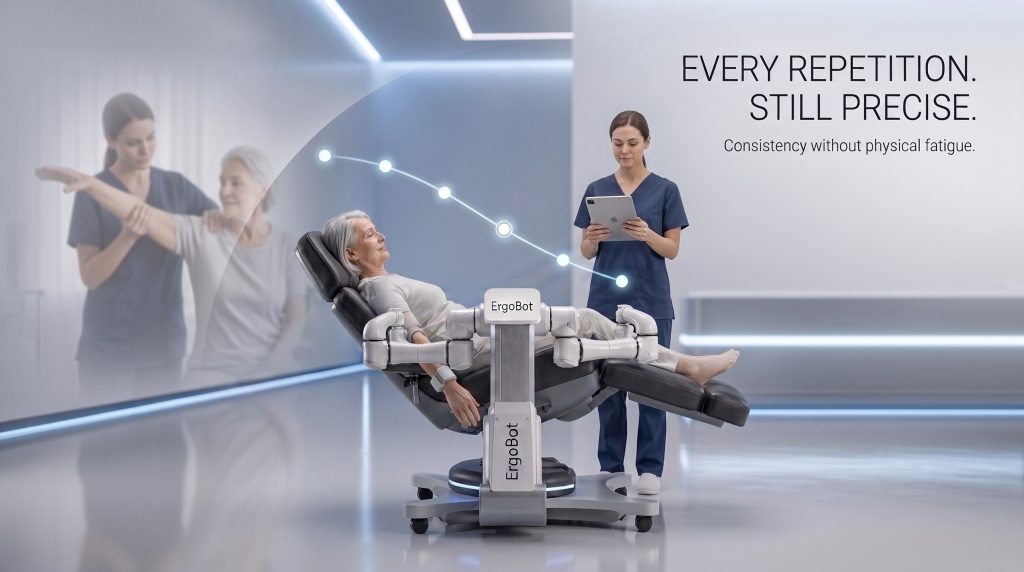
Robotic systems do not experience muscular fatigue or distraction. When a specific clinical protocol requires exactly 90 degrees of shoulder flexion at a velocity of 5 degrees per second, the ErgoBot executes it flawlessly for the entire duration of the session. This mathematical consistency ensures that the joint capsule is stretched gently and continuously, eliminating the unpredictable force spikes and angular deviations that naturally occur when a human therapist’s arms grow tired during a long session.
High-Volume Therapeutic Dosage Without Physical Fatigue
Neuroplasticity and tissue adaptation require high-volume repetition. A human therapist manually lifting and moving a heavy, flaccid, or spastic leg will inevitably fatigue after 10 to 15 minutes of continuous motion. This limits the overall dosage of therapy a patient can receive in a single day. ErgoBot removes this physical constraint. It can provide 45 minutes of continuous, perfectly executed cyclical motion, delivering the high-dose Neuromuscular Re-education required to keep synovial fluid circulating without exposing the clinician to overuse injuries.
Scalable Clinical Ratios (Multiplying Output Safely)
Manual therapy is strictly a 1-to-1 ratio: one therapist’s hands are occupied entirely by one patient’s limb. In the face of the staffing crisis, this model is mathematically unsustainable. Because ErgoBot executes the mobilization autonomously under predetermined parameters, it does not require an occupational therapist to physically hold the patient. A single clinician can oversee three to four patients simultaneously utilizing ErgoBot stations. This effectively triples a facility’s therapeutic output without increasing payroll or compromising the quality of the mobilization.
Seamless Integration with Objective Diagnostics
Manual therapy relies heavily on a clinician’s subjective visual estimation to determine baseline mobility. ErgoBot, conversely, operates within a data-driven ecosystem. Before initiating therapy, clinicians utilize PhysioEye—a Markerless Motion Capture AI assessment tool.
PhysioEye instantly calculates spinal sway, angular velocities, and exact joint limitations. This frictionless diagnostic data provides exact spatial coordinates that are fed directly into ErgoBot, ensuring the machine’s parameters are perfectly matched to the patient’s objectively measured deficits, rather than relying on guesswork.
Millisecond Spasticity Response vs. Human Reflexes
Following a neurological event like a stroke, patients often suffer from velocity-dependent spasticity. If a joint is moved too quickly, the muscle aggressively and painfully contracts against the movement. When a human therapist feels a sudden spastic “catch,” their reaction time is limited by human biology—typically taking around half a second to stop the force.
ErgoBot utilizes high-frequency torque sensors to monitor tissue resistance continuously. If the system detects the microscopic onset of a spastic catch, it instantly pauses, reduces force, or reverses direction in milliseconds. This reaction time is far faster than human reflexes, ensuring the muscle is never traumatically overstretched.
Calming Rhythmic Consistency for Dementia Patients
Dementia drastically complicates physical therapy. The WHO reports that over 55 million people live with dementia globally. These patients often struggle with sensory processing. A human therapist’s natural variations in grip pressure, breathing, pace, and conversation can sometimes overstimulate or distress a patient with advanced cognitive decline, leading to combative resistance during manual therapy.
ErgoBot provides perfectly predictable, rhythmic, and consistent sensory input. This machine-driven consistency is often highly soothing to the central nervous system of a dementia patient, allowing them to relax into the passive movement much more readily than they would with the unpredictable tactile variables introduced by a human handler.
Granular Documentation vs. Vague Chart Notes
Manual therapy generates subjective chart notes (e.g., “Patient’s knee felt less stiff today; achieved roughly 80 degrees flexion”). This lack of objective data makes it difficult to prove clinical efficacy. ErgoBot generates millions of objective data points per session, recording exact torque resistance, active assistance percentages, and precise range of motion degrees. This allows physicians and nursing home managers to track a patient’s progress on a granular level, easily proving the necessity and efficacy of the intervention to insurance providers and auditors.
The Complete Clinical Care Pathway for Joint Mobilization
Hash-Tech GmbH views effective joint preservation as a continuous, closed-loop clinical pathway, moving from objective baseline diagnostics to automated therapy, and ending with longitudinal data tracking.
Assessment to Outcome: The Evidence-Based Workflow
The clinical journey begins with objective assessment. Using PhysioEye, the clinical team conducts a rapid, markerless diagnostic screening to identify the precise degrees of mobility loss. This data provides clinical decision support, allowing the occupational therapist to construct a highly specific treatment plan.
The patient then transitions to personalized robotic rehabilitation. Utilizing ErgoBot, the patient receives high-dose, perfectly consistent Passive Range of Motion Therapy in a safe, stationary environment. Finally, the system engages in longitudinal outcome monitoring, continually tracking the patient’s functional capacity over months and years. This pathway establishes a true Predictive Care model, predicting decline before functional independence is lost. By year five, as the PhysioEye app scales toward a baseline target of 2,000 active facility users, this interconnected data ecosystem will set a new global standard for geriatric musculoskeletal health.
Original Hash-Tech Insight
The physical therapy industry has long treated the occupational therapist as the literal “engine” of patient recovery, utilizing their bodies to lift and stretch patients. This model is broken. By transitioning the heavy, repetitive labor of joint mobilization to stationary robotic platforms, we do not replace the therapist; we elevate them. The clinician transitions from manual laborer to clinical architect. By utilizing advanced markerless AI for diagnostics and stationary robotics for execution, we preserve the therapist’s physical health and cognitive bandwidth for complex behavioral and cognitive-motor interventions that machines cannot perform.
Key Takeaways
-
Passive Range of Motion Therapy is biologically essential for circulating synovial fluid and preventing irreversible joint contractures in immobile patients.
-
The global occupational therapist shortage makes providing adequate 1-to-1 manual mobilization mathematically impossible for nursing facilities.
-
ErgoBot is a stationary upper and lower limb rehabilitation device for all joints (not an exoskeleton), completely eliminating the fall risks associated with wearable robotics.
-
PhysioEye provides markerless 3D AI computer vision diagnostics, objectively guiding the exact parameters for robotic therapy.
-
Stationary robotics provide advanced spasticity management through millisecond sensor adjustments, ensuring therapy is far safer than manual human intervention.
-
Automated rehabilitation workflows allow a single clinician to supervise multiple patients safely, directly mitigating workforce deficits.
Frequently Asked Questions
Why is synovial fluid important in Passive Range of Motion Therapy? Articular cartilage does not have blood vessels. Synovial fluid acts as the joint’s lifeblood, delivering oxygen and removing metabolic waste. Because this fluid only circulates through the mechanical compression and distraction of the joint, passive movement is the only way to keep the joint tissue alive in a paralyzed or immobile patient.
How quickly can a joint contracture develop in an older adult? Without consistent movement, structural changes in the muscle and connective tissue can begin in as little as three to seven days. Within weeks, these changes can calcify into permanent contractures, completely destroying the patient’s functional independence.
Why is ErgoBot designated as a stationary device rather than an exoskeleton? Safety is the absolute priority in geriatric care. Wearable exoskeletons force frail patients to actively balance and bear weight, carrying a high risk of catastrophic falls. ErgoBot is a stationary rehabilitation system that fully supports the patient’s weight, allowing them to receive multi-joint therapy with zero risk of falling.
Can PhysioEye track a patient with dementia who cannot follow instructions? Yes. Because PhysioEye is a markerless 3D AI assessment tool, it does not require the patient to wear sensors or step onto specific platforms. It can passively analyze a patient’s natural kinematic movements—such as pacing or sit-to-stand transitions—extracting critical clinical data without causing distress or requiring strict compliance.
How does robotic therapy manage muscle spasticity better than a human? Spasticity is highly velocity-dependent. If a muscle is stretched too fast, it reflexively seizes. Human therapists often cannot react quickly enough when a heavy limb suddenly catches. ErgoBot’s high-frequency sensors detect microscopic changes in torque instantly, pausing or reversing the movement in milliseconds to protect the tissue from tearing.