
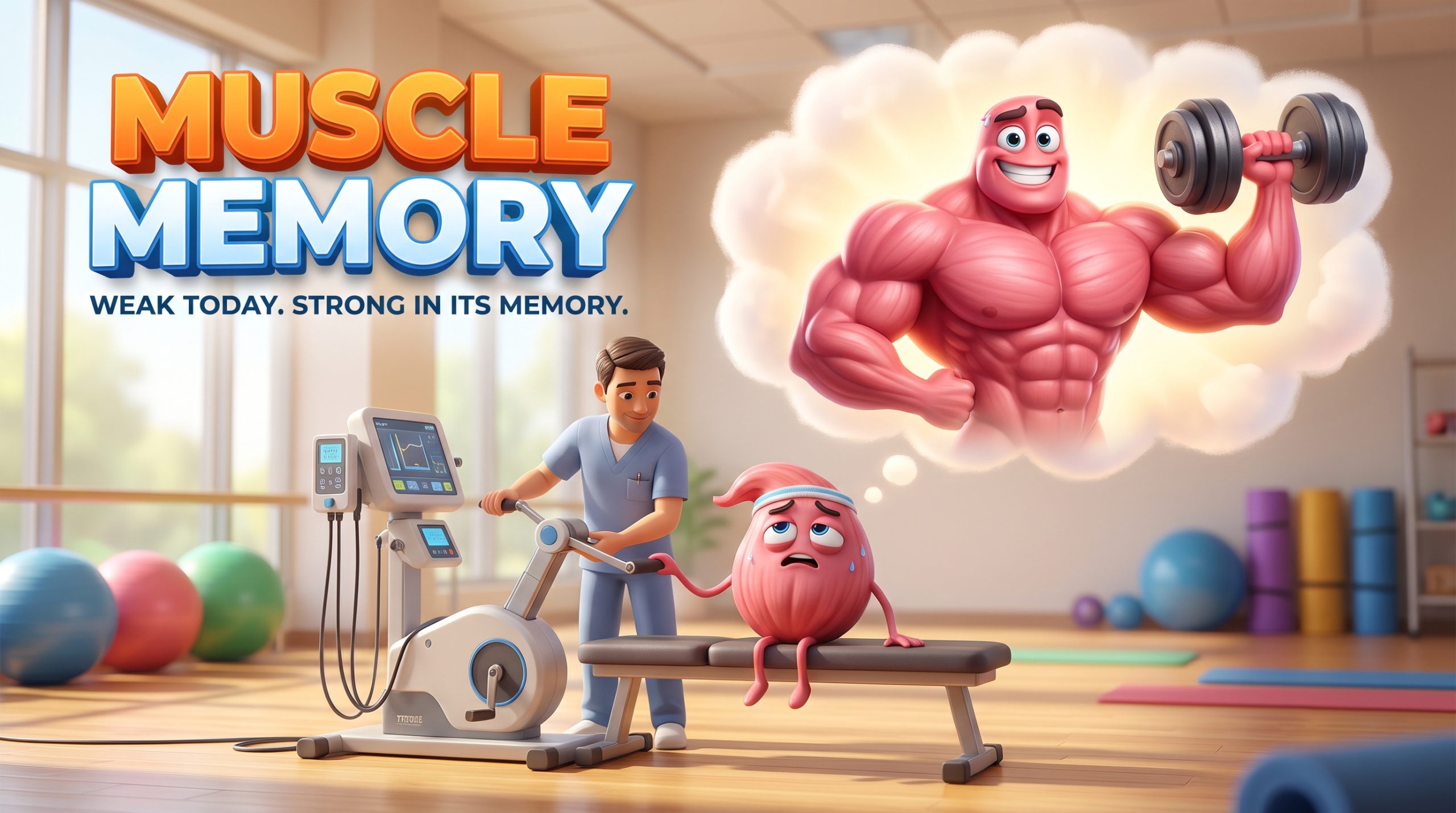
What Is Muscle Memory? Why Previously Trained Muscles Regain Strength Faster in Rehabilitation
Muscle memory is a dual-layered biological phenomenon combining rapid central nervous system re-learning with persistent cellular adaptations inside skeletal muscle fibers, including retained myonuclei, epigenetic DNA methylation signatures, and growth-associated proteins. Because these biological imprints survive periods of detraining and clinical immobilization, previously trained muscles regain strength significantly faster upon reloading. Stationary robotic ergotherapy systems like ErgoBot allow clinicians to deliver early, controlled mechanical loading safely from a seated position—reactivating muscle memory while protecting vulnerable joints from fall risks and overload.
One of the most demoralizing moments in orthopedic or geriatric rehabilitation occurs when a previously active patient faces weeks of bed rest, casting, or post-surgical immobilization. Watching quadriceps atrophy or grip strength plummet in a matter of weeks frequently triggers fear and hopelessness, convincing patients that years of hard-earned physical resilience have been permanently erased.
Yet modern skeletal muscle biology tells a far more optimistic story. When previously active individuals resume structured mechanical loading, they do not start back at zero. Through a well-documented biological phenomenon known as muscle memory, skeletal muscle and the central nervous system retain structural, molecular, and neural imprints of prior training—allowing strength and muscle mass to return dramatically faster than it took to build them initially. Understanding how this cellular machinery operates—and how stationary robotic rehabilitation can safely reactivate it—is transforming how clinics approach post-injury recovery and deconditioning.
Beyond the Gym Myth: Do Trained Muscles Really Regain Strength Twice as Fast?
In popular fitness culture, “muscle memory” is often cited casually alongside the claim that previously trained individuals regain strength twice as fast as beginners. In clinical physical medicine, that shorthand deserves closer scientific scrutiny.
Recent randomized human trials demonstrate that the retraining advantage is remarkably real—and in specific controlled settings, it closely mirrors a two-to-one recovery ratio. In a 2024 randomized controlled trial comparing 20 weeks of continuous resistance training against 10 weeks of training, 10 weeks of complete detraining, and 10 weeks of retraining, previously trained participants regained the leg strength and muscle cross-sectional area lost during their 10-week hiatus within just the first 5 weeks of retraining, ultimately matching the final outcomes of the continuous-training group (Halonen et al., 2024).
Crucially for geriatric rehabilitation, this accelerated recovery is not exclusive to young athletes. In a clinical trial involving older adult men who underwent 12 weeks of resistance training followed by 12 weeks of complete detraining, participants required less than 8 weeks of retraining to fully restore their maximal strength, accompanied by a 29% rebound in type II muscle fiber hypertrophy and a 72% surge in satellite cell availability (Blocquiaux et al., 2020).
However, clinicians should avoid framing “twice as fast” as a guaranteed mathematical constant for every patient. As a critical 2025 evaluation in The Journal of Physiology emphasizes, recovery velocity varies considerably based on patient age, duration of disuse, injury severity, and systemic health—and reflects a complex interplay between cellular memory and neuromuscular re-learning rather than a single isolated mechanism (Serrano, Dupont-Versteegden & Murach, 2025).
The Biological Architecture of Skeletal Muscle Memory
For decades, clinicians attributed rapid strength recovery purely to the nervous system—the brain “remembering” how to coordinate motor units, synchronize firing rates, and reduce antagonist co-contraction. While rapid neural re-adaptation remains a foundational driver of early strength gains, molecular research over the past six years has confirmed that skeletal muscle tissue itself stores a physical, cellular record of prior mechanical loading.
1. Myonuclear Permanence and Survival Through Immobilization
Skeletal muscle fibers are among the few multinucleated cells in the human body. When a muscle adapts to resistance loading, resident stem cells (satellite cells) fuse with existing fibers to donate new myonuclei, expanding the fiber’s transcriptional capacity to synthesize contractile proteins.
Historically, physiologists assumed these extra nuclei died off through apoptosis whenever a muscle atrophied. Human biopsy studies now refute that assumption. A 2024 human intervention study confirmed that after 10 weeks of resistance training followed by 16 weeks of detraining, muscle fiber volume shrank back toward baseline, yet the newly acquired myonuclei persisted—leaving previously trained type II fibers with 33% more myonuclei than untrained control limbs (Cumming et al., 2024).
Even more directly relevant to orthopedic physical therapy, a 2025 clinical study examining patients subjected to 6 weeks of strict immobilization following an Achilles tendon rupture found no detectable loss of myonuclei from human muscle fibers (Horwath et al., 2025). Even when a limb is locked in a cast and loses significant circumference, the cellular command centers required to rebuild that tissue remain intact.
2. Epigenetic “Epi-Memory” Inside the Nucleus
Beyond keeping extra nuclei, skeletal muscle alters how its DNA is chemically tagged. Nucleus-specific DNA methylomics research has revealed that prior loading leaves persistent hypomethylation patterns—a biochemical “epi-memory”—on genes responsible for muscle growth and structural remodeling (Wen et al., 2021). Because these growth-related gene promoters remain unwrapped and transcriptionally accessible during periods of detraining, reintroducing mechanical tension triggers a far faster surge in gene expression and protein synthesis than occurs in unconditioned tissue (Sharples & Turner, 2023).
3. Retained Proteomic Signatures
Adding a third molecular layer, a landmark 2025 proteomics investigation demonstrated that human skeletal muscle retains elevated concentrations of specific growth- and remodeling-associated proteins—including calpain-2, carbonyl reductase 1, and histone H1.5—even after 2.5 months of complete detraining (Hulmi et al., 2025). Rather than completely resetting its internal biochemistry during a layoff, the muscle maintains a primed proteomic scaffold ready to respond to reloading.
| Biological Layer | Persistent Adaptation Retained During Disuse | Clinical Impact During Rehabilitation |
| Neuromuscular (Central) | Stored motor engrams and corticospinal recruitment patterns | Rapid restoration of coordination, force timing, and joint stability |
| Myonuclear (Cellular) | Retained myonuclei inside shrunken muscle fibers despite immobilization | Eliminates the delay of recruiting new satellite cells before protein synthesis accelerates |
| Epigenetic (Genomic) | Persistent DNA hypomethylation of anabolic and structural genes | Faster transcriptional activation once mechanical tension is reapplied |
| Proteomic (Molecular) | Retained baseline elevation of key remodeling proteins (e.g., calpain-2) | Primed intracellular machinery accelerates structural tissue rebuilding |
The Clinical Warning: When Repeated Disuse Imprints a Negative Memory
While muscle memory offers profound hope for active adults recovering from an isolated injury, emerging research uncovers a sobering clinical flip side—particularly in geriatric care and post-acute hospitals.
A 2026 study published in Advanced Science revealed that muscle memory cuts both ways: while young adult muscle demonstrates transcriptional resilience during intermittent disuse, repeated episodes of disuse atrophy imprint a negative molecular memory in aged skeletal muscle, increasing transcriptional susceptibility to accelerated muscle wasting with each subsequent period of bed rest (Turner et al., 2026).
This finding directly explains why recurrent hospitalizations drive such rapid Hospital-Acquired Deconditioning and accelerate Frailty Syndrome in Geriatrics. Conversely, a 2026 synthesis in Genes emphasizes that preserving epigenetic plasticity through consistent, structured physical activity is one of the primary biological defenses against sarcopenia and impaired post-injury regeneration (Godlewski et al., 2026). For clinical teams, the mandate is unmistakable: interrupting disuse early with safe mechanical loading is biologically urgent.
The Rehabilitation Bottleneck: Why Patients Cannot Simply Reload on Their Own
This creates a major operational dilemma for physiotherapy departments and long-term care facilities. The biological infrastructure to recover strength rapidly is already sitting inside the patient’s muscle fibers—waiting for a consistent mechanical loading signal to reactivate it.
However, the patients who need that signal most—post-surgical orthopedic patients, stroke survivors, and deconditioned older adults—cannot safely walk into a weight room or perform heavy free-weight exercises. Joint pain, post-operative load precautions, postural instability, fear-avoidance behaviors, and profound initial weakness prevent them from generating the consistent, high-repetition movement volume required to wake up dormant motor pathways and cellular memory.
Conventional alternatives also present clinical friction:
-
Manual Therapist Mobilization: Manually supporting and guiding a heavy, weak limb through hundreds of precise repetitions per day causes severe physical fatigue for therapists and lacks standardized force control.
-
Wearable Exoskeletons: Bulky wearable suits require lengthy harness strapping, introduce joint alignment shear forces across fragile or swollen articulations, and expose unstable patients to over-ground balance and fall hazards.
Reactivating Muscle Memory Safely with ErgoBot
To bridge the gap between biological readiness and physical vulnerability, Hash-Tech GmbH developed the ErgoBot system. ErgoBot is engineered specifically as a stationary upper- and lower-limb rehabilitation robot for all joints—it is definitively not a wearable exoskeleton, gait suit, or conventional gym strength-training machine.
Patients remain comfortably and safely seated in a clinical chair or wheelchair, connecting to the system via minimal, clinically accurate ring-shaped attachments rather than restrictive straps or rigid full-limb frames. By eliminating over-ground fall hazards and minimizing setup friction, ErgoBot allows clinicians to reintroduce precise mechanical loading immediately—progressing seamlessly as the patient’s neural and cellular muscle memory awakens:
1. Interrupting Disuse Early with Passive Range of Motion
In the earliest window following surgery or prolonged bed rest—when voluntary drive is minimal and the risk of negative molecular atrophy signaling is highest—ErgoBot delivers smooth, controlled Passive Range of Motion Therapy. Gentle cyclic mobilization preserves capsular compliance for Joint Stiffness Prevention and Joint Contracture Prevention, while feeding steady proprioceptive input back to the central nervous system.
2. Re-Engaging Motor Pathways via Active-Assisted Ergotherapy
As soon as trace voluntary muscle activation returns, clinicians transition ErgoBot into active-assisted Robotic Assisted Ergotherapy / Occupational Therapy. Because the system detects patient intent and supplies only the torque needed to complete the anatomical trajectory, patients can execute hundreds of accurate repetitions without resorting to trunk compensations. This high-repetition precision directly drives Neuromuscular Re-education, allowing the central nervous system to quickly retrieve stored motor recruitment patterns.
3. Triggering Cellular Hypertrophy with Controlled Active Resistance
Once full joint control is re-established, ErgoBot shifts seamlessly into Personalized Rehabilitation using graded active resistance across targeted upper- and lower-limb joints. Whether guiding Post-Operative Hip Recovery, Knee Replacement Rehabilitation, or geriatric reconditioning, this seated mechanical loading supplies the exact physiological stimulus needed to wake up retained myonuclei, hypomethylated genes, and proteomic scaffolds—rebuilding functional force rapidly without placing weight-bearing shock on healing joints.
To verify that muscular reactivation translates into real-world movement quality, clinicians can complement ErgoBot therapy with objective Automated Mobility Assessment through PhysioEye. Via ErgoBot PhysioEye integration, care teams track Longitudinal mobility assessment metrics over time, confirming that regained limb capacity directly restores safe, symmetrical Functional Mobility.
Key Takeaways
-
Muscle Memory Is Biologically Verified: Faster strength recovery after detraining is driven by both central neuromuscular re-learning and persistent cellular adaptations inside muscle fibers.
-
Cellular Infrastructure Survives Immobilization: Human trials confirm that myonuclei, epigenetic DNA methylation tags, and key remodeling proteins persist even after weeks of detraining or strict clinical immobilization.
-
Retraining Speed Has Clinical Nuance: Controlled studies show previously trained muscles can recover losses in roughly half the time of a break (such as 5 weeks following a 10-week layoff), though exact recovery rates depend on age, disuse severity, and health status.
-
Repeated Disuse Harms Aged Muscle: In older adults, recurrent bed rest or hospitalization can imprint a negative molecular memory that accelerates muscle wasting, making early intervention critical.
-
Safe Mechanical Reactivation with ErgoBot: Stationary seated ergotherapy using minimal ring-shaped attachments allows clinicians to progress seamlessly from passive mobilization to active-assisted and resistive loading—waking up muscle memory with zero over-ground fall risk.
Frequently Asked Questions
What actually causes muscle memory at the biological level? Muscle memory is driven by two complementary systems: central nervous system motor memory (rapidly restoring muscle fiber recruitment and coordination) and cellular memory inside skeletal muscle fibers themselves, including retained myonuclei, epigenetic DNA methylation markers, and persistent remodeling proteins.
Do previously trained patients really regain strength twice as fast? In controlled human trials—such as regaining losses from a 10-week break within 5 weeks of retraining—recovery can occur at roughly twice the pace of initial adaptation or detraining. However, exact timelines vary based on age, injury severity, and how quickly safe mechanical loading is resumed.
Does clinical immobilization after surgery erase muscle memory? No. Recent human biopsy research confirms that even 6 weeks of strict clinical immobilization following an Achilles tendon rupture causes no detectable loss of myonuclei, meaning the cellular foundation for rapid rebuilding remains intact once controlled reloading begins.
Why is repeated bed rest so dangerous for older adults? Emerging research shows that while young skeletal muscle rebounds resiliently from intermittent disuse, repeated episodes of disuse atrophy in aged muscle can imprint a negative molecular memory, increasing susceptibility to progressive muscle wasting and frailty.
Is ErgoBot a wearable exoskeleton or a gym strength-training machine? Neither. ErgoBot is strictly a stationary upper- and lower-limb rehabilitation robot designed for all-joint ergotherapy. Patients remain safely seated and connect via minimal ring-shaped attachments, allowing safe passive, active-assisted, and guided resistive therapy without wearable harness hazards or over-ground fall risks.