
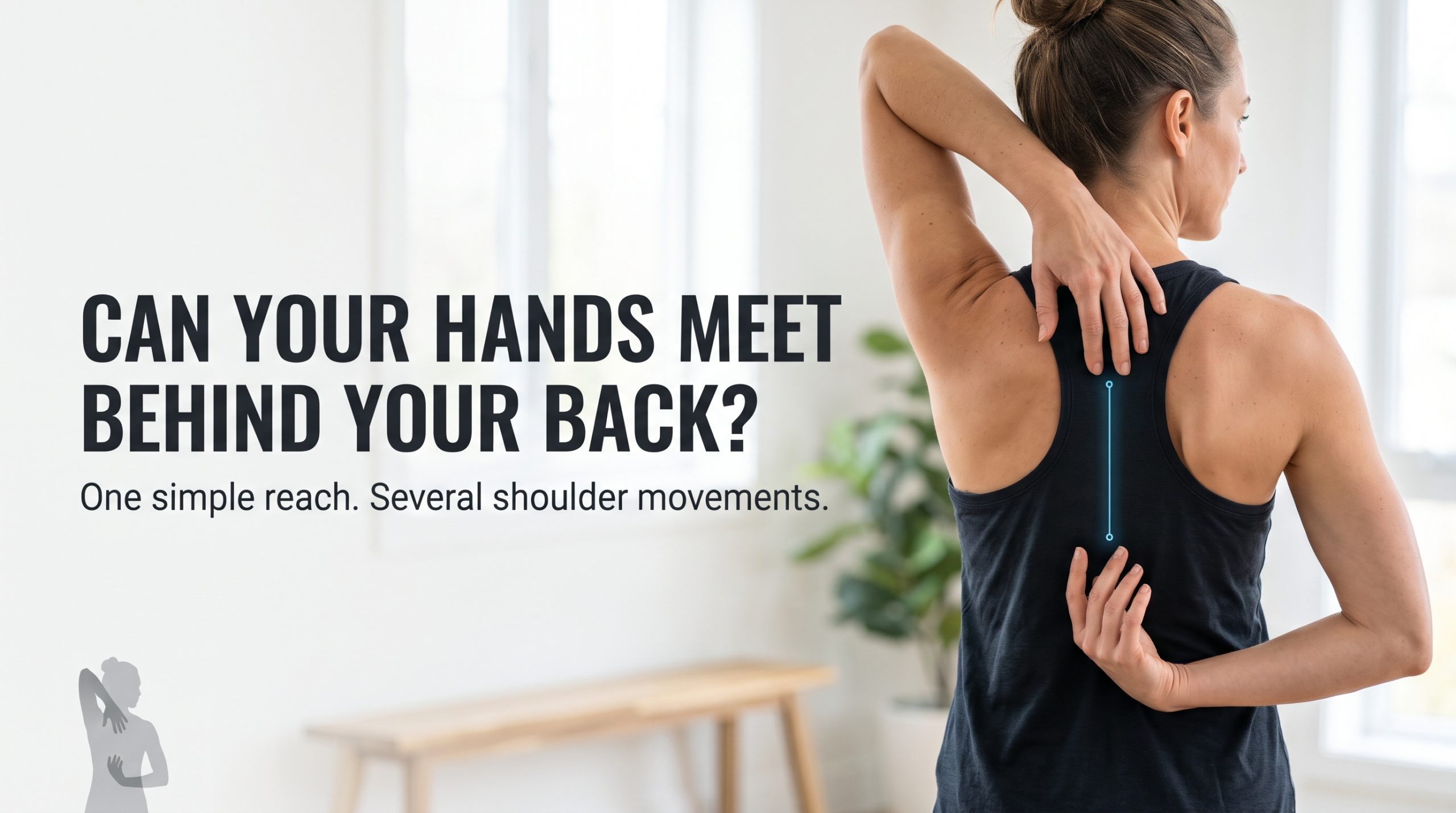
Apley Scratch Test: What Can Reaching Behind Your Back Reveal About Your Shoulder?
Reaching behind your back to hook a bra strap, tucking in a shirt, or retrieving an item from a back pocket requires a highly complex, multi-joint movement pattern. In clinical practice, shoulder dysfunction frequently manifests during these exact multi-planar activities of daily living. When a patient presents with shoulder pain, stiffness, or post-injury functional loss, evaluating isolated shoulder motions (such as simple forward flexion) provides an incomplete picture of their functional capacity.
To rapidly screen overall shoulder girdle mobility, physical therapists and orthopedic clinicians rely on the Apley Scratch test. This classic physical examination protocol combines multiple shoulder motions into functional reaching tasks, offering an immediate window into joint health, capsular flexibility, and rotator cuff integrity.
The Apley Scratch test evaluates functional shoulder range of motion through three composite movement patterns: overhead reaching, external rotation, and internal rotation behind the back. While invaluable for rapid screening, visual scoring lacks precise angular quantification. Integrating markerless 3D motion analysis like PhysioEye transforms this qualitative screening into objective, sub-millimeter kinematic data.
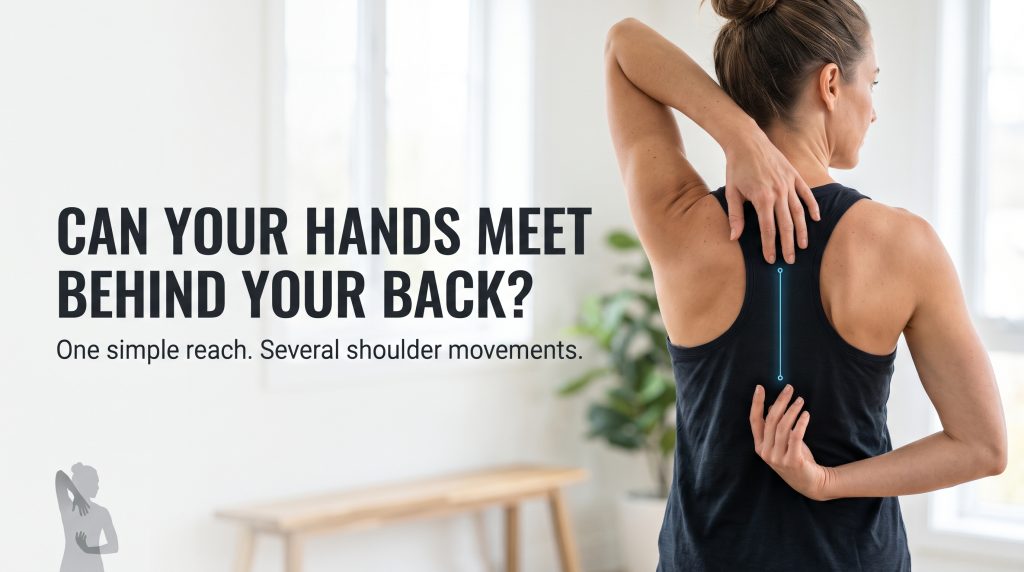
What Is the Apley Scratch Test?
First popularized by orthopedic surgeon A. Graham Apley, the Apley Scratch test is a functional maneuver designed to assess active Range of Motion Assessment across the shoulder complex.
Unlike isolated goniometric measurements that evaluate single-plane joint angles (such as pure glenohumeral abduction), the Apley Scratch maneuver combines abduction, adduction, internal rotation, external rotation, extension, and scapular motion into three distinct functional reaching maneuvers:
Anatomical Significance of Reaching Behind the Back
The behind-the-back component of the Apley Scratch test is often the most restricted maneuver in clinical practice. Successfully reaching up the spine requires a synchronized combination of:
-
Glenohumeral joint extension and maximal adduction.
-
Glenohumeral internal rotation.
-
Scapular anterior tilt and protraction.
When any component of this kinetic chain breaks down—whether due to muscle weakness, capsular tightness, or pain—the patient’s ability to reach up the spine degrades significantly.
What Does an Abnormal Apley Scratch Test Reveal?
Because the Apley Scratch maneuver challenges multiple anatomical structures simultaneously, restrictions or asymmetry during testing provide vital diagnostic clues regarding underlying shoulder pathologies:
Adhesive Capsulitis (Frozen Shoulder)
Adhesive capsulitis involves fibrotic thickening and shrinkage of the glenohumeral joint capsule. Internal rotation in adduction is typically one of the first movements severely restricted. Patients with frozen shoulder exhibit marked deficits during behind-the-back reaching, often failing to reach past the ipsilateral gluteal region.
Rotator Cuff Tendinopathy and Tears
The rotator cuff muscles—supraspinatus, infraspinatus, teres minor, and subscapularis—dynamically stabilize the humeral head within the glenoid fossa. Deficits during overhead reaching frequently point to supraspinatus impingement or tear, while severe restrictions during internal rotation highlight subscapularis involvement.
Posterior Capsule Tightness and Subacromial Impingement
In overhead athletes or manual workers, repetitive micro-trauma can cause contracture of the posterior glenohumeral capsule. This tightness forces the humeral head to translate anteriorly and superiorly during flexion, compressing subacromial structures and limiting behind-the-back reaching.
Scapular Dyskinesis and Trunk Compensations
When shoulder joint excursion is limited, patients instinctively compensate. During the Apley Scratch maneuver, clinicians frequently observe trunk leaning, scapular hiking, or excessive cervical flexion as the body attempts to bypass glenohumeral restrictions.
How Clinicians Perform and Score the Assessment
In standard clinical environments, the clinician instructs the patient to execute the test while standing or sitting comfortably:
-
Overhead Reach: The patient raises their affected arm overhead and reaches behind their neck to touch the superior angle of the opposite scapula (evaluating abduction and external rotation).
-
Behind-Back Reach: The patient lowers their arm and reaches behind their lower back, attempting to slide their knuckles up the spine to touch the inferior angle of the opposite scapula (evaluating internal rotation and extension).
-
Contralateral Comparison: The clinician repeats the instructions for the opposite arm to establish a bilateral baseline.
Qualitative Scoring and Its Limitations
In traditional practice, the therapist visually measures the distance between the patient’s fingertips and specific anatomical landmarks (such as spinous process levels T7 or L3). While quick and requiring zero specialized equipment, traditional visual scoring presents clear limitations:
-
Inaccurate Distance Estimates: Visual estimates using vertebral levels (e.g., “reaches to L1 vs T12”) vary based on patient spinal anatomy and therapist palpation errors.
-
Masked Compensations: The human eye struggles to isolate true glenohumeral internal rotation from compensatory forward trunk leaning or scapular tilting.
-
Poor Longitudinal Sensitivity: Small, clinically meaningful improvements in joint flexibility (such as 3° to 5° of internal rotation) remain undetected by crude visual benchmarks.
To support evidence-based care, clinics require tools that transform qualitative reaching observations into precise, objective 3D spatial data.
Elevating Assessment with Markerless 3D Kinematics via PhysioEye
At Hash-Tech GmbH, our biomedical engineering approach focuses on modernizing clinical evaluations without adding setup complexity. The PhysioEye platform delivers Class Im CE-marked 3D Markerless Motion Capture without attaching physical markers, goniometers, or wearable sensors to the patient’s body.
Driven by advanced computer vision models like ViTPose, PhysioEye conducts an Automated Mobility Assessment during the Apley Scratch test and related shoulder protocols.
As the patient executes reaching maneuvers, PhysioEye tracks 3D spatial coordinates, calculating exact joint angles, scapular symmetry, and compensatory trunk movements. The software generates an objective digital baseline that streamlines Clinical Decision Support and supports long-term Longitudinal mobility assessment.
Closing the Rehabilitation Loop with ErgoBot Ergotherapy
When PhysioEye identifies severe shoulder internal rotation deficits, rotator cuff weakness, or capsular contracture, clinicians require safe, repeatable physical intervention tools.
While some developers have experimented with wearable upper-body exoskeletons, wearable suits present major hurdles in shoulder therapy: rigid mechanical pivot points fail to match the dynamic translational center of the glenohumeral joint, risking severe joint shear and soft-tissue injury.
To resolve these anatomical risks, Hash-Tech GmbH designed the ErgoBot system. ErgoBot is engineered specifically as a stationary upper- and lower-limb rehabilitation robot for all joints—it is definitively not a wearable exoskeleton, gait suit, or strength training machine.
Patients remain safely and comfortably seated while interfacing with ErgoBot using minimal, clinically accurate ring-shaped attachments connected to the affected limb. These minimal ring interfaces replace outdated fork-type end-effectors, preventing localized pressure spikes and accommodating hypertonic deformities.
ErgoBot delivers high-dose Robotic Assisted Ergotherapy / Occupational Therapy and Passive Range of Motion Therapy, offering gentle, motor-assisted stretching for Joint Stiffness Prevention and Neuromuscular Re-education. This targeted approach supports Robotic Shoulder Rehabilitation without subjecting patients to joint misalignment risks or therapists to physical lifting strain.
Through complete ErgoBot PhysioEye integration, healthcare providers can measure baseline Apley Scratch deficits on PhysioEye, deliver high-density robotic joint ergotherapy on ErgoBot, and re-assess the patient to verify objective functional gains over time.
Key Takeaways
-
Functional Composite Screen: The Apley Scratch test evaluates combined abduction, adduction, extension, internal rotation, and external rotation across three reaching maneuvers.
-
Pathology Biomarker: Behind-the-back reaching deficits strongly correlate with posterior capsule tightness, adhesive capsulitis, subscapularis tendinopathy, and scapular dyskinesis.
-
Overcoming Visual Limits: Markerless 3D tracking via PhysioEye replaces subjective fingertip estimates with precise, sub-millimeter angular kinematics and compensation detection.
-
Stationary Ergotherapy Safety: Interventions using ErgoBot deliver targeted joint mobilization via minimal ring-shaped end-effectors, completely avoiding the joint shear hazards of wearable exoskeletons.
Frequently Asked Questions
What is the Apley Scratch test used for? The Apley Scratch test is a functional physical examination maneuver used by clinicians to rapidly evaluate active range of motion, capsular flexibility, and joint coordination across the shoulder complex.
Which shoulder motions are tested during behind-the-back reaching? Reaching behind the back evaluates a composite movement pattern consisting of glenohumeral internal rotation, extension, and adduction, combined with scapular protraction and anterior tilting.
How does PhysioEye measure the Apley Scratch test without physical sensors? PhysioEye utilizes Class Im CE-marked 3D markerless motion capture powered by advanced computer vision models. As the patient executes reaching movements, the software dynamically tracks 3D spatial coordinates, calculating joint angles and compensatory movements without requiring physical markers or wearable hardware.
Is ErgoBot classified as a wearable upper-body exoskeleton? No. ErgoBot is strictly a stationary upper and lower limb rehabilitation robot designed for joint ergotherapy. Patients remain comfortably seated during therapy and connect via minimal ring-shaped end-effectors, eliminating the joint misalignment errors and harness hassles of wearable suits.
Why is behind-the-back reaching typically restricted in frozen shoulder? Adhesive capsulitis causes fibrotic contraction of the inferior and posterior glenohumeral joint capsule. Because reaching behind the back requires maximal internal rotation and extension, capsular tightness severely restricts this specific movement early in the disease process.