
Clinical Decision Support: 7 Powerful Ways PhysioEye Helps Clinicians Make Faster, More Objective Mobility Decisions
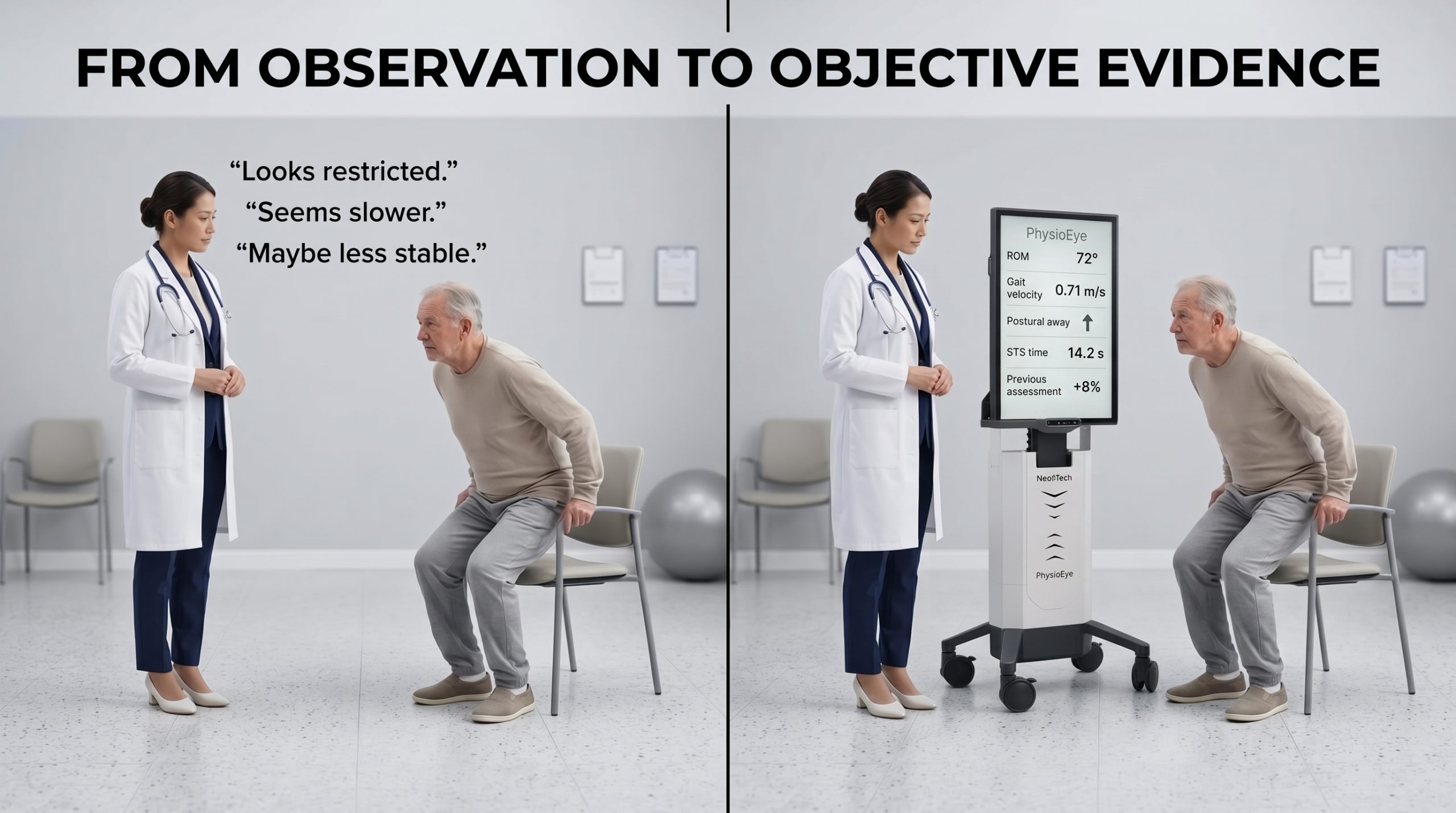
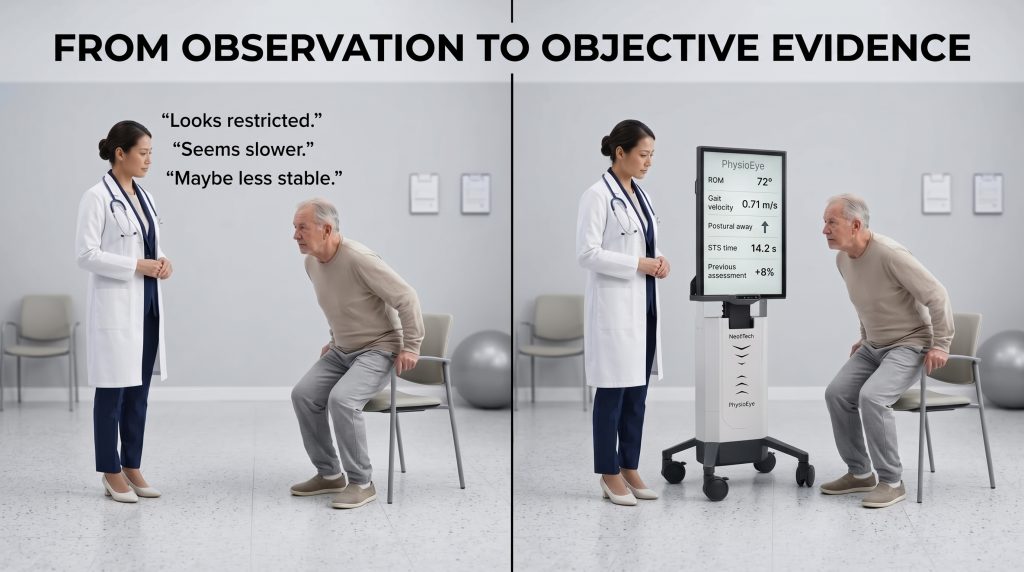
Rehabilitative medicine has long relied on observational assessments, forcing clinicians to estimate joint angles, grade functional performance by eye, and manually record metrics on paper or standard spreadsheets. While experienced practitioners develop strong clinical intuition, human observation is difficult to standardize, quantify, or compare reliably across extended treatment timelines. Modern clinical workflows require objective precision. By transforming continuous 3D spatial data into clear kinematic variables, advanced technological frameworks bridge the gap between raw data collection and expert interpretation.
At Hash-Tech GmbH, our approach is built on a fundamental principle: clinical decision support does not replace human expertise. Instead, systems like the PhysioEye markerless 3D motion analysis platform reduce the administrative and cognitive burden of manual measurement, converting visual observation into measurable, comparable evidence. Below are seven powerful ways structured kinematic data streamlines clinical decision-making.
Decide What Needs Attention First
What Is Initial Clinical Prioritization?
Initial clinical prioritization is the systematic process of evaluating a patient across multiple movement domains—such as posture, balance, gait performance, and joint range of motion (ROM)—to identify the primary driver of functional restriction. According to guidance from the World Health Organization (WHO), comprehensive geriatric evaluation requires structured screening to target limited healthcare resources effectively.
PhysioEye streamlines this initial phase by capturing multidimensional movement profiles in a single assessment. Rather than generating an unmanageable volume of numerical data, the system structures kinematic outputs so clinicians can immediately determine whether a patient’s primary deficit lies in postural control, locomotor velocity, or isolated joint stiffness. This objective clarity directs the subsequent physical examination toward the most clinically relevant areas without wasting time on guesswork.
Decide Whether a Limitation Is Actually Measurable
How Is Range of Motion Quantified Objectively?
Quantifying range of motion involves capturing precise joint angle coordinates across sagittal, frontal, and transverse planes during active or passive movement. Systematic reviews archived in the National Institutes of Health (NIH) PubMed database demonstrate that traditional manual goniometry and visual estimation suffer from substantial inter-rater and intra-rater variability due to inconsistent landmark placement and variable manual stabilization.
Using automated spatial tracking, PhysioEye’s ROM module provides objective kinematic measurements of specific joint capabilities. This shifts clinical documentation from subjective qualitative descriptions—such as “shoulder flexion appears moderately restricted”—to exact angular values recorded under standardized protocols. It is important to note that the software measures the kinematic parameter; the human clinician interprets whether that specific numerical restriction holds clinical significance for the individual.
| Assessment Approach | Traditional Visual & Manual Method | AI-Assisted Kinematic Measurement (PhysioEye) |
| Data Acquisition | Manual goniometers and visual estimation | Automated 3D contactless spatial tracking |
| Reliability | Prone to inter-rater and intra-rater variability | High measurement consistency across evaluations |
| Documentation | Qualitative notes and manual entry | Quantitative angular values and standardized logs |
| Workflow Impact | Time-consuming setup and manual recording | Rapid, non-invasive assessment capture |
Decide Which Functional Mobility Problem Deserves Further Investigation
What Defines Multidimensional Functional Mobility?
Functional mobility encompasses complex, multi-joint movement patterns required for independent living, including walking, rising from a chair, and maintaining postural stability. Research highlighted by the Centers for Disease Control and Prevention (CDC) indicates that isolated joint restrictions do not always correlate linearly with overall functional decline.
A patient may present with restricted joint mobility while maintaining acceptable functional independence, or conversely, exhibit normal isolated joint measurements alongside severe dynamic instability. PhysioEye combines metrics from gait analysis, the Timed Up and Go (TUG), the Five Times Sit to Stand Test, and balance assessments to construct a multidimensional movement profile. This integration helps clinicians determine whether further diagnostic investigation should target muscular strength, vestibular balance, dynamic coordination, or structural joint flexibility.
Decide Whether a Patient’s Mobility Is Changing
Why Longitudinal Trajectories Matter More Than Single Scores
A single clinical assessment provides only a static snapshot of a patient’s physical state. Evaluating rehabilitation progress requires tracking movement trajectories across weeks and months. Modern measurement science emphasizes that clinical decision-making relies heavily on responsiveness and minimal clinically important differences rather than isolated baseline scores.
Through continuous Longitudinal Mobility Assessment, PhysioEye logs kinematic trends over time, allowing treatment teams to answer a critical question: What has changed since the last evaluation? Detecting subtle downward trends in Gait Speed Measurement or Postural Sway Assessment enables care teams to prompt timely clinical reviews before minor functional drops escalate into acute mobility crises.
Decide Whether the Rehabilitation Target Should Change
How Objective Data Refines Rehabilitation Targets
Rehabilitation targets must adapt dynamically as a patient progresses through recovery. When repeated assessments reveal persistent movement asymmetries, declining gait parameters, or altered trunk mechanics, therapists must decide whether to modify their therapeutic focus.
As established in modern motor control research, not all kinematic asymmetries are pathological; many represent natural adaptations or structural variations. PhysioEye identifies and quantifies these movement characteristics objectively, but the clinician determines their clinical meaning. By reviewing concrete kinematic shifts, the physical therapist can refine rehabilitation targets with confidence, ensuring interventions address true functional bottlenecks. When targeted joint mobilization or strength training is required, clinicians can integrate interventions utilizing stationary systems such as ErgoBot, which provides controlled upper- and lower-limb ergotherapy without the balance risks associated with wearable exoskeletons.
Decide Whether the Patient Is Responding to the Intervention
How to Distinguish True Change from Measurement Error
Determining intervention efficacy requires comparing standardized measurements taken before and after a treatment block. However, raw numerical differences can sometimes reflect measurement error rather than true physiological adaptation.
By utilizing standardized capture protocols, PhysioEye helps clinicians calculate whether observed improvements in joint ROM or gait velocity exceed baseline measurement error. This objective outcome evidence provides a clear foundation for clinical teams to decide whether to continue, modify, or expand the current rehabilitation plan. When paired with the comprehensive care continuum—moving from objective assessment to targeted robotic therapy via Robotic Assisted Rehabilitation—longitudinal tracking ensures every therapeutic adjustment is supported by verifiable data.
Decide When More Clinical Assessment Is Needed
What Triggers a Comprehensive Clinical Review?
Markerless motion capture systems do not independently diagnose medical conditions or prescribe automated medical treatments. Instead, unusual kinematic shifts or sudden performance declines function as objective triggers for human clinical attention.
Evidence compiled by NICE Guidelines emphasizes that relying on a single fall-risk or mobility test is insufficient for comprehensive patient management. When PhysioEye detects a meaningful drop in functional test scores, increasing postural instability, or a new restriction in movement symmetry, it alerts the care team. This prompts the physician or physical therapist to conduct a deeper clinical review, physical examination, or medication review, ensuring potential underlying issues are never overlooked.
Key Takeaways
-
Objective Measurement: PhysioEye converts visual observation into quantified 3D kinematics, eliminating the guesswork of manual goniometry and visual scoring.
-
Multidimensional Profiles: Integrates gait, balance, TUG, and joint ROM assessments to give clinicians a complete functional overview.
-
Longitudinal Tracking: Monitors patient trajectories over time to detect stabilization, improvement, or early deterioration.
-
Enhanced Decision Support: Provides structured evidence that helps clinicians prioritize interventions and evaluate treatment responses.
-
Human-Centric Judgment: AI supplies objective measurement, while the expert clinician retains full responsibility for diagnosis and treatment planning.
Future Outlook
By 2040, clinical decision support software will be deeply integrated into routine geriatric and orthopedic care workflows. Ambient 3D vision systems will operate seamlessly in rehabilitation clinics and long-term care facilities, continuously tracking patient movement kinetics during everyday activities. Predictive machine learning models will synthesize this continuous data stream to forecast functional decline before it manifests clinically. This evolution will transform physical rehabilitation from a reactive treatment model into a proactive, precision-guided discipline, optimizing recovery timelines and preserving long-term independence.
Frequently Asked Questions
Does PhysioEye diagnose medical conditions automatically? No. PhysioEye is designed exclusively as a clinical decision support tool that captures objective 3D kinematics. It does not provide automated diagnoses or independent treatment prescriptions; all data interpretation and medical decisions remain strictly under the purview of the licensed clinician.
How does markerless motion capture improve upon manual goniometry? Manual goniometry is susceptible to significant inter-rater and intra-rater variability due to manual palpation differences and posture stabilization challenges. Markerless 3D systems automate spatial coordinate tracking, providing highly consistent angular measurements without requiring physical sensor attachments.
Can PhysioEye track patient progress over multiple months? Yes. The platform supports longitudinal monitoring, allowing clinicians to compare current kinematic metrics against historical patient baselines to evaluate whether a rehabilitation program is producing measurable functional improvements.
How does ErgoBot integrate with PhysioEye data? Once PhysioEye identifies specific joint mobility or functional deficits, clinicians can utilize ErgoBot—a stationary upper- and lower-limb rehabilitation device—to deliver targeted, adaptive joint ergotherapy based on the objective assessment findings.
Is PhysioEye compliant with medical device regulations? Yes. PhysioEye is developed and classified as a Class Im CE-marked medical device, ensuring it meets stringent European regulatory standards for safety, quality management (ISO 13485), and clinical performance.
What types of clinical facilities benefit most from markerless motion capture? Orthopedic outpatient clinics, geriatric rehabilitation centers, hospitals, and long-term care facilities benefit significantly by replacing subjective visual estimates with objective, audit-ready kinematic data.