
Range of Motion Assessment: How PhysioEye Makes Joint Mobility Measurable
The ability to move a joint through its full anatomical arc—pain-free and with appropriate neuromuscular control—is the foundation of human biomechanics. When this capacity degrades due to aging, injury, or neurological disease, the secondary impacts on a patient’s functional independence are severe.
According to the World Health Organization (WHO), an estimated 1.71 billion people worldwide currently live with musculoskeletal conditions that limit mobility and dexterity. Effectively treating this massive population relies on one foundational clinical metric: the range of motion assessment.
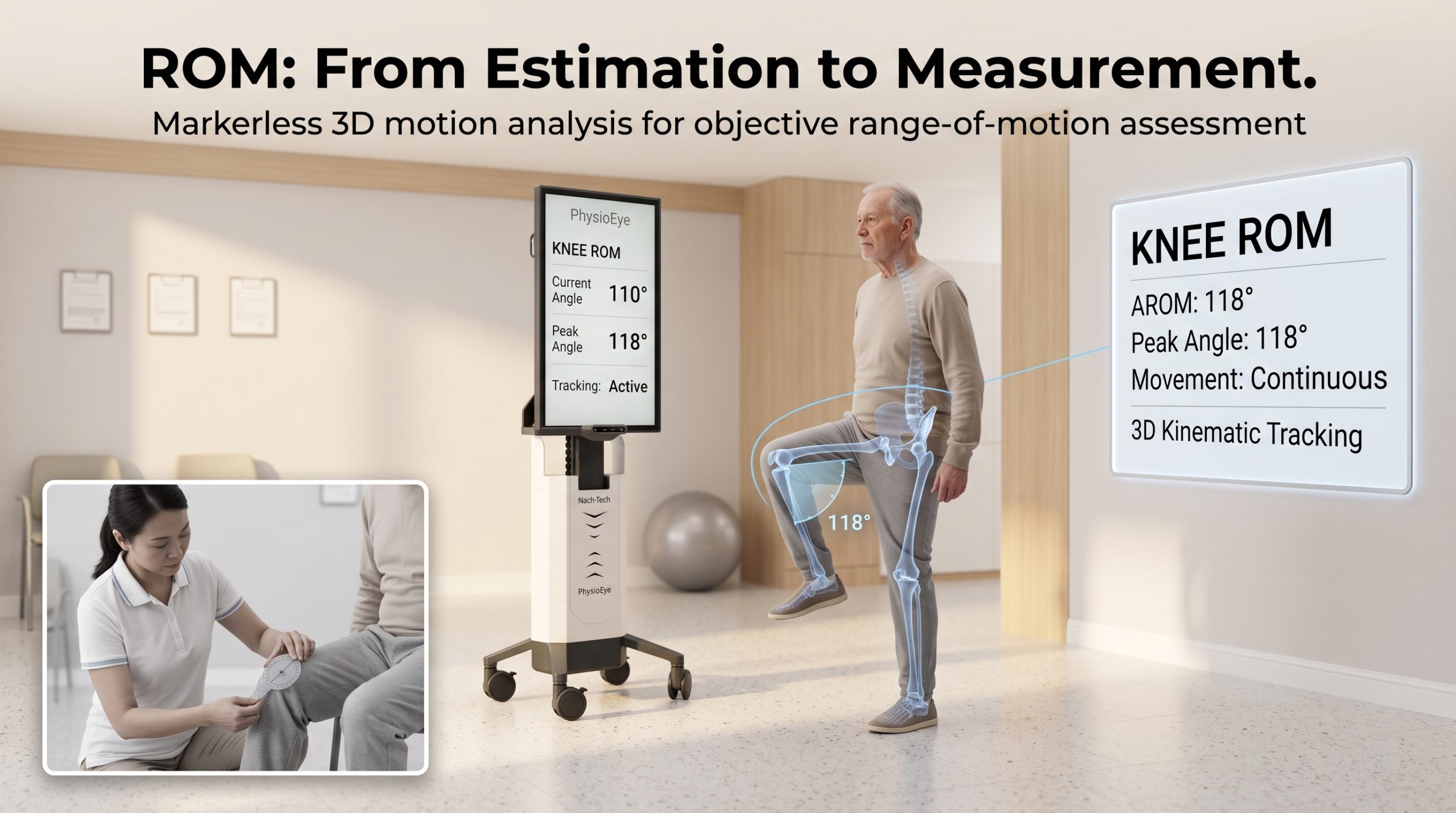
Historically, range of motion assessment has been an analog, highly subjective process. Today, however, the integration of advanced computer vision and spatial computing is transforming range of motion assessment from an educated estimation into a precise, laboratory-grade data point.
The Clinical Importance of Range of Motion Assessment
range of motion assessment is not just a measure of flexibility; it is a primary vital sign for the musculoskeletal system. Clinical literature confirms that functional parameters, specifically ROM and isometric strength, are the leading predictors of an individual’s movement proficiency. In a 2024 study published in the National Library of Medicine regarding functional movement capacity, researchers highlighted that individuals scoring poorly on mobility and ROM metrics are at a significantly heightened risk for permanent disability and acute injury.
Clinicians divide range of motion assessment into two primary categories:
-
Active Range of Motion (AROM): The degree to which a patient can voluntarily contract their muscles to move a joint through its arc. This tests both joint mobility and muscle strength.
-
Passive Range of Motion (PROM): The degree to which a clinician can move the patient’s relaxed joint through its arc. This isolates the structural limits of the joint capsule, ligaments, and fascia.
Tracking minute changes in AROM and PROM is how therapists determine whether a rehabilitation protocol is succeeding or if surgical intervention is necessary.
The Statistical Flaws of Traditional Goniometry
For over a half-century, the universal goniometer—a simple plastic protractor with two arms—has been the standard tool for range of motion assessment. While inexpensive and portable, it suffers from severe inter-rater reliability issues.
A clinician must visually estimate the joint’s axis of rotation, align the stationary arm with a proximal bone landmark, and align the moving arm with a distal landmark, all while holding the patient’s limb steady. This human element introduces massive statistical variability.
A comprehensive comparative study on goniometric validity revealed the startling extent of this measurement error. When compared against the radiographic gold standard (X-rays), measurements taken with a universal goniometer showed an absolute maximal error of up to 10.3° for extension and ± 11.5° for total range of motion.
When a 10-degree margin of error exists purely due to the assessment tool, determining true clinical progress becomes impossible. A patient might appear to have gained 8 degrees of mobility in their knee, when in reality, they have regressed, and the variance is entirely due to different therapists placing the plastic arms slightly differently.
Digitizing Mobility: The PhysioEye Advantage
To eliminate the statistical noise of human error, modern physical therapy is shifting toward markerless 3D motion capture. The PhysioEye system replaces the plastic protractor with advanced depth-sensing hardware and neural networks to track human kinematics in real-time.
By utilizing high-fidelity optical sensors the system creates a digital twin of the patient’s skeletal structure.
-
Sub-Millimeter Precision: Research validating 3D markerless motion capture tools demonstrates exceptional accuracy. These systems achieve a Root Mean Square Error (RMSE) of less than 3°, drastically outperforming the 10-degree error rate of manual goniometers.
-
Dynamic Assessment: A goniometer requires the patient to freeze in place while the clinician measures a static angle. PhysioEye calculates joint angles continuously at 30 to 60 frames per second, allowing therapists to assess the exact degree of ROM during dynamic, fluid movements like squats, lunges, or gait cycles.
Acting on the Data: Precision Recovery with ErgoBot
Once a specific ROM deficit is quantified, the physical intervention must be equally precise. For patients requiring targeted joint mobilization—particularly those with severe ROM limitations or high fall risks—standard free weights or complex walking exoskeletons are inappropriate and potentially dangerous.
Intervention is executed through the ErgoBot, a fully stationary upper- and lower-limb rehabilitation robot. ErgoBot is explicitly designed for joint-specific ergotherapy, completely removing the balance requirements of gait-assistance devices.
If the PhysioEye assessment reveals a patient lacks the final 15 degrees of knee extension, the ErgoBot is programmed to provide intelligent, motor-assisted therapy through exactly that specific arc of motion. The stationary design and non-restrictive ring attachments ensure the patient can rebuild joint mobility and muscular endurance with zero risk of falling or joint hyper-extension.
Original Hash-Tech Insight
The transition from analog estimation to digital verification is the most important leap in modern physical therapy. Relying on a plastic tool with a 10-degree margin of error to manage the rehabilitation of complex, post-surgical joints is no longer clinically defensible. By fusing high-definition depth cameras with advanced Python-driven biomechanical signal processing, we remove the guesswork from joint mechanics. Systems like PhysioEye and CareWell allow us to map the precise geometry of human movement, while stationary robotic systems like ErgoBot allow us to safely correct it. True healthcare innovation doesn’t just digitize old methods; it redefines the standard of accuracy entirely.
Key Takeaways
-
Massive Global Need: Over 1.71 billion people suffer from musculoskeletal conditions, making accurate ROM assessment a critical global healthcare priority.
-
The Error of Analog Tools: Clinical studies confirm that universal manual goniometers can produce measurement errors of over 10 degrees, compromising patient care data.
-
Unprecedented Precision: Markerless 3D tracking systems utilize advanced neural networks to map joint angles dynamically, reducing the margin of error to less than 3°.
-
Integrated Wellness Ecosystems: The CareWell platform ingests kinematic data to provide clinical supervisors with real-time, longitudinal tracking of patient progress.
-
Stationary, Safe Rehabilitation: Following assessment, the ErgoBot system provides targeted joint ergotherapy utilizing safe, minimal ring-shaped attachments, offering highly controlled resistance without the risks of wearable exoskeletons.
Frequently Asked Questions
Why is dynamic ROM assessment better than static assessment? Static assessment forces a patient to stop moving, which alters their natural biomechanics. Dynamic ROM assessment (via markerless tracking) measures the joint angles continuously while the patient performs functional movements, providing a much more accurate picture of how they actually move in daily life.
Can PhysioEye replace physical therapists? Absolutely not. PhysioEye is an advanced measurement tool that augments clinical expertise. It automates the data collection so that the physical therapist can spend 100% of their time designing interventions and providing hands-on care, rather than acting as a data-entry clerk.
How does ErgoBot differ from rehabilitation exoskeletons? Exoskeletons are wearable suits designed to assist with walking and over-ground mobility, which inherently carry a risk of falling for frail patients. ErgoBot is a strictly stationary system. It uses minimal ring-shaped attachments to isolate and rehabilitate specific joints (ergotherapy) without requiring the patient to bear weight or balance across a room.
What underlying technology drives markerless motion capture? Systems like PhysioEye rely on a combination of high-resolution depth cameras (like Intel RealSense) and deep learning algorithms (such as ViTPose) that are trained on millions of images to instantly recognize and map the human skeletal structure in 3D space.