
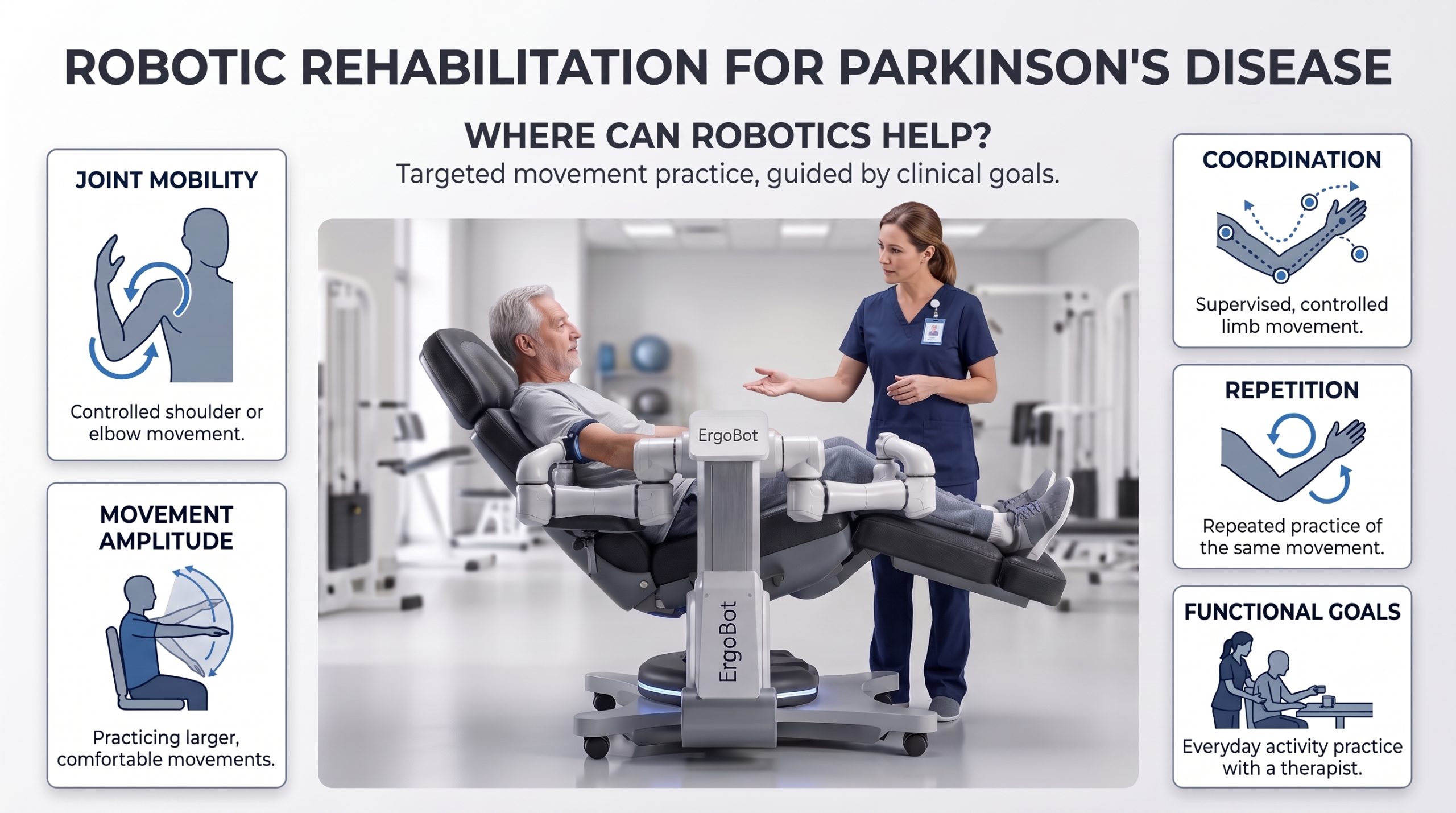
Robotic Rehabilitation for Parkinson’s Disease: Where Can Robotics Help?
Robotic rehabilitation for Parkinson’s disease delivers high-dose, task-specific motor training to address bradykinesia, rigidity, and freezing of gait. By pairing objective 3D markerless motion analysis with stationary joint ergotherapy, clinical teams can safely deliver high-repetition exercise without fall risks, promoting neuroplasticity and enhancing long-term quality of life.
Parkinson’s disease (PD) is a progressive neurodegenerative disorder characterized by the loss of dopaminergic neurons in the substantia nigra. This neural depletion disrupts basal ganglia circuitry, creating classic motor hallmarks: resting tremor, muscle rigidity, bradykinesia (slowness of movement), dynamic postural instability, and freezing of gait (FOG). As the disease advances, these motor impairments severely compromise Activities of Daily Living (ADL), increase dependence on caregivers, and elevate fall risks.
According to global epidemiological research published by the World Health Organization (WHO), Parkinson’s disease is the fastest-growing neurological condition worldwide, with prevalence doubling over past decades. While pharmacotherapy (such as levodopa) remains essential for symptom management, long-term pharmaceutical use is often accompanied by motor fluctuations and dyskinesia. Consequently, non-pharmacological physical interventions are vital. Modern robotic rehabilitation for Parkinson’s disease has emerged as a frontline clinical solution, offering targeted, high-repetition motor training that drives neuroplasticity and preserves functional independence.
The Neuromuscular Breakdown in Parkinson’s Disease
The motor deficits of Parkinson’s disease stem from impaired internal cueing mechanisms within the central nervous system. In healthy individuals, the basal ganglia generate automatic movement rhythms required for smooth locomotion and reaching. In Parkinson’s patients, this automaticity is disrupted, requiring patients to consciously execute every phase of a movement sequence.
Clinical reviews archived by the National Institutes of Health (NIH) highlight several distinct biomechanical obstacles in PD rehabilitation:
-
Freezing of Gait (FOG): Brief, sudden episodes where patients feel their feet are “glued to the floor,” occurring most frequently during gait initiation or turning.
-
Bradykinesia and Akinesia: Progressive reduction in movement amplitude and speed during continuous physical repetition.
-
Hypertonia and Rigidity: Increased passive resistance across flexor and extensor muscle groups, restricting shoulder and lower-limb Range of Motion.
-
Postural Deficits: Impaired automatic postural responses, leading to abnormal trunk leaning and elevated fall rates.
Where Can Robotics Help in Parkinson’s Rehabilitation?
Traditional physical therapy is crucial, but human clinicians encounter physical limitations when attempting to deliver the sheer volume of precise, rhythmic movements required to stimulate dopaminergic pathways and induce Neuroplasticity Training. Robotic devices bridge this operational gap by supplying consistent external mechanical cueing, quantifiable force feedback, and high repetition density.
| Clinical Parameter | Traditional Manual Physical Therapy | AI-Assisted Robotic Ergotherapy (ErgoBot) |
| Movement Repetition Density | 30 to 50 manual repetitions per session | 500 to 1,000+ controlled joint cycles per session |
| External Rhythm & Cueing | Variable verbal or visual therapist cues | Millisecond-precise mechanical rhythm delivery |
| Spasticity & Rigidity Resistance | Subjective manual resistance grading | Real-time torque monitoring in Newton-meters |
| Kinematic Tracking Accuracy | Visual inspection or manual goniometry | Sub-millimeter optical 3D motion capture |
| Patient Fall Risk During Therapy | High during over-ground balance drills | Zero over-ground fall risk with stationary seating |
Overcoming Bradykinesia with High-Dose Repetitions
In Parkinson’s disease, repetitive active movement normally causes progressively smaller and slower motor outputs (the hypokinetic sequence effect). Robotic systems counter this by enforcing constant amplitude and velocity. Systematic reviews published in Frontiers in Neurology demonstrate that high-dose robot-assisted training significantly improves motor scale scores, stride length, and overall walking speed compared to standard care alone.
Managing Muscular Rigidity and Preventing Joint Stiffness
Axial and appendicular rigidity creates persistent joint stiffness that limits joint excursion. Advanced robotic interfaces deliver smooth, motor-assisted Continuous Passive Motion (CPM) and active-assisted stretching. This gentle, high-frequency mobilization helps maintain tissue elasticity, supporting Joint Stiffness Prevention and reducing pain without causing micro-trauma to contracted tissues.
Delivering External Mechanical and Proprioceptive Cues
Because PD patients lose internal motor timing, they rely heavily on external sensory cues to bypass damaged basal ganglia pathways. Robotic devices serve as dynamic physical cues, guiding limbs through physiological trajectories at a constant cadenced rhythm. This persistent mechanical cueing helps patients override freezing episodes and re-establish smoother motor patterns.
Enabling Safe Upper and Lower Extremity Dual-Tasking
Functional impairment in PD extends beyond locomotion to include upper-limb dexterity, reaching, and shoulder coordination. Clinical trials indexed in PubMed Central confirm that intensive, task-oriented robotic upper-limb therapy yields significant improvements in manual dexterity (evaluated via the Nine-Hole Peg Test) and motor control.
Stationary Safety: Why ErgoBot Is Ideal for Parkinson’s Patients
When designing robotic solutions for progressive neurodegenerative conditions, safety and ease of access are paramount. Historically, clinics evaluated heavy wearable exoskeletons for gait retrain. However, wearable exoskeletons present distinct clinical challenges for Parkinson’s patients:
-
Freezing and Postural Panic: Strapping a patient with severe freezing or postural instability into a heavy wearable exoskeleton frame can provoke anxiety, worsening freezing episodes.
-
Rigidity Misalignment: Rigid wearable suits struggle to accommodate asymmetric axial rigidity, leading to joint shear forces.
-
Setup Overhead: Complex harness donning can consume 15 to 20 minutes of therapy time.
To eliminate these hazards, Hash-Tech GmbH developed the ErgoBot system. ErgoBot is engineered specifically as a stationary upper- and lower-limb rehabilitation robot for all joints—it is definitively not a wearable exoskeleton, gait suit, or strength training machine.
Patients remain safely seated in their chair or wheelchair while interfacing with ErgoBot using minimal, clinically accurate ring-shaped attachments connected to the limbs. These minimal ring interfaces replace outdated fork-type end-effectors, eliminating pressure points and accommodating hypertonic deformities. ErgoBot delivers targeted Parkinson’s rehabilitation through pure, motor-assisted joint ergotherapy with zero fall risk during therapy sessions.
Objective Kinematic Screening with PhysioEye
Effective robotic intervention requires accurate baseline screening to track disease progression and adjust therapy parameters over time. The PhysioEye platform provides Class Im CE-marked 3D markerless motion analysis, capturing precise movement metrics without attaching physical sensors or markers to the patient’s body.
Driven by computer vision models, PhysioEye evaluates dynamic movement during standard screening protocols like the Timed Up and Go (TUG) or Five Times Sit to Stand Test. PhysioEye automatically quantifies subtle kinematic biomarkers, including:
-
Sub-millimeter Postural Sway Assessment metrics.
-
Movement velocity degradation during continuous exercise.
-
Gait asymmetry and stride time variability.
The evaluation culminates in an Automated Geriatric Fall Risk Assessment / Fall Prevention report where the Fall Risk Index serves as the final feature of the diagnostic dashboard. This objective data flows directly into the clinical decision loop, enabling therapists to tailor ErgoBot treatment parameters with exact precision.
Key Takeaways
-
Targeting Core Deficits: Robotic rehabilitation for Parkinson’s disease directly addresses bradykinesia, muscle rigidity, and movement amplitude decay through high-repetition motor practice.
-
External Cueing Advantage: Consistent mechanical rhythms supplied by robotic systems help bypass damaged basal ganglia circuits, facilitating smoother movement initiation.
-
Stationary Ergotherapy Safety: Devices like ErgoBot provide isolated joint mobilization using minimal ring-shaped end-effectors, eliminating the postural anxiety and fall hazards of wearable exoskeletons.
-
Objective Markerless Assessment: PhysioEye captures 3D kinematic biomarkers without physical sensors, delivering an automated Fall Risk Index to guide personalized robotic therapy.
Frequently Asked Questions
Can robotic rehabilitation help reduce freezing of gait (FOG) in Parkinson’s patients? Yes. Robotic systems supply continuous external rhythm and velocity guidance, acting as a physical cueing mechanism. This external rhythmic driver helps bypass disrupted basal ganglia pathways, training patients to maintain stride length and cadence to reduce freezing frequency.
How does PhysioEye measure Parkinsonian motor deficits without attached sensors? PhysioEye utilizes Class Im CE-marked 3D markerless motion capture powered by advanced computer vision models. As the patient completes functional tasks, the software dynamically maps joint trajectories, calculating movement speed, range of motion, and posture sway metrics without requiring physical markers or wearable sensors.
Is ErgoBot safe for Parkinson’s patients with severe balance impairments? Yes. ErgoBot is a stationary rehabilitation device designed so that patients remain safely seated in a standard chair or wheelchair throughout treatment. Utilizing minimal ring-shaped end-effectors, it mobilizes the limbs without placing the patient in an unstable over-ground position.
How does robotic therapy complement Parkinson’s pharmacotherapy (e.g., Levodopa)? While medication helps restore chemical dopamine levels, it does not retrain motor patterns on its own. Robotic ergotherapy provides the high-dose, repetitive physical practice required to induce neuroplastic changes, maximizing motor function during “on” medication phases and maintaining joint flexibility during “off” periods.