
Falls in Older Adults: Why Do They Fall? The Hidden Movement Patterns AI Can Measure
Falls in older adults stem from complex interactions between age-related sensory degradation, central nervous system processing delays, and biomechanical compensations. While traditional visual screening misses subtle gait and posture deviations, advanced 3D motion capture technology uses artificial intelligence to detect hidden kinematic biomarkers, enabling proactive clinical interventions and automated fall risk prediction.
Accidental falls represent the leading cause of injury, loss of independence, and trauma-related hospitalization among seniors worldwide. Every year, millions of aging individuals experience an unexpected loss of balance that leads to severe fractures, prolonged bed rest, or permanent functional decline. While traditional clinical assessments often attribute these incidents to generalized frailty or muscle weakness, the underlying biomechanical reality is far more intricate.
According to global epidemiological data published by the World Health Organization (WHO), an estimated 684,000 fatal falls occur annually, making fall injury prevention a paramount public health priority. Uncovering why falls in older adults happen requires looking beyond gross motor deficits to identify sub-clinical, microscopic breakdowns in human movement control.
The Biomechanical Anatomy of Fall Risk: Why Do Seniors Fall?
Human locomotion requires continuous, real-time integration across the visual, vestibular, and proprioceptive systems, coupled with precise musculoskeletal motor execution. As individuals age, progressive physiological changes compromise this dynamic feedback loop. When a senior stumbles, their ability to execute a rapid compensatory step depends on millisecond-level neural transmission and explosive muscle power—both of which decline with age.
Clinical research archived by the National Institutes of Health (NIH) categorizes the primary contributors to accidental falls into three interconnected domains:
-
Neuromuscular Degradation: Age-related loss of Type II fast-twitch muscle fibers reduces peak power generation, limiting the body’s capacity to execute rapid protective stepping maneuvers.
-
Sensory Mismatch: Decreased plantar tactile sensitivity and age-related vestibular decline impair spatial awareness, increasing reliance on visual feedback during ambulation.
-
Central Processing Delays: Slowed central nervous system transmission delays the recognition of postural perturbations, lengthening reaction time during dynamic balance disruptions.
The Limitations of Traditional Visual Fall Screening
In conventional clinical practice, healthcare providers evaluate fall risk using standardized observational tools such as the Berg Balance Test, the Timed Up and Go (TUG), or the Short Physical Performance Battery (SPPB). While these ordinal scoring scales offer valuable functional benchmarks, they suffer from inherent clinical limitations:
-
Subjective Human Observation: The human eye cannot quantify sub-millimeter postural sway velocity, subtle trunk tilt acceleration, or micro-adjustments in stride symmetry.
-
Ceiling and Floor Effects: High-functioning seniors frequently pass basic observational screens despite harboring dangerous, hidden biomechanical compensations that manifest under real-world fatigue.
-
Reactive Rather Than Predictive: Standard screens typically identify high risk only after functional mobility has severely degraded or after a previous fall has already occurred.
Implementing effective Fall Prevention Strategies demands a transition from subjective visual observation to precise, objective digital health analytics.
5 Hidden Movement Patterns AI Can Measure Before a Fall Occurs
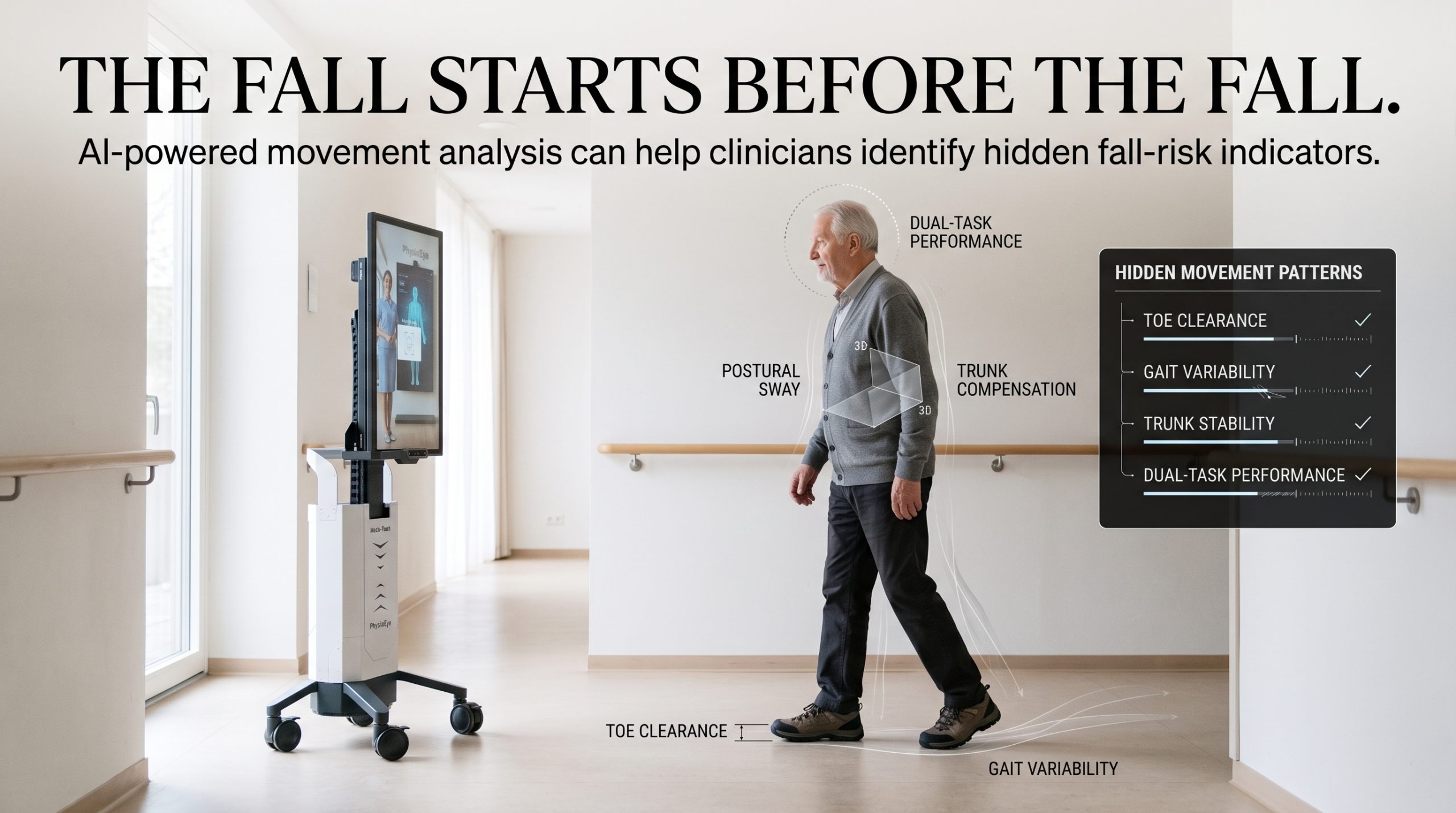
Artificial intelligence and computer vision platforms have unlocked unprecedented access to human movement dynamics. By analyzing high-density 3D spatial coordinates in real time, AI detects subtle, pre-symptomatic kinematic anomalies that human observers miss.
| Kinematic Feature | Traditional Visual Inspection | AI-Driven 3D Motion Analysis | Clinical Significance for Fall Risk |
| Minimum Toe Clearance (MTC) | Unmeasurable visually | Calculated in sub-millimeters | Identifies subtle trip hazards during swing phase |
| Gait Velocity Variability | Subjectively estimated | Microsecond-level stride timing | Detects executive motor control breakdown |
| Postural Sway Velocity | Gross balance observation | Millimeter center-of-mass tracking | Exposes hidden somatosensory & vestibular loss |
| Trunk Compensation Symmetry | Unquantified visual posture | Exact 3D angular kinematic calculation | Uncovers lateral instability during weight transfer |
| Dual-Task Gait Degradation | Binary pass/fail observation | Real-time velocity & cadence drop metrics | Highlights cognitive-motor interference |
Minimum Toe Clearance (MTC) Anomalies
Minimum Toe Clearance refers to the exact vertical distance between the shoe sole and the walking surface during the mid-swing phase of gait—a distance that often measures a mere 1 to 2 centimeters in healthy adults. As dynamic control declines, MTC becomes highly variable. AI motion tracking detects subtle drops in toe elevation, identifying Minimum Toe Clearance invisible fall risks weeks before a severe trip occurs.
Micro-Variability in Stride Timing
While a senior may appear to walk with a steady rhythm, microsecond variations in step duration reveal underlying motor control instability. AI algorithms evaluate stride-to-stride timing consistency, highlighting erratic motor patterns associated with subcortical vascular changes or early-stage Parkinson’s rehabilitation needs.
Elevated Postural Sway Velocity and Center of Mass Shift
During quiet standing or narrow-stance tasks, the body undergoes constant micro-corrections. AI-powered Postural Sway Assessment tracks center-of-mass displacement speed. Accelerated sway velocity indicates that proprioceptive feedback from the lower extremities is impaired, a key biomarker in Frailty Syndrome in Geriatrics.
Asymmetrical Trunk Compensations During Turning
Turning around tight corners requires precise lateral balance transfer. Seniors with hidden hip abductor weakness or unaddressed joint pain frequently lean their torso laterally to compensate. AI motion capture quantifies multi-planar trunk movement, identifying biomechanical imbalances that lead to loss of balance during directional changes.
Cognitive-Motor Dual-Task Breakdown
In everyday life, walking rarely occurs in isolation; seniors must navigate obstacles while talking, reading signs, or carrying objects. AI analytics measure speed and cadence drops during Dual-Task Gait Assessment, pinpointing cognitive-motor interference that drastically increases fall risk in community settings.
Transforming Fall Risk Assessment with PhysioEye
To operationalize these advanced biomechanical insights without burdensome clinical setup, Hash-Tech GmbH developed the PhysioEye platform. PhysioEye delivers Class Im CE-marked 3D markerless motion capture, eliminating the need for physical body markers, force plates, or wearable sensors.
Driven by computer vision models, PhysioEye conducts an Automated Mobility Assessment during functional tests like the Functional Reach Test or Five Times Sit to Stand Test. The platform analyzes joint trajectories, spatial symmetry, and movement velocity, culminating in a comprehensive Automated Geriatric Fall Risk Assessment / Fall Prevention report where the Fall Risk Index serves as the final feature of the evaluation dashboard.
Key Takeaways
-
Sub-Clinical Fall Risks: Falls in older adults are rarely random accidents; they stem from hidden biomechanical breakdowns like toe clearance variability and sway velocity spikes.
-
Beyond Visual Limits: Traditional observational balance scales miss micro-variability, whereas AI-powered 3D motion capture quantifies movement down to sub-millimeter levels.
-
Objective Diagnostic Dashboard: The PhysioEye platform automatically captures spatial kinematics without wearable sensors, presenting a validated Fall Risk Index as the final feature of the screening process.
-
Stationary Rehabilitation Safety: Interventions using ErgoBot deliver targeted joint ergotherapy via minimal ring-shaped end-effectors, completely avoiding the fall hazards and alignment issues of wearable suits.
Frequently Asked Questions
Why are visual balance tests insufficient for detecting early fall risks in seniors? Visual tests rely on ordinal scoring and human observation, which cannot measure sub-millimeter movement parameters like minimum toe clearance or center-of-mass sway velocity. AI motion capture detects these microscopic kinematic deviations long before they manifest as visible balance loss.
How does PhysioEye measure fall risk without attached sensors or markers? PhysioEye uses advanced depth sensing and computer vision algorithms to track joint centers dynamically in 3D space. As the patient completes standard movements, the system calculates range of motion, symmetry, and sway velocity, summarizing these metrics into a validated Fall Risk Index.
Is ErgoBot safe for elderly patients who have already experienced a severe fall? Yes. ErgoBot is a stationary rehabilitation device designed so that patients remain safely seated during treatment. Utilizing minimal ring-shaped end-effectors, it provides controlled motor-assisted joint mobilization without putting the patient at risk of losing balance or falling during therapy.
How does AI assist in differentiating between neurological and orthopedic fall risks? AI algorithms analyze movement patterns across multiple joints simultaneously. Neurological fall risks often display high stride variability and cognitive-motor dual-task breakdown, whereas orthopedic risks manifest as asymmetrical joint load distribution and localized range-of-motion restrictions.