
Active-Assisted Rehabilitation: How Intelligent Robotics Support Patients Rebuilding Independent Movement
The transition from complete muscular weakness or paralysis to voluntary, functional movement is one of the most critical and challenging phases of neurological recovery. Following a stroke, traumatic brain injury, or spinal cord trauma, patients often find themselves trapped in a frustrating clinical gap: they possess partial neural drive or trace muscle activation, yet lack the muscular strength to move their limbs through a complete functional arc of motion.
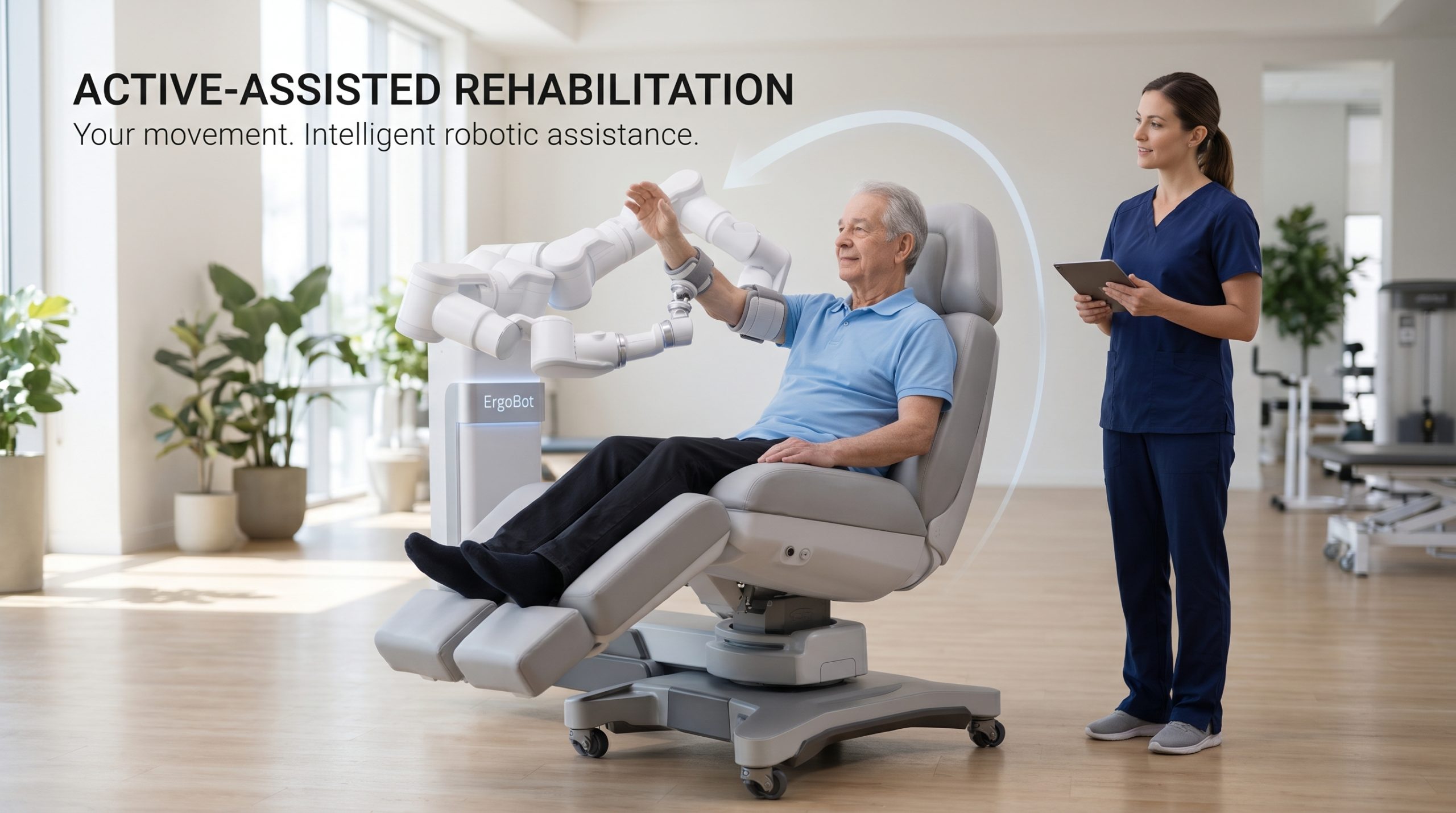
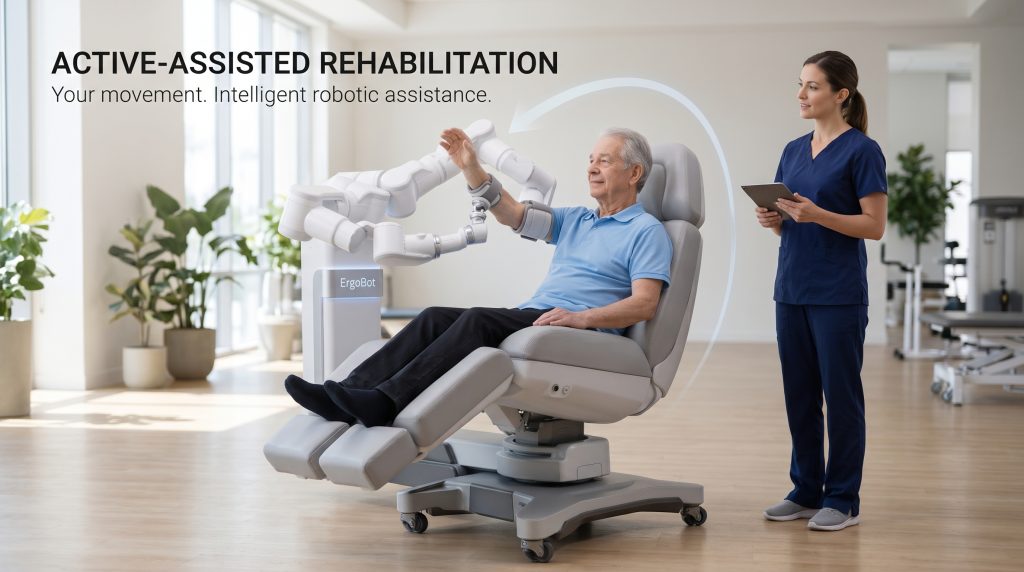
When a patient cannot complete a movement independently, traditional manual physical therapy typically relies on clinicians to physically lift and support the weight of the limb. However, manually estimating how much help a patient needs moment-by-moment is extraordinarily difficult for human therapists. Active-assisted rehabilitation addresses this challenge directly. By leveraging intelligent robotic force feedback, this control paradigm delivers precise “assistance-as-needed,” allowing patients to initiate movements voluntarily while the robotic system provides only the minimum mechanical support required to complete the task.
Active-assisted rehabilitation provides intelligent, adaptive mechanical support to bridge the gap between passive joint mobilization and fully independent movement. By utilizing “assistance-as-needed” control algorithms, stationary rehabilitation robotics provide just enough torque to help patients execute complete functional trajectories. This approach maximizes active neural engagement, prevents muscular compensation, and accelerates neuroplastic motor learning.
The Neuromuscular Spectrum: Bridging Flaccidity and Voluntary Control
Neuromuscular recovery following central nervous system injury does not occur instantly; it progresses along a continuous continuum of motor control. According to clinical guidelines indexed by the National Institutes of Health (NIH), stroke rehabilitation protocols must adapt dynamically as a patient transitions through distinct recovery stages (such as the Brunnstrom Stages of Stroke Recovery):
-
Passive Phase (Continuous Passive Motion): During early acute flaccidity, external motors safely guide the joint through pre-programmed ranges to preserve capsular flexibility and send proprioceptive feedback to the brain.
-
Active-Assisted Phase: As initial neural recovery begins, the patient can trigger or initiate a movement but lacks the motor unit recruitment to overcome gravity or joint stiffness.
-
Active / Resistive Phase: Once voluntary movement is established across full ranges, treatment shifts toward resistive strengthening and task-specific dexterity.
The Active-assisted rehabilitation phase is the most critical window for driving neuroplasticity. If a clinician provides too much assistance, the patient’s central nervous system stops actively attempting to recruit motor units (a phenomenon known as motor slackening). Conversely, if too little assistance is provided, the patient becomes fatigued, frustrated, and instinctively resorts to pathological compensatory movement strategies—such as trunk hiking or shoulder shrugging.
How Robotic Active-Assisted Rehabilitation Works: The “Assistance-as-Needed” Principle
Modern robotic systems execute active-assisted control using advanced impedance and admittance control algorithms. Rather than driving the limb along a rigid, unyielding trajectory, the robot acts as an intelligent mechanical partner:
-
Intention Detection: High-frequency force-torque sensors continuously monitor the user interface. When the patient exerts voluntary force toward a target trajectory, the robot detects the intentional effort.
-
Adaptive Torque Assistance: If the patient’s voluntary effort is sufficient to maintain movement speed, the robot remains transparent and applies zero force. If the patient’s velocity drops or their voluntary drive fades halfway through the reach, the robot seamlessly injects just enough mechanical torque to help them reach the target.
-
Preventing Compensatory Mechanics: If the patient attempts to bypass weak muscles by leaning their torso or hiking their scapula, optical sensors and mechanical constraints detect the deviation, guiding the effort strictly back into the primary joint trajectory.
Research archived in the Cochrane Database of Systematic Reviews confirms that electromechanical and robot-assisted arm training utilizing active-assisted control paradigms yields statistically significant improvements in upper-extremity Fugl-Meyer motor scores (p < 0.001) and Activities of Daily Living (ADL) independence compared to standard care alone.
Comparing Rehabilitation Control Modes
Understanding where Active-assisted rehabilitation fits within physical medicine requires comparing it directly against other common therapeutic modalities:
| Control Mode | Patient Voluntary Drive | Robotic Motor Role | Primary Clinical Goal |
| Passive Mode (CPM) | 0% (Passive / Flaccid) | 100% Mechanical Drive | Preserve ROM, reduce edema, maintain joint elasticity |
| Active-Assisted Mode | 1% to 99% (Partial / Traced) | Adaptive “Assist-as-Needed” | Drive neuroplasticity, empower voluntary recruitment |
| Active-Resistive Mode | 100% (Full Excursion) | Variable Opposing Resistance | Increase muscle mass, build explosive power |
| Bilateral Sync Mode | Healthy limb drives paretic side | Mirrors healthy limb motion | Encourage interhemispheric cortical transfer |
By delivering hundreds of precisely assisted repetitions per session, active-assisted robotic training bridges the gap between passive joint mobilization and full motor autonomy.
Clinical Applications Across Pathologies
Active-assisted robotic rehabilitation is uniquely versatile, supporting recovery across a broad spectrum of neurological and orthopedic conditions:
1. Robotic Stroke Rehabilitation
Following a stroke, damaged upper motor neurons impair voluntary muscle recruitment. Active-assisted therapy engages motor cortex circuits by rewarding patient effort: the moment the brain initiates a motor command, the robot validates that effort by helping the arm complete the motion. This immediate sensory-motor feedback loop accelerates Neuroplasticity Training and helps restore functional reaching.
2. Parkinson’s Disease and Bradykinesia
Parkinson’s patients frequently experience bradykinesia (slowness of movement) and hypometria (reduced movement amplitude). In Parkinson’s rehabilitation, active-assisted devices serve as a physical cueing mechanism. When a patient begins a reaching maneuver, the system provides rhythmic assistance to ensure the movement reaches full physiological amplitude, helping override central movement freezing.
3. Post-Operative Orthopedic Recovery
Following complex joint surgery, such as Knee Replacement Rehabilitation or rotator cuff repair, early movement is essential to support Joint Stiffness Prevention. Active-assisted mode allows patients to actively engage their muscles within safe, pre-programmed angular limits, accelerating recovery while protecting healing surgical structures.
Why Stationary Ergotherapy with ErgoBot Is Ideal for Active-Assisted Care
The mechanical design of a rehabilitation system directly impacts its safety and clinical efficacy during active-assisted training. While early developers attempted to build wearable upper-body exoskeletons, wearable suits introduce severe hurdles in active-assisted care:
-
Glenohumeral Misalignment: The biological shoulder joint center translates dynamically during movement. A rigid wearable exoskeleton with fixed mechanical pivots exerts unnatural shear forces on fragile joints during assisted reaching.
-
Setup Overhead: Strapping a weak or hemiparetic patient into a multi-segment exoskeleton suit takes 15 to 20 minutes of valuable clinical time.
-
Fall Hazards: Wearable gait and arm suits carry over-ground balance risks for patients with impaired postural control.
To solve these clinical challenges, Hash-Tech GmbH designed the ErgoBot system as a stationary upper- and lower-limb rehabilitation robot for all joints. ErgoBot is explicitly not a wearable exoskeleton, gait suit, or strength training machine.
Patients remain safely and comfortably seated in a standard chair or wheelchair while interfacing with ErgoBot using minimal, clinically accurate ring-shaped attachments connected to the limbs. These minimal ring interfaces replace outdated fork-type end-effectors, preventing pressure spikes and accommodating hypertonic joint contractures.
ErgoBot delivers high-dose Robotic Assisted Ergotherapy / Occupational Therapy, offering smooth, motor-assisted active-assisted training for Passive Range of Motion Therapy, Joint Contracture Prevention, and Neuromuscular Re-education without exposing patients to over-ground fall risks or therapists to physical lifting strain.
Key Takeaways
-
Empowering Intent: Active-assisted rehabilitation utilizes “assistance-as-needed” algorithms to help weak patients complete full movement cycles without causing motor slackening.
-
Preventing Compensation: Intelligent force sensors deliver targeted assistance along anatomical trajectories, preventing patients from resorting to energetic trunk compensations.
-
Stationary Safety Advantage: Devices like ErgoBot deliver targeted active-assisted joint ergotherapy using minimal ring-shaped end-effectors, completely avoiding the fall risks and joint shear hazards of wearable exoskeletons.
-
Objective Diagnostic Guidance: Markerless 3D tracking via PhysioEye measures the exact gap between active and passive range of motion, parameterizing robotic assistance for optimal recovery.
Frequently Asked Questions
What is active-assisted rehabilitation? Active-assisted rehabilitation is a therapeutic exercise paradigm where a patient actively initiates a movement using their own voluntary muscle power, and an external assistant (such as a physical therapist or intelligent robot) provides the remaining mechanical force required to complete the movement trajectory.
How does active-assisted mode differ from Continuous Passive Motion (CPM)? Continuous Passive Motion (CPM) moves the patient’s limb entirely passively with zero required muscle activation from the user. Active-assisted mode requires the patient to initiate or contribute voluntary motor effort, providing mechanical assistance only when voluntary force is insufficient to complete the movement.
Why is active-assisted therapy critical for neuroplasticity? Neuroplasticity requires active motor command generation from the central nervous system. By requiring the patient to initiate movement voluntarily before assistance is provided, active-assisted therapy reinforces motor cortex pathways far more effectively than passive movement.
Is ErgoBot classified as a wearable exoskeleton? No. ErgoBot is strictly a stationary upper and lower limb rehabilitation robot designed for joint ergotherapy. Patients remain safely seated next to the device and connect via minimal ring-shaped end-effectors, eliminating the mechanical setup hassles, joint alignment errors, and fall risks associated with wearable suits.
Can active-assisted robotic therapy be used for post-stroke hemiparesis? Yes. Active-assisted therapy is exceptionally beneficial for post-stroke hemiparesis. It allows stroke survivors who possess trace muscle activation to complete full-range reaching and leg extension exercises, helping retrain motor pathways and rebuild voluntary strength.