
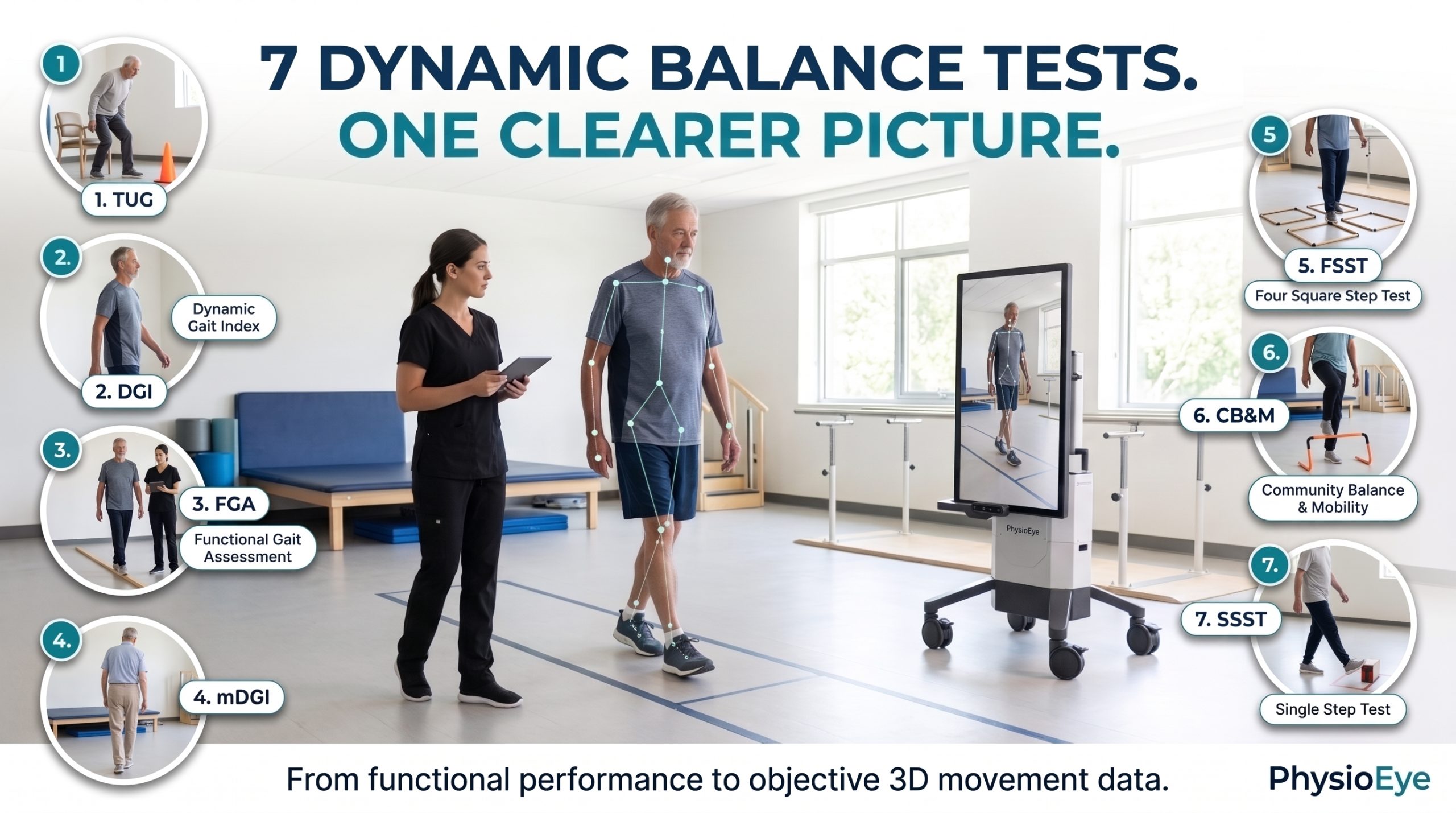
Dynamic Balance Tests: 7 Ways Clinicians Reveal Hidden Instability While You Walk, Turn and Step
Dynamic balance test is essential for identifying hidden postural instability in aging populations and neurological patients. Standardized clinical tools measure walking, turning, and stepping performance to quantify fall risks. Integrating advanced 3D motion analysis enables clinicians to transform subjective observational scores into precise, objective biomechanical data.
Postural stability during stationary standing is only one dimension of human motor control. In daily life, safe ambulation requires continuous, complex neuromuscular adjustments while walking over uneven terrain, turning around tight corners, navigating stairs, and stepping over unexpected obstacles. When neurological disease, orthopedic trauma, or age-related sarcopenia compromises these dynamic mechanisms, patients often experience insidious balance deficits that routine static examinations fail to reveal.
According to data compiled by the Centers for Disease Control and Prevention (CDC), more than 1 in 4 older adults experience a fall every year, with direct medical costs surpassing $50 billion annually. To intercept progressive functional decline before catastrophic falls occur, physical therapists and rehabilitation physicians rely on standardized dynamic balance test protocols. These clinical assessments challenge the vestibular, visual, and somatosensory systems simultaneously, providing actionable metrics to quantify patient instability and direct evidence-based interventions.
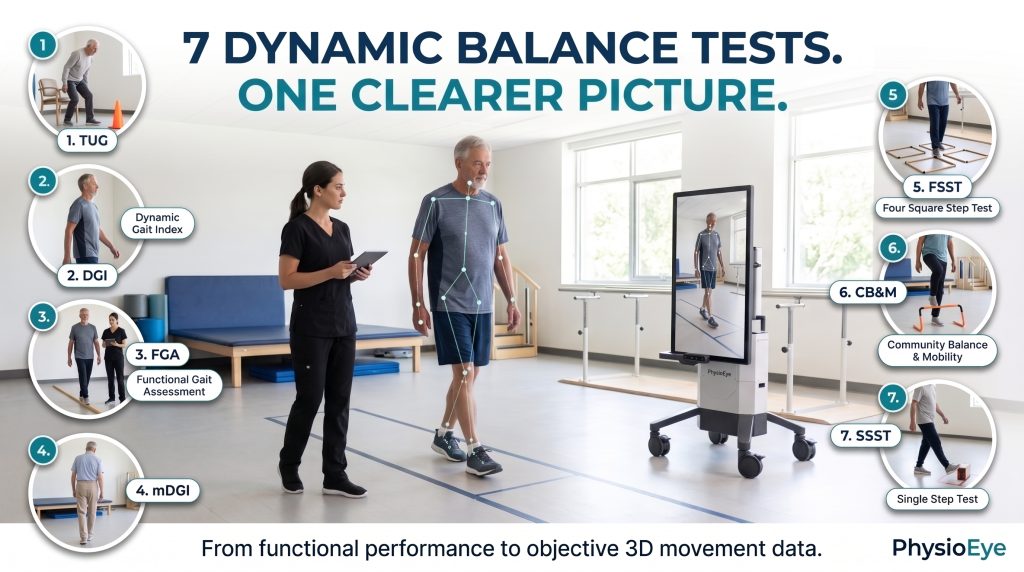
The Limitations of Subjective Observation in Balance Assessment
Historically, clinical balance evaluation relied heavily on visual observation and basic walking assessments. However, human eyes alone cannot measure sub-millimeter postural sway, asymmetrical weight shifting, or subtle trunk compensatory movements during high-speed directional transitions. Furthermore, traditional tests often suffer from ceiling effects when applied to high-functioning neurological patients or active older adults, masking mild vestibular or proprioceptive deficits.
To overcome these diagnostic bottlenecks, modern clinics utilize structured performance-based measures. By challenging balance across multiple functional domains—including gait speed changes, head turns, dual-task cognitive loading, and multi-directional stepping—clinicians can expose the exact neuromuscular failure points causing instability.
7 Dynamic Balance Tests Used by Leading Clinicians
A comprehensive functional evaluation requires a battery of specialized assessments tailored to the patient’s specific presentation, whether recovering from a stroke, managing Parkinson’s disease, or rehabilitating post-operative lower-limb trauma. Below are seven gold-standard clinical assessments used to reveal hidden instability.
Timed Up and Go (TUG) Test
The Timed Up and Go (TUG) test is one of the most widely administered clinical screens for functional mobility and fall risk. The patient starts seated in a standard arm chair, stands up upon command, walks a distance of 3 meters, turns around a cone, walks back, and sits down.
-
What It Measures: Dynamic balance, lower-extremity strength, and turning agility.
-
Clinical Value: Research published on Physiopedia regarding the Timed Up and Go Test demonstrates high inter-rater reliability with intraclass correlation coefficients (ICCs) ranging from 0.92 to 0.99 in older populations. A cut-off time of 13.5 seconds or longer generally indicates a significantly elevated risk of community falls.
Dynamic Gait Index (DGI)
Developed to assess an individual’s ability to modify balance in response to changing environmental task demands, the Dynamic Gait Index evaluates walking under eight distinct functional conditions, including changes in gait speed, horizontal and vertical head turns, stepping over obstacles, and pivoting 180 degrees.
-
What It Measures: Dynamic stability during complex walking tasks and vestibular-ocular reflex integration.
-
Clinical Value: Each item is scored on a 4-point ordinal scale (0 to 3), yielding a maximum score of 24. Scores of 19 or lower indicate a heightened risk of falling in community-dwelling older adults.
Functional Gait Assessment (FGA)
Recognizing the ceiling effects of the original DGI, the Functional Gait Assessment was developed by modifying and expanding upon DGI items while incorporating challenging tasks like walking with a narrow base of support, walking with eyes closed, and navigating stairs.
-
What It Measures: Postural stability during advanced, unsteadiness-inducing walking maneuvers.
-
Clinical Value: Clinical trial data archived in PubMed Central on FGA psychometric properties establishes an optimal cut-off score of ≤20, yielding a sensitivity of 87.3% and a specificity of 96.7% in distinguishing balance impairments among stroke survivors and healthy cohorts.
Modified Dynamic Gait Index (mDGI)
The Modified Dynamic Gait Index refines the original 8-item DGI into a streamlined 10-item instrument that removes redundant obstacle tasks and adds critical assessments for backward ambulation and narrow-base walking.
-
What It Measures: Fine-tuned directional control and dynamic stability under altered sensory conditions.
-
Clinical Value: The mDGI significantly reduces scoring ceiling effects in patients with mild traumatic brain injury, multiple sclerosis, or early-stage Parkinson’s disease, providing greater responsiveness to therapeutic change.
Four Square Step Test (FSST)
Unlike linear walking tests, the Four Square Step Test evaluates rapid, multi-directional stepping performance. The patient is required to step sequentially clockwise and counter-clockwise through four squares formed on the floor by intersecting canes or tape, facing forward throughout the entire sequence.
-
What It Measures: Dynamic standing balance, agility, and the ability to step over obstacles in multiple planes without losing equilibrium.
-
Clinical Value: Validated performance studies published in rehabilitation literature show that completion times exceeding 15 seconds yield a sensitivity of 85% and specificity up to 100% in identifying older adults with multiple fall histories.
Community Balance and Mobility Scale (CB&M)
Designed specifically for high-functioning individuals who have plateaued on traditional scales but still experience instability during complex community navigation, the CB&M comprises 13 highly challenging tasks, including tandem walking with head turns, unilateral jumping, and stair descent.
-
What It Measures: Advanced balance, coordination, and explosive lower-limb stability required for safe community integration.
-
Clinical Value: Psychometric evaluations published in PubMed Central on the CB&M scale report excellent test-retest reliability with an ICC of 0.983, making it the premier tool for detecting subtle deficits in active neurological patients.
Six-Spot Step Test (SSST)
Originally engineered as a sensitive lower-limb functional measure for patients with multiple sclerosis, the Six-Spot Step Test requires the patient to kick five wooden blocks out of designated target circles while navigating a 5-meter path as quickly as possible.
-
What It Measures: Ambulatory speed, lower-extremity co-ordination, dynamic balance, and motor agility under time constraints.
-
Clinical Value: Clinical trials indexed in PubMed regarding SSST dual-task performance confirm that the test possesses exceptional discriminatory power, yielding an Area Under the Curve (AUC) value greater than 0.8 in separating healthy controls from individuals with mild motor impairments.
Bridging Clinical Tests with Markerless 3D Assessment
While clinical rating scales like the TUG, FGA, and CB&M provide essential observational scores, modern medical technology allows clinics to elevate these assessments from subjective grading to sub-millimeter kinematic science.
At Hash-Tech GmbH, our engineering philosophy integrates traditional balance protocols with advanced digital health infrastructure. By utilizing the PhysioEye markerless motion analysis platform, healthcare providers capture high-resolution 3D kinematic data during functional movements without strapping physical markers, goniometers, or wearable sensors onto the patient. PhysioEye automatically tracks joint trajectories, stride length symmetry, and trunk sway during dynamic tasks, culminating in a comprehensive Fall Risk Index as the final feature of the assessment dashboard.
This objective kinematic data directly informs targeted interventions. When rehabilitation is required, clinicians pair these diagnostic insights with stationary robotic ergotherapy systems such as the ErgoBot stationary rehabilitation device. ErgoBot is explicitly engineered as a stationary upper- and lower-limb rehabilitation robot for all joints—it is definitively not a wearable exoskeleton, gait suit, or strength training machine. Patients interface with ErgoBot using minimal, clinically accurate ring-shaped attachments that connect safely to the limbs, ensuring precise, isolated joint mobilization without the tripping or balance risks associated with wearable frames.
Original Hash-Tech Insight
The historical divide between subjective clinical observation and objective biomechanical analysis is rapidly closing. Relying solely on stopwatch timings or ordinal grading scales leaves room for human observational error when evaluating complex multi-planar balance deficits. At Hash-Tech GmbH, we believe that true clinical excellence requires a unified ecosystem. By coupling the zero-touch 3D spatial intelligence of PhysioEye with the stationary, precision-guided motor ergotherapy of ErgoBot, clinics can seamlessly transition from identifying hidden instability to actively rebuilding motor pathways. Maintaining strict compliance with European Medical Device Regulation (EU MDR 2017/745) and ISO 13485 quality standards, our technology empowers healthcare professionals to make dynamic balance recovery entirely reproducible, measurable, and scientifically verifiable.
Key Takeaways
-
Beyond Static Standing: Safe ambulation requires continuous neuromuscular control during walking, turning, and multi-directional stepping, necessitating dynamic rather than static balance evaluations.
-
Comprehensive Battery: Utilizing a diverse test battery—from the standard Timed Up and Go (TUG) to advanced tools like the CB&M and Six-Spot Step Test—allows clinicians to catch subtle instability across all functional levels.
-
Objective Markerless Tracking: Integrating tools like PhysioEye transforms observational clinical scores into precise 3D kinematic data, concluding with an automated Fall Risk Index.
-
Stationary Robotic Safety: Interventions using ErgoBot provide targeted joint ergotherapy via minimal ring-shaped end-effectors, completely avoiding the fall risks and alignment hazards of wearable exoskeletons.
Frequently Asked Questions
Why are dynamic balance tests superior to static standing tests for fall risk evaluation? Static balance tests only measure postural sway while standing still. However, the vast majority of falls occur during movement transitions, such as turning, walking over uneven surfaces, or stepping around obstacles. Dynamic balance tests challenge the vestibular, visual, and motor systems simultaneously, revealing hidden instability that static tests miss.
How does PhysioEye enhance standard clinical balance tests? PhysioEye provides a Class Im CE-marked 3D markerless motion analysis platform that records patient movement without physical sensors. During tests like the TUG or FGA, it captures sub-millimeter kinematic metrics such as trunk sway velocity and asymmetry, culminating in an objective Fall Risk Index as the final feature of the evaluation.
Is ErgoBot considered a wearable exoskeleton for balance and gait training? No. ErgoBot is strictly a stationary upper and lower limb rehabilitation robot designed for targeted joint ergotherapy. Patients remain safely seated next to the console and connect via minimal ring-shaped end-effectors, completely eliminating the balance hazards, over-ground fall risks, and mechanical setup friction associated with wearable exoskeletons.
What score on the Functional Gait Assessment (FGA) indicates an increased fall risk? Clinical validation studies establish that a score of ≤20 out of 30 on the FGA is an optimal cut-off for identifying community-dwelling older adults and stroke survivors who are at high risk of experiencing unexplained falls.