
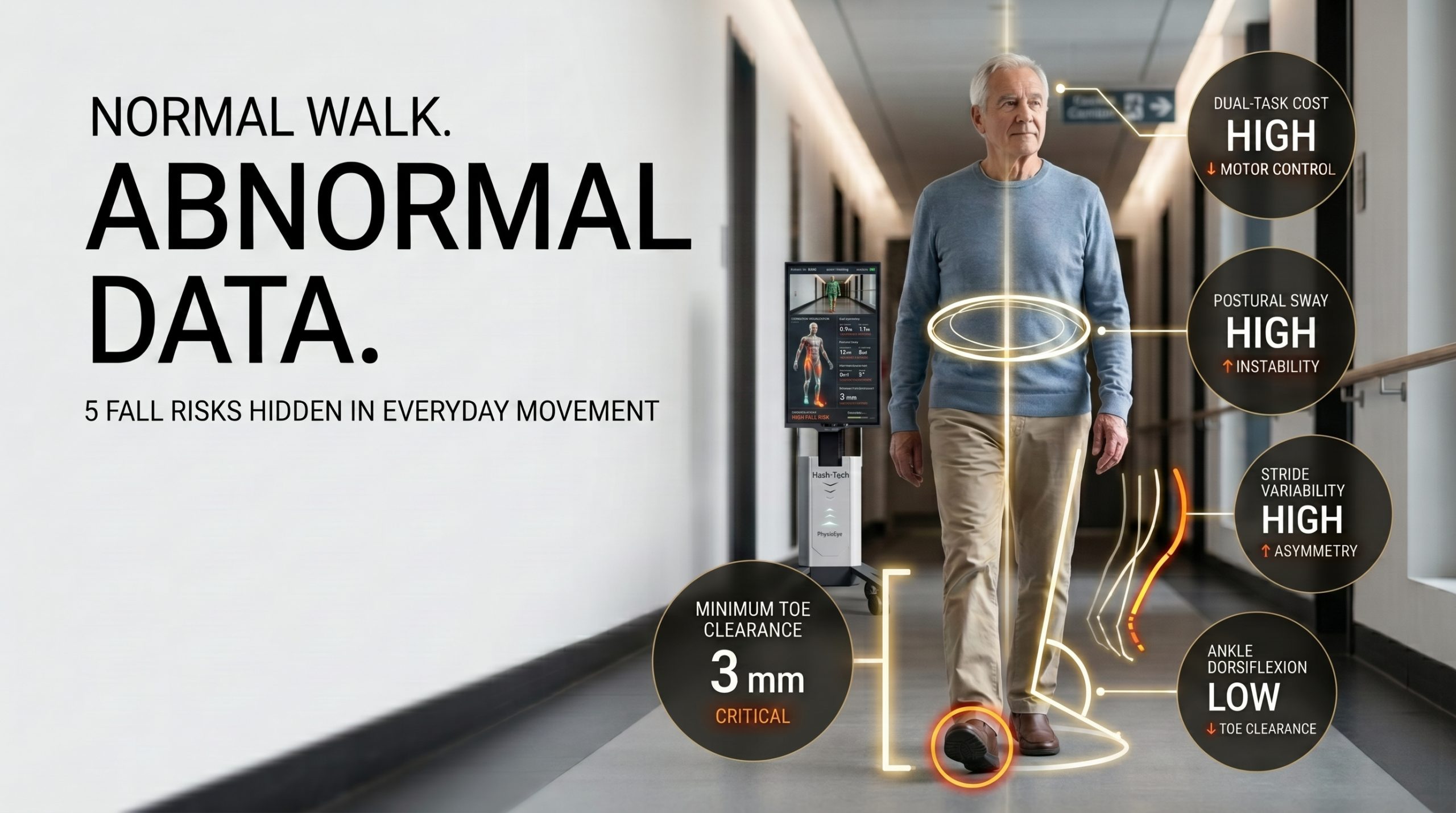
Fall Prevention: 5 Hidden Risk Factors Healthcare Providers Still Miss Every Day
In acute, post-acute, and long-term care settings, fall prevention remains one of the most urgent and complex clinical mandates. According to global health data from the World Health Organization (WHO), falls are the second leading cause of unintentional injury deaths worldwide, with older adults suffering the highest proportion of severe trauma and long-term functional loss.
Despite universal fall-screening protocols, dedicated nursing care, and standardized environmental modifications, thousands of high-risk patients suffer devastating falls inside healthcare facilities every day. The fundamental reason for this persistent clinical challenge is that conventional fall risk screening relies heavily on macro-level indicators—such as patient fall history, gross mobility scores, or broad environmental hazards—while completely missing subclinical, micro-level biomechanical and neurological degradation.
When a patient exhibits normal walking speed or passes a basic observational balance check, healthcare teams often assume the patient is safe. However, subclinical deficits in foot clearance, postural sway velocity, and motor-cognitive integration frequently operate undetected beneath the surface. To achieve true, proactive fall prevention, clinical practice must evolve to identify and measure the invisible risk factors that precede catastrophic balance loss.
The Diagnostic Limit of Observational Fall Screening
Standard clinical assessment tools—such as the Morse Fall Scale, Hendrich II Fall Risk Model, or manual Timed Up and Go (TUG) testing—provide valuable triage data, but they carry distinct diagnostic limitations when attempting to isolate micro-level fall triggers.
| Screening Approach | Primary Evaluation Parameters | Diagnostic Blind Spot | Clinical Outcome |
| Paper-Based Fall Questionnaires | Fall history, medication count, mental status | Ignores real-time motor control and joint biomechanics | Reactive; flags risk only after functional loss or prior fall occurs. |
| Observational Gait Checks | Gross walking speed, cadence, use of mobility aids | Cannot resolve millimeter-level spatial margins or stride variability | Misses subclinical foot clearance collapse and subtle asymmetric loading. |
| Static Balance Tests | Duration of standing, gross postural sway | Fails to quantify Center of Pressure (CoP) path velocity or sensory fatigue | Overlooks dynamic postural instability during functional transfers. |
| 3D Markerless Computer Vision | Millimeter MTC tracking, CoP velocity, dual-task cost | Requires integrated clinical workflow | Proactive; identifies subclinical risk factors before a fall occurs. |
To bridge this diagnostic gap, healthcare organizations are adopting advanced 3D markerless computer vision platforms like PhysioEye, which continuously capture objective kinematic data during routine patient movement without physical sensors or time-consuming laboratory setups.
5 Hidden Risk Factors Healthcare Providers Still Miss Every Day
Comprehensive fall risk management requires isolating the subtle physiological, biomechanical, and environmental interactions that lead to acute balance failure. Here are five critical, hidden risk factors that frequently slip past standard clinical observation:
Subclinical Minimum Toe Clearance (MTC) Trajectory Degradation
While clinicians routinely check for obvious “foot drop,” subtle mid-swing foot trajectory collapse remains virtually invisible during standard observation.
-
The Hidden Deficit: Minimum Toe Clearance is the smallest vertical spatial margin between the toe and the floor during mid-swing (typically 10 to 20 mm). As highlighted in biomechanical literature by Begg et al. (2007), subtle fatigue in the tibialis anterior muscle or minor calf tightness can reduce this clearance to 2 or 3 mm without reducing overall gait speed.
-
The Fall Trigger: When swinging the foot forward at peak velocity, a toe margin of just a few millimeters guarantees an unrecoverable trip upon contacting carpet edges, threshold transitions, or slight floor irregularities. Identifying these trajectory drops requires objective Predictive Gait Analysis.
Dual-Task Motor-Cognitive Interference
In clinical testing rooms, patients concentrate entirely on walking. In real-world care settings, locomotion is constantly combined with cognitive processing.
-
The Hidden Deficit: Dual-task cost (DTC) represents the degradation in motor control (gait speed, balance, or toe clearance) when a patient performs a simultaneous cognitive task, such as holding a conversation, reading hallway signage, or carrying an object.
-
The Fall Trigger: Patients with early executive dysfunction or motor control degradation divert cognitive resources away from balance management to process environmental stimuli. When distracted, their motor control collapses, leading to sudden, unexplained falls during basic Activities of Daily Living (ADL).
Elevated Center of Pressure (CoP) Path Velocity During Quiet Standing
A patient may appear visually steady while standing beside their bed, leading clinicians to rate their balance as unimpaired.
-
The Hidden Deficit: Visual observation cannot evaluate Center of Pressure (CoP) path velocity—the speed at which the body’s center of gravity shifts over the base of support to maintain upright posture. High CoP velocity indicates that the neuromuscular system is making rapid, hyperactive micro-corrections to prevent tipping over.
-
The Fall Trigger: A patient operating with high CoP path velocity is functioning at the absolute edge of their neuromuscular capacity. The moment they attempt a voluntary movement, such as reaching for a nightstand or turning toward a walker, their balance control is overwhelmed, precipitating a fall.
Subclinical Ankle Dorsiflexor Fatigue and Footwear Mechanics
Footwear is routinely checked for non-skid soles, but its interaction with subtle muscular fatigue across a prolonged day is rarely evaluated.
-
The Hidden Deficit: As the day progresses, low-grade neuromuscular fatigue subtly decreases active ankle dorsiflexion during initial contact (heel strike). When paired with flexible or overly cushioned footwear that alters sensory feedback, the foot transitions prematurely into flat-foot or toe-first contact.
-
The Fall Trigger: Impaired heel-strike kinematics reduce directional stability during weight acceptance, causing the knee to buckle or the ankle to roll during routine turns, especially during late afternoon or evening bathroom visits. Conducting a regular Senior joint mobility assessment helps catch these fatigue-induced shifts early.
Delayed Visual Contrast and Spatial Transition Accommodation
Environmental modifications focus heavily on physical hazards (e.g., removing rugs), but frequently overlook the physiological delay in visual accommodation among older adults.
-
The Hidden Deficit: Aging eyes require significantly more time to adapt when transitioning between areas of varying illumination (such as moving from a brightly lit dayroom into a dimly lit residential corridor).
-
The Fall Trigger: During the 5 to 10 seconds required for visual adaptation, depth perception and contrast sensitivity are severely compromised. Patients misjudge step edges, door frames, or furniture placement, leading to spatial disorientation and tripping. Guidelines from the CDC STEADI Initiative emphasize combining environmental lighting adjustments with patient accommodation awareness to mitigate this risk.
The Closed-Loop Care Pathway: From Screening to Multi-Joint Rehabilitation
Transforming fall prevention from a reactive reporting system into a proactive clinical intervention requires integrating frictionless screening technology with targeted physical therapy. Hash-Tech GmbH provides a unified, technology-driven framework:
-
Automated Kinematic Screening: The patient completes a brief, non-invasive motion test tracked by PhysioEye. Without physical sensors or markers, the 3D computer vision platform quantifies MTC height, CoP path velocity, dual-task stability, and sit-to-stand power during an Automated Mobility Assessment by PhysioEye.
-
Objective Fall Risk Profiling: The diagnostic software automatically maps subclinical deficits, generating an objective risk score that highlights specific physiological drivers (e.g., dorsiflexor weakness, high sway velocity, or gait asymmetry).
-
Targeted Robotic Rehabilitation: Based on the identified deficits, the patient is prescribed structured neuromuscular training using ErgoBot. ErgoBot is a stationary upper and lower limb rehabilitation system for all joints. It delivers precise, motor-assisted active resistance and active-assistive movement to strengthen the lower-limb kinetic chain, improve ankle joint mobility, and retrain dynamic balance control.
-
Mandatory 30-Day Evaluation Cycle: Healthcare facilities enforce a mandatory monthly evaluation cycle (every 30 days) to track kinetic progress. This continuous data stream feeds into the patient’s overall Predictive Care strategy, establishing an automated framework for AI-Assisted Fall Prevention.
Original Hash-Tech Clinical Insight
For decades, the healthcare industry has treated fall prevention primarily as an environmental and administrative problem—focusing on bed alarms, non-slip socks, and incident reporting. While these measures are necessary, they fail to address the core issue: falls are ultimately caused by unmitigated, subclinical biomechanical failure.
A bed alarm alerts staff after a patient has already initiated an unsafe transfer; a non-slip sock does not restore a collapsed Minimum Toe Clearance trajectory or stabilize high postural sway velocity.
True innovation in fall prevention requires treating mobility as a dynamic vital sign. By leveraging computer vision to identify subclinical kinematic deficits weeks before a fall occurs, and using stationary multi-joint robotics like ErgoBot to rebuild functional capacity, we can shift healthcare from managing the aftermath of falls to systematically preventing them altogether.
Key Takeaways
-
Effective fall prevention requires moving beyond macro-level risk tools to measure subclinical, micro-level biomechanical deficits.
-
The 5 critical hidden risk factors include MTC Trajectory Collapse, Dual-Task Interference, High CoP Path Velocity, Fatigue-Induced Dorsiflexion Failure, and Delayed Visual Accommodation.
-
Standard visual observation cannot resolve millimeter-level foot clearance or dynamic postural sway velocities.
-
PhysioEye provides rapid, markerless 3D computer vision screening to detect subclinical movement risks in under two minutes without body sensors.
-
ErgoBot serves as a stationary upper and lower limb rehabilitation device for all joints, delivering targeted multi-joint therapy to address specific physical weaknesses.
-
Implementing a mandatory 30-day evaluation cycle enables continuous predictive care, drastically reducing fall incidence across clinical networks.
Future Outlook
The future of fall prevention lies in continuous, ambient clinical intelligence. Rather than relying solely on periodic manual testing, care environments will feature ambient markerless sensors that discreetly evaluate patient movement during daily activities. Algorithms running in the background will monitor stride symmetry, sway velocity, and transfer speeds in real-time. When subclinical degradation is detected, automated alerts will immediately update the care plan and schedule targeted multi-joint therapy on systems like ErgoBot, eliminating fall risks long before balance is lost.
Clinical Implications
For physical therapists, geriatricians, and hospital administrators, integrating subclinical mobility screening into routine fall prevention protocols delivers a measurable reduction in patient injury rates, shortens length-of-stay in acute care, and lowers legal and financial liabilities associated with in-facility falls. Adopting markerless computer vision and targeted robotic rehabilitation transforms fall prevention into a highly predictable, science-driven discipline.
Frequently Asked Questions
Why do conventional fall risk scales fail to predict every fall? Conventional scales (such as the Morse or Hendrich II) evaluate historical data, general diagnosis, and high-level behavioral factors. They do not measure real-time biomechanical parameters, such as sub-millimeter toe clearance margins, muscle fatigue, or Center of Pressure sway velocity, which are the physical triggers of balance loss.
How does dual-task motor-cognitive interference increase fall risk? When walking or standing, motor control requires neurological bandwidth. In patients with subtle neurological or physical deficits, walking consumes nearly all available cognitive capacity. When forced to perform a simultaneous mental task (like talking or navigating), motor control temporarily degrades, leading to sudden tripping or loss of balance.
What makes markerless 3D computer vision superior to wearable sensors for screening? Wearable sensors and force plates require manual attachment, calibration, and hygiene protocols, taking 15 to 30 minutes per patient. Systems like PhysioEye use deep learning 3D computer vision to instantly collect full-body kinematic data as the patient walks naturally in front of a camera, making routine screening practical for high-volume clinical workflows.
How does ErgoBot address specific biomechanical fall risks? ErgoBot is a stationary upper and lower limb rehabilitation device designed to treat all joints. When screening identifies specific risk factors—such as weak ankle dorsiflexors driving low Minimum Toe Clearance or reduced knee extension power affecting sit-to-stand transfers—ErgoBot delivers targeted, active-assistive or resistive exercises to retrain the kinetic chain.
How often should fall risk screenings be repeated in residential or acute care settings? Clinical best practice recommends an automated, objective evaluation upon admission, following any medication or health status change, and on a mandatory monthly cycle (every 30 days) to track functional maintenance and catch subclinical decline before an injury occurs.