
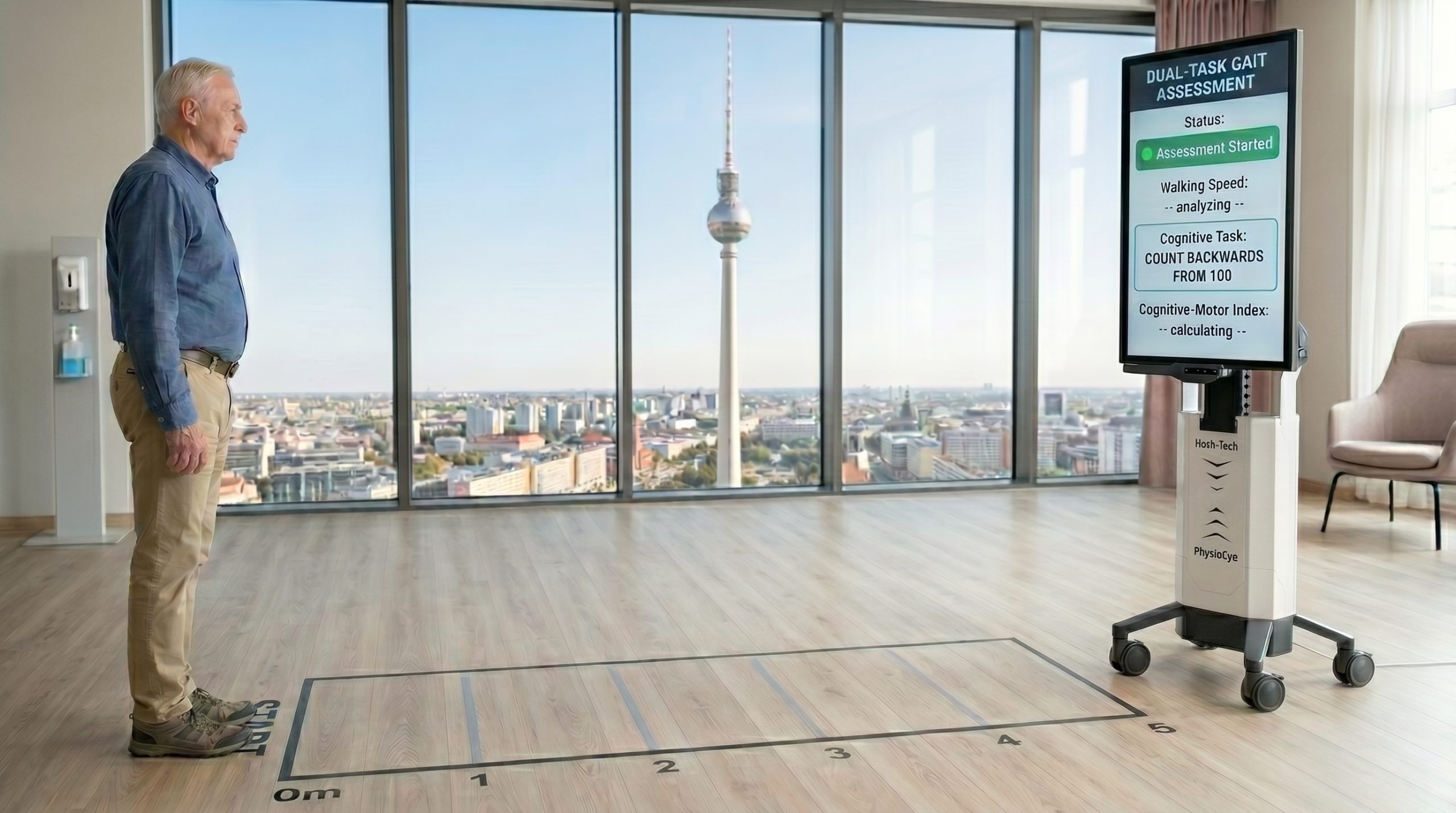
Dual-Task Gait Assessment: 4 Spectacular Ways PhysioEye’s 3D AI Detects Early Dementia
Dual-Task Gait Assessment is fundamentally transforming how clinical facilities diagnose early dementia and prevent the devastating falls associated with cognitive decline. In specialized memory clinics and geriatric units across Germany—from neurology wards in Munich to our advanced engineering headquarters in Buchbach—relying solely on single-task walking tests is rapidly becoming a major operational liability.
A senior patient with Mild Cognitive Impairment (MCI) or early-stage Alzheimer’s might walk perfectly straight down a quiet hallway when fully focused. However, the real world demands simultaneous processing. The moment that same patient tries to walk while answering a question or navigating an obstacle, their declining executive function becomes overwhelmed. The brain prioritizes the cognitive challenge, abandons motor control, and a catastrophic fall instantly follows.
To achieve true predictive care, facilities must implement a mathematically precise Dual-Task Gait Assessment. By utilizing the markerless, contact-free AI of the PhysioEye platform by Hash-Tech GmbH, clinics can measure the exact moment a patient’s brain fails to coordinate with their body.
Here are 4 spectacular ways PhysioEye utilizes digital kinematic tracking during a Dual-Task Gait Assessment to expose early dementia, backed by exact clinical literature.
Eradicating the Cognitive Blind Spot in Dual-Task Gait Assessment
Standard Fall Prevention Strategies and manual tools like the Berg Balance Test only measure physical balance, completely ignoring the cognitive roots of falling. If a patient is evaluated using a single task, their early dementia remains dangerously hidden.
PhysioEye eradicates this clinical blind spot. By capturing the patient’s exact skeletal movement while they perform a cognitive challenge (like counting backwards), a digital Dual-Task Gait Assessment establishes the objective diagnostic foundation required before initiating active Cognitive-Motor Therapy.
Predicting Dementia Progression Quantitatively
A Dual-Task Gait Assessment is not merely a fall-risk tool; it is a direct, physiological biomarker for the rapid progression of neurodegenerative disease. When the brain deteriorates, the “cost” of performing two tasks simultaneously skyrockets.
By mathematically tracking this dual-task cost in real-time, PhysioEye functions as an automated early-warning system. It flags high-risk patients for medical intervention long before they exhibit visible Frailty Syndrome in Geriatrics.
Exposing Microscopic Kinematic Failures
When executive function declines due to dementia, the brain loses the ability to maintain rhythmic, forward momentum. A Dual-Task Gait Assessment exposes this breakdown through microscopic biomechanical compensations that a human observer cannot see.
PhysioEye captures this slowing velocity and micro-stuttering frame-by-frame. Whether the system is monitoring a patient during a digital Postural Sway Assessment or evaluating the complex multi-joint transitions required for a safe Post-Operative Hip Recovery, the AI prevents sudden impacts that could lethally exacerbate hidden Osteoporosis Warning Signs.
Automating the Dual-Task Gait Assessment
Historically, measuring the exact interference between cognition and gait required cumbersome, pressure-sensitive electronic mats that were entirely impractical for daily clinical workflows.
PhysioEye completely replaces these obsolete walkways with contact-free, markerless optical AI. Just as we use ErgoBot to drive synchronized brain repair through Bilateral Arm Therapy and intensive Spinal Cord Injury Therapy, PhysioEye provides the frictionless diagnostic infrastructure required to conduct a mathematically flawless Dual-Task Gait Assessment.
The Objective Standard for Dementia Care
Diagnosing the intersection of fall risk and dementia through subjective observation is a critical operational failure. By deploying PhysioEye’s 3D AI, care facilities generate undeniable digital proof of cognitive-motor decline, transforming elderly care from reactive guesswork into proactive, preventative science.