
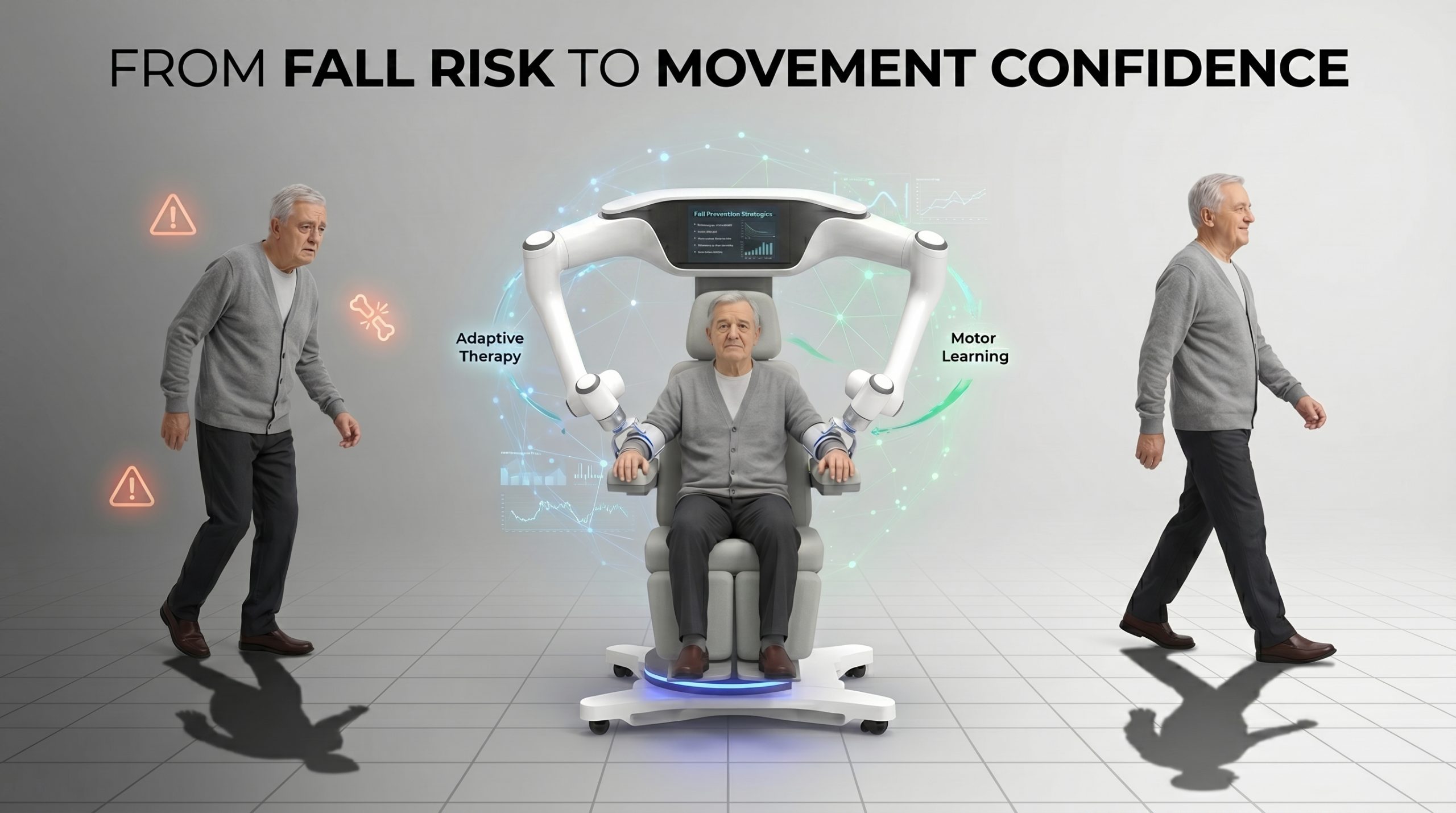
Fall Prevention Strategies: 4 Devastating Joint & Neuromotor Deficits ErgoBot Effortlessly Fixes
Fall Prevention Strategies represent the most critical operational priority in modern geriatric care. In specialized clinics across Germany—from critical care hospitals in Munich to our engineering headquarters in Buchbach—traditional rehabilitation often treats elderly fall-risk patients by focusing purely on raw muscle strength through static leg-press machines or forced walking exercises.
However, building brute leg strength does not stop a fall. True stability requires precise neuromuscular control across every joint in the human body, from the ankle to the shoulder. If a patient’s central nervous system cannot rapidly process complex environments, or if they lack the upper-body reflexes to catch themselves, a fall is inevitable.
To achieve genuine predictive care, facilities must shift their focus away from “dumb” strength machines and toward active neurological rewiring. By integrating the intelligent ErgoBot by Hash-Tech GmbH, clinics are completely modernizing their Fall Prevention Strategies. It is vital to understand that ErgoBot is not an exoskeleton, nor is it a gait-assisted walking robot. It is a highly advanced, stationary rehabilitation system designed to safely and precisely rehabilitate all human joints—both upper and lower limbs—in a secure, seated environment.
Here are 4 devastating joint and neuromotor deficits ErgoBot effortlessly fixes to ensure patient safety.
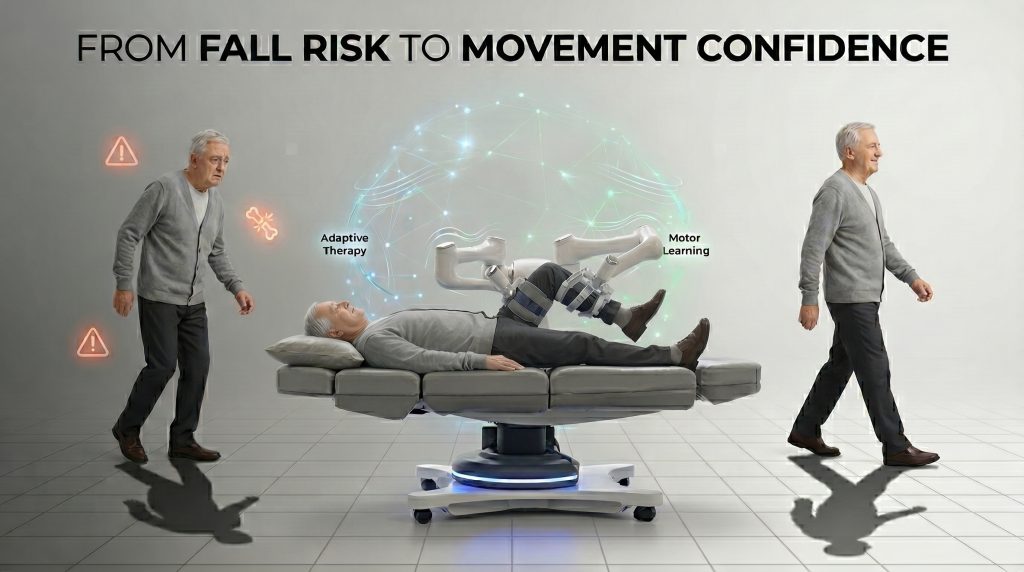
Enhancing Stationary Joint Proprioception in Fall Prevention Strategies
Falls frequently initiate at the ground level due to a loss of proprioception in the ankle and knee joints. Traditional Fall Prevention Strategies often fail to dynamically retrain these lower-limb joints in a secure environment, relying instead on subjective tools like a manual Berg Balance Test to measure progress.
Because ErgoBot is a stationary system, patients can safely rebuild this joint awareness without the immediate risk of standing or walking. Ankle joint proprioception plays a crucial role in maintaining postural balance and preventing falls in older adults.
ErgoBot seamlessly adapts to the lower extremities, guiding the hips, knees, and ankles through mathematically precise, seated trajectories. Whether a senior is suffering from general instability or undergoing a delicate Post-Operative Hip Recovery, this stationary approach restores the neuromuscular kinesthesia required to navigate uneven terrain.
Rebuilding Dual-Task Capabilities in Fall Prevention Strategies
A massive flaw in traditional physical therapy is separating physical exertion from cognitive load. Falls rarely happen when a senior is simply walking in a straight line; they happen when a senior is walking and trying to process their environment simultaneously.
ErgoBot addresses this deficit across all joints by delivering simultaneous Cognitive-Motor Therapy. By challenging the patient with interactive, AI-driven mental tasks while they exert precise physical force with their limbs, the robot forces the brain and body to communicate in real-time, curing the core deficits of Frailty Syndrome in Geriatrics.
Restoring Upper-Limb Protective Extension
When a catastrophic fall initiates and the lower limbs fail, the body’s final defense mechanism is an automatic upper-limb protective extension—reaching out to grab a handrail or brace for impact. Because ErgoBot rehabilitates all human joints, it perfectly bridges the gap between lower-body balance and upper-body reflexes.
Through high-dosage Bilateral Arm Therapy, ErgoBot retrains these lightning-fast neural pathways in the shoulders, elbows, and wrists. This full-body approach is especially crucial for vulnerable patients undergoing Spinal Cord Injury Therapy, ensuring that upper-limb motor control serves as a reliable protective barrier against devastating fractures.
Eradicating the Fear of Falling Through Errorless Joint Support
Fear of falling is a paralyzing psychological barrier that leads directly to physical deterioration. Terrified seniors adopt rigid, compensatory postures that negatively impact their Postural Sway Assessment and exacerbate hidden skeletal vulnerabilities like Osteoporosis Warning Signs.
ErgoBot provides a 100% secure rehabilitation environment for every joint. Its intelligent haptic sensors guide the patient flawlessly through movements without relying on brute strength. If the patient fatigues, the robot immediately provides support, eliminating the fear of failure and allowing the nervous system to heal without the paralyzing anxiety of a potential fall.
The Objective Ecosystem of Predictive Care
Effective Fall Prevention Strategies require undeniable digital truth and intelligent, stationary, full-body neurological rehabilitation. By combining ErgoBot’s restorative power with PhysioEye’s diagnostic precision, Hash-Tech GmbH is building the ultimate standard for modern clinical automation.