
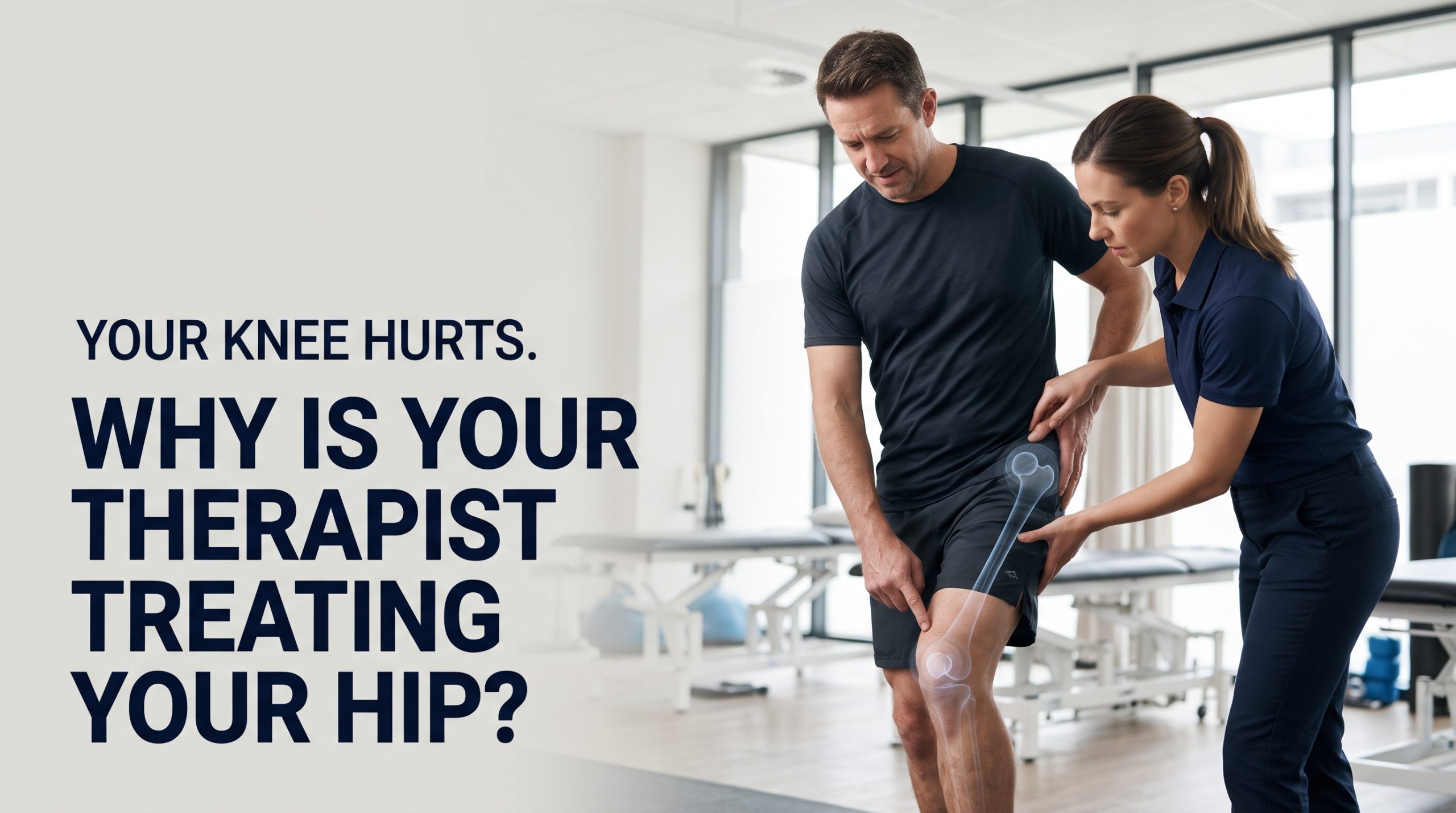
Patellofemoral Pain Syndrome: How Hip Mobility and Strength Protect the Knee Joint
Patellofemoral Pain Syndrome (PFPS) is frequently driven by proximal biomechanical deficits, specifically hip abductor weakness and capsular stiffness. Through the principle of regional interdependence, these hip deficits cause femoral internal rotation and dynamic knee valgus, heavily overloading the patellofemoral joint. Integrating 3D kinematic screening and stationary joint ergotherapy allows clinicians to assess and correct these hip mechanics, providing long-term relief for knee pain.
When a patient complains of a sharp, aching pain behind or around their kneecap, their natural instinct is to assume the problem lies entirely within the knee. They often arrive at the clinic icing their patella, wearing compressive knee braces, and avoiding stairs. However, in the vast majority of non-traumatic anterior knee pain cases, focusing exclusively on the knee joint is a biomechanical dead end.
The human lower limb operates as a synchronized kinetic chain. The knee is essentially a “dumb joint”—a hinge caught between two highly mobile, multi-directional spheres of influence: the ankle below, and the hip above. To permanently resolve anterior knee pain, physical medicine must look proximally. By mobilizing stiff hip capsules and strengthening the gluteal complex, clinicians can profoundly alter knee joint mechanics, completely relieving stubborn knee pain without ever directly touching the knee itself.
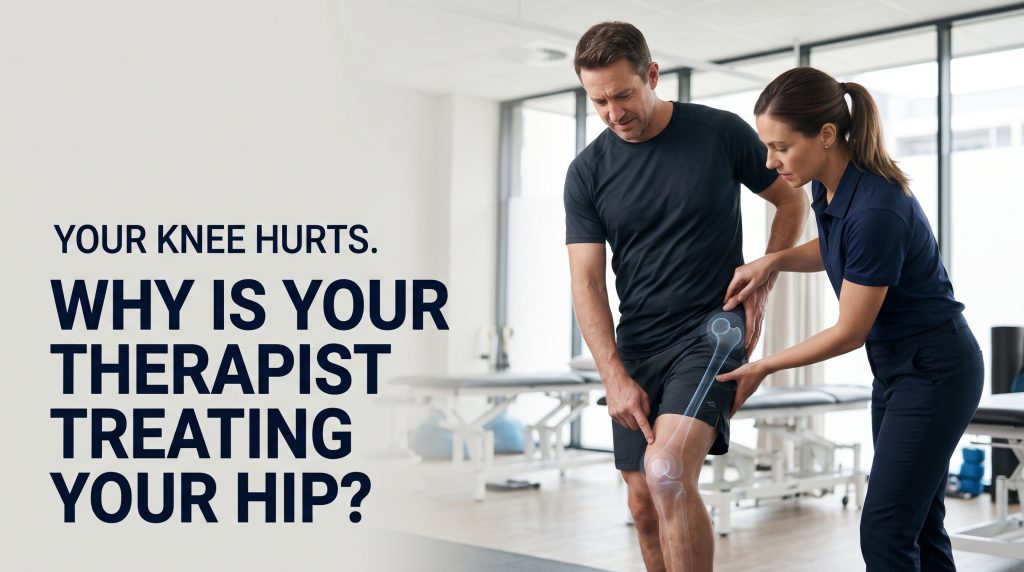
The Biomechanics of Dynamic Knee Valgus
The most common mechanical cause of Patellofemoral Pain Syndrome is a movement fault known as Dynamic Knee Valgus.
During weight-bearing activities like descending stairs, squatting, or landing from a jump, the femur (thigh bone) must remain neutrally aligned over the tibia. The primary muscles responsible for maintaining this alignment are the hip abductors (gluteus medius) and the hip external rotators.
When a patient suffers from hip weakness or a restricted posterior hip capsule, they lose the ability to stabilize the femur. As they bear weight, the femur uncontrollably rotates internally and adducts toward the midline of the body. This forces the knee to collapse inward (dynamic valgus), which pulls the patella laterally out of its physiological groove (the trochlea), creating severe, localized friction and retropatellar joint stress.
A recent clinical trial published in Scientific Reports (PMID: 40987761) highlighted exactly this mechanism, establishing that Patellofemoral Pain Syndrome has a multifactorial etiology heavily dependent on proximal joint control. Simply resting the knee will never correct the fact that the femur is collapsing inward on every step.
Regional Interdependence: Treating the Hip to Fix the Knee
The clinical strategy of treating adjacent joints to relieve local pain is known as Regional Interdependence. By acknowledging that the hip directly dictates knee alignment, therapists can prescribe gentle, guided hip mobilization and targeted gluteal strengthening to effectively “steer” the knee out of danger.
The scientific literature strongly validates this approach. A randomized controlled trial published in BMC Musculoskeletal Disorders (PMID: 42063015) proved that integrating proximal hip strengthening significantly reduces pain and improves function in patients with PFPS. Similarly, high-intensity eccentric hip abductor strength training has been shown to directly improve dynamic knee valgus moments and restore neuromuscular control, allowing patients to return to pain-free loading (PMCID: PMC13143104).
When clinicians add manual hip mobilization to standard exercise protocols, the improvement in Patellofemoral Pain Syndrome outcomes is statistically superior to knee-focused therapy alone. Furthermore, evaluating how a patient handles unilateral loading—such as through a clinical step-up or step-down test—provides an excellent window into proximal hip control. Recent clinical data confirms that changes in step-up performance strongly correlate with improved patient-reported outcomes for PFPS (PMCID: PMC13319674). In older populations, ensuring the full kinetic chain is treated—including hip strength and mobility—has proven highly effective for reducing medial knee osteoarthritis pain and improving overall gait load distribution (PMCID: PMC10806725).
Evaluating the Kinetic Chain with Objective Kinematics
To properly treat Patellofemoral Pain Syndrome via regional interdependence, clinicians must first be able to measure dynamic knee valgus accurately.
At Hash-Tech GmbH, the PhysioEye platform delivers 3D markerless motion capture, allowing clinicians to conduct an Automated Mobility Assessment without attaching physical sensors to the patient. When a patient performs a single-leg squat or a step-down test, PhysioEye automatically calculates the valgus collapse angle and tracks pelvic drop, instantly confirming if hip weakness is the root cause of the knee pain.
Because regional interdependence relies heavily on posture and weight acceptance, patients with knee pain often develop compensatory habits. To capture this, clinicians can utilize the PhysioEye Orbit, which adds a 360-degree visual scan combined with body composition and weight distribution analysis. Seeing exactly how a patient subconsciously shifts their weight away from the painful knee, or how asymmetric loading originates from the hips, provides critical functional context that standard visual observation misses.
Rehabilitating Hip Mobility and Strength with ErgoBot
Once diagnostic screening confirms that stiff, weak hips are causing the anterior knee pain, the focus shifts to targeted rehabilitation.
For patients requiring neuromuscular re-education of the hip abductors and external rotators, clinicians transition them to the ErgoBot system. ErgoBot is engineered specifically as a stationary upper- and lower-limb rehabilitation robot for all joints—it is definitively not a wearable exoskeleton. Patients remain safely seated while connecting to ErgoBot via minimal, clinically accurate ring-shaped attachments around the thigh or ankle.
This setup enables precise, motor-assisted joint ergotherapy to gently stretch the posterior hip capsule and provide targeted resistance for the gluteal muscles. Because the patient is seated, there is no weight-bearing stress placed on the painful knee joint during therapy. ErgoBot supports Neuromuscular Re-education and Passive Range of Motion Therapy, safely rewiring the hip’s motor control without exposing the patient to over-ground fall risks or knee compression.
Key Takeaways
-
Regional Interdependence: The biomechanical function of the hip directly controls the alignment and stress placed upon the knee joint during weight-bearing movements.
-
Dynamic Knee Valgus: Hip abductor weakness and capsular stiffness cause the femur to rotate internally, forcing the knee to collapse inward and triggering Patellofemoral Pain Syndrome.
-
Objective Markerless Assessment: 3D markerless motion capture evaluates dynamic valgus angles, while tools like the PhysioEye Orbit track weight distribution to identify proximal loading deficits.
-
Targeted Stationary Ergotherapy: Identifying hip deficits allows clinicians to prescribe targeted gluteal strengthening and mobilization on stationary robotic systems like ErgoBot, addressing the root cause without loading or stressing the painful knee.
Frequently Asked Questions
What is Patellofemoral Pain Syndrome (PFPS)? PFPS is a broad term used to describe pain at the front of the knee and around the patella (kneecap). It is typically aggravated by activities that load the knee joint, such as climbing stairs, squatting, or running, and is often caused by poor joint tracking and alignment.
How does hip weakness cause knee pain? The muscles of the hip (specifically the gluteus medius and external rotators) control the alignment of the femur (thigh bone). If these muscles are weak, the femur collapses inward during movement (dynamic knee valgus), throwing the kneecap out of alignment and causing severe friction.
Can tracking weight distribution help with knee pain? Yes. When experiencing knee pain, patients often adopt an antalgic (pain-avoidant) stance, shifting their weight asymmetrically. Evaluating exact weight distribution allows clinicians to identify these subconscious compensations and retrain proper loading mechanics.
Is ErgoBot a wearable exoskeleton for the knee? No. ErgoBot is strictly a stationary upper and lower limb rehabilitation robot designed for joint ergotherapy. Patients connect to the stationary console via minimal ring-shaped end-effectors, completely avoiding the joint misalignment risks, weight-bearing stress, and setup delays of wearable suits.