
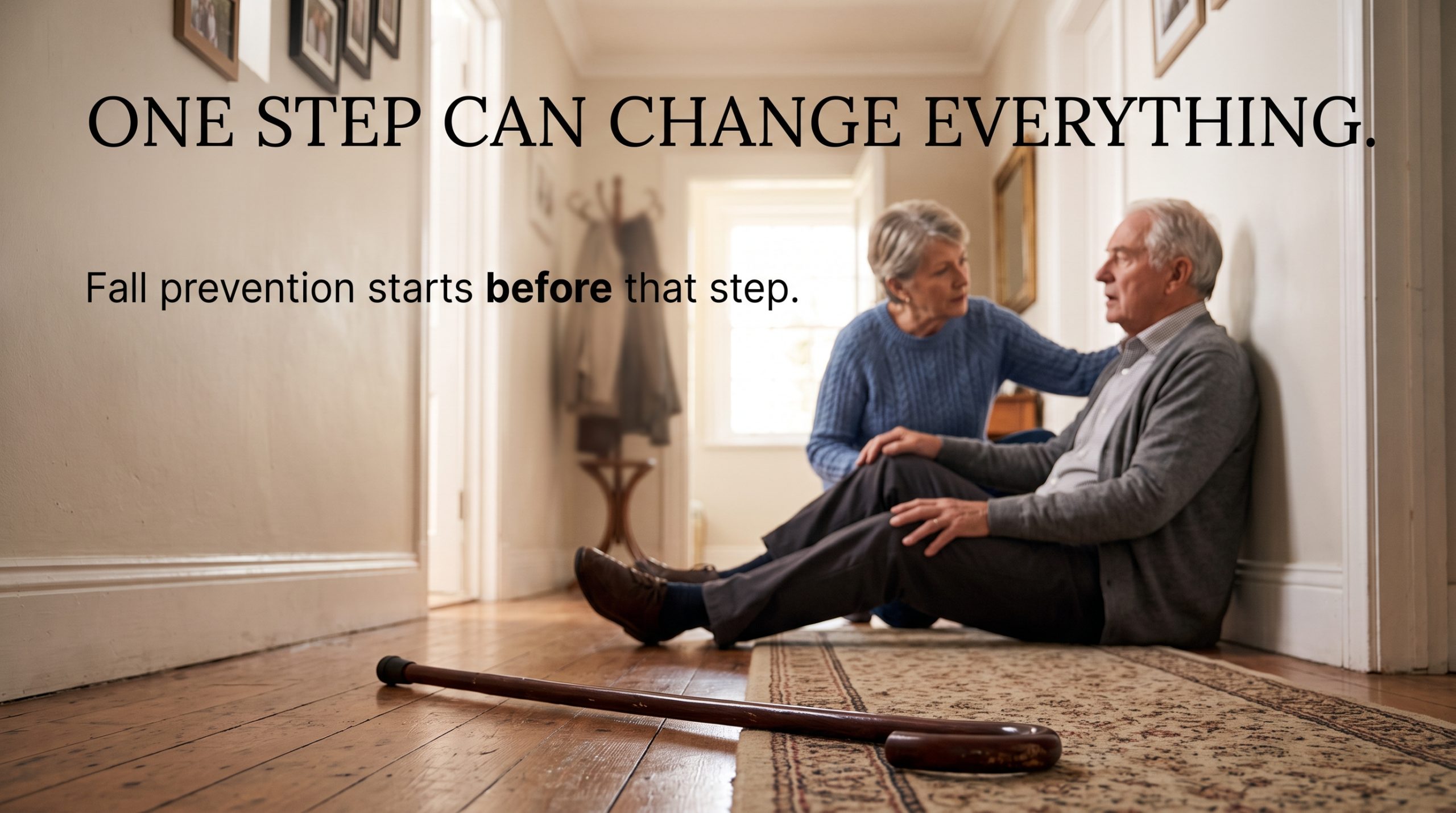
Fall Prevention for Seniors: Can AI See the Risk Before the Fall?
Falls among the elderly represent one of the most critical, expensive, and preventable crises in global healthcare. Traditionally, the medical community has operated on a reactive paradigm: a senior falls, a fracture occurs, acute surgical intervention follows, and a lengthy rehabilitation process begins. However, the biomechanical precursors to a fall—subtle declines in gait speed, increased postural sway, and asymmetrical sit-to-stand transitions—often manifest weeks or months before the actual event.
With the advent of markerless 3D motion analysis, we are no longer limited to observing the aftermath of a fall. Advanced kinematic systems can now detect the microscopic movement changes that human eyes miss. By identifying these risks early, fall prevention for seniors shifts from a theoretical goal to a data-driven, proactive reality.
The Staggering Reality: Global Incidence and Mortality Statistics
To understand the urgent need for predictive AI, one must look at the sheer volume of fall-related morbidity and mortality documented in global epidemiological literature.
-
Global Burden: According to the World Health Organization (WHO), falls are the second leading cause of unintentional injury death worldwide. An estimated 684,000 fatal falls occur each year.
-
Severe Morbidity: The WHO also reports that approximately 37.3 million falls occur annually that are severe enough to require medical attention, resulting in over 38 million Disability-Adjusted Life Years (DALYs) lost globally each year.
-
U.S. Emergency Interventions: Data published by the Centers for Disease Control and Prevention (CDC) indicates that in the United States alone, there are about 4.5 million emergency department visits annually due to older adult falls. This volume results in 1.4 million hospitalizations, heavily driven by traumatic brain injuries (TBIs) and the nearly 319,000 seniors hospitalized annually for hip fractures.
-
Escalating Mortality: A 2023 CDC Morbidity and Mortality Weekly Report (MMWR) highlighted the escalating crisis: in 2021, 38,742 older adults died as the direct result of unintentional falls—a staggering rate of 78.0 per 100,000 population.
The Crushing Economic Cost of Fall-Related Treatment
When isolating the direct medical costs of fall treatments—excluding indirect costs like lost wages of family caregivers or diminished quality of life—the financial impact on global health systems is immense.
-
United States: The CDC estimates that the direct medical costs for older adult falls drain the U.S. healthcare system of $50 billion every single year. Approximately $29 billion is absorbed by Medicare, $9 billion by Medicaid, and the remainder by private insurance and out-of-pocket payments.
-
European Economic Impact: In Europe, the economic burden is equally severe. A robust systematic review published in PubMed evaluating the cost of falls in old age found that the mean direct cost per fall-related hospitalization can reach up to $25,955 (Purchasing Power Parity).
-
German Healthcare System: Specific to the German statutory health insurance system, fall-related injuries generate massive clinical expenditures. Budget impact analyses published by the National Institutes of Health (NIH) evaluating fall-prevention lifestyle exercises estimate five-year standard care expenditures for older adult cohorts at over €35 billion, emphasizing the critical need for cost-effective preventative interventions.
Why Fall Prevention for Seniors is a Clinical Imperative
The importance of fall prevention for senior extends far beyond stabilizing hospital budgets. A fall is often the definitive inflection point in a senior’s life, permanently altering their independence and accelerating physiological decline.
-
The “Fear of Falling” Cycle (Ptophobia): Even non-injurious falls create a profound psychological impact. Seniors often develop a paralyzing fear of falling, leading them to self-restrict their activities. This self-imposed sedentary behavior accelerates muscle atrophy, reduces joint range of motion, and diminishes vestibular balance—paradoxically increasing the exact fall risk they are trying to avoid.
-
Loss of Independence: As noted by CDC injury center statistics, over 80% of hip fracture deaths and 88% of emergency department visits for hip fractures are caused directly by falls. A large percentage of these patients never regain their pre-fall level of independent mobility, requiring a permanent transition into assisted living or nursing home facilities.
-
Complications of Immobility: In seniors, the complications following a severe fall—such as hospital-acquired pneumonia, deep vein thrombosis (DVT) from prolonged bed rest, and acute surgical complications—drastically reduce overall life expectancy.
The Limitations of Traditional Fall Risk Screening
For decades, clinical fall risk assessments have relied heavily on subjective questionnaires (e.g., the Morse Fall Scale) and visually graded functional tests like the Timed Up and Go (TUG).
While foundational to geriatric care, these traditional methods possess inherent measurement limitations. A clinician armed with a stopwatch can record that a patient took 14 seconds to complete a TUG test, but visual observation cannot objectively quantify the degree of lateral sway, exact asymmetry in stride length, or micro-hesitations during the pivot turn. Because manual observation captures only the macro-outcome (total time), the subtle biomechanical warning signs that precede functional decline remain invisible until the patient crosses a critical threshold of clinical impairment.
How AI Sees the Risk Before the Fall
Artificial intelligence, deployed through markerless 3D spatial tracking systems like PhysioEye, fundamentally changes the diagnostic landscape. AI does not wait for a senior to report a fall; it analyzes the kinematics of their daily mobility to flag early deterioration with laboratory-grade precision.
| Biomechanical Risk Factor | Traditional Observation | AI-Driven Detection (PhysioEye) |
| Gait Speed & Variability | Stopwatch timing over a set distance. | Continuous calculation of step-to-step variability and velocity changes in precise millimeters. |
| Postural Sway | Visual estimation of balance during static standing. | 3D mapping of the center of mass displacement across both sagittal and frontal planes. |
| Sit-to-Stand Mechanics | Graded subjectively on a pass/fail/struggle basis. | Precise angular measurement of trunk flexion, weight transfer symmetry, and lower-limb lift-off velocity. |
By capturing high-fidelity kinematic profiles during routine assessments, the AI detects the earliest stages of sarcopenia or neurological decline. If a patient’s step length variability increases by just 5% over a two-month period—a biomechanical shift entirely imperceptible to the human eye—the system flags the data. This allows the care team to preemptively escalate fall risk protocols before a catastrophic incident occurs.
Original Hash-Tech Insight
The future of geriatric healthcare relies on shifting our financial and technological resources out of the acute operating room and into the proactive assessment room. Treating a fractured hip costs healthcare systems upwards of $30,000 to $50,000 per incident; preventing that exact fracture through automated, objective kinematic tracking costs a mere fraction of that amount. At Hash-Tech, we recognize that true innovation in fall prevention for seniors isn’t just about building better walking canes—it’s about creating a frictionless, data-driven ecosystem. Systems like PhysioEye and CareWell illuminate the unseen biomechanical risks, while tools like ErgoBot provide the highly controlled, stationary mechanical intervention needed to correct them before the fall ever happens.
Key Takeaways
-
Massive Financial Toll: The CDC estimates direct fall-related medical treatments cost the U.S. $50 billion annually, driven almost entirely by reactive, post-fall emergency interventions.
-
High Global Morbidity: The WHO reports over 37 million severe falls occur globally each year, causing a massive loss of functional independence and quality of life for seniors.
-
The Power of Kinematics: AI markerless tracking identifies micro-deviations in gait speed, stride variability, and postural sway long before a patient experiences a physical fall.
-
Actionable Ecosystems: By feeding continuous 3D motion data into wellness platforms like CareWell, clinical supervisors can seamlessly transition from reactive care to proactive health management.
-
Safe, Stationary Rehabilitation: Interventions for high-risk seniors must prioritize stability. ErgoBot provides stationary, ring-attached joint strengthening without the severe fall risks inherent to walking exoskeletons.
Frequently Asked Questions
Can AI prevent all falls in seniors? No system can prevent 100% of falls, as environmental factors (like an unseen wet floor) or sudden acute medical events (like a stroke or cardiac syncope) can cause falls regardless of baseline mobility. However, AI drastically reduces the vast majority of falls caused by progressive biomechanical decline by flagging the risk early enough for intervention.
How does PhysioEye measure fall risk without wearables? PhysioEye utilizes advanced computer vision and depth sensors to map the human body’s joints in 3D space. It calculates angles, velocities, and center of mass continuously, providing laboratory-grade kinematic data without requiring the patient to wear restrictive markers, suits, or sensors.
What makes ErgoBot safe for seniors with high fall risk? Unlike exoskeletons that require a patient to balance and walk across a room, ErgoBot is a stationary rehabilitation robot. Patients receive targeted, AI-adapted resistance for their upper and lower joints via minimal ring-shaped end-effectors, completely eliminating the risk of falling during the actual therapy session.
How is the mobility data managed in care facilities? Patient mobility and kinematic data is centralized in software ecosystems like the CareWell platform. This allows clinical teams and wellness supervisors to track longitudinal progress, generate compliance reports, and proactively adjust preventative care plans based on verifiable data trends.