
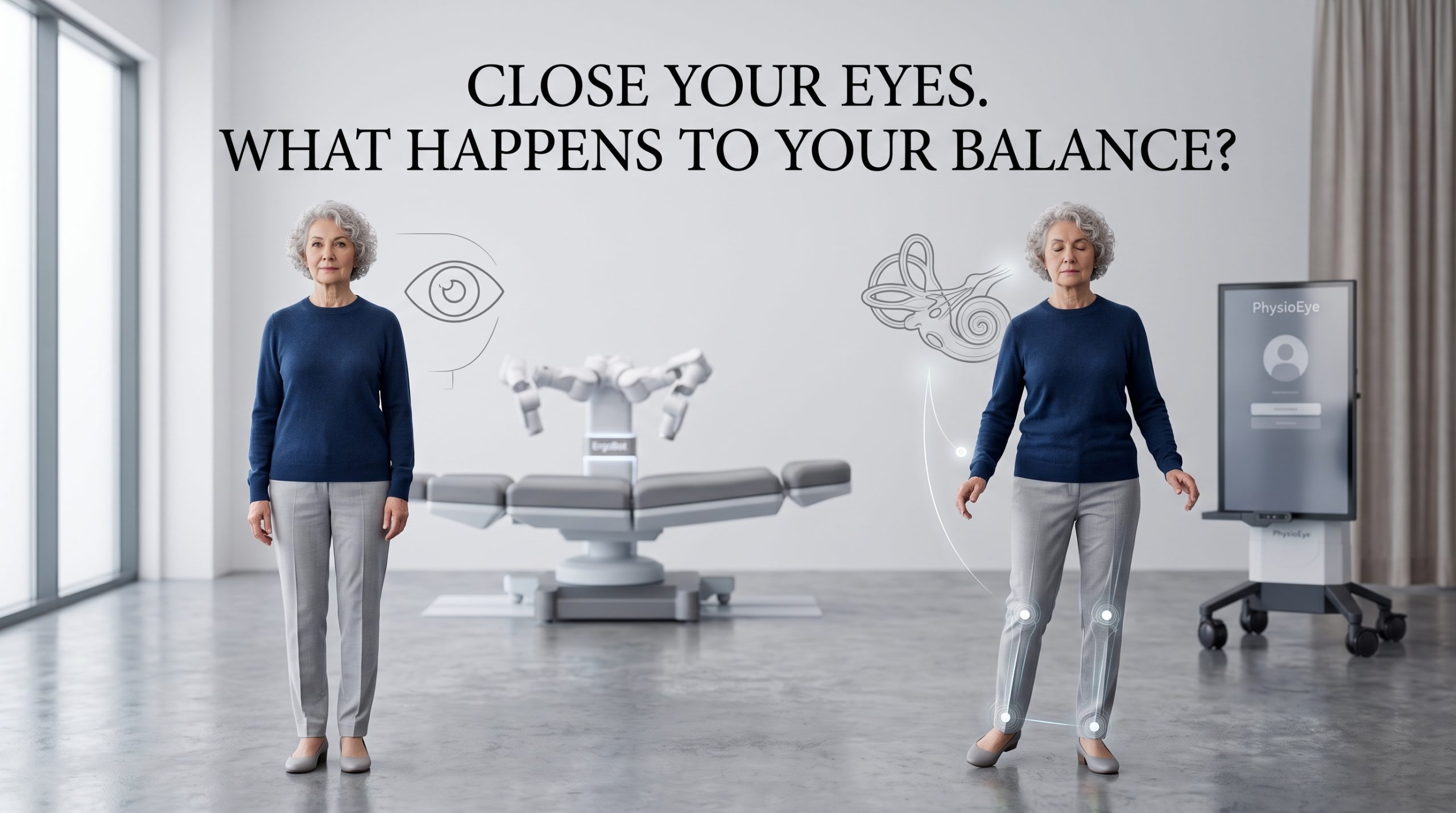
Closed Eye Balance: What Happens When You Close Your Eyes? 6 Tests That Reveal How Your Senses Keep You Upright
Human balance is an intricate, neurological balancing act orchestrated by three distinct sensory systems: the visual system (sight), the vestibular system (inner ear spatial orientation), and the somatosensory/proprioceptive system (touch and joint position sense). When one system is compromised, the brain relies on the others—a process known as sensory reweighting.
For most individuals, vision is the dominant anchor for postural control. Consequently, closed eye balance serves as a profound clinical window into a patient’s underlying neurological and musculoskeletal health. When a patient closes their eyes, they are abruptly forced to rely entirely on vestibular and proprioceptive inputs. If those underlying systems are weak, the patient will immediately exhibit increased postural sway or experience a loss of balance.
Evaluating closed eye balance is a cornerstone of fall prevention and neurological screening. Below, we break down the physiology of sensory deprivation and explore six definitive clinical tests used to isolate and assess how the human body stays upright in the dark.
The Physiology of Sensory Reweighting
Maintaining an upright posture requires continuous, micro-adjustments of the body’s center of mass (COM) over its base of support. According to landmark motor control research published in the Journal of Neurophysiology, healthy adults standing quietly on a firm surface rely on somatosensory inputs for approximately 70% of their postural control weight, while vision contributes 10–20% and vestibular inputs account for the remaining 10–20%.
When vision is removed (closed eye balance), the central nervous system must rapidly upregulate its reliance on:
-
Proprioception (70%): Mechanoreceptors in the ankles, knees, and spine detect the stretch and compression of tissues, sending immediate feedback about joint position.
-
Vestibular Input (10-20%): The semicircular canals and otolith organs in the inner ear detect angular and linear acceleration, respectively.
As individuals age, peripheral neuropathy, vestibular degradation, and sarcopenia progressively blunt these non-visual senses. Studies published in PubMed demonstrate that center-of-pressure (COP) sway velocity can increase by over 50% in older adults the moment their eyes close. Unmasking these deficits through structured testing is vital for proactive fall prevention.
6 Clinical Tests for Assessing Closed Eye Balance
Clinicians utilize a progression of standardized tests to manipulate sensory inputs, systematically isolating the somatosensory and vestibular systems to pinpoint the exact cause of instability.
The Romberg Test
Originally developed in the 19th century to diagnose neurosyphilis (tabes dorsalis), the Romberg Test is the foundational assessment of closed eye balance.
-
Protocol: The patient stands barefoot with feet completely together, arms crossed over the chest. They stand with eyes open for 30 seconds, then with eyes closed for 30 seconds.
-
Clinical Significance: If a patient stands well with eyes open but significantly loses balance with eyes closed, it indicates a positive Romberg sign. This points directly to a deficit in the dorsal column-medial lemniscus pathway (proprioception) rather than a cerebellar lesion (which would cause instability regardless of vision).
The Sharpened Romberg Test
Also known as the tandem Romberg, this test increases the biomechanical difficulty by narrowing the base of support.
-
Protocol: The patient stands in a strict tandem stance (the heel of one foot touching the toe of the opposite foot) with arms folded. They hold the position with eyes open, then with eyes closed.
-
Clinical Significance: By eliminating the lateral base of support, the Sharpened Romberg heavily taxes the ankle and hip strategies. It is highly sensitive for detecting early-stage vestibular impairments and subtle proprioceptive deficits in younger, more active populations where the standard Romberg may suffer from a ceiling effect.
Clinical Test of Sensory Interaction on Balance (CTSIB)
Developed by Shumway-Cook and Horak, the CTSIB (often called the “foam and dome” test) assesses a patient’s ability to resolve sensory conflict.
-
Protocol: The patient is tested across six conditions altering visual and surface inputs. It utilizes a compliant foam pad to disrupt proprioception and a specialized visual “dome” placed over the patient’s head. The dome moves with the patient’s head, providing inaccurate (conflict) visual feedback.
-
Clinical Significance: The CTSIB forces the brain into sensory conflict. By analyzing which specific conditions cause the patient to fall, the clinician can isolate whether the patient is overly reliant on vision (visual dependence) or unable to utilize vestibular inputs when proprioception is compromised.
Modified CTSIB (mCTSIB)
Because the visual dome in the original CTSIB was cumbersome and often induced nausea, the protocol was streamlined into the widely used mCTSIB.
-
Protocol: This four-condition test removes the visual conflict dome and focuses purely on visual deprivation and surface compliance:
-
Eyes Open on Firm Surface (Baseline)
-
Eyes Closed on Firm Surface (Removes vision)
-
Eyes Open on Foam Surface (Alters proprioception)
-
Eyes Closed on Foam Surface (Forces pure vestibular reliance)
-
-
Clinical Significance: Condition 4 is the ultimate test of the vestibular system. With vision gone and proprioception scrambled by the foam, the patient must rely almost exclusively on their inner ear to remain upright.
Sensory Organization Test (SOT)
The SOT is the gold standard of computerized dynamic posturography (CDP).
-
Protocol: Conducted on a specialized, mechanically actuated dual-force plate surrounded by a moving visual surround, the SOT replicates the six conditions of the original CTSIB. However, instead of foam and a dome, the machine precisely tilts the floor (sway-referencing the support surface) and the visual walls in direct relation to the patient’s sway.
-
Clinical Significance: The SOT generates an exact, quantified equilibrium score for each sensory system. While highly accurate, the primary limitation of the SOT is its massive physical footprint and high equipment cost, making it inaccessible for routine clinical screening in standard physical therapy clinics.
Balance Error Scoring System (BESS)
Frequently used in sports medicine and concussion protocols, the BESS test combines visual deprivation with altered bases of support.
-
Protocol: The patient completes three stances (Double Leg, Single Leg, and Tandem) first on a firm surface, and then on a foam pad. All six conditions are performed with eyes closed for 20 seconds each.
-
Clinical Significance: The clinician counts “errors” (e.g., opening eyes, stepping out of position, lifting hands off hips). It is a rapid, equipment-light method to assess closed eye balance under high mechanical stress, making it highly effective for assessing mild traumatic brain injuries (mTBIs) and sports-related concussions.
Modernizing Balance Assessment: The Role of Markerless AI
While tests like the mCTSIB and BESS are clinically invaluable, their traditional administration relies heavily on human visual grading. A physical therapist using a stopwatch must visually estimate if a patient’s sway is “mild,” “moderate,” or “severe.”
To eliminate this subjectivity without requiring the heavy machinery of the SOT, modern clinicians utilize markerless 3D motion analysis. The PhysioEye platform seamlessly captures closed eye balance testing. By utilizing advanced computer vision, PhysioEye automatically tracks the patient’s center of mass displacement across the sagittal and frontal planes.
During an mCTSIB, PhysioEye provides exact millimeter calculations of postural sway and velocity. If a senior’s sway velocity on foam with eyes closed increases by 15% between baseline and a 6-month follow-up, the system objectively flags this deterioration before it results in a clinical fall.
Proactive Intervention: Stabilizing the Sensory Loop
When closed eye balance tests reveal somatosensory or vestibular deficits, data must be translated into targeted rehabilitation. In controlled wellness environments, all objective kinematic data flows directly into the CareWell platform. This allows clinical supervisors to monitor longitudinal balance metrics and prescribe highly specific interventions.
For patients exhibiting high fall risk due to poor proprioceptive feedback, traditional over-ground balance training or the use of wearable exoskeletons can introduce severe secondary fall risks. To safely rebuild the neuro-muscular pathways, clinics deploy the ErgoBot.
ErgoBot is a fully stationary rehabilitation robot designed for joint ergotherapy. Seniors and neurological patients interact with the device via minimal, ring-shaped attachments connecting to the upper or lower limb joints. By providing AI-modulated, stationary resistance, ErgoBot allows the patient to safely stimulate joint mechanoreceptors, improving proprioceptive integration without the balance hazards associated with walking suits or unstable free-weight environments.
Original Hash-Tech Insight
The clinical utility of closed eye balance testing lies in its ability to unmask the hidden fragilities of the central nervous system. However, for decades, the gap between the subjective stopwatch (mCTSIB) and the expensive laboratory (SOT) left everyday physical therapists without scalable, objective data. By integrating ambient spatial computing into standard balance protocols, we can now capture laboratory-grade center-of-mass kinematics during routine, everyday assessments. When we quantify exactly how a patient sways in the dark, we transition from reactive injury treatment to precision-guided neuro-rehabilitation.
Key Takeaways
-
Sensory Reweighting: Closed eye balance forces the brain to rely entirely on proprioceptive and vestibular inputs, unmasking hidden neurological deficits.
-
Standardized Isolation: Tests like the Romberg, mCTSIB, and SOT systematically remove or alter visual and surface inputs to pinpoint the exact failing sensory system.
-
The Power of Vestibular Isolation: Condition 4 of the mCTSIB (eyes closed on foam) is the ultimate clinical test of inner ear vestibular function.
-
Objective Measurement: Markerless 3D systems like PhysioEye transform subjective visual sway grading into exact kinematic metrics, measured in millimeters.
-
Safe Rehabilitation: Patients with identified balance deficits require secure, stationary interventions. ErgoBot provides necessary joint ergotherapy via ring-shaped attachments, eliminating the fall risks of over-ground robotic devices.
Frequently Asked Questions
Why is it so much harder to balance with eyes closed? Under normal conditions, vision provides 20-30% of your postural control by giving the brain fixed reference points in the environment. When you close your eyes, your brain must rapidly rely entirely on the inner ear (vestibular) and joint sensors (proprioceptive). If those systems are weak or aging, balance immediately deteriorates.
What is the difference between the Romberg and the Sharpened Romberg? The standard Romberg requires the patient to stand with feet side-by-side. The Sharpened Romberg requires a heel-to-toe (tandem) stance. The tandem stance drastically narrows the base of support, making it much more sensitive to subtle vestibular or proprioceptive issues that a standard Romberg might miss.
Does a patient need to fail all 4 conditions of the mCTSIB to have a balance disorder? No. Patients often perform perfectly on Conditions 1 and 2, but fail Condition 4 (eyes closed on foam). This specific failure pattern strongly indicates a vestibular deficit, as the patient is unable to maintain balance when both vision and solid surface feedback are removed.
How does PhysioEye improve the mCTSIB? Traditionally, a therapist simply times how long a patient can stand in an mCTSIB condition. PhysioEye uses 3D markerless tracking to map the patient’s exact skeletal coordinates, providing precise measurements of postural sway velocity, sway area, and center of mass displacement, removing all subjective human error from the assessment.
How is the ErgoBot utilized if a patient has poor closed eye balance? Patients with poor balance are at high risk for falls during therapy. ErgoBot is a stationary rehabilitation system that uses minimal ring-shaped end-effectors to attach to the joints. It allows patients to perform intensive, proprioception-building joint exercises in a fully stabilized environment, entirely eliminating the risk of falling.