
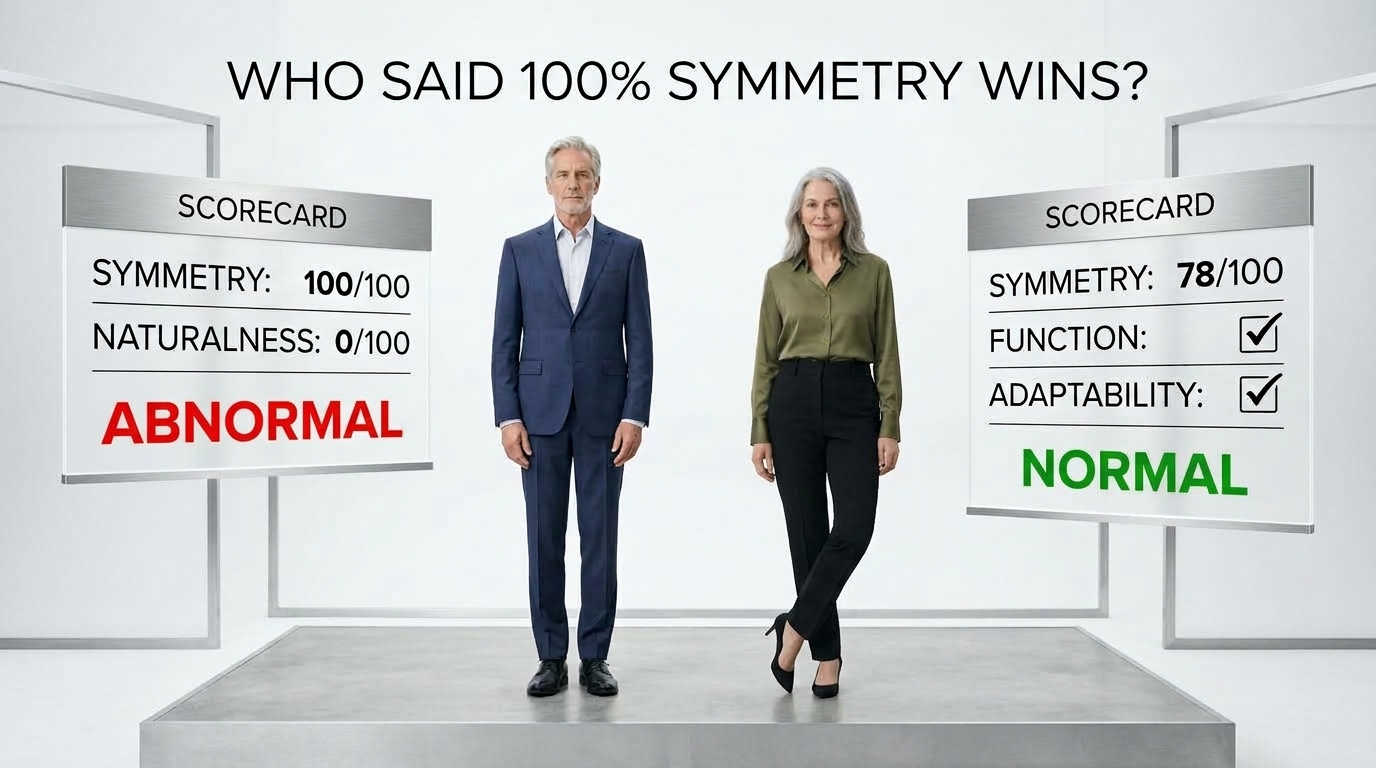
Abnormal Movement Isn’t Always Bad: 8 Surprising Reasons Your “Imperfect” Biomechanics May Be Exactly Right
For over a century, clinical orthopedics and physical therapy have been anchored to a strict ideal: the concept of perfect, symmetrical human alignment. Standard clinical evaluations historically treated any deviation from a population average—whether a slight limp, an asymmetric shoulder drop, or unequal weight distribution—as an inherent flaw requiring immediate correction. However, modern clinical literature and advanced 3D computer vision are revealing a far more nuanced reality: an abnormal movement is not inherently bad.
What appears to be a mechanical dysfunction on a static inspection sheet is frequently the human nervous system’s optimized solution for performance, energy conservation, or structural protection. At Hash-Tech GmbH, when we analyze 3D kinematic coordinate streams, we do not evaluate patients against rigid, outdated templates. We measure movement adaptability, motor control stability, and functional efficiency. This article explores 8 clinically validated reasons why an “imperfect” movement pattern may be precisely what a specific body requires to function effectively.
The Paradigm Shift: From Static Uniformity to Adaptive Biomechanics
Traditional physical assessment models were largely adapted from 19th-century engineering concepts, treating the human skeletal framework as a static architecture governed by a central “plumb line.” This approach assumed that every human body should exhibit near-perfect bilateral symmetry during movement.
Modern motor control science recognizes that biological systems are fundamentally dynamic, non-linear, and self-organizing. Rather than forcing every individual into a uniform mechanical mold, modern biomechanics evaluates movement through the lens of individual constraints: structural morphology, injury history, lateral dominance, and environmental demands.
| Assessment Dimension | Traditional Uniformity Paradigm | Modern Adaptive Biomechanics |
| Movement Deviation | Viewed as an inherent pathology or defect to be corrected. | Evaluated as a potential functional, energy-saving adaptation. |
| Bilateral Asymmetry | Assumed to directly increase tissue overload and injury risk. | Recognized as a natural outcome of limb dominance and task specialization. |
| Movement Execution | Requires strict, identical repetition on every trial. | Value “repetition without repetition” (functional variability). |
| Diagnostic Goal | Restore mechanics to population averages. | Determine if mechanics are functional, adaptive, or compensatory. |
Abnormal Movement: 8 Surprising Reasons “Imperfect” Biomechanics May Be Right

By synthesizing current sports science, motor control theory, and occupational ergonomics, we can categorize 8 evidence-based reasons why movement deviations represent intelligent biological adaptations rather than clinical flaws.
Natural Lateral Dominance Creates Baseline Asymmetry
Humans are naturally asymmetrical organisms. Handedness, leg dominance for mobilization versus stabilization, and unilateral daily tasks produce persistent structural and neural differences between the left and right sides of the body.
Expecting identical mechanics across bilateral limbs ignores fundamental human biology. Research on limb preference demonstrates that sporting and daily asymmetries are strongly associated with natural limb dominance and long-term activity participation. Clinical evidence consistently indicates that treating every baseline lateral asymmetry as a functional deficit is scientifically unsupportable.
Occupational and Athletic Adaptations Are Functional, Not Defective
Repeated physical demands alter biological tissue over time. A baseball pitcher, a tennis player, or a nurse performing bedside handling tasks repeatedly executes directional movements that reshape muscle architecture, joint capsule flexibility, and neural firing patterns.
Expecting a specialist’s dominant and non-dominant sides to move identically ignores years of SAID (Specific Adaptations to Imposed Demands) principles. Systematic reviews on athletic movement asymmetry confirm inconsistent relationships between inter-limb mechanical differences and actual performance outcomes. An observed difference must always be interpreted relative to the specific task demands placed on the individual.
In our CareWell corporate wellness research pilot at Pflegeheim Damenstift am Luitpoldpark, we monitor the musculoskeletal movement patterns of healthcare staff using our contactless 3D motion capture. We frequently observe that veteran nursing personnel develop highly specialized, asymmetric movement strategies during resident transfers. These mechanics are not inherent dysfunctions; they are task-specific motor adaptations developed over years to safely handle unpredictable physical loads.
Anatomical Structural Variations Naturally Shape Individual Movement
Human skeletons are not manufactured from standardized factory molds. Individual variations in femoral neck anteversion/retroversion, acetabular depth, tibial torsion, limb length ratios, and arch architecture naturally dictate how a joint moves.
For example, an individual with structural hip retroversion naturally squatting with a wider stance and outward foot orientation is not executing an abnormal movement; they are using the precise geometric orientation required to avoid bony impingement in the hip socket. Furthermore, clinical studies on foot symmetry metrics highlight that even scientific definitions of foot symmetry lack universal consensus, demonstrating why a simple bilateral side-by-side comparison cannot independently establish pathology.
Functional Movement Variability Protects Tissues from Overuse
Traditional fitness culture often promotes “locking in” a single movement pattern and repeating it with rigid precision. However, classical motor control research pioneered by Nikolai Bernstein identified the concept of “repetition without repetition”—the ability of healthy motor systems to achieve the exact same task outcome using slightly different joint trajectories on every attempt.
Research on movement variability in functional tasks reveals that healthy individuals naturally vary their movement mechanics between repetitions. This motor variability distributes mechanical stress across different muscle fibers and cartilage regions, preventing localized micro-trauma. Rigidly repeating a task in the exact same pattern concentrates stress on identical tissue structures, directly elevating overuse injury risks.
Protective Compensation is an Intelligent Neuromotor Defense
Following a structural strain, joint sprain, or surgical procedure, the central nervous system alters motor output to offload damaged structures. This visible compensation—such as shortened stance phase duration or altered joint flexion—is a deliberate, protective strategy orchestrated by the brain to facilitate tissue healing.
Systematic evaluations of movement adaptations emphasize that visible deviations frequently represent an intelligent strategy allowing an individual to maintain functional mobility without exposing healing tissue to peak loads. Attempting to forcibly eliminate a protective movement pattern before the underlying tissue has structurally restored can re-injure the patient.
Asymmetric Mechanics Can Optimize Metabolic Energy Expenditure
It is widely assumed that a perfectly symmetrical gait is always the most energy-efficient way to walk. However, in clinical populations—such as individuals recovering from stroke (hemiparesis) or living with lower-limb amputations—forcing mechanical symmetry actually increases physiological strain.
Predictive biomechanical models and metabolic testing demonstrate that for a compromised neuromusculoskeletal system, an asymmetric movement pattern often represents the path of least metabolic resistance. The brain automatically selects a gait mechanics strategy that minimizes total oxygen consumption per meter traveled, even if that strategy appears visually uneven.
Inter-Limb Asymmetry Does Not Directly Correlate with Injury Risk
One of the most persistent myths in sports medicine and ergonomics is that detecting a physical asymmetry automatically confirms a high injury risk. The clinical literature directly refutes this simplistic assumption.
A comprehensive systematic review analyzing 31 studies with over 6,200 participants found only low-to-moderate, highly inconsistent evidence linking functional movement asymmetry to prospective injury risk. Detecting an asymmetry is a measurement of geometric difference; it is not, by itself, a diagnosis of imminent physical harm.
Biomechanical Deviations Are Highly Task-Dependent and Require Context
A biomechanical metric cannot be interpreted in a vacuum; its clinical significance changes dramatically based on the specific movement being performed.
Meta-analyses evaluating athletic performance metrics show that inter-limb asymmetries exhibit varying relationships depending on the task—showing weak associations with linear sprinting or change-of-direction tasks, but zero significant correlation with vertical jumping performance. Furthermore, recent clinical frameworks on asymmetry interpretation emphasize that biomechanical measurements become meaningful only when interpreted alongside individualized factors such as fatigue, pain history, psychological state, and task demands.
The Hash-Tech Approach: Context-Aware Biomechanical Technology
At Hash-Tech GmbH, located in Buchbach, Germany, our technology is engineered around the principle that movement must be evaluated within its unique individual and functional context.
1. Context-Aware Screening with PhysioEye
PhysioEye is a contactless 3D motion assessment tool utilizing advanced Markerless Motion Capture. Instead of comparing a patient against a single static average, PhysioEye measures individualized kinematic trajectories, motor variability, and longitudinal movement trends during functional assessments such as gait or sit-to-stand transitions. This provides clinicians with the objective data needed to distinguish between a healthy structural adaptation and a progressive functional decline.
2. Adaptive Joint Mobilization with ErgoBot
When clinical intervention is required to address a true pathological movement restriction, the ErgoBot platform delivers precise, individualized therapy.
For patients recovering from injury or managing chronic joint conditions, ErgoBot provides smooth, controlled mobilization across all major joint axes. Its stationary design ensures absolute patient stability while adjusting to the individual’s unique anatomical range of motion. By offloading repetitive physical therapy strain, ErgoBot supports clinicians in restoring functional movement without imposing rigid, unnatural joint constraints.
Key Takeaways
-
Abnormal movement is not inherently pathological; it frequently represents an optimized biological adaptation for energy efficiency, load distribution, or tissue protection.
-
Natural lateral dominance, sport-specific training, and structural skeleton variations (such as hip version angles) create normal baseline asymmetries.
-
Motor variability (“repetition without repetition”) is a hallmark of healthy motor control that protects joints from localized overuse injury.
-
Systematic reviews confirm that movement asymmetry numbers do not directly correlate with prospective injury risk.
-
The CareWell corporate wellness program demonstrates that veteran nursing staff develop task-specific movement adaptations to perform resident care safely.
-
PhysioEye tracks 3D spatial kinematics and longitudinal movement trends without forcing rigid population averages.
-
ErgoBot provides adaptive, stationary joint rehabilitation (strictly NOT an exoskeleton) that respects unique patient anatomy.
Frequently Asked Questions
How can a clinician tell if an abnormal movement pattern is functional or pathological? A movement deviation is generally considered functional if it allows the individual to accomplish a task efficiently, without pain, excessive metabolic expenditure, or progressive tissue overload. Conversely, a movement pattern is pathological if it is driven by acute pain, causes continuous tissue degradation, or severely degrades functional performance.
Does a measurable asymmetry between the left and right legs increase injury risk? Not necessarily. Multiple systematic reviews have shown that inter-limb asymmetry metrics have a weak and inconsistent relationship with injury risk. Asymmetries are often the natural result of limb dominance, sport-specific demands, or structural anatomical differences, and must be evaluated alongside clinical context rather than as an isolated number.
What is “repetition without repetition” in human movement? Coined by motor control theorist Nikolai Bernstein, “repetition without repetition” describes the phenomenon where a healthy neuromotor system achieves the same task goal across multiple trials using slightly different joint trajectories and muscle activation patterns. This natural variability distributes mechanical stress and protects tissues from repetitive strain.
How does PhysioEye evaluate movement without forcing rigid population averages? PhysioEye utilizes markerless 3D computer vision to track a patient’s individual joint coordinates and motor variability over time. Rather than flagging any deviation from an arbitrary population average as a defect, PhysioEye establishes individualized longitudinal baselines, helping clinicians identify whether a movement pattern is stable or undergoing progressive decline.
Why is ErgoBot classified as a stationary platform rather than an exoskeleton? ErgoBot is a stationary rehabilitation system that provides controlled joint mobilization for patients who are safely seated or positioned. It is strictly not a wearable exoskeleton. Exoskeletons present balance and fall risks for frail patients, whereas stationary systems guarantee patient stability while delivering precise, adaptive joint therapy.