
Robotic Physiotherapy: 5 Revolutionary Benefits of Intelligent Rehabilitation With ErgoBot
Robotic physiotherapy is fundamentally altering the landscape of clinical rehabilitation by introducing mathematical precision to what has historically been a highly subjective, manual process. For decades, physical rehabilitation relied entirely on the physical endurance and tactile estimation of the treating therapist. Today, advanced robotic systems are bridging the gap between biomechanical assessment and targeted therapeutic execution. This article explores the limitations of conventional manual therapy, details how stationary robotic systems optimize neuromuscular recovery, and outlines the exact clinical mechanisms that make intelligent automation the new standard of care. Readers will discover how integrating highly precise robotic hardware redefines clinical efficiency and fundamentally enhances patient outcomes across geriatric and orthopedic populations.
What Is Robotic Physiotherapy?
Robotic physiotherapy is an advanced clinical discipline that utilizes automated, intelligent hardware to assist, guide, or resist patient movement during rehabilitation. It shifts the therapeutic focus from manual manipulation to precise, data-driven neuromuscular re-education.
At its core, this approach leverages robotics to execute highly repetitive, customized therapeutic protocols that adapt to a patient’s real-time functional capacity.
What is it exactly? It is the application of automated biomechanical force—delivered through sophisticated sensors and motors—to optimize joint mobility and muscle coordination without relying on clinician stamina.
Why is it important? It guarantees absolute consistency in therapeutic dosage, prevents patient injury through intelligent safety limits, and allows for the high-volume repetition required to drive neuroplasticity in compromised nervous systems.
Who needs it? Individuals recovering from acute orthopedic surgeries, stroke survivors requiring motor relearning, and older adults at risk of severe joint contractures or functional decline.
When should it be used? It should be deployed immediately following an objective biomechanical assessment and maintained as a continuous intervention to restore and preserve functional independence.
The Current Challenges of Manual Rehabilitation
Relying exclusively on manual therapy in modern healthcare environments creates unsustainable operational bottlenecks. Human therapists, while highly skilled, are constrained by physical fatigue, subjective measurement, and severe time limitations.
The global demand for rehabilitation services is vastly outpacing the supply of trained professionals. The World Health Organization (WHO) projects that by 2030, 1 in 6 people globally will be aged 60 years or over. This demographic explosion brings a proportional surge in mobility-impairing conditions. In standard clinical settings, a physiotherapist manually supporting a patient’s limb through repeated ranges of motion quickly experiences fatigue. This limits the number of repetitions a patient can complete, directly hindering recovery.
Furthermore, manual therapy lacks precise documentation. When a therapist records that a patient demonstrated “improved shoulder flexion strength,” the metric is subjective. Without exact data, adjusting the therapeutic progression relies on educated guesswork, delaying optimal recovery and extending the costly duration of clinical care.
Traditional Therapy vs. Modern Robotic Solutions
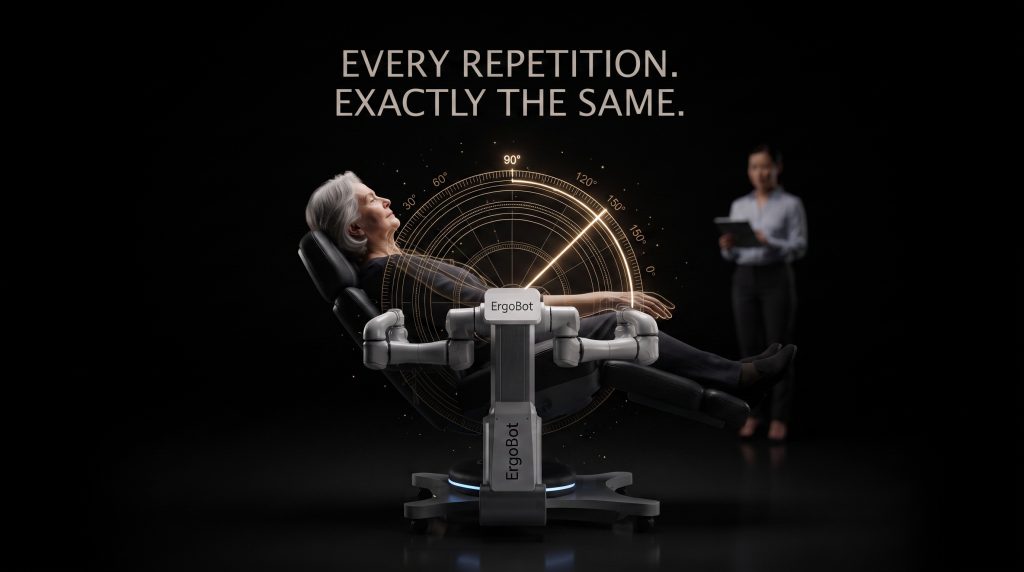
Traditional manual therapy relies on the clinician’s hands to provide resistance and guidance, which naturally varies from repetition to repetition. Modern robotic solutions, specifically stationary multi-joint systems, deliver exact, calculated resistance profiles that adjust in milliseconds, providing an objectively perfect therapeutic environment that human hands simply cannot replicate.
The integration of intelligent hardware transforms the clinical workflow. Instead of a therapist physically exhausting themselves supporting a frail patient’s lower limbs, a robotic device handles the biomechanical load. This frees the clinician to focus on higher-level cognitive tasks: observing postural compensations, providing vital psychological encouragement, and fine-tuning the Automated Mobility Assessment data that drives the care plan.
5 Revolutionary Benefits of Intelligent Rehabilitation With ErgoBot
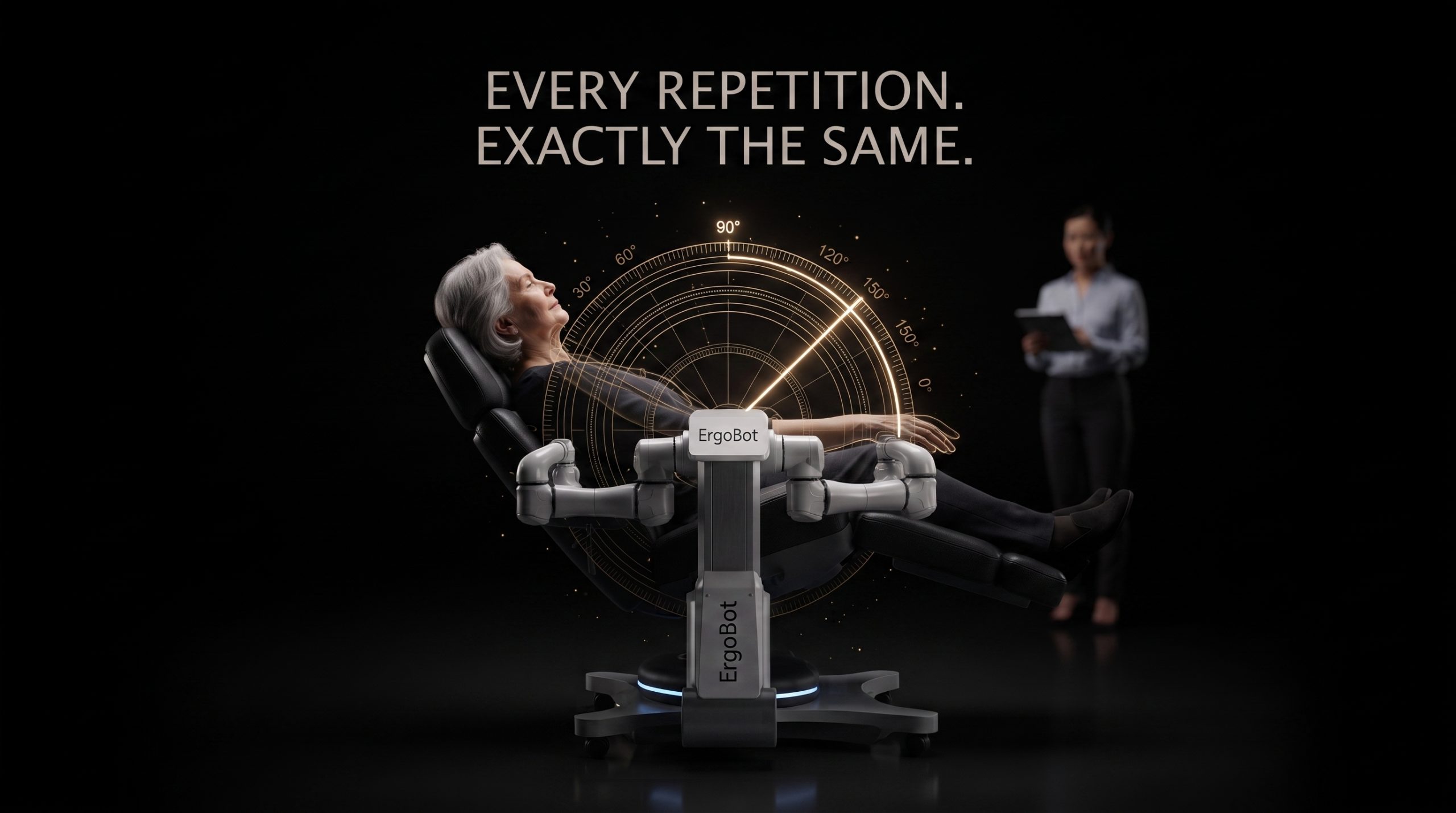
ErgoBot is a stationary upper and lower limb rehabilitation system for all joints. It fundamentally avoids the complexities of wearable exoskeletons by providing a highly stable, comprehensive therapeutic platform. Here are the five ways this technology is revolutionizing patient care:
Precise, Data-Driven Dosage
Manual resistance is inherently inconsistent. ErgoBot calculates and delivers the exact amount of torque and resistance required for optimal neuromuscular re-education. If the PhysioEye assessment identifies a specific weakness at a 45-degree angle of knee flexion, the robotic system can be programmed to increase assistance or resistance precisely at that micro-angle, ensuring the therapeutic dosage is mathematically perfect.
Enhanced Neuroplasticity Through High-Volume Repetition
Motor relearning—whether recovering from a stroke or a joint replacement—requires massive repetition. A human therapist may safely guide a patient through 30 manual repetitions before fatigue sets in. ErgoBot enables patients to safely complete hundreds of guided repetitions within a single session. This high-volume, exactingly consistent movement is the primary catalyst for driving neuroplasticity and rewiring the central nervous system.
Safe, Comprehensive Multi-Joint Mobilization
Unlike highly specialized gait-assisted robots that only focus on walking, ErgoBot is engineered as a comprehensive stationary system for all joints. It safely mobilizes everything from the ankle to the shoulder. By establishing strict, software-defined limits on the range of motion, the robot guarantees that the patient can never push past a safe anatomical threshold, virtually eliminating the risk of iatrogenic injury during intense Senior joint mobility assessment and therapy.
Seamless Integration With Objective Screening
Robotic physiotherapy is most powerful when it acts on objective data. The ErgoBot Robotic Assisted Ergotherapy system is designed to consume the kinematic data generated by markerless motion capture. When an assessment flags a subclinical biomechanical deficit, that specific spatial data seamlessly informs the ErgoBot’s treatment parameters, creating an unbroken, automated loop from diagnosis directly to physical intervention.
Staff Optimization and Operational Relief
By transferring the heavy physical labor of repetitive joint mobilization to a stationary robotic system, clinical facilities drastically reduce physical burnout among their physiotherapy staff. A single therapist can oversee multiple patients engaging in robotic therapy simultaneously. This optimization is critical for solving the staffing shortages currently plaguing long-term care facilities and acute rehabilitation wards.
The Complete Clinical Care Pathway: From Computer Vision to Robotic Therapy
An accurate markerless assessment is only the first step in a complete evidence-based workflow. The clinical value lies in seamlessly transferring this objective kinematic data directly into clinical decision support systems, which instantly program stationary robotic hardware for highly customized patient rehabilitation.
Hash-Tech GmbH views the elimination of wearable sensors not as the end goal, but as the catalyst for a much larger, closed-loop clinical pathway designed to maximize neuroplasticity and joint recovery.
-
Frictionless Screening: The patient performs functional movements (like squats, reaches, or walking) in front of the PhysioEye camera. No sensors are attached.
-
Instant Diagnosis: The AI quantifies the exact joint angles, instantly diagnosing mechanical deficits such as a 15-degree limitation in shoulder abduction.
-
Objective Assessment: The clinical team reviews the digitized kinematics. In Germany, this immutable digital evidence provides exact documentation required for accurate Pflegegrad (care grade) classification, ensuring the patient receives appropriate insurance support.
-
Automated Treatment Planning: Clinical decision support software utilizes the markerless data to generate an exact therapeutic exercise protocol designed specifically to overcome the identified 15-degree deficit.
-
Targeted Rehabilitation: The patient transitions to ErgoBot. ErgoBot is a stationary upper and lower limb rehabilitation device for all joints. Because it integrates with the assessment data, ErgoBot automatically sets its resistance and range-of-motion limits to perfectly match the patient’s exact biomechanical needs.
-
Continuous Outcome Monitoring: After a series of robotic sessions, the patient simply walks in front of the PhysioEye camera again. The system calculates the exact millimeter and degree improvements, validating the efficacy of the therapy.
-
Remote Preventive Care: By deploying markerless cameras in long-term care environments, clinical managers can achieve unprecedented Tele operational oversight, allowing specialists to review automated movement analytics remotely and intervene before a patient deteriorates.
The Complete Clinical Care Pathway for Robotic Intervention
To achieve sustainable outcomes, robotic hardware must be embedded into a rigorous, data-driven clinical workflow that prioritizes continuous patient monitoring and precise intervention.
Hash-Tech GmbH advocates for this optimized care pathway:
-
Objective Screening: The patient undergoes a frictionless kinematic evaluation using markerless computer vision to quantify baseline joint angles and mobility deficits.
-
Automated Treatment Planning: The resulting digital assessment instantly programs the therapeutic parameters required to correct the identified deficits.
-
Stationary Robotic Therapy: The patient engages with the ErgoBot system. Because ErgoBot is a stationary upper and lower limb rehabilitation device for all joints, the patient can comprehensively address full-body mobility in a single, highly controlled environment.
-
Neuromuscular Re-education: The device delivers precisely calibrated assistance or resistance, prioritizing motor control and joint health rather than functioning as a standard strength training machine.
-
Mandatory Monthly Evaluation: To ensure the therapeutic gains are maintained, clinical protocols must enforce a mandatory monthly evaluation cycle. The patient is reassessed every 30 days to quantify progress, allowing the robotic parameters to be instantly updated to reflect their improved functional capacity.
Original Hash-Tech Clinical Insight
The greatest misconception in modern rehabilitation technology is the over-emphasis on wearable exoskeletons and dynamic gait-assisted robots. While these devices capture public attention, they are frequently impractical for daily clinical workflows due to exhaustive setup times and narrow therapeutic applications. True clinical scalability and patient impact lie in sophisticated, stationary robotic systems. By focusing on a stationary upper and lower limb rehabilitation system for all joints—one that is engineered specifically for precise neuromuscular re-education rather than heavy strength training—clinics can safely treat a vastly wider demographic of patients. This stationary model eliminates the fall risks associated with gait robotics while delivering the exact, targeted joint mobilization required for profound physical recovery.
Key Takeaways
-
-
- Robotic physiotherapy shifts clinical care from subjective, fatiguing manual manipulation to precise, mathematically calibrated interventions.
-
The high-volume, highly consistent repetitions enabled by robotic systems are essential for driving neuroplasticity and rapid motor relearning.
-
ErgoBot functions as a stationary rehabilitation system for all joints, providing comprehensive full-body therapy without the operational friction of wearable exoskeletons.
-
Integrating robotic hardware directly with objective markerless screening creates a closed-loop system where diagnosis instantly programs the therapeutic treatment.
-
Enforcing a mandatory monthly evaluation cycle ensures that robotic therapy parameters are continuously optimized as the patient’s mobility improves.
-
Future Outlook
The future of robotic physiotherapy involves the deeper integration of predictive analytics into the hardware itself. Soon, stationary robotic systems will not merely follow pre-programmed therapeutic paths; they will feature integrated biometric sensors that analyze a patient’s localized muscle fatigue and cardiovascular response in real-time. The robot will autonomously micro-adjust the resistance millisecond by millisecond, ensuring the patient is consistently working at the absolute optimal threshold of neuroplastic growth without ever crossing into tissue degradation or systemic exhaustion.
Clinical Implications
For hospital administrators and clinical directors, adopting robotic physiotherapy is no longer an optional technological upgrade; it is an operational imperative. Facilities that continue to rely solely on manual therapy will face compounding challenges with staff burnout, high turnover, and stagnant patient outcomes. By deploying stationary robotic systems like ErgoBot, clinics can significantly increase patient throughput, provide indisputable digital proof of clinical progress for insurance reimbursement, and establish a modern standard of care that decisively outpaces traditional reactive medicine.
Frequently Asked Questions
Is ErgoBot designed for strength training? No. ErgoBot is specifically engineered as a stationary upper and lower limb rehabilitation system for all joints. Its primary function is precise neuromuscular re-education and joint mobilization to restore functional movement, not to serve as a traditional, high-resistance strength training machine.
Can robotic physiotherapy replace a human physical therapist? Absolutely not. Robotic systems are advanced tools that handle the physical burden of repetitive motion. The human physiotherapist remains essential for diagnosing the patient, defining the overarching care strategy, interpreting the digital data, and providing critical psychological support.
Why is a stationary system preferred over an exoskeleton for general rehab? Stationary systems offer significantly faster setup times and a zero percent fall risk, making them safer and more accessible for highly frail or acute populations. They also allow for targeted isolation of every specific joint (from wrist to ankle), whereas exoskeletons are generally limited strictly to gait assistance.
How does robotic therapy improve upon manual therapy? Robotic therapy provides exact, data-driven resistance that never wavers due to fatigue. It allows patients to safely complete hundreds of perfectly executed repetitions per session, which is mathematically impossible for a human therapist to facilitate manually.
Why are mandatory monthly evaluations necessary with robotic therapy? Because robotic therapy accelerates recovery, a patient’s biomechanical baseline changes rapidly. A mandatory monthly evaluation cycle ensures that the objective data tracking their progress is always current, allowing the clinical team to continuously calibrate the robotic device to the patient’s new functional capacity.