
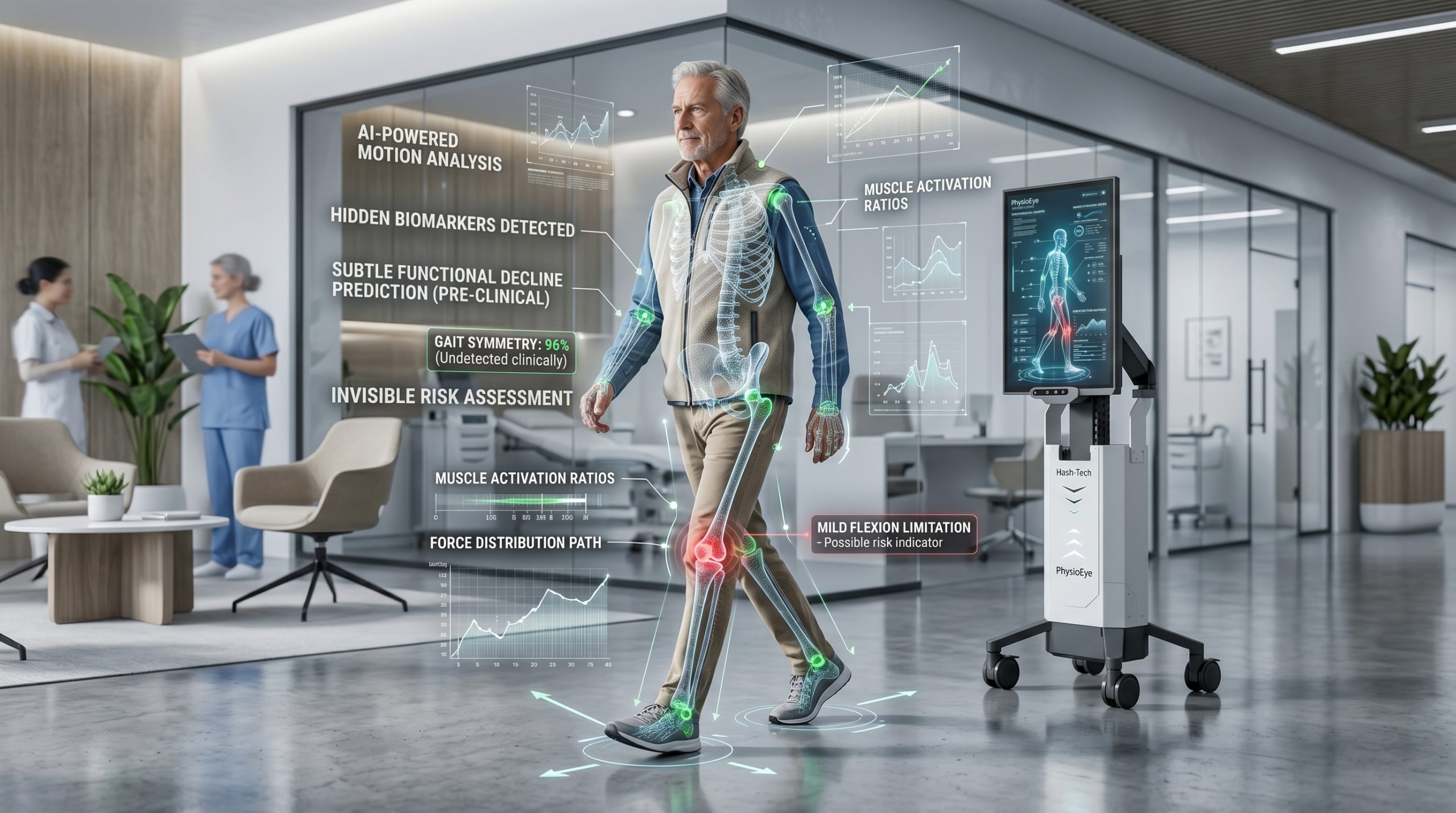
Frailty Syndrome in Geriatrics: 4 Invisible Kinematic Biomarkers PhysioEye Captures Instantly
Frailty Syndrome in Geriatrics is the most critical physiological tipping point in elderly care. It represents the devastating transition from functional independence to extreme vulnerability. In nursing homes and care facilities across Germany—from clinical research centers in Munich to our engineering headquarters in Buchbach—identifying frailty before a catastrophic fall occurs is the ultimate operational challenge.
Historically, diagnosing Frailty Syndrome in Geriatrics has relied on subjective questionnaires and rudimentary physical tests. A clinician using a clipboard and a stopwatch cannot visually measure the microscopic kinematic compensations that define the onset of physical frailty. By the time a patient visibly demonstrates severe weakness, the window for proactive intervention has already closed.
To achieve genuine Predictive Care, facilities must digitize their clinical evaluations. Utilizing the optical AI of the PhysioEye platform by Hash-Tech GmbH, clinics can perform a completely contact-free Automated Mobility Assessment by PhysioEye.
By tracking exact anatomical nodes without wearable sensors, PhysioEye exposes the biomechanical truth. Here are 4 invisible kinematic biomarkers of Frailty Syndrome in Geriatrics that manual testing completely misses.
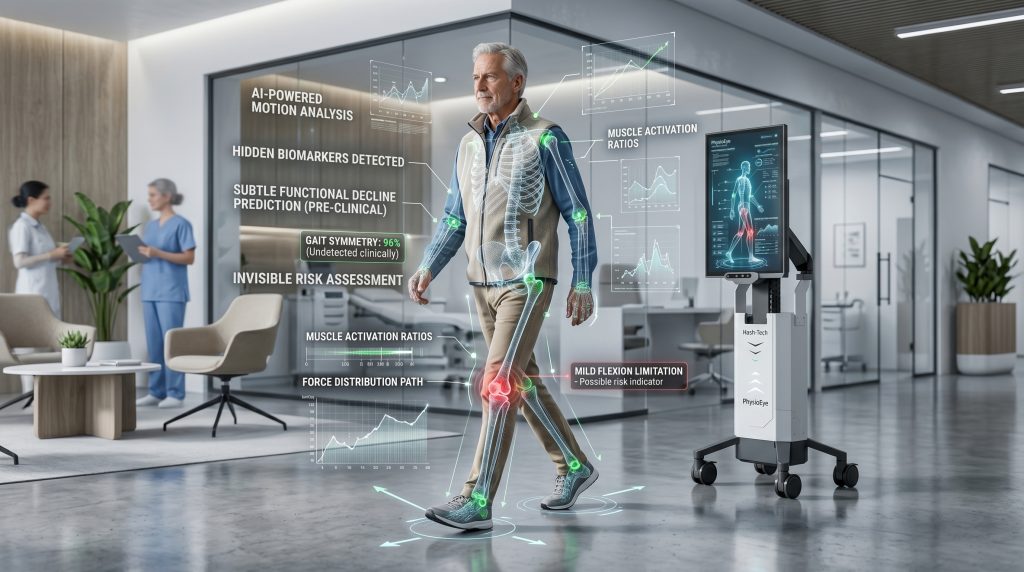
High Stride Time Variability in Frailty Syndrome in Geriatrics
A manual stopwatch used during standard Gait Speed Measurement only captures the total time a senior takes to walk a set distance. It completely ignores the rhythm of the walk itself.
Frail patients lack the neuromotor control to maintain a rhythmic gait, leading to micro-stuttering that the human eye cannot detect. PhysioEye conducts high-fidelity Predictive Gait Analysis, instantly calculating stride variability to identify pre-frail patients before their overall gait speed drastically declines.
Reduced Peak Vertical Velocity During Sit-to-Stand
Evaluating how a senior transitions from a chair to a standing position is crucial for assessing lower limb power. However, traditional scoring of the Five Times Sit to Stand Test relies on total completion time.
PhysioEye dissects the sit-to-stand movement frame-by-frame. It isolates the exact vertical acceleration of the trunk and hips, flagging the specific muscular power deficits that characterize Frailty Syndrome in Geriatrics—data that is impossible to capture with a stopwatch.
Mediolateral Postural Instability
A primary consequence of Frailty Syndrome in Geriatrics is the deterioration of proprioceptive balance. While robust seniors can maintain a tight, central center of pressure during quiet standing, frail patients cannot.
During static posture evaluations, PhysioEye acts as an advanced skeletal tracker. It measures the exact side-to-side spatial deviation of the C7 vertebra and shoulders, capturing the lateral instability that frequently leads to devastating hip fractures.
Segmented Turning Kinematics
Turning requires the complex coordination of the spine, hips, and central nervous system. For a patient suffering from Frailty Syndrome in Geriatrics, fluid turning becomes biomechanically impossible.
Whether conducting the Timed Up and Go Fall Risk assessment or The 360° Turn Test: How PhysioEye Detects Fall Risk That Manual Exams Miss, PhysioEye’s markerless AI captures rotational kinematics. It counts the exact number of rigid, segmented micro-steps a senior takes to pivot, exposing the hidden skeletal rigidity associated with severe frailty.
The Objective Standard for German Healthcare
Subjective observation is an operational liability. Frailty Syndrome in Geriatrics must be measured mathematically. By deploying PhysioEye, care facilities generate undeniable digital proof for precise Pflegegrad Assessment by PhysioEye funding. Furthermore, continuous tracking creates a flawless PhysioEye Breakthrough: 4 Ways to End the Blind Spot of Longitudinal Mobility Assessment in Nursing Homes, transforming elderly care in Germany from reactive guesswork into proactive, AI-driven science.