
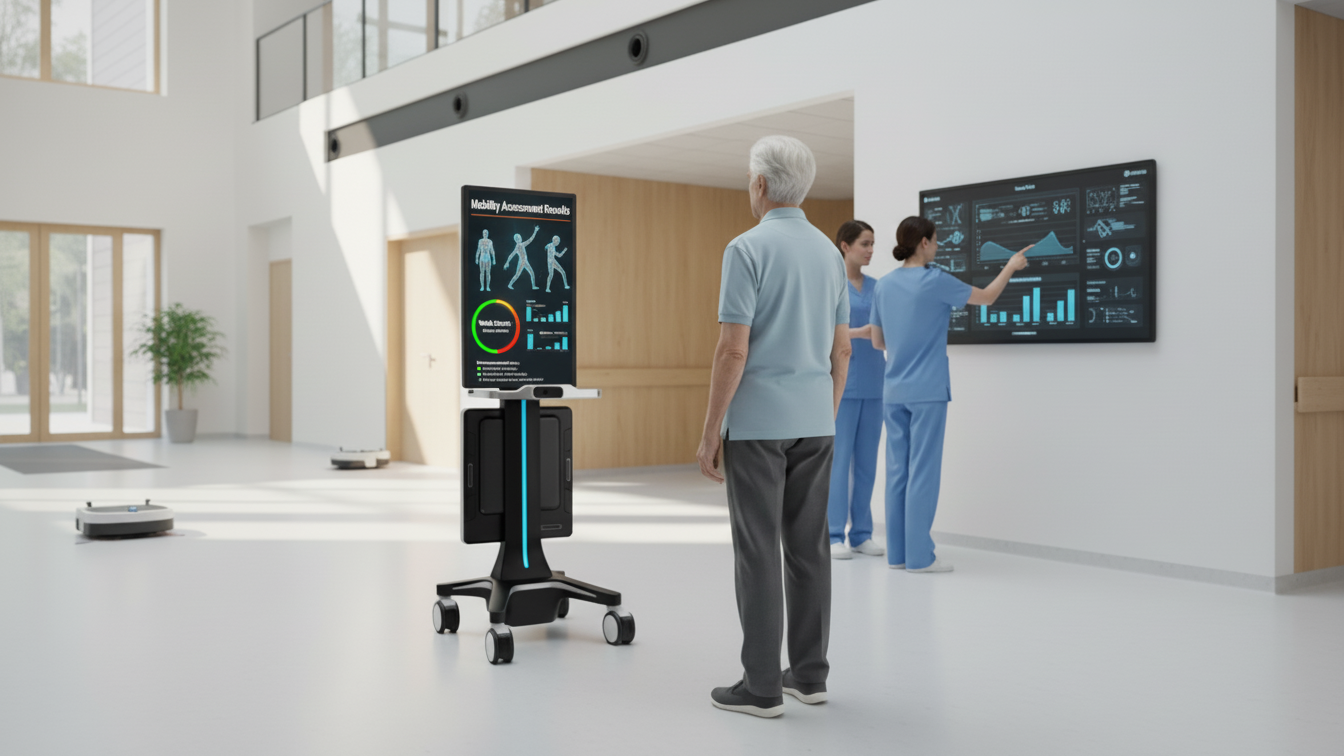
How PhysioEye Could Save Germany’s Pflegeversicherung €2 Billion in 2026 Alone by Delaying Pflegegrad Progression
Pflegegrad progression is one of the strongest—and least controlled—cost drivers in Germany’s long-term care system. Every step-up in Pflegegrad immediately increases payouts from the Pflegeversicherung, raises staffing intensity in nursing homes, and accelerates long-term dependency. In a system under growing pressure from demographic aging, caregiver shortages, and rising institutional costs, nursing home automation and the Robotic assisted nursing home are no longer optional innovations—they are structural economic necessities.
This article explains how PhysioEye, developed by HAS-Tech GmbH, introduces continuous Automated Mobility Assessment into German nursing homes and why delaying nursing care grade progression by just 6–12 months could realistically save €2 billion in 2026 alone for the Pflegeversicherung.
Pflegegrad: Germany’s Cost-Escalation Ladder
Germany officially classifies care dependency into five nursing care grade levels, determined through structured assessments across six domains:
-
Mobility
-
Cognitive and communication abilities
-
Behavioral and psychological challenges
-
Self-care
-
Coping with illness-related demands
-
Everyday life and social participation
Each nursing care grade upgrade automatically triggers higher monthly payments from the Pflegeversicherung—especially in institutional care settings.
Today:
-
Over 800,000 people live in German nursing homes
-
More than 80% are classified as Pflegegrad 3–5, where costs rise steeply and continuously
The issue is not the Pflegegrad system itself—but the absence of continuous, objective assessment.
Because of workforce shortages, mobility assessments are often:
-
Performed episodically
-
Based on subjective observation
-
Delayed until decline is already advanced
This is precisely where nursing home automation and Robotic assisted nursing home systems become economically decisive.
The Assessment Gap: Why Pflegegrad Progression Happens Too Early
Scientific evidence shows that functional decline is non-linear. Once mobility thresholds are crossed, deterioration accelerates rapidly. Yet in most facilities:
-
Elder Mobility Assessment is not continuous
-
Senior joint mobility assessment is performed only during scheduled reviews
-
Subtle biomechanical changes remain invisible
This assessment gap causes Pflegegrad progression to occur earlier than medically necessary.
PhysioEye closes this gap.
As part of HAS-Tech’s Elderly Care Solutions, PhysioEye delivers Automated Mobility Assessment as a permanent layer of nursing home automation—without adding workload for staff.
Scientific Evidence: Why a 6–12 Month Delay Is Realistic
Multiple peer-reviewed studies confirm that continuous biomechanical monitoring enables earlier intervention and slower functional decline. Continuous monitoring detected mobility decline trends with 77–81% accuracy, enabling timely corrective action. Sensor-based monitoring identifies functional decline significantly earlier than episodic clinical tests. Gait speed below 1.0 m/s also strongly predicts institutional dependency and Pflegegrad escalation that can be assessed earlier.
PhysioEye integrates Functional Movement analysis directly into daily routines and supports:
-
Geriatric Physical Therapy
—all without increasing clinical workload.
This evidence supports a conservative 6–12 month delay in Pflegegrad progression.
The €2 Billion Calculation for 2026
Step 1: Population Base
-
~600,000 residents in Pflegegrad 2–4 (progression-relevant group)
Step 2: Average Insurance Cost Increase per Pflegegrad Transition
-
Pflegegrad 3 → 4: ~€6,432 / year
-
Pflegegrad 4 → 5: ~€2,892 / year
Conservative average avoided cost per resident: ≈ €3,000 / year
Step 3: System-Level Savings
-
600,000 residents × €3,000 = €1.8 billion
-
Rounded conservatively and accounting for partial adoption:
➡ €2 billion saved in 2026 alone
Not including Fall Prevention for Seniors, Hospitalization avoidance and Workforce efficiency gains means the €2 billion estimate is structurally conservative.
Why PhysioEye Makes the Difference
PhysioEye embeds Elder Mobility Assessment into everyday operations through nursing home automation, enabling:
-
Objective Pflegegrad-relevant mobility metrics
-
Continuous Functional Movement tracking
-
Data-driven Geriatric Physical Therapy planning
-
Seamless integration with Robotic assisted nursing home workflows
PhysioEye also forms the analytical foundation for Robotic assisted rehabilitation, ensuring that robotic therapy systems are guided by objective biomechanical data rather than subjective estimation.
Strategic Implications for the Pflegeversicherung
For insurers, delaying Pflegegrad progression is not a clinical luxury—it is a financial control mechanism.
Paying for Automated Mobility Assessment is dramatically cheaper than financing accelerated Pflegegrad escalation.
-
For insurers: cost containment
-
For operators: reduced dependency on scarce staff through nursing home automation
-
For families: preserved independence via Senior joint mobility assessment
-
For Germany: stabilization of the long-term care system
Conclusion
Pflegegrad escalation is predictable, measurable, and delayable.
By introducing continuous Automated Mobility Assessment through PhysioEye, Germany’s Pflegeversicherung could save €2 billion in 2026 alone—without speculative assumptions or systemic disruption.
PhysioEye is not only transforming Pflegegrad economics at a national level—it is setting a regional benchmark for innovation and leadership in Bayern. Developed and deployed by HAS-Tech in Germany, with operational roots in Munich and engineering and implementation excellence in Buchbach, PhysioEye represents a Bavarian-built solution to a national challenge. By proving the economic and clinical value of Automated Mobility Assessment in real-world care environments, HAS-Tech is positioning Bayern as Germany’s leading hub for nursing home automation and the Robotic assisted nursing home. What begins in Munich and Buchbach today has the scalability to influence Pflegeversicherung sustainability across Germany tomorrow.