
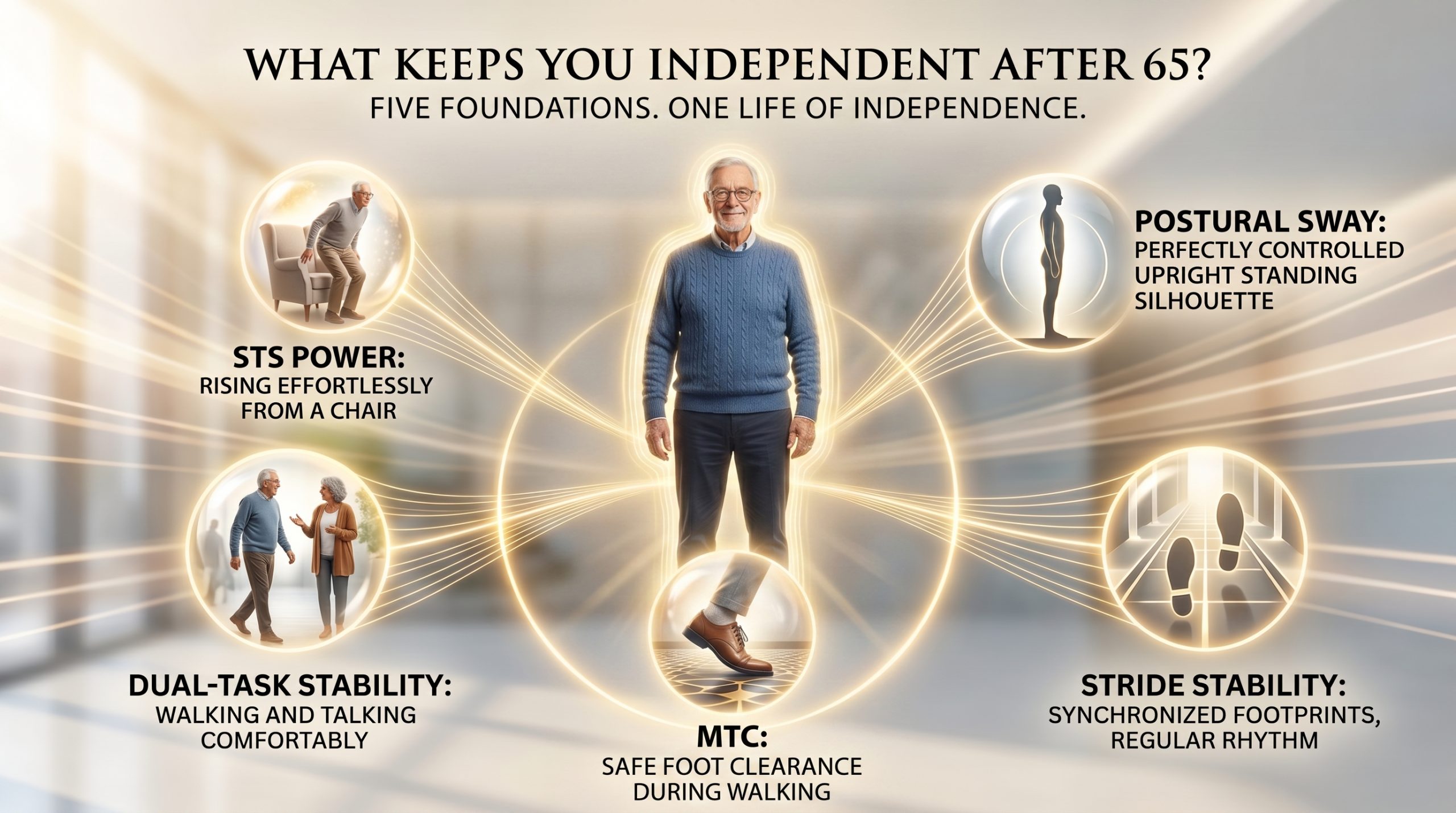
Independent Living After 65: 5 Mobility Factors That Predict Long-Term Quality of Life
Maintaining independent living after 65 is fundamentally a function of biomechanical reservation rather than chronological age. While standard healthcare metrics often evaluate cardiovascular health, cognitive status, and systemic disease management, clinical data from the World Health Organization (WHO) demonstrates that functional mobility is the single greatest determinant of whether a senior can safely age in place or require institutional care.
When a senior loses the ability to independently perform basic transfers, navigate uneven terrain, or react to environmental perturbations, their functional independence collapses rapidly. Traditional mobility evaluations often rely on subjective visual scoring or basic timed tests that only flag impairment after a catastrophic fall or major loss of function has occurred. To protect independent living after 65, clinical rehabilitation must transition from reactive fall management to proactive, subclinical biomechanical tracking.
This deep-dive clinical analysis isolates the 5 foundational mobility factors that predict long-term quality of life and functional longevity, detailing how advanced markerless computer vision and targeted robotic therapy allow clinical networks to identify and treat functional decline before independence is compromised.
Decoding Mobility and Functional Longevity in Senior Care
Preserving independent living after 65 requires an understanding of the physiological shift from “lifespan” to “mobility span”—the total years an individual maintains autonomous physical control over their environment.
| Mobility Factor | Primary Neuromuscular Substrate | Clinical Metric Range | Impact on Independent Living |
| Sit-to-Stand (STS) Power | Quadriceps, Gluteals, Core Explosive Power | Peak Vertical Velocity & Power Output | Dictates transfer independence (chairs, toilets, beds). |
| Minimum Toe Clearance (MTC) | Tibialis Anterior & Ankle Dorsiflexion | 10 – 20 mm mid-swing spatial margin | Prevents catastrophic tripping falls on micro-obstacles. |
| Dynamic Postural Sway | Vestibular, Proprioceptive, & Soleus Control | Center of Pressure (CoP) Path Velocity | Prevents unrecoverable loss of balance during standing. |
| Stride-Time Variability | Central Nervous System Motor Patterning | Coefficient of Variation (CoV < 3%) | Measures subclinical neurological gait degradation. |
| Dual-Task Stability | Executive Cognitive & Motor Integration | Dual-Task Cost (DTC < 10% velocity drop) | Ensures safe locomotion in real-world environments. |
The Diagnostic Gap in Traditional Senior Mobility Screening
Historically, clinical screening for senior fall risk and functional decline has relied on manual, paper-based assessments recommended in classic fall guidelines, such as those published by the CDC STEADI Initiative (e.g., Timed Up and Go test, Berg Balance Scale, or 10-Meter Walk Test). While these tools provide valuable gross measurements, they suffer from significant diagnostic limitations when assessing readiness for independent living after 65.
-
Gross Velocity vs. Biomechanical Strategy: A senior may complete a TUG test within an acceptable time frame by adopting hazardous compensatory mechanisms (e.g., severe trunk lean, arm-pushing during transfers, or compensatory leg circumduction). These compensations mask underlying muscle weakness or joint instability.
-
Subjective Intra-Rater Variability: Visual observation cannot reliably detect subtle changes in foot clearance, postural sway velocity, or micro-asymmetries across consecutive strides.
-
Frictionful Laboratory Setup: Force plates and wearable inertial sensors offer high accuracy, but their operational setup time (15 to 30 minutes) makes routine, large-scale screening impractical in busy outpatient clinics, assisted living facilities, or nursing homes.
To bridge this gap, modern rehabilitation networks are implementing high-resolution 3D markerless computer vision systems like PhysioEye. By capturing full-body kinematic data instantly without applying physical sensors, clinicians can continuously screen the subtle biomechanical parameters that dictate long-term independence.
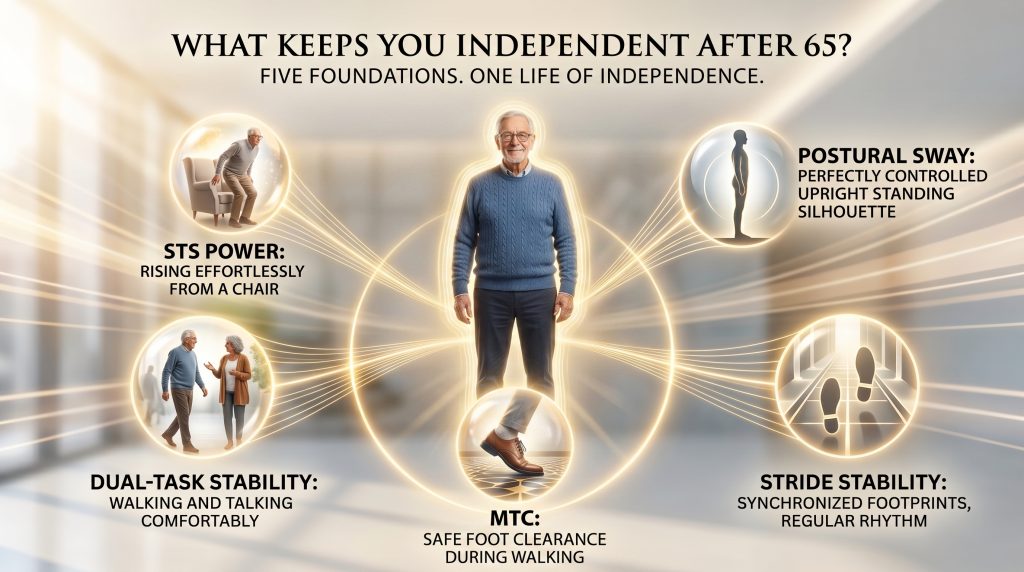
5 Mobility Factors That Predict Long-Term Quality of Life
Long-term studies in geriatric biomechanics highlight five distinct physical factors that serve as direct predictors of sustained independent living after 65.
Sit-to-Stand (STS) Vertical Power Output
The ability to rise from a chair without using armrests is the primary mechanical threshold for daily autonomy. It requires rapid force production in the lower-limb extensor kinetic chain.
-
The Hidden Deficit: As adults age, fast-twitch motor units in the quadriceps and gluteal muscles atrophy faster than slow-twitch endurance fibers. While a senior may still possess sufficient static muscle strength to stand up slowly, they frequently lose explosive vertical power output.
-
Impact on Autonomy: Loss of STS vertical velocity directly restricts a senior’s ability to perform essential Activities of Daily Living (ADL), such as unassisted toilet transfers or getting out of deep seating, accelerating the transition into dependent care settings.
Minimum Toe Clearance (MTC) and Swing-Phase Trajectory
As detailed in gait research by Begg et al. (2007), Minimum Toe Clearance is the minimal vertical spatial distance between the foot’s toe tip and the walking surface during mid-swing.
-
The Hidden Deficit: During mid-swing, the foot moves forward at peak velocity with a spatial clearance margin of often just 10 to 20 millimeters. Subclinical fatigue in the tibialis anterior muscle or subtle calf rigidity reduces this margin to dangerous near-zero thresholds.
-
Impact on Autonomy: Tripping on rugs or minor threshold transitions is the leading cause of hip fractures in older adults. Identifying subtle MTC drops through routine Predictive Gait Analysis allows therapists to intervene before a catastrophic fall occurs.
Dynamic Postural Sway and Center of Pressure (CoP) Tracking
Maintaining balance during quiet standing or during weight shifts requires constant, automated motor corrections governed by proprioceptive, visual, and vestibular inputs.
-
The Hidden Deficit: Age-related sensory degradation leads to an increased Center of Pressure (CoP) sway area and elevated sway velocity. When standing or performing static reaching tasks, seniors with elevated sway must expend significantly higher cognitive and muscular energy just to remain upright.
-
Impact on Autonomy: High gait variability signals subclinical neurological decline or worsening lower-limb joint pain. Identifying asymmetric ground reaction forces during a comprehensive Senior joint mobility assessment allows clinicians to address joint alignment and loading before mobility collapses.
Stride-Time Variability and Asymmetric Loading
Healthy locomotion is characterized by highly automated, rhythmic, and symmetrical stride timing.
-
The Hidden Deficit: A high coefficient of variation in stride-to-stride timing (greater than 3–5%) indicates a breakdown in central nervous system gait patterning or antalgic compensations from early joint degeneration.
-
Impact on Autonomy: High gait variability signals subclinical neurological decline or worsening lower-limb joint pain. Identifying asymmetric ground reaction forces during a comprehensive Senior joint mobility assessment allows clinicians to address joint alignment and loading before mobility collapses.
Dual-Task Motor-Cognitive Stability
In real-world environments, walking rarely occurs in complete isolation. Seniors must navigate complex spaces while conversing, reading signs, or carrying objects.
-
The Hidden Deficit: Dual-task cost (DTC) measures the percentage drop in gait speed, balance, or toe clearance when a cognitive load (e.g., serial subtraction or verbal fluency) is added during walking.
-
Impact on Autonomy: A dramatic dual-task drop indicates that attentional resources are fully consumed by basic motor execution. Seniors with high dual-task cost are at elevated risk for falls when navigating community environments, directly limiting their ability to live independently.
The Integrated Care Pathway: From Early Screening to Targeted Rehabilitation
Protecting independent living after 65 requires an integrated technology ecosystem that combines frictionless screening with targeted physical interventions. Hash-Tech GmbH delivers an end-to-end framework designed for scalable clinical implementation:
-
Frictionless Biomechanical Screening: The patient undergoes a rapid, non-invasive assessment using PhysioEye. In under two minutes, the 3D markerless computer vision system evaluates sit-to-stand velocity, MTC height, postural sway, stride symmetry, and dual-task stability during an Automated Mobility Assessment.
-
Subclinical Deficit Mapping: The system automatically flags specific biomechanical risk areas—such as reduced sit-to-stand vertical power or elevated stride-time variability—providing clear objective data to clinical staff.
-
Targeted Robotic Therapy: Based on the diagnostic profile, the therapist prescribes structured rehabilitation using ErgoBot. ErgoBot is a stationary upper and lower limb rehabilitation device for all joints, designed to provide precise, motor-controlled resistance and active assistance. Whether targeting ankle dorsiflexion strength for MTC recovery or lower-limb kinetic power for sit-to-stand performance, ErgoBot delivers data-driven neuromuscular retraining.
-
Mandatory Monthly Evaluation Cycle: To ensure long-term functional preservation, care facilities implement a mandatory 30-day re-evaluation cycle. Tracking mobility metrics monthly creates a comprehensive trend line within the patient’s Predictive Care plan, alerting clinicians immediately if subclinical mobility loss recurs.
Original Hash-Tech Clinical Insight
The traditional approach to geriatric care often treats functional decline as an inevitable consequence of chronological aging. This assumption is scientifically flawed.
Mobility loss is not an abrupt, unpredictable event; it is a gradual process marked by identifiable subclinical changes in biomechanics. A senior does not suddenly lose the ability to live independently overnight; rather, they experience months of unnoticed reductions in sit-to-stand power, subtle increases in postural sway, or millimeter-level drops in Minimum Toe Clearance.
When clinical networks wait for a patient to report a fall or lose the ability to perform transfers, the window for simple, non-invasive physical restoration has already passed. By measuring these five core mobility factors objectively and continuously, healthcare providers can transform senior care from a reactive model into a proactive, preventive discipline that preserves independence and quality of life.
Key Takeaways
-
-
-
-
-
-
Independent living after 65 is primarily predicted by objective biomechanical reservation rather than chronological age.
-
The 5 core mobility factors predicting functional autonomy are Sit-to-Stand Vertical Power, Minimum Toe Clearance (MTC), Dynamic Postural Sway, Stride-Time Variability, and Dual-Task Stability.
-
Traditional observational mobility tests lack the sensitivity to detect millimeter-level kinematic drops and subclinical motor-cognitive deficits.
-
PhysioEye provides rapid, markerless 3D computer vision screening to quantify subtle mobility risks without physical body sensors.
-
ErgoBot serves as a stationary upper and lower limb rehabilitation device for all joints, offering targeted, data-driven multi-joint retraining to address identified physical deficits.
-
Implementing a mandatory monthly screening cycle enables predictive care, preventing catastrophic falls and prolonged institutionalization.
-
-
-
-
-
Future Outlook
The future of senior healthcare lies in ambient, continuous mobility intelligence. As markerless computer vision systems like PhysioEye integrate into the architecture of senior living communities and clinical outpatient networks, real-time kinematic tracking will occur naturally during daily routines. Algorithms will automatically monitor sit-to-stand speed during morning routines and gait symmetry in facility hallways. When subclinical declines cross clinical thresholds, automated alerts will immediately queue targeted robotic therapy sessions on systems like ErgoBot, preventing functional loss long before independence is threatened.
Clinical Implications
For physical therapists, geriatricians, and senior care executives, measuring and managing these 5 mobility factors provides a clear framework for reducing fall-related hospitalizations, shortening length-of-stay in acute rehabilitation, and maximizing long-term resident retention in independent living settings. Transitioning to objective, markerless mobility tracking with targeted robotic rehabilitation empowers clinical teams to deliver measurable, high-value outcomes for aging populations.
Frequently Asked Questions
Why is Sit-to-Stand (STS) power more critical than general leg strength for independent living after 65? General leg strength measures static force generation, whereas Sit-to-Stand power measures how quickly that force can be generated (force × velocity). Explosive power declines faster with age than static strength and is required to perform independent transfers from chairs, beds, and toilets without falling back or requiring physical assistance.
How does dual-task testing help predict real-world fall risk? In daily life, seniors rarely walk in completely quiet environments without cognitive distractions. Dual-task testing measures the motor performance drop when a cognitive task is added. A high dual-task cost reveals that motor control requires conscious cognitive effort, leaving the senior vulnerable to balance loss and tripping when distracted.
Can markerless gait analysis be integrated into busy clinical routines without delaying patient flow? Yes. Unlike traditional motion capture systems that require physical retroreflective markers or wearable sensors—taking 20 to 30 minutes to apply—systems like PhysioEye use deep learning computer vision to collect 3D kinematic data immediately as the patient walks naturally in front of a camera.
How does ErgoBot support multi-joint rehabilitation for seniors? ErgoBot is a stationary upper and lower limb rehabilitation system designed to treat all human joints. When screening identifies deficits in lower-limb explosive power, ankle dorsiflexion, or range of motion, ErgoBot provides structured, motor-assisted active resistance and assistance to retrain the kinetic chain and restore functional movement patterns.
How frequently should mobility factors be evaluated in adults over 65? Clinical best practice recommends a mandatory monthly evaluation cycle (every 30 days) for seniors in rehabilitation or living facilities. Routine monthly screening captures subclinical mobility loss driven by muscle fatigue, acute health events, or medication changes before a fall or loss of independence occurs.