
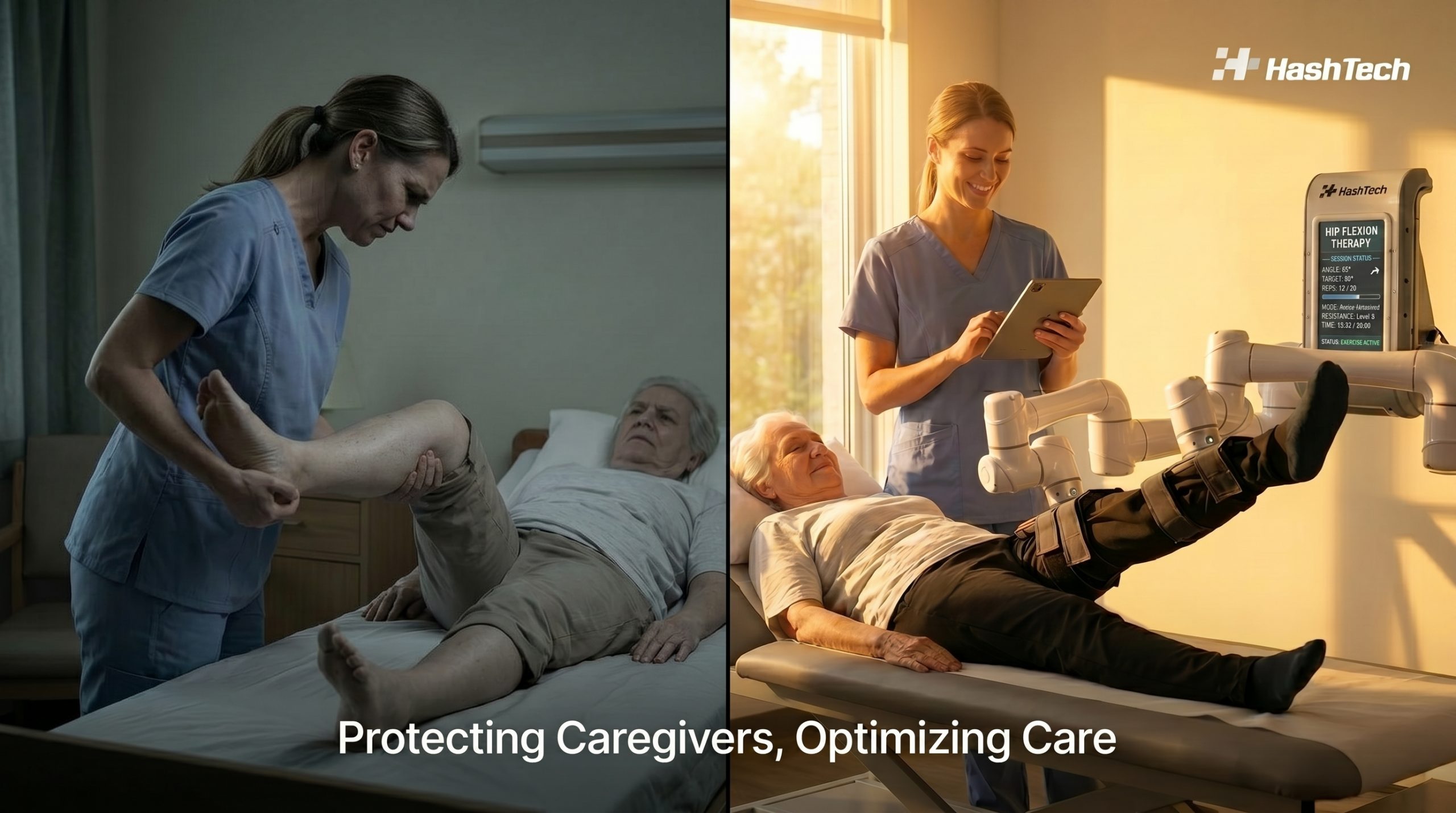
Robotic Assisted Elderly Care: 5 Brilliant Ways ErgoBot Transforms Nursing Home Automation
The industry is at a breaking point. Research indicates that the global shortage of nurses is projected to reach up to 13 million by 2030, leading to catastrophic levels of caregiver burnout and compromised resident safety. To survive, modern facilities must embrace intelligent Robotic Assisted Elderly Care.
The demographic reality facing healthcare systems across Munich, Bavaria, and the broader European union is unprecedented. The rapidly aging population is colliding directly with a severe, structural shortage of clinical nursing staff. In this high-pressure environment, relying exclusively on manual human labor to rehabilitate and assist seniors is no longer economically or physically viable.
By integrating intelligent systems like the ErgoBot developed by Hash-Tech GmbH, clinics are completely redefining Nursing Home Automation. The ErgoBot eliminates the physical strain on therapists while delivering the exact, mathematically precise therapy required to rebuild elderly independence.
Here are 5 brilliant ways the ErgoBot ecosystem is transforming Robotic Assisted Elderly Care.
Eliminating Caregiver Burnout and Ergonomic Risk
The most immediate benefit of Robotic Assisted Elderly Care is the protection of the clinical workforce. Guiding frail seniors through complex, high-dosage therapy requires immense physical exertion from nurses. Studies show that over 70% of nursing staff experience Work-Related Musculoskeletal Disorders (WMSDs) due to manual patient handling and therapy assistance. The ErgoBot completely offloads this physical burden. By actively supporting the weight of the patient’s limbs and guiding multi-directional movements, the robot allows therapists to facilitate intense rehabilitation sessions with zero ergonomic risk to their own bodies.
High-Dosage Repetition for Stroke Recovery
Following a neurological event, the aging brain requires thousands of precise repetitions to trigger neuroplasticity. Manual therapy simply cannot provide this volume without severe fatigue. Clinical trials definitively prove that high-dosage, robot-assisted upper limb therapy yields significantly better motor recovery in stroke survivors compared to standard manual care. ErgoBot utilizes advanced AI torque sensors to provide continuous, active-assistive movements, allowing elderly patients to safely practice the complex kinematics needed for feeding, grooming, and dressing over hundreds of repetitions per session.
Combating Sarcopenia with Intelligent Resistance
Sarcopenia (age-related muscle loss) is a primary driver of frailty and falls. Rebuilding this lost muscle requires targeted resistance, but standard gym equipment is often too dangerous for frail seniors. ErgoBot delivers perfectly calibrated, AI-monitored resistance tailored to the exact micro-voltage of effort the patient can exert. Whether training the upper body for reaching tasks or performing isolated, symmetrical leg pressing to safely rebuild the strength required for bed transfers, the system provides a zero-impact environment to reverse muscular atrophy.
Seamless Diagnostic-to-Therapeutic Integration
The true brilliance of Robotic Assisted Elderly Care is realized when it operates as a closed-loop ecosystem. When a senior undergoes an automated evaluation using the PhysioEye—whether capturing Parkinson’s early signs, conducting a Timed Up and Go (TUG) Test, or performing a predictive gait analysis—that vital kinematic data does not just sit on a clipboard. It syncs instantly to the ErgoBot. The robotic system uses these precise digital biomarkers to automatically formulate and deliver a highly targeted therapy prescription, bridging the gap between diagnosis and recovery.
Fostering Cognitive Engagement Through Biofeedback
A critical challenge in geriatric care is keeping patients cognitively engaged during repetitive therapy. Research demonstrates that providing real-time, interactive biofeedback during rehabilitation significantly enhances both motor learning and patient motivation. ErgoBot transforms repetitive movements into highly engaging, gamified tasks. Seniors receive instant visual and mechanical feedback as they complete their therapeutic trajectories, ensuring the brain remains highly active and accelerating the overall recovery of functional independence.
The Future of Facility Operations
We can no longer expect sheer human endurance to solve the aging crisis. By implementing the ErgoBot, facilities across Munich and the global healthcare sector are advancing a new standard of Robotic Assisted Elderly Care. This is the absolute foundation of proactive Predictive Care—healing the patient, protecting the caregiver, and securing the economic future of the healthcare facility.