
A Complete Solution Ecosystem for Tomorrow’s Aging Population
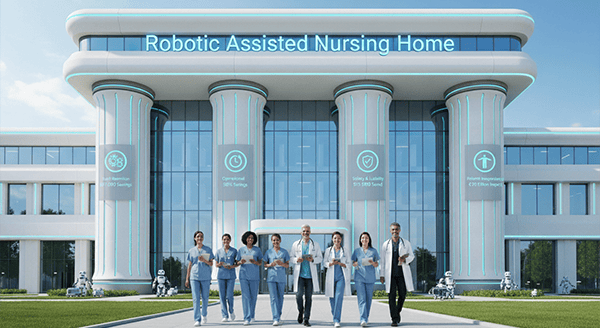
At Hash-Tech, we believe the future of elderly care lies in integration, intelligence, and empathy. Around the world, nursing homes face growing challenges — from staff shortages and rising costs to safety, quality-of-life, and sustainability concerns. Our vision is to transform these challenges into opportunities through nursing home automation and AI-driven care ecosystems.
By combining robotics, smart architecture, sustainable design, and continuous data-driven insight, Hash-Tech builds Robotic Assisted Nursing Homes that elevate efficiency, compassion, and independence for every resident.
Workforce & Staff-related Challenges
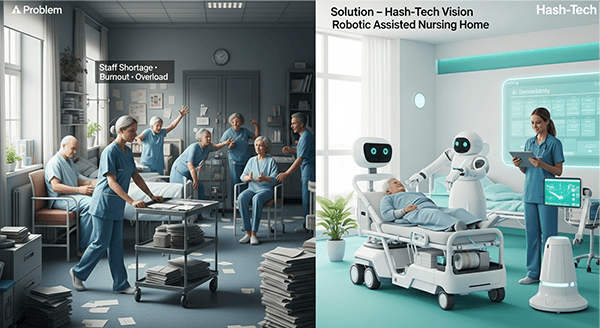
Challenges:
- Many homes struggle to recruit enough qualified caregivers.
- The work is physically and emotionally demanding, leading to lots of staff leaving.
- Staff may lack sufficient geriatric, rehabilitation or tech-training.
- Manual tasks, documentation burdens, fragmented workflows.
Solution:
- Automation of routine tasks (feeding, logistics, documentation)
- AI-powered scheduling for balanced workload
- Assistive robots to handle physical therapy and transfers
- Training hubs & simulation labs for ongoing staff education
- Wearable monitoring devices to support fewer caregivers managing more residents efficiently
Operational, Infrastructure & Safety Challenges

Challenges:
- Older residents are vulnerable to falls which lead to serious injury.
- Old homes may lack accessible design, modern layout, safety features.
- Weak safety protocols, poor staffing for emergencies, infection risk.
- Manual documentation, error-prone, inconsistent record keeping.
Solution:
- Robotic-designed architecture: ceiling-integrated robotic railways for transport and monitoring
- Universal design standards for full accessibility
- Modular construction enabling scalability, easy evacuation and barrier-free mobility
- AI-based building management (energy, safety, air quality)
- AI-based incident detection cameras (privacy-safe)
- Zonal sterilization units (UV/steam robots)
Hospitals
The complex hospital challenges
- Combatting Infections
- Optimizing Bed Utilization
- Streamlining Operations driving down healthcare costs
- Enhancing ICU Safety
Transforming Hospitals with Robotic Solutions
- Enhanced Efficiency
- Reduced Costs
- Infection Control
- Improved Patient Outcomes
- Reduced Wait Times
- Empowered Staff

Laboratories
The Laboratory Challenge
- Hazardous Environments
- Minimized Infections
- Repetitive Tasks Conquered
- Streamlined Sample Handling
- Unwavering Precision
The Laboratory Solution
Effortless Sample and Material Transport:
- Eliminate contamination risks.
- Streamline workflows.
Precise Equipment Operation:
- Program robots to set up and operate specific lab equipment.
- Free researchers from repetitive tasks.
Consistent Cleaning and Disinfection:
- Maintain a sterile environment.
- Minimize contamination risks.
Invaluable Research Assistance:
- Perform precise actions during complex experiments.
- Free researchers for crucial analysis and interpretation.

Chain Stores
The Challenge: A Retail Revolution
- Staff Shortages and High Turnover
- Repetitive Tasks Drain Resources
- Optimizing Floor Space
The Solution: A Robotic Partner
- Empowering Staff, Not Replacing Them
- Boosting Efficiency and Productivity
- Maximizing Space Utilization

Clinical & Care Quality Challenges

Challenges:
- Complex health needs & multiple comorbidities: Residents often have multiple ailments needing careful care.
- Medication management & adverse events: Errors in dosing, missed medication, side-effects.
- Monitoring mobility/rehabilitation: Keeping track of residents’ mobility decline and providing timely rehab is hard.
- Integration of health & social care services: Care homes often siloed from broader health services.
Solution:
- Continuous digital health monitoring (vital signs, mobility, sleep)
- AI-based medication management system (alerts, dosage validation)
- AI-Fall prediction and alerting system
- Remote physician access and telemedicine integration
- Robotic assisted occupational therapy for consistent rehabilitation
- Predictive analytics for early detection of decline
Financial & Economic Challenges
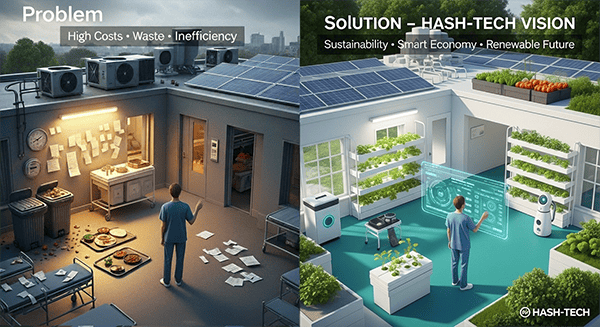
Challenges:
- Rising operational costs: Energy, utilities, food, staffing costs are increasing.
- Funding and reimbursement pressures: Limited budgets, insufficient government support.
- Affordability for residents/families: Costs rise, making choices harder.
Solution:
- Energy-efficient architecture (natural ventilation, insulation)
- Solar panels & green micro-farm producing clean energy and fresh food
- Smart resource tracking (robotic logistics + IoT metering)
- AI-powered budget optimization and preventive maintenance alerts
- Hydroponic or vertical gardens providing fresh food
- Recycling & waste segregation robots
- Rainwater harvesting and smart irrigation
- Eco-architecture with renewable materials
Social, Emotional & Quality-of-Life Challenges
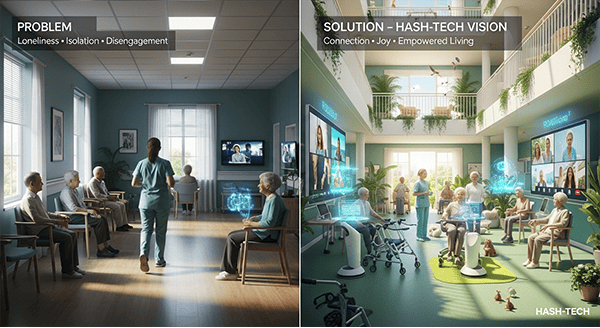
Challenges:
- Social isolation & loneliness: Residents can feel disconnected, which impacts mental and physical health.
- Resident autonomy & dignity: Balancing safety and independence is difficult.
- Engagement, rehabilitation & maintaining mobility: Keeping residents active and engaged is hard.
Solution:
- Interactive AI companions for conversation and entertainment
- Group engagement robots that organize activities
- Sensor-guided independence assistance (smart walkers, exosupport)
- Nature-integrated living spaces (green corridors, animal-assisted areas)
- Digital communication platforms for family connectivity
Technological & Innovation Uptake Challenges

Challenges:
- Digital adoption & recordkeeping: Many homes lag in tech integration.
- Scaling innovative care models: Implementing new systems (AI, robotics) faces barriers of cost, training, culture.
- Infrastructure for advanced monitoring and transport systems: Care homes often not designed with modern robotics/automation in mind.
Solution:
- Phased integration model – from smart sensors to full robotics
- Intuitive interfaces for non-technical users
- Hybrid human–robot collaboration workflows (assist, not replace)
- Data privacy & ethics frameworks ensuring trust