
Reimagining Clinical and Care Quality in Elderly Homes: How AI, Robotics, and Predictive Technologies Ensure Safer, Smarter Care
The Growing Challenge of Clinical Care in Aging Populations
By 2050, the global population aged 60 and above will double to 2.1 billion, while the healthcare workforce will shrink by over 15 million professionals.
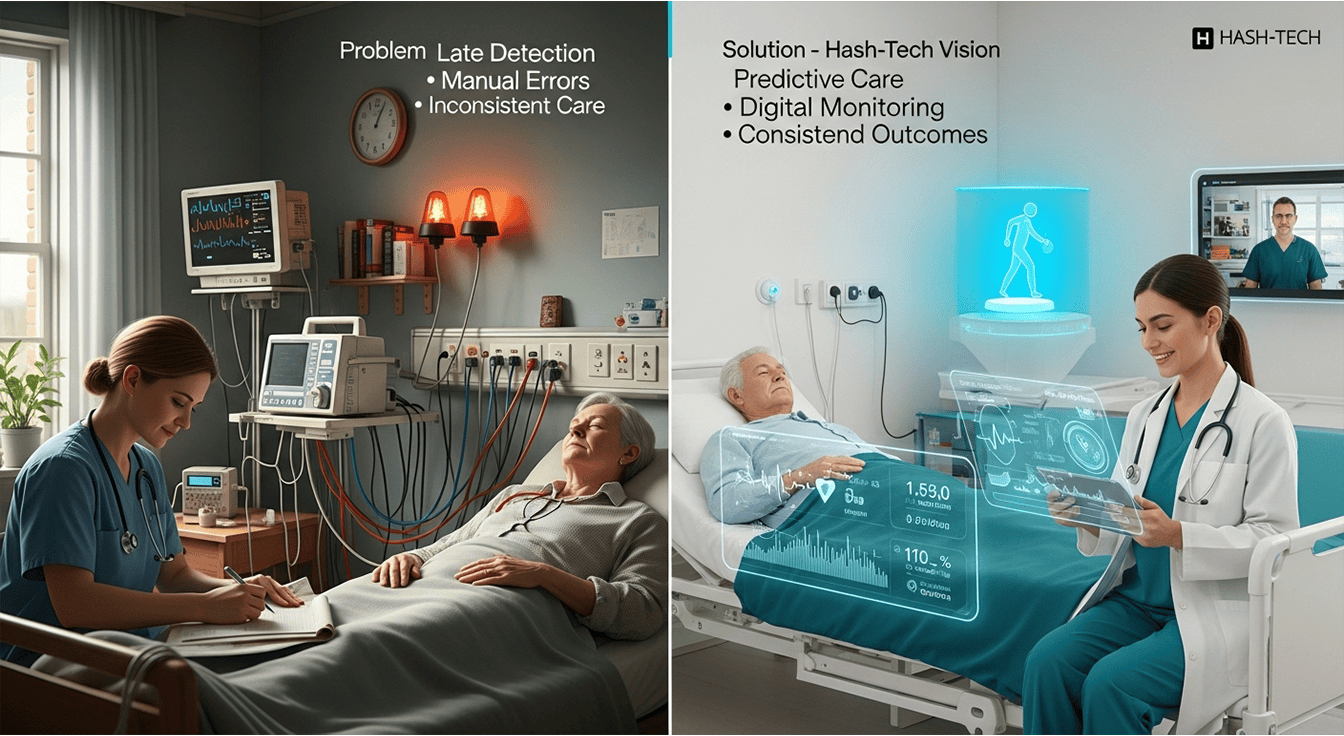
Nursing homes are already under immense pressure to provide consistent, high-quality care despite limited staff, fragmented documentation, and delayed interventions.
Traditional elderly care models rely heavily on manual monitoring, where vital signs, medication schedules, and rehabilitation progress are tracked inconsistently — often leading to avoidable hospitalizations, medication errors, and late detection of decline.
To overcome these limitations, Hash-Tech’s Integrated Clinical Intelligence System blends AI, robotics, telemedicine, and predictive analytics to redefine what clinical care means in a Robotic Assisted Nursing Home.
💡 Our Integrated Solutions for Clinical & Care Quality Challenges
1️⃣ Continuous Digital Health Monitoring
Our Continuous Health Monitoring Network tracks vital signs, mobility, sleep, and activity levels 24/7.
Through wearable IoT sensors and PhysioEye, residents’ physiological and biomechanical data are continuously recorded and analyzed.
This provides:
- Real-time updates on heart rate, blood pressure, and oxygen saturation.
- Mobility tracking for early detection of Parkinson, frailty and fall risk.
- Sleep quality assessment for behavioral and neurological insights.
📈 Facilities using continuous digital monitoring have reduced emergency transfers by 30–40% (source).
2️⃣ AI-Based Medication Management System
Medication errors account for nearly 1 in 10 hospital admissions among the elderly.
Hash-Tech’s AI Medication Management System integrates electronic health records with pharmacy databases to:
- Verify correct dosage and timing.
- Send alerts for missed or conflicting medications.
- Track inventory and refill schedules automatically through TrollyBot’s smart delivery function.
In a Robotic Assisted Nursing Home, this ensures zero manual errors and safe medication workflows — saving lives and time.
3️⃣ AI-Based Fall Prediction and Alerting System
Falls remain the leading cause of injury-related deaths in seniors — responsible for over 680,000 deaths annually.
By integrating AI-powered motion analysis from PhysioEye and wearable devices, our Fall Prediction Engine identifies gait instability, balance changes, and early warning signs of decline.
Alerts are sent instantly to caregivers and physicians, reducing emergency response times by up to 60%.
This predictive layer turns reactive care into proactive prevention — a cornerstone of the Robotic Assisted Nursing Home philosophy.
4️⃣ Remote Physician Access & Telemedicine Integration
Rural and small-scale nursing homes often lack on-site medical specialists.
Through secure telemedicine portals, residents can now access remote physician consultations, medication reviews, and therapy supervision without leaving their rooms.
ErgoBot and SeniorFit assist in Robotic Assisted Ergotherapy and Robotic Assisted Occupational Therapy, enabling doctors to observe sessions and adjust care plans remotely.
This hybrid care model reduces unnecessary hospital transfers and enhances the continuity of clinical oversight.
5️⃣ Robotic Assisted Rehabilitation
Rehabilitation continuity is a major determinant of recovery and mobility in elderly patients.
With ErgoBot and SeniorFit, nursing homes can now deliver Robotic Assisted Ergotherapy, Occupational Therapy, and Rehabilitation sessions automatically, with AI-driven customization based on real-time performance data.
These systems enable:
- Consistent therapy schedules without therapist fatigue.
- Personalized resistance levels and movement guidance.
- Integration with PhysioEye data for biomechanical accuracy.
Facilities using robotic therapy have seen 25% faster recovery rates and 40% higher patient engagement.
6️⃣ Predictive Analytics for Early Detection of Decline
Using aggregated data from PhysioEye, wearables, and medical records, our AI analytics engine learns each resident’s baseline.
It detects deviations in gait, sleep, or vitals that may indicate early cognitive decline, infection, or heart failure, prompting preemptive intervention.
Predictive analytics transforms care from reactive treatment to preventive precision care, dramatically improving outcomes and reducing hospitalizations.
🧠 The Hash-Tech Vision: Data-Driven, Human-Centered Care
Our integrated nursing home automation ecosystem doesn’t just streamline tasks — it builds a real-time clinical safety net.
From continuous digital monitoring and AI-driven medication management to Robotic Assisted Rehabilitation, every layer of Hash-Tech’s system contributes to safer, smarter, and more compassionate elderly care.
By connecting robotics, data, and design, we are creating a Robotic Assisted Nursing Home where:
- Residents are continuously monitored but never intruded upon.
- Therapists focus on human connection, not routine tasks.
- Physicians make decisions based on live, predictive data.
This is not the future — it’s the present of intelligent elderly care, made possible by Hash-Tech.