
Redefining the Elderly Care Workforce: How Hash-Tech’s Integrated Ecosystem Restores Balance and Efficiency
The Workforce Crisis in Elderly Care: A System Under Pressure
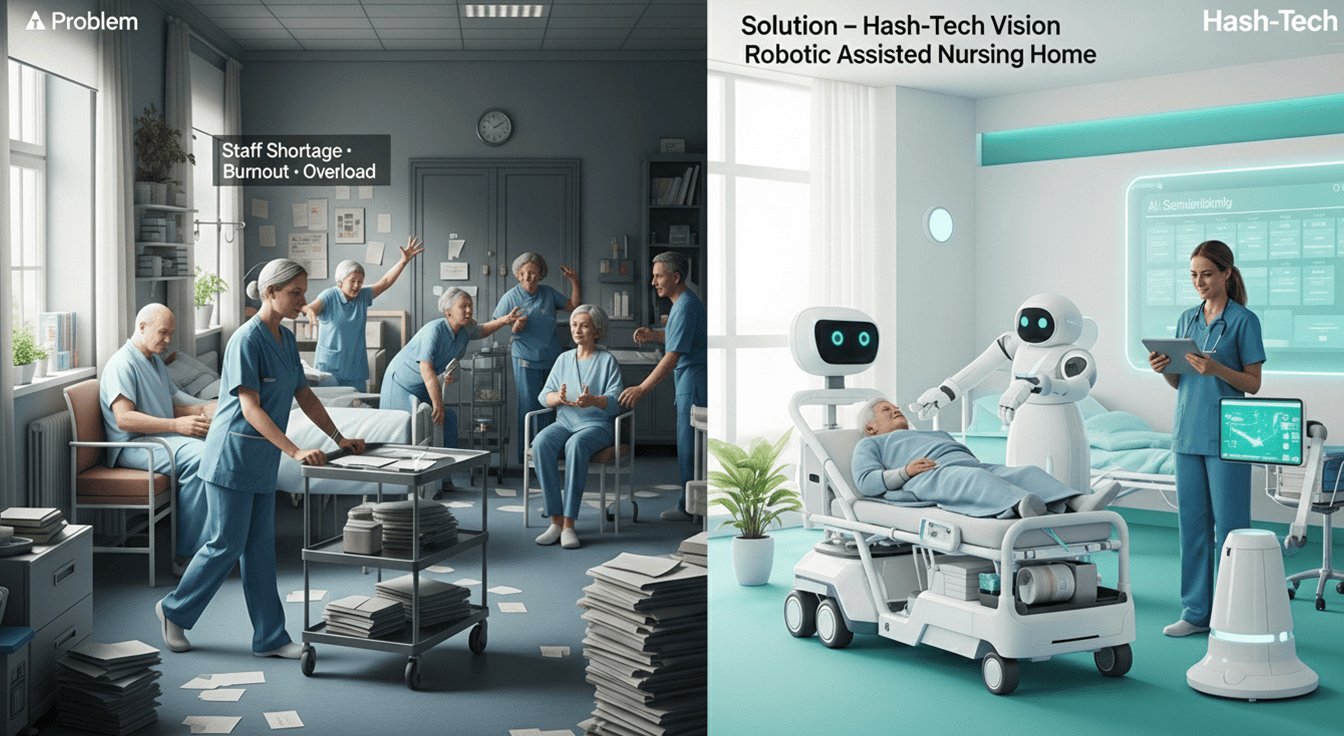
The Workforce Crisis in Elderly Care: A System Under Pressure
By 2050, the global population aged over 65 will surpass 1.6 billion people — nearly double today’s number (UN, 2023). Meanwhile, the healthcare sector faces a projected shortage of 10 million workers by 2030.
In elderly care homes, this imbalance is already visible.
- 45% of care workers report symptoms of burnout.
- 60% suffer from back or shoulder injuries due to manual transfers.
- And up to 40% of total working hours are lost to non-clinical tasks — like moving supplies, cleaning, or record-keeping
The result: exhausted caregivers, reduced quality of care, and growing operational costs.
The question is no longer how to find more caregivers, but how to enable existing ones to do more — safely and sustainably.
The Vision: A Robotic Assisted Nursing Home Ecosystem
At Hash-Tech, we envision the Robotic Assisted Nursing Home — an environment where automation, AI, and architecture work in harmony to multiply the impact of every caregiver.
This concept is built on three pillars:
- Automation of routine tasks, freeing time for human interaction
- Intelligent support systems, empowering caregivers with data, prediction, and physical assistance
- Continuous training and adaptive management, ensuring long-term workforce sustainability
The goal is not to replace humans — but to restore their capacity for compassion by removing fatigue, inefficiency, and unnecessary labor.
1️⃣ Automation of Routine Tasks: Giving Time Back to Care
In traditional care homes, staff spend up to two-thirds of their shift on repetitive duties.
Through Nursing Home Automation, these can be delegated to integrated robotic systems:
🔹 Feeding & Nutrition
- Automated meal delivery via TrollyBot, capable of transporting and serving meals precisely on schedule.
- Smart feeding stations that assist residents with tremor or weakness using adaptive utensils and motion-guided trays.
- Nutritional tracking powered by AI to monitor intake and prevent malnutrition.
🔹 Logistics & Facility Operations
- TrollyBot and ceiling-track robotic carriers deliver supplies, laundry, and medications between units — eliminating long transport walks for staff.
- Smart inventory sensors automatically alert managers when consumables run low, ensuring continuous service.
🔹 Documentation & Reporting
- AI-driven voice-to-text systems allow caregivers to record notes while caring, not after shifts.
- PhysioEye’s digital analytics auto-populate clinical reports with movement, balance, and rehabilitation data — cutting paperwork time by over 50%.
Together, these innovations allow caregivers to reclaim 2–3 hours daily for meaningful resident engagement.
2️⃣ AI-Powered Scheduling and Smart Resource Management
Traditional staffing schedules rely on intuition. But care demand fluctuates hourly.
Hash-Tech introduces AI-Powered Workforce Management Systems:
- Predicts high-activity periods (e.g., morning transfers, evening meals)
- Adjusts staffing dynamically
- Reassigns robotic units (like TrollyBot or ErgoBot) based on real-time workload
- Prevents burnout by balancing physical load between human and robotic resources
Managers receive visual dashboards that highlight care density, risk zones, and predictive maintenance schedules for robots and facility systems.
This intelligent coordination converts chaotic environments into balanced, efficient ecosystems — the hallmark of the Robotic Assisted Nursing Home.
3️⃣ Robotic Assisted Rehabilitation & Physical Support
Physical strain remains the #1 cause of early retirement among care staff.
Robotic Assisted Ergotherapy, Occupational Therapy, and Rehabilitation are key to solving this.
🔹 ErgoBot: Robotic Assisted Ergotherapy & Occupational Therapy
ErgoBot automates fully passive rehabilitation for upper and lower limbs, handling the physical effort of movement repetition.
Therapists can now supervise several patients simultaneously, while ErgoBot ensures accurate, fatigue-free motion cycles — perfect for post-stroke or orthopedic recovery.
🔹 PhysioEye: Continuous Evaluation & Predictive Insight
PhysioEye transforms rehabilitation from reactive to predictive.
By analyzing 3D motion data, it identifies early biomechanical changes that precede injury or neurological decline — allowing proactive intervention.
It turns every therapy session into a data point for AI-driven improvement.
🔹 SeniorFit: Smart Active Rehabilitation
SeniorFit complements this system through Robotic Assisted Rehabilitation.
Its adaptive resistance technology provides strength training that automatically adjusts to tremor, weakness, or fatigue.
Gamified interfaces and wearables boost motivation and prevent over-exertion.
Together, these solutions form a closed-loop rehabilitation system:
→ PhysioEye assesses,
→ ErgoBot rehabilitates,
→ SeniorFit strengthens,
→ and AI monitors progress automatically.
4️⃣ Training Hubs & Simulation Labs: Building a Skilled, Confident Workforce
Technology adoption succeeds only with training.
That’s why every Robotic Assisted Nursing Home integrates a Digital Training Hub — an interactive space where staff can practice robot-human collaboration safely.
- Virtual reality (VR) simulations allow staff to experience emergency procedures, lifting techniques, or device handling.
- AI coaching assistants provide real-time feedback on posture, motion, and ergonomics — reducing risk of staff injuries.
- Continuous certification programs ensure long-term digital literacy, preparing caregivers for a tech-driven future.
This investment in people sustains the automation ecosystem — turning resistance into empowerment.
5️⃣ Wearable Monitoring & Data-Driven Oversight
Wearable sensors (wristbands, smart badges, or clip-on monitors) extend the intelligence of the Robotic Assisted Nursing Home to both staff and residents.
- Staff wearables monitor fatigue, posture, and overexertion, providing early warnings before strain or injury.
- Resident devices feed continuous vitals and mobility data to the central AI, which assists caregivers in prioritizing interventions.
- Combined with PhysioEye’s longitudinal analytics, this creates a live “digital twin” of the care facility — a constantly learning system improving every day.
6️⃣ Beyond Technology: Human-Centered Design and Emotional Support
Automation alone cannot sustain care quality.
Human connection remains irreplaceable — but Hash-Tech’s solutions amplify it.
Design Innovations Include:
- Quiet robotic corridors that reduce background noise and stress.
- Ergonomic staff stations with real-time data visualization to simplify decisions.
- Companion AI interfaces that facilitate friendly interaction with residents, reducing loneliness.
- Flexible lighting and air quality systems that respond to human activity and circadian rhythm, supporting mental health.
Each design choice enhances caregiver focus and resident comfort — creating the emotional balance that defines successful elderly care.
The Measurable Impact of Hash-Tech’s Integrated Workforce Solutions
|
Key Indicator |
Conventional Care Home |
Robotic Assisted Nursing Home |
|
Staff burnout rate |
45–50% |
<20% |
|
Time spent on non-care tasks |
~40% |
<10% |
|
Musculoskeletal injury rate |
~60% |
<15% |
|
Rehab productivity (patients/therapist) |
1:1 |
1:4 (ErgoBot + SeniorFit) |
|
Data entry/documentation time |
3 hrs/day |
<30 min (AI automation) |
|
Resident engagement score |
Moderate |
High (gamified & interactive systems) |
🌍 The Future Workforce: Human Compassion, Robotic Precision
The Robotic Assisted Nursing Home represents more than automation — it represents a philosophy of care where every system, from ceiling rails to wearable sensors, serves one purpose: to support the human caregiver.
Through Nursing Home Automation, Robotic Assisted Ergotherapy, Occupational Therapy, and Rehabilitation, Hash-Tech creates an environment where:
- Robots handle routine, repetitive, and physical work
- AI optimizes efficiency and safety
- Humans focus on empathy, creativity, and meaningful connection
This is not just the future of care — it’s the restoration of humanity through intelligent design.